
Halaven 2ml Solution for injection
PDF Leaflet Revision Date: 6 March 2025
Clinical Summary
Quick overview from the medicine insert
Indication
Treatment of advanced breast cancer and unresectable liposarcoma after prior therapy.
Dosage (summary)
1.23 mg/mu00b2 IV on Days 1 and 8 of a 21-day cycle.
Special Populations
- Hepatic impairment
- Renal impairment
- Elderly patients
Pregnancy & Breastfeeding
Contraindicated in pregnancy and lactation; embryotoxic and teratogenic.
Key Drug Interactions
- CYP3A4 substrates
- QT prolonging agents
Contraindications
- Hypersensitivity to eribulin
- Pregnancy
- Lactation
Common side effects
- Neutropenia
- Peripheral neuropathy
- Nausea
- Fatigue
Counselling Points
- Avoid pregnancy during treatment
- Use contraception
- Monitor for signs of infection
Serious warnings
- Myelosuppression
- QT prolongation
- Severe neutropenia
Important Disclaimer
The Halaven 2ml Solution for injection professional information leaflet below is the property of Eisai Pharmaceuticals Africa and is provided on Medinsert exactly as issued, with no.. alterations or editorial changes. We make every effort to keep content current by updating documents as soon as new versions become available. Medinsert serves as a trusted access point for healthcare professionals, but does not replace official sources or clinical judgement. For more details, please read our full disclaimer. read more>>
 Healthcare Professionals Only
This content is for registered healthcare professionals
Sign in or create a free account to read the full package insert.
Free for HPCSA-registered professionals. Powered by Medinsert.
Clinical Particulars
Section 4 of the official insert — extracted exactly as issued, no alterations
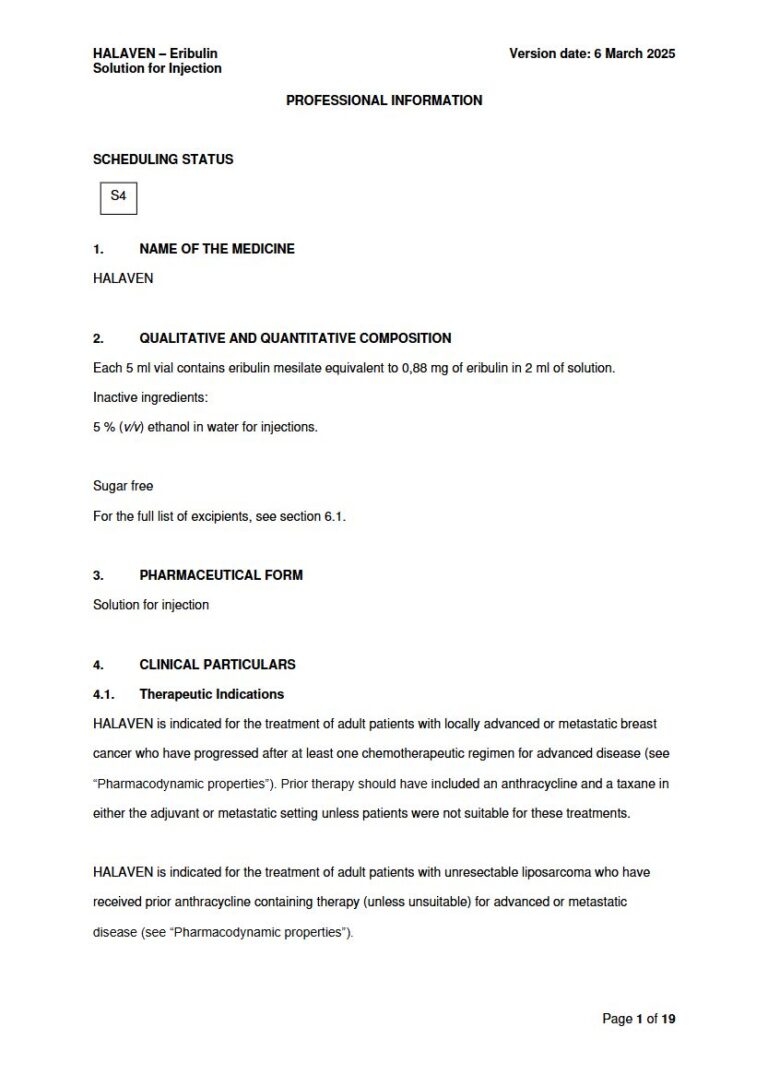
4.1. Therapeutic Indications
HALAVEN is indicated for the treatment of adult patients with locally advanced or metastatic breast cancer who have progressed after at least one chemotherapeutic regimen for advanced disease (see u201cPharmacodynamic propertiesu201d). Prior therapy should have included an anthracycline and a taxane in either the adjuvant or metastatic setting unless patients were not suitable for these treatments. HALAVEN is indicated for the treatment of adult patients with unresectable liposarcoma who have received prior anthracycline containing therapy (unless unsuitable) for advanced or metastatic disease (see u201cPharmacodynamic propertiesu201d).
4.2. Posology and method of administration
HALAVEN should be administered in units specialised in the administration of cytotoxic chemotherapy and only under the supervision of a qualified medical practitioner experienced in the appropriate use of cytotoxic medicines.
Dosage
The recommended dose of HALAVEN as ready-to-use solution is 1,23 mg/m2 which should be administered intravenously over 2 to 5 minutes on Day 1 and 8 of every 21-day cycle.
IMPORTANT: PLEASE NOTE: The recommended dose refers to the base of the active substance (eribulin). Calculation of the individual dose to be administered to a patient must be based on the strength of the ready-to-use solution that contains 0,44 mg/ml eribulin and the dose recommendation of 1,23 mg/m2. The dose reduction recommendation shown below are also shown as the dose of eribulin to be administered based on the strength of the ready-to-use solution. In the pivotal trials, the corresponding publications and in some other regions e.g. the US and Switzerland, the recommended dose is based on the salt form (eribulin mesilate). Patients may experience nausea or vomiting. Anti-emetic prophylaxis including corticosteroids should be considered.
Dose delays during therapy
The administration of HALAVEN should be delayed on Day 1 or Day 8 for any of the following:
- Absolute neutrophil count (ANC) < 1 x 10⁹/l
- Platelets < 75 x 109/l
- Grade 3 or 4 non-haematological toxicities.
Dose reduction during therapy
Dose reduction recommendations for retreatment are shown in the following table.
Dose reduction recommendations
Adverse reaction after previous HALAVEN administration
Recommended dose of HALAVEN
- Haematological
- ANC < 0,5 x 10⁹/l lasting more than 7 days 0,97 mg/ml
- ANC < 1 x 10⁹/l neutropenia complicated by fever or infection
- Platelets < 25 x 109/l thrombocytopenia
- Platelets < 50 x 109/l thrombocytopenia complicated by haemorrhage or requiring blood or platelet transfusion
Non-haematological
- Any Grade 3 or 4 in the previous cycle
- Reoccurrence of any haematological or non-haematological adverse reactions as specified above
Despite reduction to 0,97 mg/m2 0,62 mg/m2 Despite reduction to 0,62 mg/m2 Consider discontinuation Do not re-escalate the HALAVEN dose after it has been reduced.
Patients with hepatic impairment
Impaired liver function due to metastases: The recommended dose of HALAVEN in patients with mild hepatic impairment (Child-Pugh A) is 0,97 mg/m2 administered intravenously over 2 to 5 minutes on Days 1 and 8 of a 21-day cycle. The recommended dose of HALAVEN in patients with moderate hepatic impairment (Child-Pugh B) is 0,62 mg/m2 administered intravenously over 2 to 5 minutes on Days 1 and 8 of a 21-day cycle. Severe hepatic impairment (Child-Pugh C) has not been studied but it is expected that a more marked dose reduction is needed if HALAVEN is used in these patients.
Impaired liver function due to cirrhosis: This patient group has not been studied. The doses given above may be used in mild and moderate impairment, but close monitoring is advised as the doses may need readjustment.
Patients with renal impairment
Patients with moderately or severely impaired renal function (creatinine clearance < 50 ml/min) will have increased HALAVEN exposure. The recommended dose of HALAVEN in patients with moderate renal impairment (creatinine clearance (CLcr) 30-50 ml/min) is 1,1 mg/m2 administered intravenously over 2 to 5 minutes on Days 1 and 8 of a 21-day cycle. The safety of HALAVEN was not studied in patients with severe renal impairment (CrCl < 30 ml/min). For all patients with renal impairment, caution and close safety monitoring is advised. (See u201c 5.1 Pharmacokinetic Propertiesu201d).
Elderly patients
No specific dose adjustments are recommended based on the age of the patient.
Paediatric population
There is no relevant use of HALAVEN in children and adolescents in the indication of breast cancer. The safety and efficacy of HALAVEN in children from birth to 18 years of age have not been established in soft tissue sarcoma. No data are available.
Method of Administration
HALAVEN is for intravenous use. The dose may be diluted in up to 100 ml of sodium chloride 9 mg/ml (0,9 % NaCl) solution for injection. It should not be diluted in glucose 5 % infusion solution. In the absence of compatibility studies HALAVEN must not be mixed with other medicines except sodium chloride 9 mg/ml (0,9 % NaCl) solution for injection. Good peripheral venous access or a patent central line should be ensured prior to administration.
There is no evidence that HALAVEN is a vesicant or an irritant. In the event of extravasation, treatment should be symptomatic. Following administration, it is recommended that the intravenous line be flushed with sodium chloride 9 mg/ml (0,9 % NaCl) solution for injection to ensure administration of the complete dose. HALAVEN is a cytotoxic anticancer medicine and caution should be exercised in its handling. The use of gloves, goggles, and protective clothing is recommended. If the skin comes into contact with the HALAVEN solution, the skin should be washed immediately and thoroughly with soap and water. If the HALAVEN solution comes into contact with mucous membranes, the membranes should be flushed thoroughly with water. HALAVEN should only be prepared and administered by personnel appropriately trained in handling of cytotoxic medicines. Pregnant staff should not handle HALAVEN. Discard any unused portion of the vial.
4.3. Contraindications
Hypersensitivity to eribulin or to any of the excipients of HALAVEN.
Pregnancy and lactation (see u201c4.6 Fertility, pregnancy and lactationu201d).
4.4. Special warnings and precautions for use
Haematology
Myelosuppression is dose dependent and primarily manifested as neutropenia (see u201c4.8 Undesirable effectsu201d). Monitoring of complete blood counts should be performed on all patients prior to each dose of HALAVEN. Treatment with HALAVEN should only be initiated in patients with Absolute Neutrophil Count (ANC) values u2265 1,5 x 10⁹/l and platelets > 100 x 109/l. Febrile neutropenia occurred in < 5 % of breast cancer patients treated with HALAVEN. Patients experiencing febrile neutropenia, severe neutropenia or thrombocytopenia, should be treated according to the recommendations in section 4.2 u201cPosology and method of administrationu201d.
Patients with alanine aminotransferase (ALT) or aspartate aminotransferase (AST) > 3 x upper limit of normal (ULN) experienced a higher incidence of Grade 4 neutropenia and febrile neutropenia. Although data are limited, patients with bilirubin > 1,5 x ULN also have a higher incidence of Grade 4 neutropenia and febrile neutropenia. Fatal cases of febrile neutropenia, neutropenic sepsis, sepsis and septic shock have been reported. Severe neutropenia may be managed by the use of granulocyte colony-stimulating factor (G-CSF) or equivalent at the medical practitioneru2019s discretion in accordance with relevant guidelines (see u201cPharmacodynamic propertiesu201d).
Peripheral neuropathy
Patients should be closely monitored for signs of peripheral motor and sensory neuropathy. The development of severe peripheral neurotoxicity requires a delay or reduction of dose (see 4.2 u201cPosology and method of administrationu201d). In clinical trials, patients with pre-existing neuropathy greater than Grade 2 were excluded. However, patients with pre-existing neuropathy Grade 1 or 2 were no more likely to develop new or worsening symptoms than those who entered the study without the condition.
QT prolongation
In an uncontrolled open-label ECG study in 26 patients, QT prolongation was observed on Day 8, independent of HALAVEN concentration. ECG monitoring is recommended if therapy is initiated in patients with congestive heart failure, bradydysrhythmias and electrolyte abnormalities. Concomitant treatment with medicines known to prolong the QT interval, including Class Ia and III antidysrhythmics is not recommended. Hypokalaemia or hypomagnesaemia should be corrected prior to initiating HALAVEN and these electrolytes should be monitored periodically during therapy. HALAVEN should be avoided in patients with congenital long QT syndrome.
4.5. Interaction with other medicines and other forms of interaction
Formal interaction studies have not been done. HALAVEN is mainly (up to 70 %) eliminated through biliary excretion. The transport protein involved in this process is unknown. HALAVEN is not a substrate of breast cancer resistance protein (BCRP), organic anion (OAT1, OAT3, OATP1B1, OATP1B3), multi-drug resistance-associated protein (MRP2, MRP4) and bile salt export pump (BSEP) transporters. No interactions are expected with CYP3A4 inhibitors and inducers. HALAVEN exposure (AUC and Cmax) was unaffected by rifampicin, a CYP3A4 inducer.
Effects of HALAVEN on the pharmacokinetics of other medicine
HALAVEN may inhibit CYP3A4 according to in vitro data. Caution and monitoring for adverse events is recommended with concomitant use of substances that have a narrow therapeutic window and that are eliminated mainly via CYP3A4-mediated metabolism (e.g. alfentanil, ciclosporin, ergotamine, fentanyl, pimozide, quinidine, sirolimus, tacrolimus). HALAVEN does not inhibit the CYP enzymes CYP1A2, 2B6, 2C8, 2C9, 2C19, 2D6 or 2E1 at relevant clinical concentrations. At relevant clinical concentrations, HALAVEN did not inhibit BCRP, OCT1, OCT2, OAT1, OAT3, OATP1B1 and OATP1B3 transporter-mediated activity.
4.6. Fertility, pregnancy and lactation
Pregnancy
HALAVEN is contraindicated in pregnancy and lactation. There are no data from the use of HALAVEN in pregnant women. HALAVEN is embryotoxic, foetotoxic, and teratogenic in rats. HALAVEN should not be used during pregnancy (see u201c4.3 Contraindicationsu201d).
Women of childbearing age
If you could become pregnant, you should use appropriate contraception methods during treatment and for 7 months following the last dose of eribulin.
Men receiving eribulin
Men receiving eribulin are advised to use appropriate contraception methods during treatment and for 4 months following the last dose of eribulin. It is recommended that those who wish to become fathers in the future discuss the possibility of freezing of their sperm prior to treatment.
Lactation
There is no information on the excretion of HALAVEN or its metabolites in human or animal breast milk. Mothers on HALAVEN must not breastfeed their infants (see 4.3 u201cContraindicationsu201d).
Fertility
Testicular toxicity has been observed in rats and dogs. Male patients should seek advice on conservation of sperm prior to treatment because of the possibility of irreversible infertility due to therapy with HALAVEN.
4.7. Effects on ability to drive and use machines.
HALAVEN may cause tiredness and dizziness which may influence the ability to drive or use machines. Patients should be advised not to drive or use machines when receiving HALAVEN.
4.8. Undesirable effects
Summary of safety profile
The most commonly reported adverse reactions related to HALAVEN, are bone marrow suppression manifested as neutropenia, leukopenia, anaemia and thrombocytopenia with associated infections. New onset or worsening of pre-existing peripheral neuropathy has also been reported. Gastrointestinal toxicities, manifested as anorexia, nausea, vomiting, diarrhoea, constipation and stomatitis are among the undesirable effects reported. Other undesirable effects include fatigue, alopecia, increased liver enzymes, sepsis and musculoskeletal pain syndrome.
Tabulated list of adverse reactions
Unless otherwise noted, the table below shows the incidence of adverse reactions observed in breast cancer and soft tissue sarcoma patients who received the recommended dose in Phase 2 and Phase 3 studies. Frequency categories are defined as: very common (u2265 1/10), common (u2265 1/100 to < 1/10) and uncommon (u2265 1/1000 to < 1/100). Within each frequency grouping, undesirable effects are presented in order of decreasing frequency. Where Grade 3 or 4 reactions occurred, the actual total frequency and the frequency of Grade 3 or 4 reactions are given.
System Organ Class Adverse reactions u2013 All Grades Very Common (Frequency %) Common (Frequency %) Uncommon
Infections and infestations
- Urinary tract infection (8,5 %) (G3/4: 0,7 %)
- Pneumonia (1,6 %) (G3/4: 1,0 %)
- Oral candidiasis
- Oral herpes
- Upper respiratory tract infection
- Nasopharyngitis
- Rhinitis
- Herpes zoster
- Sepsis (0,5 %) (G3/4: 0,5 %) a
- Neutropenic sepsis (0,2 %) (G3/4: 0,2 %) a
- Septic Shock (0,2 %) (G3/4: 0,2 %) a
Blood and lymphatic disorders
- Neutropenia (53,6 %) (G3/4: 46,0 %)
- Leukopenia (27,9 %) (G3/4: 17,0 %)
- Anaemia (21,8 %) (G3/4: 3,0 %)
- Lymphopenia (5,7 %) (G3/4: 2,1 %)
- Febrile neutropenia (4,5 %) (G3/4: 4,4 %) a
- Thrombocytopenia (4,2 %) (G3/4: 0,7 %)
Metabolism and nutrition disorders
- Decreased appetite (22,5 %) (G3/4: 0,7 %)
- Hypokalaemia (6,8 %) (G3/4: 2,0 %)
- Hypomagnesaemia (2,8 %) (G3/4: 0,3 %)
- Dehydration (2,8 %) (G3/4: 0,5 %)
- Hyperglycaemia
- Hypophosphataemia
Psychiatric disorders
- Insomnia
- Depression
Nervous system disorders
- Peripheral neuropathy b (35,9 %) (G3/4: 7,3 %)
- Headache (17,5 %) (G3/4: 0,7 %)
- Dysgeusia
- Dizziness (9,0 %) (G3/4: 0,4 %)
- Hypoaesthesia
- Lethargy
- Neurotoxicity
Eye disorders
- Lacrimation increased (5,8 %) (G3/4: 0,1 %)
- Conjunctivitis
Ear and Labyrinth Disorders
- Vertigo
- Tinnitus
Cardiac disorders
- Tachycardia
Vascular disorders
- Hot flush
- Pulmonary embolism (1,3 %) (G3/4: 1,1 %) a
- Deep vein thrombosis
Respiratory, thoracic and mediastinal disorders
- Dyspnoea (15,2 %) a (G3/4: 3,5 %) a
- Cough (15,0 %) (G3/4: 0,5 %)
- Oropharyngeal pain
- Epistaxis
- Rhinorrhoea
- Interstitial lung disease (0,2 %) (G3/4: 0,1 %)
Gastrointestinal disorders
- Nausea (35,7 %) (G3/4: 1,1 %)
- Constipation (22,3 %)
- Abdominal pain
- Stomatitis (11,1 %) (G3/4: 1,0 %)
- Mouth ulceration
- Pancreatitis (G3/4: 0,7 %)
- Diarrhoea (18,7 %) (G3/4: 0,8 %)
- Vomiting (18,1 %) (G3/4: 1,0 %)
- Dry mouth
- Dyspepsia (6,5 %) (G3/4: 0,3 %)
- Gastrooesophageal reflux disease
- Abdominal distension
Hepatobiliary disorders
- Aspartate aminotransferase increased (7,7 %) (G3/4: 1,4 %)
- Alanine aminotransferase increased (7,6 %) (G3/4: 1,9 %)
- Gamma glutamyl transferase increased (1,7 %) (G3/4: 0,9 %)
- Hyperbilirubinaemia (1,4 %) (G3/4: 0,4 %)
- Hepatotoxicity (0,8 %) (G3/4: 0,6 %)
Skin and subcutaneous tissue disorders
- Alopecia
- Rash (4,9 %) (G3/4: 0,1 %)
- Pruritus (3,9 %) (G3/4: 0,1 %)
- Nail disorder
- Night sweats
- Dry skin
- Erythema
- Hyperhidrosis
- Palmar plantar Erythrodysaesthesia (1,0 %) (G3/4: 0,1 %)
- Angioedema
Musculoskeletal and connective tissue disorders
- Arthralgia and myalgia (20,4 %) (G3/4: 1,0 %)
- Back pain (12,8 %) (G3/4: 1,5 %)
- Pain in extremity (10,0 %) (G3/4: 0,7 %)
- Bone pain (6,7 %) (G3/4: 1,2 %)
- Muscle spasms (5,3 %) (G3/4: 0,1 %)
- Musculoskeletal pain
- Musculoskeletal chest pain
- Muscular weakness
Renal and urinary disorders
- Dysuria
- Haematuria
- Proteinuria
- Renal failure
General disorders and administration site conditions
- Fatigue/Asthenia (53,2 %) (G3/4: 7,7 %)
- Pyrexia (21,8 %) (G3/4: 0,7 %)
- Mucosal inflammation (6,4 %) (G3/4: 0,9 %)
- Peripheral oedema
- Pain
- Chills
- Influenza-like illness
- Chest pain
Investigations
- Weight decreased (11,4 %) (G3/4: 0,4 %)
a Includes Grade 5 events
b Includes preferred terms of peripheral neuropathy, peripheral motor neuropathy, polyneuropathy, paraesthesia, peripheral sensory neuropathy, peripheral sensorimotor neuropathy and demyelinating polyneuropathy. Overall, the safety profiles in the breast cancer and soft tissue sarcoma patient populations were similar.
Description of selected adverse reactions
Neutropenia
The neutropenia was reversible and not cumulative; the mean time to nadir was 13 days and the mean time to recovery from severe neutropenia (< 0,5 x 10⁹/l) was 8 days. Neutrophil counts of < 0,5 x 10⁹/l that lasted for more than 7 days occurred in 13 % of breast cancer patients treated with HALAVEN. Neutropenia was reported as a Treatment Emergent Adverse Event (TEAE) in 151/404 (37,4 % for all grades) in the sarcoma population, compared with 902/1559 (57,9 % for all grades) in the breast cancer population. The combined grouped TEAE and neutrophil laboratory abnormality frequencies were 307/404 (76,0 %) and 1314/1559 (84,3 %), respectively. The median duration of treatment was 12,0 weeks for sarcoma patients and 15,9 weeks for breast cancer patients. Fatal cases of febrile neutropenia, neutropenic sepsis, sepsis and septic shock have been reported. Out of 1 963 breast cancer and soft tissue sarcoma patients who received HALAVEN at the recommended dose in clinical trials, there was one fatal event each of neutropenic sepsis (0,1 %) and febrile neutropenia (0,1 %). In addition, there were 3 fatal events of sepsis (0,2 %) and one of septic shock (0,1 %). Severe neutropenia may be managed by the use of G-CSF or equivalent at the medical practitioneru2019s discretion in accordance with relevant guidelines. 18 % and 13 % of HALAVEN-treated patients received G-CSF in the two phase 3 breast cancer studies. In the phase 3 sarcoma study, 26 % of the HALAVEN-treated patients received G-CSF. Neutropenia resulted in discontinuation in < 1 % of patients receiving HALAVEN.
Disseminated intravascular coagulation
Cases of disseminated intravascular coagulation have been reported, typically in association with neutropenia and/or sepsis.
Peripheral neuropathy
In the 1 559 breast cancer patients the most common adverse reaction resulting in discontinuation of treatment with HALAVEN was peripheral neuropathy (3,4 %). The median time to Grade 2 peripheral neuropathy was 12,6 weeks (post 4 cycles). Out of the 404 sarcoma patients, 2 patients discontinued treatment with HALAVEN due to peripheral neuropathy. The median time to Grade 2 peripheral neuropathy was 18,4 weeks. Development of Grade 3 or 4 peripheral neuropathy occurred in 7,4 % of HALAVEN-treated breast cancer patients and 3,5 % of sarcoma patients. In clinical trials, patients with pre-existing neuropathy were as likely to develop new or worsening symptoms as those who entered the study without the condition. In breast cancer patients with pre-existing Grade 1 or 2 peripheral neuropathy, the frequency of treatment-emergent Grade 3 peripheral neuropathy was 14 %.
Hepatotoxicity
In some patients with normal/abnormal liver enzymes prior treatment with HALAVEN, increased levels of liver enzymes were reported with initiation of HALAVEN treatment. Such elevations appeared to have occurred early with HALAVEN treatment in cycle 1 u2013 2 for the majority of these patients and, whilst thought likely to be a phenomenon of adaptation to HALAVEN treatment by the liver and not a sign of significant liver toxicity in most patients, hepatotoxicity has also been reported.
Post-marketing experience
Post-marketing spontaneous side effects include disseminated intravascular coagulation and Stevens-Johnson syndrome/toxic epidermal necrolysis. The frequencies are not known.
Reporting of suspected adverse reactions
Reporting suspected adverse reactions after authorisation of the medicine is important. It allows continued monitoring of the benefit/risk balance of the medicine. Health care providers are asked to report any suspected adverse reactions to SAHPRA via the u201c6.04 Adverse Drug Reactions Reporting Formu201d, found online under SAHPRAu2019s publications: https://www.sahpra.org.za/Publications/Index/8
4.9. Overdose
Symptoms of overdosage reported were hypersensitivity reactions and neutropenia. There is no known antidote for HALAVEN overdose. In the event of an overdose, the patient should be closely monitored. Management of overdose should include supportive medical interventions to treat the presenting clinical manifestations.
