
Truloc 40 Mg Film-Coated Tablets
PDF Leaflet Revision Date: 17 November 2025
Clinical Summary
Quick overview from the medicine insert
Indication
Used to treat GORD, stomach ulcers, and Zollinger-Ellison syndrome.
Dosage (summary)
40 mg once daily for GORD; 20-40 mg once daily for NSAID-induced ulcers.
Special Populations
- Renal impairment
- Hepatic impairment
Pregnancy & Breastfeeding
Not recommended during pregnancy or breastfeeding.
Key Drug Interactions
- Clopidogrel
- Warfarin
- Atazanavir
- Nelfinavir
Contraindications
- Hypersensitivity to esomeprazole
- HIV medications (atazanavir, nelfinavir)
Common side effects
- Stomach pain
- Diarrhoea
- Nausea
- Constipation
- Headache
Counselling Points
- Take as prescribed
- Avoid sharing medication
- Monitor for severe side effects
Serious warnings
- Serious skin rashes
- Risk of hypomagnesaemia
- May hide symptoms of other diseases
Important Disclaimer
The Truloc 40 Mg Film-Coated Tablets professional information leaflet below is the property of Pharma Dynamics and is provided on Medinsert exactly as issued, with no.. alterations or editorial changes. We make every effort to keep content current by updating documents as soon as new versions become available. Medinsert serves as a trusted access point for healthcare professionals, but does not replace official sources or clinical judgement. For more details, please read our full disclaimer. read more>>
 Healthcare Professionals Only
This content is for registered healthcare professionals
Sign in or create a free account to read the full package insert.
Free for HPCSA-registered professionals. Powered by Medinsert.
Clinical Particulars
Section 4 of the official insert — extracted exactly as issued, no alterations
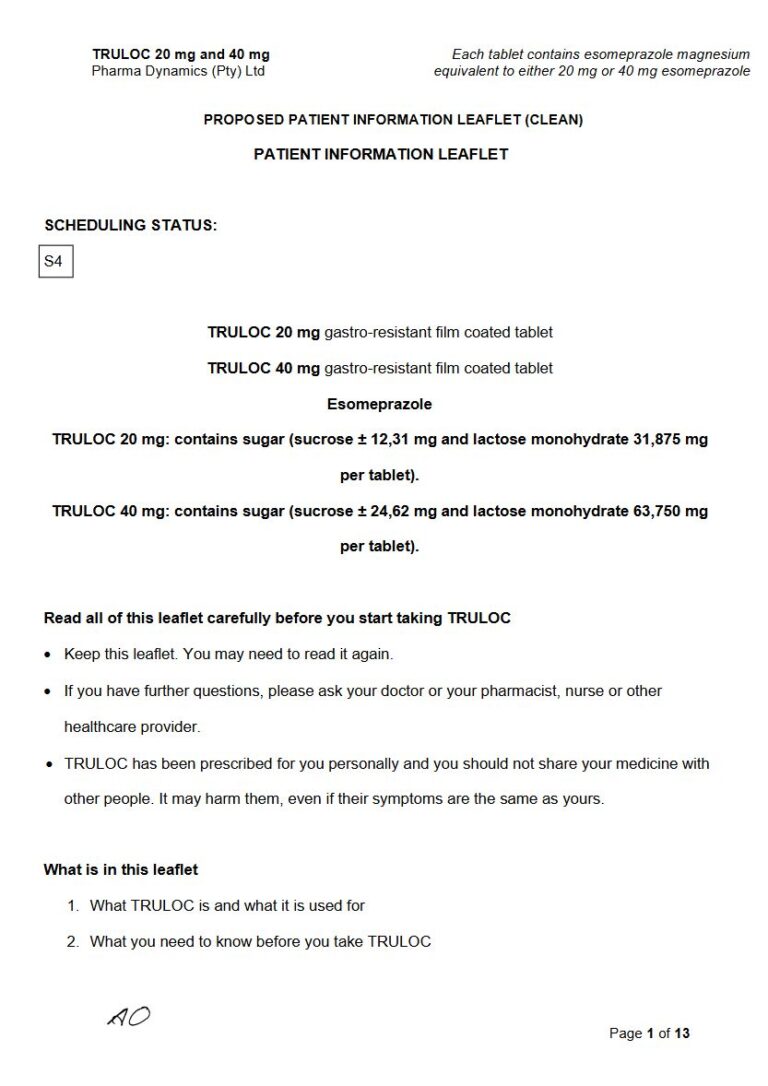
4.1 Therapeutic indications
TRULOC is used to treat the following conditions:
- u2018Gastro-oesophageal Reflux Diseaseu2019 (GORD). This is where acid from the stomach escapes into the gullet (the tube which connects your throat to your stomach) causing pain, inflammation, and heartburn.
- ulcers in the stomach or upper part of the gut (intestine) that are infected with bacteria called u2018Helicobacter pyloriu2019. If you have this condition, your doctor may also prescribe antibiotics to treat the infection and allow the ulcer to heal.
- stomach ulcers caused by medicines called NSAIDs (nonsteroidal anti-inflammatory drugs (Medicine)). Esomeprazole can also be used to stop stomach ulcers from forming if you are taking NSAIDs.
- too much acid in the stomach caused by a growth in the pancreas (Zollinger-Ellison syndrome).
4.2 Posology and method of administration
The recommended doses are given below:
Adults & Adolescents (12 - 18 years):
- The usual dose is:
- Gastro-oesophageal Reflux Disease (GORD): to treat an inflamed food pipe caused by Gastro-oesophageal Reflux Disease (GORD): 40 mg once daily for 4 weeks.
- patients requiring continued NSAID (nonsteroidal anti-Inflammatory drugs) therapy: to prevent stomach ulcers if you are taking NSAIDs: 20 mg or 40 mg once daily.
- eradication of Helicobacter pylori and healing of Helicobacter pylori associated ulcers: 20 mg TRULOC with 1 g amoxicillin and 500 mg clarithromycin, all twice daily for 7 days.
- to treat too much acid in the stomach caused by a growth in the pancreas (Zollinger-Ellison syndrome): the recommended initial dosage is 40 mg twice daily. The dosage should then be individually adjusted, and treatment continued, as long as clinically indicated.
The safety and efficacy of TRULOC in children younger than 12 years of age has not been established. No data is available. Your doctor will tell you how long your treatment with TRULOC will last.
4.3 Contraindications
Do not take TRULOC:
- if you are hypersensitive (allergic) to esomeprazole or any of the other ingredients of TRULOC (see section 6).
- if you are taking medication for HIV treatment (atazanavir or nelfinavir).
4.4 Special warnings and precautions for use
Take special care with TRULOC:
- if you have been experiencing indigestion.
- if you have been on continuous medication for longer than a year.
- if you have been taking a medication that contains clopidogrel (used in the treatment of blood clots).
- if you are due to have a specific blood test (Chromogranin A).
- if you have had previous intestinal conditions.
- if you develop severe diarrhoea that has watery stools, abdominal pain and fever.
- if you are taking TRULOC when necessary and your symptoms change.
- if you have a vitamin B 12 deficiency.
- if you develop tiredness, dizziness, tremor and muscle problems (hypomagnesaemia).
- if you have been diagnosed with osteoporosis (brittle bones) or are at risk of breaking your bones.
- if you develop kidney problems such as cloudy urine, pain in the kidney area, blood or pus in the urine, frequent urination.
TRULOC may hide the symptoms of other diseases. Therefore, if any of the following happen to you before you start taking TRULOC or while you are taking it, talk to your doctor straight away:
- if you lose a lot of weight for no reason and have problems swallowing.
- if you get stomach pain or indigestion.
- if you begin to vomit food or blood.
- if you pass black stools (blood-stained faeces).
Serious skin rashes, which can be fatal, have occurred in patients taking TRULOC (see also section 4). The rash can involve ulcers of the mouth, throat, nose, genitals and conjunctivitis (red and swollen eyes). These serious skin rashes often come after flu-like symptoms such as fever, headache, body ache. The rash may cover large parts of the body with blistering and peeling of the skin. If at any time during the treatment (even after several weeks) you develop a rash or any of these skin symptoms, stop taking this medicine and contact your doctor immediately.
4.5 Interactions with other medicines
Always tell your healthcare provider if you are taking any other medicine. (This includes complementary or traditional medicines.) It is particularly important that you mention the following:
- itraconazole, ketoconazole, voriconazole u2013 Used in the treatment of fungal infections.
- diazepam u2013 used in the treatment of anxiety.
- medicines used to prevent fitting (phenytoin).
- medicines used to prevent blood clotting (warfarin or clopidogrel).
- medicine used to help the symptoms of intermittent claudication (cilostazol).
- medicines used to speed up stomach emptying (cisapride).
- digoxin u2013 used in the treatment of heart problems.
- rifampicin u2013 used for the treatment of tuberculosis.
- St. Johnu2019s wort u2013 used to treat depression, or certain type of anti-malignancy medicines (such as erlotinib or another anti-malignancy medicine from the same class).
- TRULOC should not be taken at the same time as some medicines for HIV, such as atazanavir and nelfinavir, as TRULOC may reduce the blood levels of your antiretroviral medicine.
- tipranavir u2013 used to treat HIV.
- clarithromycin, an antibiotic.
- tacrolimus u2013 used to prevent organ transplant rejection.
- if you are taking a high dose of methotrexate (a chemotherapy medicine in which a high dose is used to treat cancer), TRULOC may need to be temporarily withdrawn.
4.6 Fertility, pregnancy and lactation
If you are pregnant or breastfeeding your baby, think you may be pregnant or are planning to have a baby, please consult your doctor, pharmacist or other healthcare provider for advice before using TRULOC. You should not take TRULOC if you are pregnant or breastfeeding your baby.
4.7 Effects on ability to drive and use machines
TRULOC has minor influence on the ability to drive and use machines. TRULOC may cause dizziness and blurred vision, thereby affecting the ability to drive or use machinery. It is not always possible to predict to what extent TRULOC may interfere with the daily activities of a patient. Patients should ensure that they do not engage in the above activities until they are aware of the measure to which TRULOC affects them.
4.8 Undesirable effects
TRULOC can have side effects. Not all side effects reported for TRULOC are included in this leaflet. Should your general health worsen, or if you experience any untoward effects while using TRULOC, please consult your doctor, pharmacist or other healthcare professional for advice.
If any of the following happens, stop using TRULOC and tell your doctor immediately or go to the casualty department at your nearest hospital:
- swelling of the hands, feet, ankles, face, lips, mouth or throat, which may cause difficulty in swallowing or breathing.
- rash or itching.
- fainting.
These are all very serious side effects. If you have them, you may have had a serious allergic reaction to TRULOC. You may need urgent medical attention or hospitalisation.
Tell your doctor immediately or go to the casualty department at your nearest hospital if you notice any of the following:
- rash or itching in the form of reddening of the skin with blisters or peeling. There may also be severe blisters and bleeding in the lips, eyes, mouth, nose and genitals. This could be u2018erythema multiformeu2019, u2018Stevens-Johnson syndromeu2019, u2018toxic epidermal necrolysisu2019 or u2018drug reaction with eosinophilia and systemic symptomsu2019.
- yellow skin, dark urine and tiredness which can be symptoms of liver problems.
- tightening of chest accompanied with severe coughing (bronchospasm).
- loss or decreased vision.
- abdominal swelling (may be an indication of liver failure).
- excessive sweating.
- blood in the urine (nephritis).
- significant reduction in the amount of urine with shortness of breath (this could be a sign of kidney failure).
These are all serious side effects. You may need urgent medical attention.
Tell your doctor if you notice any of the following:
Frequent side effects:
- stomach pain.
- diarrhoea.
- nausea/vomiting.
- constipation.
- headache.
Less frequent side effects:
- muscle weakness/pain, fracture of the hips, wrists or spine, joint pain.
- fever.
- development of breast tissue in males.
- hair loss.
- dry mouth.
- inflammation of the mouth and lips.
- dizziness.
- blurred vision.
- tingling sensation.
- loss of balance.
- taste disturbance.
- sleepiness, inability to sleep.
- confusion, depression, agitation, hallucination.
- low white blood cell count.
The following side effects have been reported but the frequency for them to occur is not known:
- decreased levels of calcium.
- decreased levels of magnesium.
- u201cbutterfly rashu201d that lasts hours - days.
If you notice any side effects not mentioned in this leaflet, please inform your doctor or pharmacist.
Reporting of side effects: If you get side effects, talk to your doctor, pharmacist or nurse. You can also report side effects to SAHPRA via the Med Safety APP (Medsafety X SAHPRA) and eReporting platform (who-umc.org) found on SAHPRA website. By reporting side effects, you can help provide more information on the safety of TRULOC. You can also send an email directly to the company, [email protected], to ensure safety of the product.
4.9 Overdose
In the event of overdosage, consult your doctor or pharmacist. If neither is available, contact the nearest hospital or poison control centre.
