
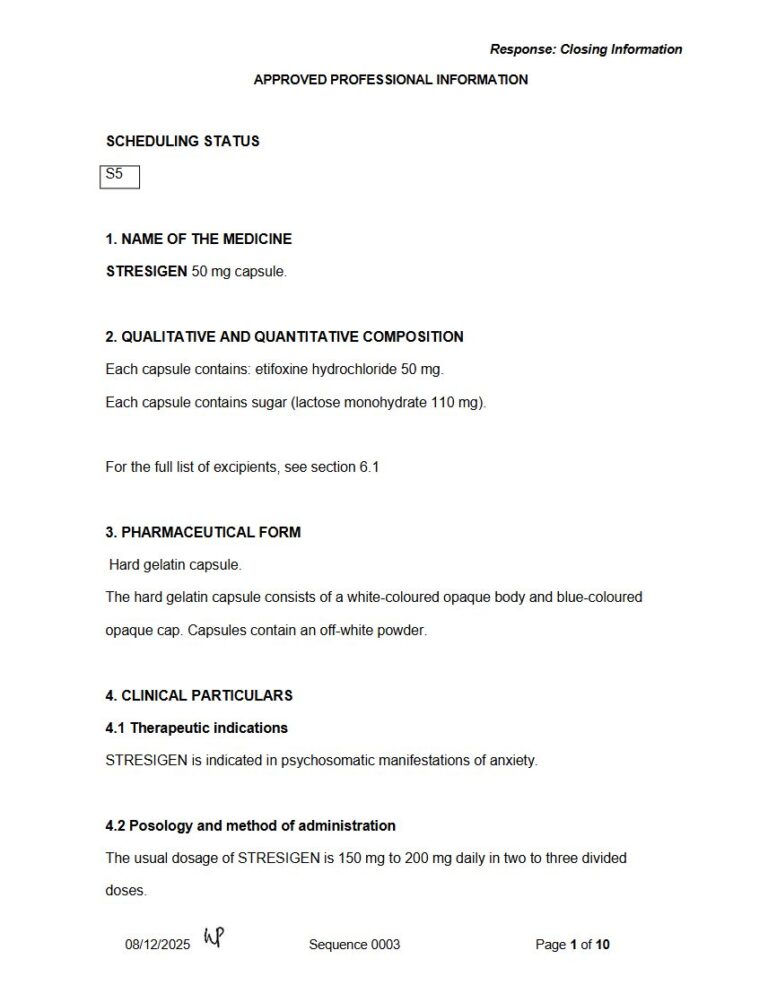
Stresigen 50 mg Capsule
PDF Leaflet Revision Date: 08/12/2025
Clinical Summary
Quick overview from the medicine insert
Indication
Psychosomatic manifestations of anxiety.
Dosage (summary)
150 mg to 200 mg daily in 2-3 divided doses.
Special Populations
- Elderly
- Hepatic impairment
- Renal impairment
Pregnancy & Breastfeeding
Not recommended during pregnancy and breastfeeding due to limited data.
Key Drug Interactions
- Alcohol
- CNS depressants
Contraindications
- Hypersensitivity to etifoxine
- States of shock
- Severe liver/renal impairment
- Myasthenia gravis
- Severe hepatitis
- Severe dermatological reactions
Common side effects
- Slight drowsiness
- Lymphocytic colitis
- Hepatitis
- Skin reactions
Counselling Points
- Avoid alcohol and CNS depressants
- Monitor for skin toxicity
- Do not exceed 8 weeks of treatment
Serious warnings
- Severe dermatological reactions
- Severe hepatic reactions
- Risk of drowsiness
Important Disclaimer
The Stresigen 50 mg Capsule professional information leaflet below is the property of Pharma Dynamics and is provided on Medinsert exactly as issued, with no.. alterations or editorial changes. We make every effort to keep content current by updating documents as soon as new versions become available. Medinsert serves as a trusted access point for healthcare professionals, but does not replace official sources or clinical judgement. For more details, please read our full disclaimer. read more>>
 Healthcare Professionals Only
This content is for registered healthcare professionals
Sign in or create a free account to read the full package insert.
Free for HPCSA-registered professionals. Powered by Medinsert.
Clinical Particulars
Section 4 of the official insert — extracted exactly as issued, no alterations
4.1 Therapeutic indications
STRESIGEN is indicated in psychosomatic manifestations of anxiety.
4.2 Posology and method of administration
The usual dosage of STRESIGEN is 150 mg to 200 mg daily in two to three divided doses.
STRESIGEN is prescribed for a few days to a few weeks. Treatment duration may not exceed 8 weeks
Method of administration
Oral. Capsules should be swallowed with a little water.
Missed dose: Medical practitioners should advise patients who forget to take STRESIGEN to take a dose as soon as possible and then continue with the normal dose. Patients should not take a double dose to compensate for the missed dose.
4.3 Contraindications
STRESIGEN is contraindicated in the following patients:
- hypersensitivity to etifoxine hydrochloride or to any of the ingredients of STRESIGEN (see section 6.1)
- states of shock
- severely impaired liver and/or renal function
- myasthenia gravis
- patients who have had severe cases of hepatitis or cytolytic hepatitis during previous treatment with STRESIGEN
- patients who have had severe dermatological reactions, including Drug Rash with Eosinophilia and Systemic Symptoms (DRESS) syndrome, Stevens Johnson Syndrome (SJS) and dermatitis exfoliative generalized, during previous treatment with etifoxine.
4.4 Special warnings and precautions for use
Severe dermatological reactions
Severe dermatological reactions, including DRESS syndrome, SJS and dermatitis exfoliative generalized, have been reported with etifoxine, (as contained in STRESIGEN), with a very rare frequency. The onset of skin toxicity with etifoxine usually ranged from a few days to 1 month, depending on the reactions. Outcome of skin reactions is mostly favourable after STRESIGEN withdrawal. No fatal outcome due to severe cutaneous adverse reactions has been reported with STRESIGEN. Patients should be aware of this risk of skin toxicity and cutaneous signs and symptoms should be closely monitored. STRESIGEN should be immediately discontinued and never reintroduced should skin toxicity occur whilst taking this medicine.
Severe hepatic reactions
Severe cases of cytolytic hepatitis have been reported with the use of etifoxine, (as contained in STRESIGEN), with a very rare frequency. Time to onset of hepatic reactions after etifoxine introduction mainly occurred between 2 weeks and 1 month of treatment. Caution should be taken in patients with risk factors for hepatic disorders such as elderly patients, patients with medical history of previous viral hepatitis or any other conditions identified on an individual basis by the medical practitioner. Hepatic disorders can be asymptomatic and detected only through specific laboratory tests. In patients with risk factors for hepatic disorders, liver function tests should be performed before starting STRESIGEN and around one month after treatment initiation. After the occurrence of liver toxicity with STRESIGEN, this medicine should be immediately discontinued and never reintroduced.
Lymphocytic colitis
Few cases of lymphocytic colitis have been reported with the use of etifoxine, (as contained in STRESIGEN). In cases of watery diarrhoea, appropriate examinations should be considered in those patients treated with STRESIGEN. Should the patient experience watery diarrhoea whilst taking STRESIGEN, the medicine should be immediately discontinued.
Metrorrhagia
In women on oral contraceptives, cases of metrorrhagia have been reported with the use of etifoxine, (as contained in STRESIGEN).
Central nervous system depressants
Because of the risk of reciprocal potentialisation:
- caution is advised when STRESIGEN is used in conjunction with central nervous system depressants
- simultaneous intake of alcoholic drinks is not advised.
Lactose intolerance
STRESIGEN contains lactose. Patients with the rare hereditary conditions of galactose intolerance, total lactase deficiency or glucose-galactose malabsorption should not take STRESIGEN (see section 4.3).
4.5 Interaction with other medicines and other forms of interaction
Concomitant use not advised
Alcohol
Alcohol increases the sedative effect of STRESIGEN, impairing alertness, which may make vehicle driving and operation of machinery dangerous. Concomitant use of alcoholic drinks and alcohol-containing medicines should be avoided.
Combinations to be taken into account
Other central nervous system (CNS) depressants
Morphine derivatives (analgesics, antitussives and narcotic substitutes); benzodiazepines; hypnotics; neuroleptics, sedative H 1 antihistamines, sedative antidepressants, central antihypertensives, baclofen; thalidomide. The concurrent use of STRESIGEN and these medicines may lead to increased central nervous system depression. Impaired alertness may make vehicle driving or machinery operation dangerous.
4.6 Fertility, pregnancy and lactation
The administration of STRESIGEN during pregnancy and whilst breastfeeding is not recommended as there is limited data available. STRESIGEN crosses the placenta.
Fertility
No data on male and female fertility are available.
4.7 Effects on ability to drive and use machines
Slight drowsiness, occurring at the start of STRESIGEN therapy, disappearing spontaneously with its continuation, has been reported. Patients, particularly vehicle drivers and machine operators, should be advised of the risks of drowsiness associated with the intake of STRESIGEN.
4.8 Undesirable effects
The frequencies of adverse events are ranked according to the following: Frequent = (u2265 1/100 to < 1/10). Less frequent = Infrequent (u2265 1/1,000 to < 1/100); Rare (u2265 1/10,000 to < 1/1,000); Very rare (<1/10,000). Frequency not known = cannot be estimated from the available data.
Tabulated summary of adverse reactions
System Organ Class Frequency Side effects
Immune system disorders Less frequent Frequency unknown Allergic reactions (urticaria, Quinckeu2019s oedema) Anaphylactic shock
Nervous system disorders Less frequent Slight drowsiness, occurring at the start of therapy and disappearing spontaneously with STRESIGEN continuation
Gastrointestinal disorders Less frequent Lymphocytic colitis
Hepatobiliary disorders Less frequent Hepatitis, cytolytic hepatitis
Skin and subcutaneous tissue disorders Less frequent Frequency unknown Skin reactions (rash, maculo- papular, polymorphe erythema, pruritus, face oedema), DRESS syndrome, Stevens- Johnson syndrome, generalized exfoliative dermatitis Leukocytoclastic vasculitis
Reproductive system and breast disorders Less frequent Metrorrhagia in women taking oral contraceptives
Reporting of suspected adverse reactions
Reporting suspected adverse reactions after authorisation of the medicine is important. It allows continued monitoring of the benefit/risk balance of the medicine. Healthcare professionals are requested to report any suspected adverse drug reactions to SAHPRA via the Med Safety APP (Medsafety X SAHPRA) and eReporting platform (who-umc.org) found on SAHPRA website. An email can be sent directly to the company, [email protected] to ensure safety of the product.
4.9 Overdose
Signs and symptoms: Risk of somnolence.
Management of overdose: Symptomatic treatment will be implemented if necessary. There is no specific antidote.
