
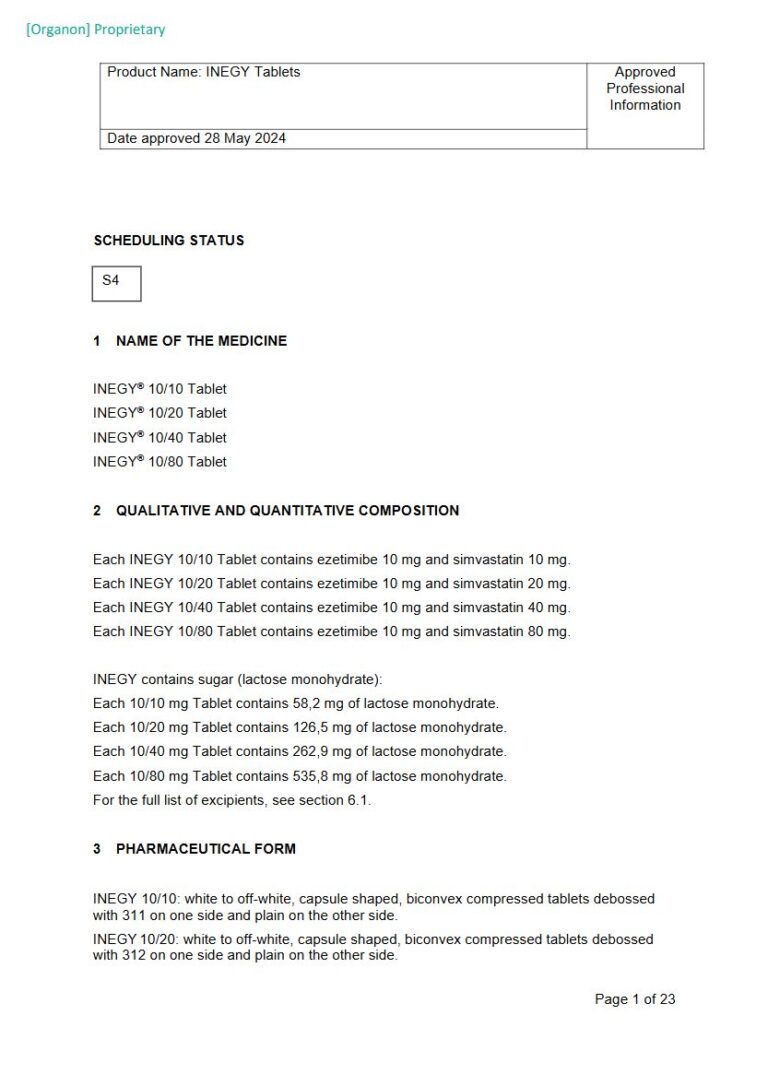
Inegy 10mg. 20mg. 40mg. 80mg Tablet
PDF Leaflet Revision Date: 28 May 2024
Clinical Summary
Quick overview from the medicine insert
Indication
Reduction of cardiovascular events and cholesterol levels.
Dosage (summary)
10/20 mg once daily in the evening; adjust based on LDL-C levels.
Special Populations
- Elderly
- Renal impairment
- Hepatic impairment
Pregnancy & Breastfeeding
Contraindicated in pregnancy and breastfeeding.
Key Drug Interactions
- Potent CYP3A4 inhibitors
- Gemfibrozil
- Ciclosporin
- Danazol
Contraindications
- Hypersensitivity
- Active liver disease
- Moderate to severe hepatic impairment
- Pregnancy
- Lactation
Common side effects
- Myalgia
- Headache
- Dizziness
- Abdominal pain
- Increased liver enzymes
Counselling Points
- Report muscle pain or weakness immediately.
- Avoid grapefruit juice.
- Adhere to cholesterol-lowering diet.
Serious warnings
- Risk of myopathy/rhabdomyolysis
- Monitor liver function
- Caution in elderly
Important Disclaimer
The Inegy 10mg. 20mg. 40mg. 80mg Tablet professional information leaflet below is the property of Organon South Africa and is provided on Medinsert exactly as issued, with no.. alterations or editorial changes. We make every effort to keep content current by updating documents as soon as new versions become available. Medinsert serves as a trusted access point for healthcare professionals, but does not replace official sources or clinical judgement. For more details, please read our full disclaimer. read more>>
 Healthcare Professionals Only
This content is for registered healthcare professionals
Sign in or create a free account to read the full package insert.
Free for HPCSA-registered professionals. Powered by Medinsert.
Clinical Particulars
Section 4 of the official insert — extracted exactly as issued, no alterations
4.1 Therapeutic Indications
Reduction in the risk of Cardiovascular Events
nINEGY is indicated to reduce the risk of cardiovascular events in patients with coronary artery heart disease (CHD) and a history of acute coronary syndrome (ACS), either previously treated with a statin or not. Benefits have been shown for this group of patients when their LDL-C was above 1,2 mmol/L. No statistically significant benefit was demonstrated for risk reduction of stroke, hospitalisation for unstable angina pectoris and for coronary artery revascularisation procedures.
nPrimary Hypercholesterolaemia
nINEGY is indicated as adjunctive therapy to diet for the reduction of elevated total cholesterol (total-C), low-density lipoprotein cholesterol (LDL-C), apolipoprotein B (Apo B), triglycerides (TG), and non-high-density lipoprotein cholesterol (non-HDL-C), and to moderately increase high-density lipoprotein cholesterol (HDL-C) in patients with primary (heterozygous familial and non-familial) hypercholesterolaemia or mixed hyperlipidaemia.
nHomozygous Familial Hypercholesterolaemia (HoFH)
nINEGY is indicated for the reduction of elevated total-C and LDL-C levels in patients with HoFH.
4.2 Posology and method of administration
The patient should be placed on a standard cholesterol-lowering diet before receiving INEGY and should continue on this diet during treatment with INEGY. The dosage should be individualised according to the baseline LDL-C level, the recommended goal of therapy, and the patientu2019s response. INEGY should be taken as a single daily dose in the evening, with or without food.
nIn patients with primary hyperlipidaemia or mixed hyperlipidaemia, the dosage range is 10/10 mg/day through 10/80 mg/day. The recommended usual starting dose is 10/20 mg/day. Initiation of therapy with 10/10 mg/day may be considered for patients requiring less aggressive LDL-C reductions. Patients who require a larger reduction in LDL-C (u02c3 55 %) may be started at 10/40 mg/day. After initiation or titration of INEGY, lipid levels may be analysed after 2 weeks and dosage adjusted, if needed. The 10/80 mg dose of INEGY is only recommended in patients at high risk for cardiovascular complications who have not achieved their treatment goals on lower doses (see Section 4.4).
nPatients with Coronary Heart Disease and ACS Event History
nThe starting dose is 10/40 mg once a day in the evening. The 10/80 mg dose is only recommended in patients who have not achieved a suitable reduction in LDL-C.
nPatients with Homozygous Familial Hypercholesterolaemia
nThe recommended dosage for patients with Homozygous Familial Hypercholesterolaemia is INEGY 10/40 mg/day or 10/80 mg/day in the evening. INEGY should be used as an adjunct to other lipid-lowering treatments (e.g., LDL apheresis) in these patients or if such treatments are unavailable.
nIn patients taking lomitapide concomitantly with INEGY, the dose of INEGY should not exceed 10/40 mg/day (see Sections 4.4 Myopathy/Rhabdomyolysis and 4.5).
nCo-administration with other medicines
nDosing of INEGY should occur either 2 or more hours before or 4 or more hours after administration of a bile acid sequestrant. In patients taking amiodarone, verapamil or diltiazem, or products containing elbasvir or grazoprevir concomitantly with INEGY, the dose of INEGY should not exceed 10/20 mg/day (see Sections 4.4 and 4.5). In patients taking amlodipine concomitantly with INEGY, the dose of INEGY should not exceed 10/40 mg/day (see Sections 4.4 and 4.5).
nSpecial populations
nUse in the Elderly
nNo dosage adjustment is required for elderly patients. Because advanced age (u2265 65 years) is a predisposing factor for myopathy, INEGY should be prescribed with caution in the elderly.
nIn a clinical trial of patients treated with simvastatin 80 mg/day, patients u2265 65 years of age had an increased risk of myopathy compared to patients < 65 years of age.
nUse in Paediatric (10 to 17 Years of Age) Patients
nThe recommended usual starting dose is 10/10 mg once a day in the evening. The recommended dosing range is 10/10 to a maximum of 10/40 mg/day. Doses should be individualised according to the recommended goal of therapy.
nChildren u02c2 10 years: Treatment with INEGY is not recommended in children under 10 years due to insufficient data on safety and efficacy.
nPatients with Renal Impairment/Chronic Kidney Disease
nIn patients with mild renal insufficiency (estimated GFR u2265 60 mL/min/1,73 m2) no dosage adjustment is necessary. In patients with chronic kidney disease and estimated glomerular filtration rate < 60 mL/min/1,73 m2, the dose of INEGY is 10/20 mg once a day in the evening. In such patients, the use of higher doses should be closely monitored (see section 5.2).
nUse in Hepatic Impairment
nNo dosage adjustment is required in patients with mild hepatic insufficiency (Child-Pugh score 5 or 6). Treatment with INEGY is contraindicated in patients with moderate (Child-Pugh score 7 to 9) or severe (Child - Pugh score u02c3 9) liver dysfunction due to unknown effects (see section 4.4).
nMethod of Administration
nFor oral administration.
4.3 Contraindications
- n
- Hypersensitivity to the active substances or to any of the excipients of INEGY (listed in section 6.1) n
- Active liver disease or unexplained persistent elevations of serum transaminases, moderate to severe hepatic impairment n
- Pregnancy and lactation (see Section 4.6) n
- Concomitant administration of potent CYP3A4 inhibitors (e.g., itraconazole, ketoconazole, posaconazole, voriconazole, HIV protease inhibitors, boceprevir, telaprevir, erythromycin, clarithromycin, telithromycin, nefazodone and medicines containing cobicistat (see Sections 4.4 and 4.5) n
- Concomitant administration of gemfibrozil, ciclosporin or danazol (see Sections 4.4 and 4.5). n
4.4 Special warnings and precautions for use
Myopathy/Rhabdomyolysis
nSimvastatin may cause myopathy manifested as muscle pain, tenderness or weakness with CK above 10 times the ULN. Myopathy sometimes takes the form of rhabdomyolysis with or without acute renal failure secondary to myoglobinuria, and fatalities have occurred. The risk of myopathy is increased by high levels of HMG-CoA reductase inhibitory activity in plasma (i.e. elevated simvastatin and simvastatin acid plasma levels), which may be due, in part, to interacting medicines that interfere with simvastatin metabolism and/or transporter pathways (see Section 4.5). Predisposing factors for myopathy include advanced age (u2265 65 years), female gender, uncontrolled hypothyroidism, and renal impairment. The risk of myopathy/rhabdomyolysis is dose related for simvastatin. In a clinical trial database in which 41 413 patients were treated with simvastatin, 24 747 (approximately 60 %) of whom were enrolled in studies with a median follow-up of at least 4 years, the incidence of myopathy was approximately 0,03 %, 0,08 % and 0,61 % at 20, 40 and 80 mg/day, respectively. In these trials, patients were carefully monitored, and some interacting medicines were excluded. In a clinical trial in which patients with a history of myocardial infarction were treated with simvastatin 80 mg/day (mean follow-up 6,7 years), the incidence of myopathy was approximately 1,0 % compared with 0,02 % for patients on 20 mg/day. Approximately half of these myopathy cases occurred during the first year of treatment. The incidence of myopathy during each subsequent year of treatment was approximately 0,1 %.
nThe risk of myopathy is greater in patients on simvastatin 80 mg compared with other statin-based therapies with similar LDL-C-lowering efficacy. Therefore, the 10/80 mg dose of INEGY should only be used in patients at high risk for cardiovascular complications who have not achieved their treatment goals on lower doses. In patients taking INEGY 10/80 mg for whom an interacting agent is needed, a lower dose of INEGY or an alternative statin-ezetimibe regimen with less potential for interactions should be used (see Sections 4.2 and 4.3). Patients who develop rhabdomyolysis on therapy with simvastatin may have complicated medical histories, including renal insufficiency which may be as a consequence of long-standing diabetes mellitus. Such patients taking INEGY merit closer monitoring.
nAll patients starting therapy with INEGY, or whose dose of INEGY is being increased, should be advised of the risk of myopathy and told to report promptly any unexplained muscle pain, tenderness or weakness. INEGY therapy should be discontinued immediately if myopathy is diagnosed or suspected. In most cases, when patients were promptly discontinued from simvastatin treatment, muscle symptoms and CK increases resolved (See Section 4.8). Periodic CK determinations may be considered in patients starting therapy with INEGY or whose dose is being increased. Periodic CK determinations are recommended for patients titrating to the 10/80 mg dose. There is no assurance that such monitoring will prevent myopathy.
nTherapy with INEGY should be temporarily stopped a few days prior to elective major surgery and when any major medical or surgical condition supervenes. In a clinical trial in which patients at high risk of cardiovascular disease were treated with simvastatin 40 mg/day (median follow-up 3.9 years), the incidence of myopathy was approximately 0.05% for non-Chinese patients (n= 7367) compared with 0.24% for Chinese patients (n=5468). While the only Asian population assessed in this clinical trial was Chinese, caution should be used when prescribing INEGY to Asian patients and the lowest dose necessary should be employed.
nMedicine Interactions
n- n
- The risk of myopathy/rhabdomyolysis is increased by use of INEGY with the following medicines: n
Contraindicated Medicines
n- n
- Potent inhibitors of CYP3A4: Concomitant use with medicines labelled as having a potent inhibitory effect on CYP3A4 at therapeutic doses (e.g., itraconazole, ketoconazole, posaconazole, voriconazole, erythromycin, clarithromycin, telithromycin, HIV protease inhibitors, boceprevir, telaprevir, nefazodone or medicines containing cobicistat), is contraindicated. n
- If short-term treatment with potent CYP3A4 inhibitors is unavoidable, therapy with INEGY should be suspended during the course of treatment (see Sections 4.3, 4.5 and 5.2). n
- Gemfibrozil, ciclosporin or danazol: Concomitant use of these medicines with INEGY is contraindicated. See Sections 4.3, 4.5 and 5.2. n
Other Medicines
n- n
- Fusidic acid: Patients on fusidic acid treated concomitantly with INEGY (simvastatin component) may have an increased risk of myopathy/rhabdomyolysis (see section 4.5). Co-administration with fusidic acid is not recommended. In patients where the use of systemic fusidic acid is considered essential, INEGY should be discontinued throughout the duration of fusidic acid treatment. n
- Amiodarone: In a clinical trial, myopathy was reported in 6 % of patients receiving simvastatin 80 mg and amiodarone. The dose of INEGY should not exceed 10/20 mg daily in patients receiving concomitant medication with amiodarone (see section 4.5). n
- Calcium channel blockers: Verapamil or diltiazem: Patients on diltiazem treated concomitantly with simvastatin 80 mg had an increased risk of myopathy. The dose of INEGY should not exceed 10/20 mg daily in patients receiving concomitant medication with verapamil or diltiazem (see Section 4.5). Amlodipine: In a clinical trial, patients on amlodipine treated concomitantly with simvastatin 80 mg had an increased risk of myopathy (see Section 4.5). The dose of INEGY should not exceed 10/40 mg daily in patients receiving concomitant medication with amlodipine. n
- Lomitapide: The dose of INEGY should not exceed 10/40 mg daily in patients with HoFH receiving concomitant medication with lomitapide (see Section 4.5). n
- Moderate inhibitors of CYP3A4: Patients taking other medicines labelled as having a moderate inhibitory effect on CYP3A4 concomitantly with INEGY, particularly higher INEGY doses, may have an increased risk of myopathy. When co-administering INEGY with a moderate inhibitor of CYP3A4, a dose adjustment of INEGY may be necessary. n
- Inhibitors of Breast Cancer Resistant Protein (BCRP): Concomitant administration of products that are inhibitors of BCRP (e.g., elbasvir and grazoprevir) may lead to increased plasma concentrations of simvastatin and an increased risk of myopathy; therefore, a dose adjustment of INEGY may be necessary. Coadministration of elbasvir and grazoprevir with simvastatin has not been studied; however, the dose of INEGY should not exceed 10/20 mg daily in patients receiving concomitant medication with products containing elbasvir or grazoprevir (see Section 4.5). n
- Other Fibrates: There is an increased risk of myopathy when simvastatin is used concomitantly with fibrates, especially gemfibrozil. The safety and effectiveness of INEGY administered with fibrates, except fenofibrate, have not been studied. Therefore, the concomitant use of INEGY and fibrates, except fenofibrate, should be avoided. Concomitant use of gemfibrozil is contraindicated (see Section 4.3). n
- Niacin (1 g or more per day): Cases of myopathy/rhabdomyolysis have been observed with simvastatin co-administered with lipid modifying doses (u2265 1 g/day) of niacin. In a clinical trial (median follow-up 3.9 years) involving patients at high risk of cardiovascular disease and with well-controlled LDL-C levels on simvastatin 40 mg/day with or without ezetimibe 10 mg, there was no incremental benefit on cardiovascular outcomes with the addition of lipid-modifying doses (u22651 g/day) of niacin. Therefore, the benefit of the combined use of simvastatin with niacin should be carefully weighed against the potential risks of the combination. In addition, in this trial, the incidence of myopathy was approximately 0.24% for Chinese patients on simvastatin 40 mg or ezetimibe/simvastatin 10/40 mg compared with 1.24% for Chinese patients on simvastatin 40 mg or ezetimibe/simvastatin 10/40 mg co-administered with extended-release niacin/laropiprant 2 g/40 mg. While the only Asian population assessed in this clinical trial was Chinese, co-administration of INEGY with lipid-modifying doses of niacin (u2265 1 g/day) in Asian patients is not recommended (see Section 4.5). n
- Daptomycin: Reports of myopathy and/or rhabdomyolysis have been observed with HMG-CoA reductase inhibitors co-administered with daptomycin. Caution should be used when prescribing HMG-CoA reductase inhibitors with daptomycin, as either medicine can cause myopathy and/or rhabdomyolysis when given alone. Consideration should be given to suspending INEGY temporarily in patients taking daptomycin (see Section 4.5). n
- Anticoagulants: If INEGY is added to warfarin, the International Normalised Ratio (INR) should be appropriately monitored (see Section 4.5). n
Myasthenia Gravis / Ocular Myasthenia
nStatins as contained in INEGY have been reported to induce new onset or aggravate pre-existing myasthenia gravis or ocular myasthenia (see section 4.8). INEGY should be discontinued in the case these conditions occur. There have been reports of recurrences of these conditions when the same or a different statin was (re-) administered.
nLiver Enzymes
nIn controlled trials in patients receiving INEGY, consecutive transaminase elevations (u2265 3 times the ULN) have been observed (see Section 4.8). Hepatic function tests should be performed before treatment with INEGY begins and thereafter when clinically indicated. Patients titrated to the 10/80 mg dose should receive an additional test prior to titration, 3 months after titration to the 10/80 mg dose and periodically thereafter (e.g., semi-annually) for the first year of treatment. Special attention should be paid to patients who develop elevated serum transaminase levels, and in these patients, measurements should be repeated promptly and then performed more frequently. If the transaminase levels show evidence of progression, particularly if they rise to 3 times the ULN and are persistent, INEGY should be discontinued. Note that ALT may emanate from muscle, therefore ALT rising with CK may indicate myopathy (see Section 4.4).
nThere have been post-marketing reports of fatal and non-fatal hepatic failure in patients taking statins, including simvastatin. If serious liver injury with clinical symptoms and/or hyperbilirubinaemia or jaundice occurs during treatment with INEGY, promptly interrupt therapy. If an alternate aetiology is not found, treatment with INEGY should not be restarted. INEGY should be used with caution in patients who consume substantial quantities of alcohol and/or have a past history of liver disease. Active liver diseases or unexplained persistent transaminase elevations are contraindications to the use of INEGY.
nHepatic Insufficiency
nDue to the unknown effects of the increased exposure to ezetimibe in patients with moderate or severe hepatic insufficiency, INEGY is not recommended in these patients.
4.5 Interaction with other medicines and other forms of interaction
INEGY
nNo clinically significant pharmacokinetic interaction was seen when ezetimibe was co-administered with simvastatin. INEGY is bioequivalent to co-administered ezetimibe and simvastatin. Multiple mechanisms may contribute to potential interactions with HMG Co-A reductase inhibitors. Medicines or herbal products that inhibit certain enzymes (e.g., CYP3A4) and/or transporter (e.g., OATP1B) pathways may increase simvastatin and simvastatin acid plasma concentrations and may lead to an increased risk of myopathy/rhabdomyolysis. Consult the prescribing information of all concomitantly used medicines to obtain further information about their potential interactions with simvastatin and/or the potential for enzyme or transporter alterations and possible adjustments to dose and regimens.
nContraindicated medicines
nConcomitant use of the following medicines is contraindicated:
n- n
- Potent Inhibitors of CYP3A4 n
- In preclinical studies, it has been shown that ezetimibe does not induce cytochrome P450 medicine metabolising enzymes. No clinically significant pharmacokinetic interactions have been observed between ezetimibe and medicines known to be metabolised by cytochromes P450 1B2, 2D6, 2C8, 2C9, and 3A4, or N-acetyltransferase. Simvastatin is metabolised by CYP3A4 but has no CYP3A4 inhibitory activity; therefore, it is not expected to affect the plasma concentrations of other medicines metabolised by CYP3A4. Potent inhibitors of CYP3A4 (below) increase the risk of myopathy by reducing the elimination of the simvastatin component of INEGY. Concomitant use of medicines labelled as having a potent inhibitory effect on CYP3A4 (e.g., itraconazole, ketoconazole, posaconazole, erythromycin, clarithromycin, telithromycin, HIV protease inhibitors, boceprevir, telaprevir, nefazodone and medicines containing cobicistat is contraindicated (see Sections 4.3, 4.4, and 5.2). n
- Gemfibrozil, Ciclosporin or Danazol n
- In a pharmacokinetic study, concomitant gemfibrozil administration increased total ezetimibe concentrations approximately 1,7 -fold. Co-administration with INEGY is contraindicated. No clinical data are available (see Sections 4.3 and 4.4). n
- Ciclosporin: In a study of eight post-renal transplant patients with creatinine clearance of > 50 mL/min on a stable dose of ciclosporin, a single 10 mg dose of ezetimibe resulted in a 3,4-fold (range 2,3 to 7,9 -fold) increase in the mean AUC for total ezetimibe compared to a healthy control population from another study (n=17). In a different study, a renal transplant patient with severe renal insufficiency (creatinine clearance of 13,2 mL/min/1,73 m2) who was receiving multiple medicines including ciclosporin, demonstrated a 12-fold greater exposure to total ezetimibe compared to concurrent controls. In a two-period crossover study in twelve healthy subjects, daily administration of 20 mg ezetimibe for 8 days with a single 100 mg dose of ciclosporin on Day 7 resulted in a mean 15 % increase in ciclosporin AUC (range 10 % decrease to 51 % increase) compared to a single 100 mg dose of ciclosporin alone (see Sections 4.3 and 4.4). n
Other medicine interactions
n- n
- Fibrates: Concomitant fenofibrate administration increased total ezetimibe concentrations approximately 1,5-fold, however this increase is not considered clinically significant. The safety and effectiveness of INEGY administered with fibrates have not been established. Fibrates may increase cholesterol excretion into the bile, leading to cholelithiasis. In a preclinical study in dogs, ezetimibe increased cholesterol in the gallbladder bile. Although the relevance of this preclinical finding to humans is unknown, co-administration of INEGY with fibrates is not recommended until use in patients is studied. n
- Fusidic Acid: The risk of myopathy/rhabdomyolysis may be increased by concomitant administration of fusidic acid (see Section 4.4). n
- Amiodarone: The risk of myopathy/rhabdomyolysis is increased by concomitant administration of amiodarone with higher doses of INEGY (see Sections 4.2 and 4.4). n
- Cholestyramine: Concomitant cholestyramine administration decreased the mean AUC of total ezetimibe (ezetimibe + ezetimibe glucuronide) approximately 55 %. The incremental LDL-C reduction due to adding INEGY to cholestyramine may be lessened by this interaction. n
- Calcium channel blockers: The risk of myopathy/rhabdomyolysis is increased by concomitant administration of verapamil, diltiazem, or amlodipine (see Sections 4.2 and 4.4). n
- Lomitapide: The risk of myopathy/rhabdomyolysis may be increased by concomitant administration of lomitapide (see Sections 4.2 & 4.3). n
- Moderate inhibitors of CYP3A4: Patients taking other medicines labelled as having a moderate inhibitory effect on CYP3A4 concomitantly with INEGY, particularly higher INEGY doses, may have an increased risk of myopathy (see section 4.4). n
- Inhibitors of the transport protein OATP1B1: Simvastatin acid is a substrate of the transporter protein OATP1B1. Concomitant administration of medicinal products that are inhibitors of the transporter protein OATP1B1 may lead to increased plasma concentrations of simvastatin acid and an increased risk of myopathy (see sections 4.3 and 4.4). n
- Inhibitors of Breast Cancer Resistant Protein (BCRP): Simvastatin is a substrate of the efflux transporter BCRP. Concomitant administration of products that are inhibitors of BCRP (e.g., elbasvir and grazoprevir) may lead to increased plasma concentrations of simvastatin and an increased risk of myopathy. When co-administering simvastatin with an inhibitor of BCRP, a dose adjustment of INEGY may be necessary (see Sections 4.2 and 4.4). n
- Niacin: In a study of 15 healthy adults, concomitant INEGY (10/20 mg daily for 7 days) caused a small increase in the mean AUCs of niacin (22 %) and nicotinuric acid (19 %) administered as NIASPAN extended-release tablets (1 000 mg for 2 days and 2 000 mg for 5 days following a low-fat breakfast). In the same study, concomitant NIASPAN slightly increased the mean AUCs of ezetimibe (9 %), total ezetimibe (26 %), simvastatin (20 %) and simvastatin acid (35 %). Cases of myopathy/rhabdomyolysis have been observed with simvastatin co-administered with lipid-modifying doses (u2265 1 g/day) of niacin (see Section 4.4 Myopathy/Rhabdomyolysis). n
- Colchicine: There have been reports of myopathy and rhabdomyolysis with the concomitant administration of colchicine and INEGY in patients with renal insufficiency. Close clinical monitoring of such patients taking this combination is advised. n
- Rifampicin: Because rifampicin is a potent CYP3A4 inducer, patients undertaking long-term rifampicin therapy (e.g., treatment of tuberculosis) may experience loss of efficacy of simvastatin. In a pharmacokinetic study in normal volunteers, the area under the plasma concentration curve (AUC) for simvastatin acid was decreased by 93 % with concomitant administration of rifampicin. n
- Daptomycin: The risk of myopathy and/or rhabdomyolysis may be increased by concomitant administration of HMG-CoA reductase inhibitors and daptomycin (see Section 4.4). n
4.6 Fertility, pregnancy and lactation
Pregnancy
nINEGY is contraindicated during pregnancy (see Section 4.3). Reports of congenital anomalies following intrauterine exposure to HMG-CoA reductase inhibitors have been received.
nMaternal treatment with INEGY may reduce the foetal levels of mevalonate which is a precursor of cholesterol biosynthesis. For this reason, INEGY should not be used in women who are pregnant, trying to become pregnant or suspect they are pregnant. Treatment with INEGY should be suspended for the duration of pregnancy or until it has been determined that the woman is not pregnant (see Section 4.3).
nLactation
nEzetimibe is excreted in rat milk. Women who are taking INEGY should not breastfeed their infants.
nFertility
nEzetimibe did not affect the fertility of male or female rats. Simvastatin at maximally tolerated doses in both the rat and the rabbit, simvastatin had no effects on fertility or reproductive function.
4.7 Effects on ability to drive and use machines
Certain side effects that have been reported with INEGY may affect some patients' ability to drive or operate machinery. Individual responses to INEGY may vary (see section 4.8).
4.8 Undesirable effects
Summary of the safety profile
nINEGY (or co-administration of ezetimibe and simvastatin equivalent to INEGY) has been evaluated for safety in approximately 12 000 patients in clinical trials. The following common (u2265 1/100, < 1/10) or uncommon (u2265 1/1 000, < 1/100) medicine-related adverse experiences were reported:
nINEGY (ezetimibe plus simvastatin)
nOrgan class Adverse reaction
n- n
- Psychiatric disorders n
- Uncommon sleep disorder; insomnia n
- Nervous system disorders n
- Uncommon dizziness; headache; paraesthesia n
- Gastrointestinal disorders n
- Uncommon abdominal pain; abdominal discomfort; abdominal distension; abdominal pain upper; dyspepsia; flatulence; diarrhoea; nausea; vomiting; dry mouth; gastroesophageal reflux disease n
- Skin and subcutaneous tissue disorders n
- Uncommon pruritus; rash; urticaria n
- Musculoskeletal and connective tissue disorders n
- Common myalgia n
- Uncommon arthralgia; muscle spasms; muscular weakness; musculoskeletal discomfort; musculoskeletal pain; neck pain; back pain; pain in extremity n
- General disorders and administration site conditions n
- Uncommon asthenia; fatigue; malaise; chest pain; oedema peripheral n
- Investigations n
- Common ALT and/or AST increased; blood CK increased n
- Uncommon blood bilirubin increased; blood uric acid increased; gamma-glutamyltransferase increased; international normalised ratio increased; protein urine present; weight decreased n
LABORATORY VALUES
nAdverse effects with combination
nIn controlled clinical co-administration trials, the incidence of clinically important elevations in serum transaminases [alanine transaminase (ALT) and/or aspartate transaminase (AST) u2265 3 times the upper limit of normal (ULN), consecutive] was 1,7 % for patients treated with INEGY.
nClinically important elevations of creatinine kinase (CK) (u2265 10 times the ULN) were seen in 0,2 % of the patients treated with INEGY. Increases in HbA1c and fasting serum glucose levels have been reported with statins, including simvastatin as in INEGY.
nAdverse effects with individual components
nAdditional information on individual components: In addition to the adverse reactions listed above for the combination product, other undesirable effects previously reported during clinical studies or post-marketing use with one of the individual components may be potential undesirable effects with INEGY.
nEzetimibe
nAdverse reactions from clinical trials
n- n
- Metabolism and nutrition disorders n
- Less frequent: decreased appetite n
- Vascular disorders n
- Less frequent: hot flush; hypertension n
- Respiratory, thoracic and mediastinal disorders n
- Less frequent: cough n
- Gastrointestinal disorders n
- Less frequent: gastritis n
- General disorders and administration site conditions n
- Less frequent: pain n
- Investigations n
- Less frequent: liver function test abnormal n
Post-marketing
n- n
- Blood and lymphatic system disorders n
- Thrombocytopenia n
- Psychiatric Disorders n
- Depression n
- Gastrointestinal disorders n
- Constipation; pancreatitis n
- Hepatobiliary disorders n
- Hepatitis/jaundice, cholelithiasis, cholecystitis n
- Skin and subcutaneous tissue disorders n
- Hypersensitivity reactions, including rash, urticaria, anaphylaxis angioedema, erythema multiforme n
- Musculoskeletal, connective tissue and bone disorders n
- Myopathy/rhabdomyolysis (see Section 4.4 Myopathy/Rhabdomyolysis). n
Simvastatin
nAdverse reactions from clinical trials
n- n
- Gastrointestinal disorders n
- Less frequent: constipation n
Post-marketing
n- n
- Blood and lymphatic system disorders n
- Anaemia n
- Nervous system disorders n
- Peripheral neuropathy, frequency unknown: myasthenia gravis n
- Eye disorders n
- Frequency unknown: ocular myasthenia n
- Respiratory, thoracic and mediastinal disorders n
- Cough, interstitial lung disease n
- Hepatobiliary disorders n
- Hepatitis/jaundice, fatal and non-fatal hepatic failure n
- Skin and subcutaneous tissue disorders n
- Alopecia, lichen planus n
- Musculoskeletal, connective tissue and bone disorders n
- Muscle cramps n
There have been reports of immune-mediated necrotising myopathy (IMNM), an autoimmune myopathy associated with statin use. IMNM is characterised by: proximal muscle weakness and elevated serum creatine kinase, which persists despite discontinuation of statin treatment; muscle biopsy showing necrotising myopathy without significant inflammation; improvement with immunosuppressive agents (see Section 4.4 Myopathy/Rhabdomyolysis).
nReproductive system and breast disorders
nErectile dysfunction
nThere have been reports of an apparent hypersensitivity syndrome with simvastatin which has included some of the following features: angioedema, lupus-like syndrome, polymyalgia rheumatica, dermatomyositis, vasculitis, thrombocytopenia, eosinophilia, ESR increased, arthritis and arthralgia, urticaria, photosensitivity, fever, flushing, dyspnoea and malaise.
nThere have been post-marketing reports of cognitive impairment (e.g., memory loss, forgetfulness, amnesia, memory impairment, confusion) associated with statin use. The reports are generally non-serious and reversible upon statin discontinuation, with variable times to symptom onset (1 day to years) and symptom resolution (median of 3 weeks).
nReporting of suspected adverse reactions
nReporting suspected adverse reactions after authorisation of the medicine is important. It allows continued monitoring of the benefit/risk balance of the medicine. Healthcare professionals are asked to report any suspected adverse reactions to SAHPRA via the u201c6.04 Adverse Drug Reaction Reporting Formu201d, found online under SAHPRAu2019s publications: https://www.sahpra.org.za/Publications/Index/8.
4.9 Overdose
In overdose, side effects due to the statin component may be exacerbated and exaggerated (see Section 4.8). INEGY (ezetimibe plus simvastatin) No specific treatment of overdosage with INEGY can be recommended. In the event of an overdose, symptomatic and supportive measures should be employed.
nEzetimibe
nIn clinical studies, administration of ezetimibe, 50 mg/day to 15 healthy subjects for up to 14 days, 40 mg/day to 18 patients with primary hypercholesterolaemia for up to 56 days, and 40 mg/day to 27 patients with homozygous sitosterolaemia for 26 weeks was generally well tolerated. Cases of overdosage have been reported; some have been associated with adverse experiences.
nSimvastatin
nCases of overdosage have been reported; the maximum dose taken was 3,6 g.
