
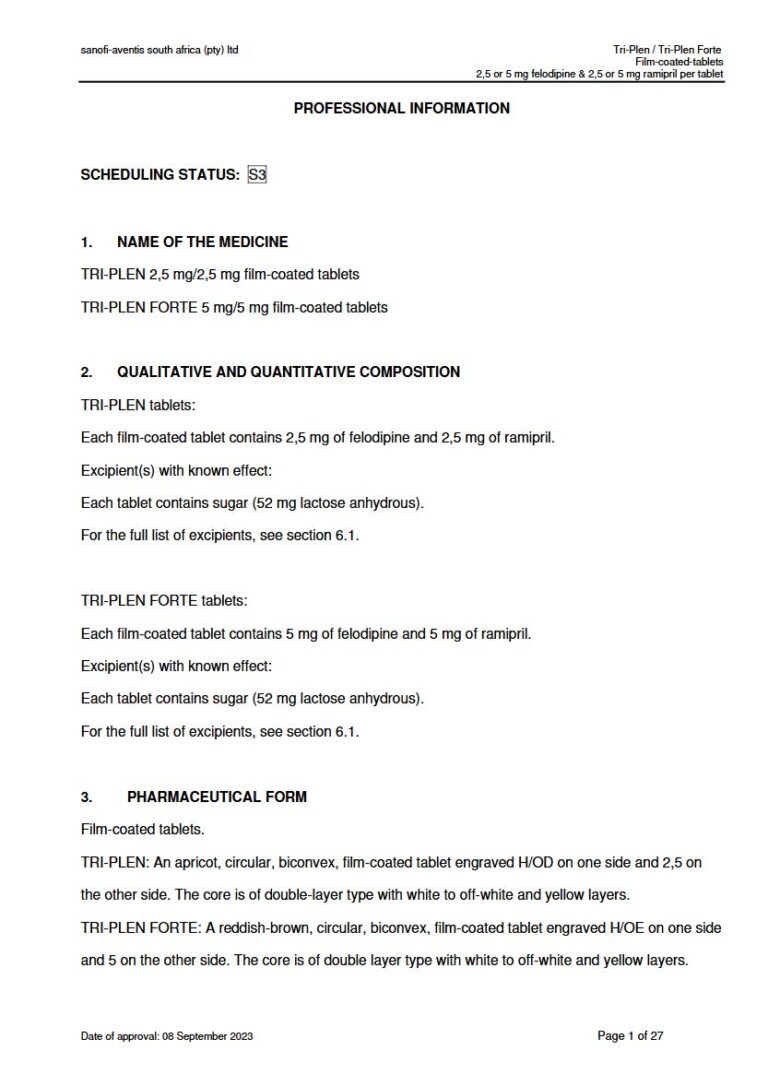
Tri-Plen 2.5 mg Tablets
PDF Leaflet Revision Date: 08 September 2023
Clinical Summary
Quick overview from the medicine insert
Indication
Treatment of mild to moderate hypertension.
Dosage (summary)
One tablet daily; max one TRI-PLEN FORTE tablet.
Onset of Action / Duration
Onset: 1-2 hours, Duration: 24 hours
Special Populations
- Elderly
- Renal impairment
- Hepatic impairment
Pregnancy & Breastfeeding
Contraindicated in pregnancy and breastfeeding.
Key Drug Interactions
- Potassium-sparing diuretics
- Aliskiren-containing products
- Angiotensin-II receptor blockers
Contraindications
- Hypersensitivity to components
- History of angioedema
- Severe renal impairment
Common side effects
- Headache
- Dizziness
- Hypotension
Counselling Points
- Monitor blood pressure regularly.
- Avoid potassium supplements.
- Report any signs of angioedema immediately.
Serious warnings
- Angioedema risk
- Dual blockade of RAAS contraindicated
- Symptomatic hypotension
Important Disclaimer
The Tri-Plen 2.5 mg Tablets professional information leaflet below is the property of Sanofi-Aventis South Africa and is provided on Medinsert exactly as issued, with no.. alterations or editorial changes. We make every effort to keep content current by updating documents as soon as new versions become available. Medinsert serves as a trusted access point for healthcare professionals, but does not replace official sources or clinical judgement. For more details, please read our full disclaimer. read more>>
 Healthcare Professionals Only
This content is for registered healthcare professionals
Sign in or create a free account to read the full package insert.
Free for HPCSA-registered professionals. Powered by Medinsert.
Clinical Particulars
Section 4 of the official insert — extracted exactly as issued, no alterations
4.1 Therapeutic indications
Treatment of mild to moderate hypertension in patients whose blood pressure is normalised with individual components in the same doses as the proposed fixed combination.
4.2 Posology and method of administration
Posology
Adults, including elderly: One TRI-PLEN tablet or one TRI-PLEN FORTE tablet once daily. The maximum dose is one TRI-PLEN FORTE tablet once daily.
Special populations
Patients on diuretics: Consideration should be given to temporarily discontinuing the diuretic or at least to reducing the dose 2 or 3 days before initiation of treatment with TRI-PLEN tablets (2,5 mg/2,5 mg). If this is not possible start with ramipril 1,25 mg daily and increase to ramipril 2,5 mg daily before transferring to TRI-PLEN tablets (2,5 mg/2,5 mg).
Patients with incompletely corrected fluid or salt depletion: Start with ramipril 1,25 mg daily and increase to ramipril 2,5 mg daily before transferring to TRI-PLEN tablets (2,5 mg/2,5 mg).
Patients with severe hypertension or those in whom a hypotensive reaction would constitute a particular risk (e.g. those with significant stenoses of the coronary vessels or those vessels supplying the brain): Start with ramipril 1,25 mg daily and increase to ramipril 2,5 mg daily before transferring to TRI-PLEN tablets (2,5 mg/2,5 mg).
Patients with impaired renal function: Creatinine clearance 30 to 50 mL/min: start with ramipril 1,25 mg daily and increase to ramipril 2,5 mg daily before transferring to TRI-PLEN tablets (2,5 mg/2,5 mg). A maximum dose of ramipril 5 mg daily must not be exceeded. Creatinine clearance below 30 mL/min and dialysis patients: no experience with ramipril (see section 4.3).
Patients with impairment of liver function: There is no experience in the use of TRI-PLEN and TRI-PLEN FORTE in patients with severe impairment of the liver function. As both felodipine and ramipril are metabolised by the liver it is recommended that treatment in patients with impaired liver function be initiated with low doses of felodipine or ramipril under close medical supervision. The maximum permitted daily dose for ramipril in such cases is 2,5 mg and therefore TRI-PLEN (2,5 mg/2,5 mg) is the maximum dose in this patient group. TRI-PLEN FORTE (5 mg/5 mg) should not be used.
Children: No experience is available. TRI-PLEN and TRI-PLEN FORTE should not be given to children.
Method of administration
The tablets should be swallowed whole with a sufficient amount of liquid. The tablets must not be divided, crushed or chewed. The tablets can be administered without food or following a light meal not rich in fat or carbohydrate.
4.3 Contraindications
- hypersensitivity to felodipine (or other dihydropyridines), ramipril, other angiotensin converting enzyme (ACE) inhibitors or any of the excipients listed in section 6.1.
- a history of angioedema related to previous therapy with ACE inhibitors or angiotensin receptor blockers (ARBu2019s): These patients must never again be given these medicines.
- hereditary or idiopathic angioedema.
- hypertrophic obstructive cardiomyopathy (HOCM).
- bilateral renal artery stenosis.
- renal artery stenosis in patients with a single kidney.
- aortic stenosis.
- concomitant therapy with potassium sparing diuretics, such as spironolactone, triamterene, amiloride.
- porphyria.
- lithium therapy: concomitant administration with TRI-PLEN or TRI-PLEN FORTE may lead to toxic blood concentrations of lithium.
- unstable haemodynamic conditions: cardiovascular shock, untreated heart failure, acute myocardial infarction, unstable angina pectoris, stroke.
- patients with AV block II or III.
- severely impaired hepatic function.
- severe renal function impairment (creatinine clearance less than 30 mL/min).
- pregnancy and lactation.
- concomitant use of ACE inhibitors with fluoroquinolones is contraindicated in patients with moderate to severe renal impairment.
- concomitant use with sacubitril/valsartan therapy (see sections 4.4 and 4.5).
- the concomitant use of TRI-PLEN or TRI-PLEN FORTE with aliskiren-containing products is contraindicated (see sections 4.4 and 4.5).
- the concomitant use of TRI-PLEN or TRI-PLEN FORTE with an ARB is contraindicated (see sections 4.4 and 4.5).
Concomitant use of ACE inhibitors and extracorporeal treatments leading to contact of blood with negatively charged surfaces must be avoided since it may lead to severe anaphylactoid reactions. Such extracorporeal treatments include dialysis or haemofiltration with certain high-flux (e.g. polyacrylonitrile) membranes and low-density lipoprotein apheresis with dextran sulphate.
4.4 Special warnings and precautions for use
Angioedema
Angioedema occurring during treatment with an ACE inhibitor necessitates immediate discontinuation of the medicinal product. Angioedema may involve the tongue, glottis or larynx may be fatal. Emergency therapy should be given including, but not necessarily limited to, immediate subcutaneous adrenaline solution 1:1 000 (0,3 to 0,5 mL) or slow intravenous adrenaline 1 mg/mL (observe dilution instructions) with control of ECG and blood pressure. The patient should be hospitalised and observed for at least 12 to 24 hours and should not be discharged until complete resolution of symptoms has occurred.
Intestinal angioedema has been reported in patients treated with ACE inhibitors. These patients presented with abdominal pain (with or without nausea or vomiting); in some cases, facial angioedema also occurred. The intestinal angioedema symptoms stopped after stopping the ACE inhibitor.
Dual blockade of the renin-angiotensin-aldosterone system (RAAS)
Dual blockade of the renin-angiotensin-aldosterone system by combining TRI-PLEN or TRI-PLEN FORTE with an angiotensin-II receptor blocker (ARB) or with aliskiren is contraindicated since there are increased risks of hypotension, hyperkalaemia and change in renal function (including acute renal failure). The use of TRI-PLEN or TRI-PLEN FORTE in combination with aliskiren is contraindicated (see sections 4.3 and 4.5). The use of TRI-PLEN or TRI-PLEN FORTE in combination with an ARB is contraindicated (see sections 4.3 and 4.5).
Patients with a significantly activated renin-angiotensin system:
Caution should be observed in patients with an activated renin-angiotensin system. These patients are at risk of an acute pronounced fall in blood pressure and deterioration of renal function due to ACE inhibition, especially when an ACE inhibitor and a concomitant diuretic is given for the first time or for the first time at an increased dose. They therefore need close blood pressure monitoring until no further acute reduction in blood pressure is expected. Significant activation of the renin-angiotensin system is to be expected in:
u2022 patients with severe hypertension: Initiation of treatment with ACE inhibitor should preferably be carried out in hospital or similar setting.
u2022 patients with concomitant moderate heart failure: Initiation of treatment with ACE inhibitor should preferably be carried out in hospital or similar setting.
u2022 patients with haemodynamically relevant left-ventricular inflow or outflow impediment (e.g. stenosis of the aortic or mitral valve, obstructive cardiomyopathy u2013 see section 4.3): The initial phase of treatment requires special medical supervision.
u2022 patients with haemodynamically relevant artery stenosis: Initiation of treatment with ACE inhibitor should preferably be carried out in hospital or similar setting (see section 4.3).
Discontinuation of diuretic therapy may be required (see also below under u201cMonitoring of renal functionu201d).
u2022 patients on concomitant diuretic therapy.
u2022 patients in whom fluid or salt depletion is present: If possible, the salt and/or fluid deficiencies should be corrected before initiation of therapy.
Monitoring of renal function:
Treatment with ramipril may impair renal function. Patients with renal insufficiency may require reduced or less frequent doses of ramipril and their renal function should be closely monitored, particularly in the initial weeks of treatment with ACE inhibitors. Especially careful monitoring is required in patients with:
u2022 concomitant heart failure.
u2022 renovascular disease: Note that in patients with haemodynamically relevant unilateral renal artery stenosis even a small increase in serum creatinine may be indicative of unilateral loss of renal function (see section 4.3).
u2022 impairment of renal function.
u2022 kidney transplantation: There is no experience regarding the administration of TRI-PLEN and TRI-PLEN FORTE in patients with recent kidney transplantation.
Electrolyte monitoring/Hyperkalaemia:
Elevated serum potassium has been observed in some patients treated with ACE inhibitors, including ramipril. Risk factors for the development of hyperkalaemia include renal insufficiency, potassium-sparing diuretics and the concomitant use of agents to treat hypokalaemia. It is recommended that serum potassium be monitored regularly. More frequent monitoring of serum potassium is necessary in patients with impaired renal function (see section 4.3).
Potassium-sparing diuretics, potassium supplements and other medicines that may increase serum potassium level increase the risk of hyperkalaemia, sometimes severe, and should, therefore, not be given together with TRI-PLEN and TRI-PLEN FORTE (see section 4.5).
Electrolyte monitoring/Hyponatremia
Treatment with TRI-PLEN or TRI-PLEN FORTE requires regular monitoring of serum sodium.
Patients with impairment of liver function:
As ramipril is a prodrug metabolised in the liver to its active moiety, particular caution and close monitoring should be applied in patients with liver impairment. The metabolism rate of the parent compound and therefore the formation of the bioactive metabolite ramiprilat may be slower and result in markedly elevated plasma levels of the parent compound due to the diminished activity of esterases in the liver.
Patients with severe impairment of liver function: There is no experience in the use of TRI-PLEN and TRI-PLEN FORTE in patients with severe impairment of liver function. In patients in whom severe liver cirrhosis with oedema and/or ascites is present, the renin-angiotensin system may be significantly activated; therefore, particular caution must be exercised in treating these patients with TRI-PLEN or TRI-PLEN FORTE.
Symptomatic hypotension:
In some patients, symptomatic hypotension may be observed after the initial dose mainly in patients with heart failure (with or without renal insufficiency) treated with high doses of loop diuretics, in hyponatraemia or in reduced renal function. Therefore, TRI-PLEN and TRI-PLEN FORTE should only be given to such patients after special consideration and after the doses of the individual components have been carefully titrated. TRI-PLEN and TRI-PLEN FORTE should only be given if the patient is in a stable circulatory condition (see section 4.3). In hypertensive patients without cardiac and renal insufficiency, hypotension may occur especially in patients with decreased blood volume due to diuretic therapy, salt restriction, diarrhoea or vomiting.
Patients at particular risk from a pronounced reduction in blood pressure:
Patients who would be at particular risk from an undesirably pronounced reduction in blood pressure (e.g. patients with coronary or cerebrovascular insufficiency) should be treated with ramipril and felodipine in a free combination. If satisfactory and stable blood pressure control is achieved with the doses of ramipril and felodipine included in TRI-PLEN and TRI-PLEN FORTE, the patient can be switched to this combination. In some cases, felodipine may cause hypotension with tachycardia, which may aggravate angina pectoris. Patients with haemodynamically relevant stenosis of the coronary arteries or of the blood vessels supplying the brain will require especially careful monitoring, preferably in a hospital or similar setting.
Haematological monitoring:
It is recommended that during ACE inhibitor therapy the white blood cell count is monitored so that a possible leucopenia can be detected. More frequent monitoring is advised in the initial phase of treatment and the risk groups mentioned under section 4.4.
Neutropenia/Agranulocytosis:
TRI-PLEN and TRI-PLEN FORTE may cause agranulocytosis and neutropenia. These undesirable effects have also been shown with other ACE inhibitors, rarely in uncomplicated patients, but more frequently in patients with some degree of renal impairment, especially when it is associated with collagen vascular disease (e.g. systemic lupus erythematosus, scleroderma) and therapy with immunosuppressive agents. Monitoring of white blood cell counts should be considered for patients who have collagen vascular disease, especially if the disease is associated with impaired renal function. Neutropenia and agranulocytosis are reversible after discontinuation of the ACE inhibitor. Should symptoms such as fever, swelling of the lymph nodes, and/or inflammation of the throat occur in the course of therapy with TRI-PLEN and TRI-PLEN FORTE, the treating medical practitioner must be consulted and the white blood cell picture immediately investigated.
Cough:
During treatment with an ACE inhibitor a dry cough may occur which disappears after discontinuation (see section 4.8).
Concomitant use of ACE inhibitors and highly permeable dialysis membranes, haemofiltration, LDL apheresis and hyposensitisation with the venom of wasps or bees: Must be avoided since such use may lead to severe anaphylactoid reactions (see section 4.5).
Fluoroquinolones and ACE inhibitors:
Concomitant use of fluoroquinolones and ACE inhibitors may precipitate acute kidney injury in patients, especially those with moderate to severe renal impairment and elderly patients (see section 4.3). Renal function should be assessed before initiating treatment and monitored during treatment with fluoroquinolones or ACE inhibitors whether used separately and/or concomitantly.
4.5 Interaction with other medicines and other forms of interaction
Potassium salts, potassium-sparing diuretics or other medicines that may increase kalaemia:
Rise in serum potassium concentration, sometimes severe, is to be anticipated. Concomitant treatment with potassium-sparing diuretics (e.g. spironolactone, amiloride, triamterene), potassium salts, or other medicines that may increase kalaemia requires close monitoring of serum potassium.
Sacubitril/valsartan:
The concomitant use of ACE inhibitors with sacubitril/valsartan is contraindicated as this increases the risk of angioedema.
Aliskiren-containing medicines:
The combination of TRI-PLEN or TRI-PLEN FORTE with aliskiren containing medicines is contraindicated (see sections 4.3 and 4.4).
Angiotensin-II receptor blockers (ARBs):
The use of TRI-PLEN or TRI-PLEN FORTE in combination with an ARB is contraindicated (see sections 4.3 and 4.4).
Dual blockade of the RAAS with ARBs, ACE inhibitors or aliskiren:
Clinical trial data has shown that dual blockade of the renin-angiotensin-aldosterone-system (RAAS) through the combined use of ACE inhibitors, such as TRI-PLEN or TRI-PLEN FORTE, with an angiotensin-II receptor blocker (ARB) or aliskiren is not recommended as there are increased risks of hypotension, hyperkalaemia and changes in renal function (see sections 4.3 and 4.4).
Extracorporeal treatment:
Leading to contact of blood with negatively charged surfaces such as dialysis or haemofiltration with certain high-flux (e.g. polyacrylonitrile) membranes and low-density lipoprotein apheresis with dextran sulphate: Risk of severe anaphylactoid reactions (see section 4.3).
Lithium:
Excretion of lithium may be reduced by ACE inhibitors leading to lithium toxicity. Lithium levels must, therefore, be monitored (see section 4.3).
Antihypertensive agents or other substances with blood pressure-lowering potential:
Potentiation of the antihypertensive effect of TRI-PLEN or TRI-PLEN FORTE is to be anticipated. Concerning diuretics see sections 4.2 and 4.4.
Allopurinol, immunosuppressants, corticosteroids, procainamide, cytostatics and other substances that may change the blood picture:
Increased likelihood of haematological reactions due to ramipril.
Enzyme inhibitors of the cytochrome P450 enzyme system:
(e.g. cimetidine, erythromycin, itraconazole, ketoconazole and certain flavonoids found e.g. in grapefruit juice): Increase in the plasma levels of felodipine may be expected.
Enzyme inducers of the cytochrome P450 enzyme system:
[e.g. rifampicin, phenytoin, carbamazepine, barbiturates and Hypericum perforatum (St Johnu2019s wort)]: A decrease in the plasma levels of felodipine may be expected.
Tacrolimus:
Felodipine may increase the concentration of tacrolimus. When used together, the tacrolimus serum concentration should be followed, and the tacrolimus dose may need to be adjusted.
Non-steroidal anti-inflammatory drugs (NSAIDs):
Attenuation of the effect of ramipril is to be expected. Furthermore, concomitant administration of ACE inhibitors and NSAIDs may lead to an increased risk of worsening of renal function and an increase in serum potassium.
Vasopressor sympathomimetics:
These may reduce the antihypertensive effect of TRI-PLEN or TRI-PLEN FORTE. Close blood pressure monitoring is recommended.
Insulins, metformin, sulphonylureas:
Concomitant treatment with ACE inhibitors and antidiabetic agents may cause a pronounced hypoglycaemic effect with the risk of hypoglycaemia. The effect is most pronounced at the beginning of treatment.
Fluoroquinolones:
Concomitant use of ACE inhibitors and fluoroquinolones may precipitate acute kidney injury. The mechanism of the possible interaction between the different classes of medicines, over and above different mechanisms of kidney damage, is unknown (see section 4.3).
Heparin:
Rise in serum potassium concentration possible.
Salt:
Increased dietary salt intake may attenuate the antihypertensive effects of TRI-PLEN and TRI-PLEN FORTE.
Alcohol:
Increased vasodilatation.
Food:
The absorption of felodipine and ramipril is not influenced by food intake.
Desensitisation therapy:
Increased likelihood and greater severity of anaphylactic and anaphylactoid reactions to insect venom under ACE inhibition (see section 4.4).
4.6 Fertility, pregnancy and lactation
Pregnancy
TRI-PLEN or TRI-PLEN FORTE must not be taken during pregnancy (see section 4.3). Pregnancy must be excluded before initiation of treatment and it must be avoided during therapy with TRI-PLEN or TRI-PLEN FORTE. Should women become pregnant while receiving an ACE inhibitor, the treatment must be stopped promptly and switched to a different class of medicine. Should women contemplate pregnancy, the doctor should consider alternative medicine. ACE inhibitors pass through the placenta and can be presumed to cause disturbances in foetal blood pressure regulatory mechanisms. Oligohydramnios as well as hypotension, oliguria and anuria in newborns have been reported after administration of ACE inhibitors in the second and third trimester. Cases of defective skull ossification have been observed. Prematurity and low birth-mass can occur. Infants exposed to ACE inhibitors in utero are to be closely monitored for hypotension, oliguria and hyperkalaemia. If oliguria is present or developing, support of blood pressure and renal perfusion may be necessary.
Breastfeeding
TRI-PLEN or TRI-PLEN FORTE must not be taken by breastfeeding women (see section 4.3).
Fertility
No fertility data available.
4.7 Effects on ability to drive and use machines
Some undesirable effects (e.g. some symptoms of reduction in blood pressure such as dizziness) may be accompanied by an impairment of the ability to concentrate and react. This may constitute a risk in situations where these abilities are of special importance, e.g. when driving a car or operating machinery.
4.8 Undesirable effects
The following CIOMS frequency rating is used, when applicable: Very common: u2265 10 %; Common: u2265 1 and < 10 %; Uncommon u2265 0,1 and < 1 %; Rare: u2265 0,01 and < 0,1 %; Very rare: < 0,01 %. The following undesirable effects may occur in connection with felodipine treatment:
Immune system disorders
Very rare: hypersensitivity reactions e.g. angioedema
Nervous system disorders
Common: headache
Uncommon: dizziness, paraesthesia
Cardiac disorders
Uncommon: tachycardia, palpitations
Rare: syncope
Vascular disorders
Common: flush
Uncommon: hypotension
Gastrointestinal disorders
Uncommon: nausea, abdominal pain
Rare: vomiting
Very rare: gingival hyperplasia, gingivitis
Hepatobiliary disorders
Very rare: increased liver enzymes
Skin and subcutaneous tissue disorders
Uncommon: rash, pruritus
Rare: urticaria
Very rare: photosensitivity reactions, leucocytoclastic vasculitis
Musculoskeletal and connective tissue disorders
Rare: arthralgia, myalgia
Renal and urinary disorders
Very rare: polyuria
General disorders and administration site conditions
Uncommon: fatigue
Reproductive system and breast disorders
Rare: impotence/sexual dysfunction.
The following undesirable effects may occur in connection with ramipril treatment:
Blood and lymphatic system disorders
Rare: decreased white blood cell count (including neutropenia or agranulocytosis), decreased red blood cell count, decreased haemoglobin, decreased platelet count
Immune system disorders
Uncommon: angioedema with fatal outcome (may be/become life-threatening, rarely severe course can cause fatal obstruction)
Endocrine disorders
Not known: syndrome of inappropriate antidiuretic hormone secretion (SIADH)
Metabolism and nutrition disorders
Common: blood potassium increased
Uncommon: anorexia, decreased appetite
Psychiatric disorders
Uncommon: depressed mood, anxiety, nervousness, restlessness, sleep disorder including somnolence
Rare: confusional state
Nervous system disorders
Common: headache, dizziness
Uncommon: paraesthesia, ageusia, dysgeusia, drowsiness
Rare: tremor, balance disorder
Eye disorders
Uncommon: visual disturbances including blurred vision
Rare: conjunctivitis
Ear and labyrinth disorders
Uncommon: vertigo
Rare: impaired hearing, tinnitus
Cardiac disorders
Uncommon: myocardial ischaemia including angina pectoris or myocardial infarction, tachycardia, dysrhythmia, palpitations, peripheral oedema
Vascular disorders
Common: hypotension, orthostatic hypotension, syncope
Uncommon: flushing
Rare: vascular stenosis, hypoperfusion, vasculitis
Respiratory, thoracic and mediastinal disorders
Common: non-productive tickling cough, bronchitis, sinusitis, dyspnoea
Uncommon: bronchospasm including aggravated asthma, nasal congestion
Gastrointestinal disorders
Common: gastrointestinal inflammation, digestive disturbances, abdominal discomfort, dyspepsia, diarrhoea, nausea, vomiting
Uncommon: fatal pancreatitis, pancreatic enzymes increased, small bowel angioedema, abdominal pain upper including gastritis, constipation, dry mouth
Rare: glossitis
Hepatobiliary disorders
Uncommon: increased hepatic enzymes and/or increased bilirubin conjugated
Rare: cholestatic jaundice, hepatocellular damage
Skin and subcutaneous tissue disorders
Common: rash in particular maculo-papular
Uncommon: pruritus, hyperhidrosis
Rare: exfoliative dermatitis, urticaria, onycholysis
Very rare: photosensitivity reaction
Musculoskeletal and connective tissue disorders
Common: muscle spasms, myalgia
Uncommon: arthralgia
Renal and urinary disorders
Uncommon: renal impairment including acute renal failure, increased urine output, worsening of a pre-existing proteinuria, increased blood urea, increased blood creatinine
General disorders and administration site conditions
Common: chest pain, fatigue
Uncommon: pyrexia
Rare: asthenia
Reproductive system and breast disorders
Uncommon: transient erectile impotence, decreased libido.
Post-marketing:
Blood and lymphatic system disorders
Bone marrow failure, pancytopenia, haemolytic anaemia, eosinophilia
Immune system disorders
Anaphylactic or anaphylactoid reactions, increased antinuclear antibody
Metabolism and nutrition disorders
Decreased blood sodium
Psychiatric disorders
Disturbance in attention
Nervous system disorders
Cerebral ischaemia including ischaemic stroke and transient ischaemic attack, impaired psychomotor skills, burning sensation, parosmia
Vascular disorders
Raynaudu2019s phenomenon, exacerbation of perfusion disturbances
Gastrointestinal disorders
Aphthous stomatitis
Hepatobiliary disorders
Acute hepatic failure, cholestatic or cytolytic hepatitis (fatal outcome has been very exceptional)
Skin and subcutaneous tissue disorders
Toxic epidermal necrolysis, Stevens-Johnson syndrome, erythema multiforme, pemphigus, aggravated psoriasis, dermatitis psoriasiform, pemphigoid or lichenoid exanthema or enanthema, alopecia
Reproductive system and breast disorders
Gynaecomastia, trans erectile impotence, reduced libido
General disorders and administration site conditions
Sweating, fatigue.
4.9 Overdose
Signs and symptoms:
Overdosage may cause excessive peripheral vasodilatation with marked hypotension, bradycardia, shock, electrolyte disturbances and renal failure.
Management:
Primary detoxification by, for example, gastric lavage, administration of adsorbents and/or sodium sulphate (if possible, during the first 30 minutes). In case of hypotension, administration of u03b11-adrenergic agonists and angiotensin II must be considered in addition to volume and salt substitution.
