
Durogesic Patch
PDF Leaflet Revision Date: 28 May 2018
Clinical Summary
Quick overview from the medicine insert
Indication
Management of chronic intractable pain requiring opioid analgesia.
Dosage (summary)
Opioid-tolerant adults: titrate based on previous opioid use. Replace patch every 72 hours.
Onset of Action / Duration
Onset: 12-24 hours, Duration: 72 hours
Special Populations
- Elderly
- Hepatic impairment
- Renal impairment
Pregnancy & Breastfeeding
Contraindicated in pregnancy and lactation; may cause respiratory depression in newborns.
Key Drug Interactions
- CYP3A4 inhibitors
- Other CNS depressants
- MAOIs
Contraindications
- Pregnancy
- Lactation
- Children < 2 years
- Hypersensitivity to fentanyl
Common side effects
- Somnolence
- Nausea
- Constipation
- Dizziness
Counselling Points
- Avoid heat exposure
- Do not cut patches
- Monitor for signs of misuse
Serious warnings
- Risk of respiratory depression
- Not for acute pain
- Monitor for opioid toxicity
Important Disclaimer
The Durogesic Patch professional information leaflet below is the property of Janssen Pharmaceutica and is provided on Medinsert exactly as issued, with no.. alterations or editorial changes. We make every effort to keep content current by updating documents as soon as new versions become available. Medinsert serves as a trusted access point for healthcare professionals, but does not replace official sources or clinical judgement. For more details, please read our full disclaimer. read more>>
 Healthcare Professionals Only
This content is for registered healthcare professionals
Sign in or create a free account to read the full package insert.
Free for HPCSA-registered professionals. Powered by Medinsert.
Clinical Particulars
Section 4 of the official insert — extracted exactly as issued, no alterations
4.1 Therapeutic indications
DUROGESIC is indicated in the management of chronic intractable pain that requires opioid analgesia, which cannot be managed by lesser means such as paracetamol u2013 opioid combinations, non-steroidal analgesics or as required dosing with short-acting opioids.
4.2 Posology and method of administration
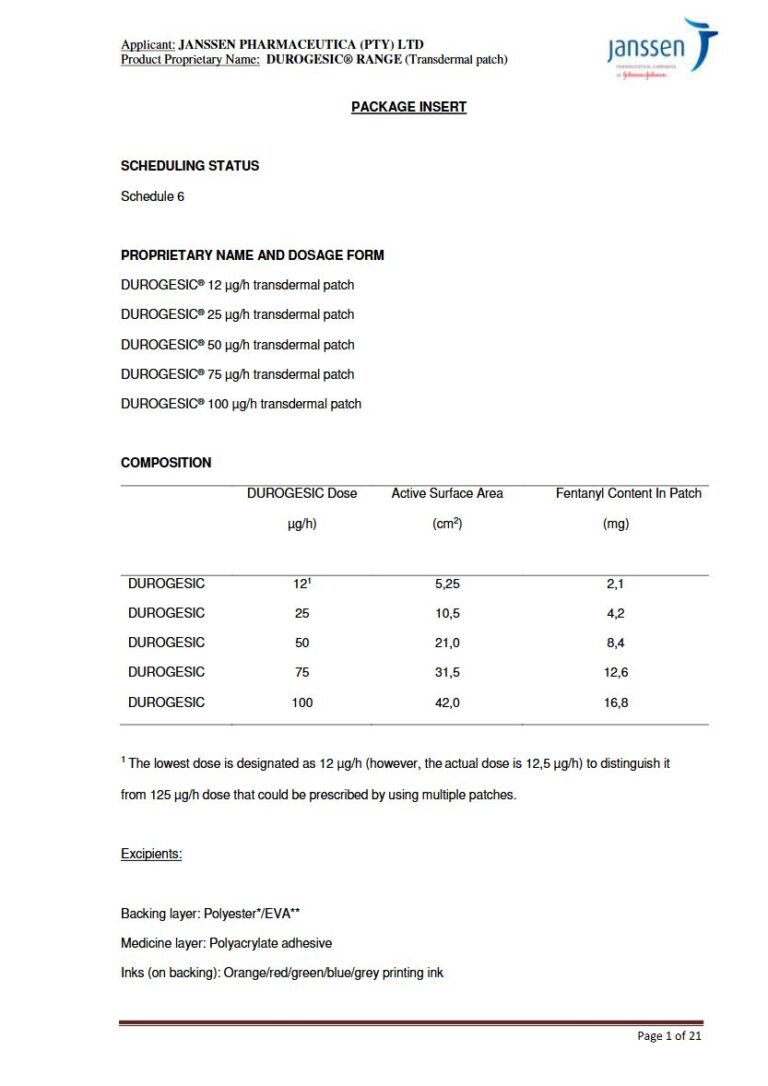
DUROGESIC doses should be individualised based upon the status of the patients and should be assessed at regular intervals after application. The patches are designed to deliver approximately 12, 25, 50, 75 and 100 u03bcg/h fentanyl to the systemic circulation, which represent about 0,3- 0,6- 1,2- 1,8- and 2,4-mg per day (see COMPOSITION), respectively.
Initial dosage selection
The appropriate initiating dose of DUROGESIC should be based on the patientu2019s current opioid use. Other factors to be considered are the current general condition and medical status of the patient, including body size, age and extent of debilitation as well as degree of opioid tolerance.
Adults
Opioid-tolerant patients
To convert opioid-tolerant patients from oral or parenteral opioids to DUROGESIC, refer to Equianalgesic potency conversion (Table 1), and Recommended DUROGESIC dose based upon daily oral morphine dose (Table 2). The dosage may subsequently be titrated upwards or downwards, if required, in increments of either 12 or 25 u03bcg/h to achieve the lowest appropriate dosage of DUROGESIC depending on response and supplementary analgesic requirements.
Opioid-nau00efve patients
Clinical experience with DUROGESIC is limited in opioid-nau00efve patients. In the circumstance in which therapy with DUROGESIC is considered appropriate in opioid-nau00efve patients, it is recommended that these patients be titrated with low doses of opioids to attain an equianalgesic dose to DUROGESIC 25 u03bcg/h. Patients can then be converted to DUROGESIC 25 u03bcg/h. The dosage may subsequently be titrated upwards or downwards, if required, in increments of either 12 or 25 u03bcg/h to achieve the lowest appropriate dose of DUROGESIC depending on response and supplementary analgesic requirements. (See Tables 1 and 2.) (See also WARNINGS AND SPECIAL PRECAUTIONS: Opioid-nau00efve and not opioid-tolerant states.)
Paediatrics
DUROGESIC should be administered only to opioid-tolerant paediatric patients (ages 2 to 16 years) who are already receiving at least 30 mg oral morphine equivalents per day. To convert paediatric patients from oral or parenteral opioids to DUROGESIC, refer to Equianalgesic potency conversion (Table 1), and Recommended DUROGESIC dose based upon daily oral morphine dose (Table 2).
4.3 Contraindications
DUROGESIC is contra-indicated in:
- Pregnancy
- Lactation (See PREGNANCY AND LACTATION)
- Children less than 2 years of age
- Patients with a known hypersensitivity to fentanyl or to the adhesives present in the transdermal patch.
- Concomitant use with CYP3A4 Inhibitors is not recommended unless the patient is closely monitored. Oral ritonavir (one of the most potent CYP3A4 inhibitors) reduced the clearance of IV fentanyl by two thirds (See INTERACTIONS and WARNINGS AND SPECIAL PRECAUTIONS).
4.4 Special warnings and precautions for use
DUROGESIC SHOULD NOT BE USED IN THE MANAGEMENT OF ACUTE OR POSTOPERATIVE PAIN SINCE SERIOUS OR LIFE THREATENING HYPOVENTILATION COULD RESULT AND THERE IS NO OPPORTUNITY FOR DOSE TITRATION DURING SHORT TERM USE. PATIENTS WHO HAVE EXPERIENCED OPIOID TOXICITY SHOULD BE MONITORED FOR AT LEAST 12 TO 24 HOURS AFTER DUROGESIC REMOVAL SINCE SERUM FENTANYL CONCENTRATIONS DECLINE GRADUALLY AND ARE REDUCED BY 50 %, 17 (RANGE: 13 - 22) HOURS LATER.
DUROGESIC SHOULD BE PRESCRIBED ONLY BY PERSONS KNOWLEDGEABLE:
- IN THE CONTINUOUS ADMINISTRATION OF POTENT OPIOIDS
- IN THE MANAGEMENT OF PATIENTS RECEIVING POTENT OPIOIDS FOR TREATMENT OF PAIN
- IN THE DETECTION AND MANAGEMENT OF HYPOVENTILATION INCLUDING THE USE OF OPIOD ANTAGONISTS.
DUROGESIC should be kept out of reach of children before and after use. Do not cut DUROGESIC patches.
Opioid-nau00efve and not opioid-tolerant states
Use of DUROGESIC transdermal system in the opioid-nau00efve patient has been associated with very rare cases of significant respiratory depression and/or fatality when used as initial opioid therapy. The potential for serious or life threatening hypoventilation exists even if the lowest dose of DUROGESIC transdermal system is used in initiating therapy in opioid-nau00efve patients. It is recommended that DUROGESIC be used in patients who have demonstrated opioid tolerance. See DOSAGE AND DIRECTIONS FOR USE: Initial dose selection, Adults and Paediatrics
Respiratory Depression
Some patients may experience significant respiratory depression with DUROGESIC; patients must be observed for these effects. Respiratory depression may persist beyond the removal of the DUROGESIC patch. The incidence of respiratory depression increases as the DUROGESIC dose is increased. Central nervous system active agents may increase the respiratory depression. (see INTERACTIONS).
Chronic Pulmonary Disease
DUROGESIC may have more severe adverse effects in patients with chronic obstructive pulmonary disease, or other pulmonary disease. In such patients, opioids may decrease respiratory drive and increase airway resistance.
Drug Dependence
Tolerance, physical dependence, and psychological dependence may develop upon repeated administration of opioids. DUROGESIC can be abused in a manner similar to other opioid agonists. Abuse or intentional misuse of DUROGESIC may result in overdose and / or death. Patients at increased risk of opioid abuse may still be appropriately treated with DUROGESIC; however, these patients will require monitoring for signs of misuse, abuse or addiction.
Increased Intracranial Pressure
DUROGESIC should not be used in patients who may be particularly susceptible to the intracranial effects of CO2 retention such as those with evidence of increased intracranial pressure, impaired consciousness, or coma. DUROGESIC should be used with caution in patients with brain tumours. Opioids may obscure the clinical course of patients with head injury.
Cardiac disease
DUROGESIC may produce bradycardia and should therefore be administered with caution to patients with bradyarrhythmias.
Hepatic and Renal Disease
Presently insufficient information exists to make recommendations regarding the use of DUROGESIC in patients with impaired renal or hepatic functions. If the drug is used in these patients, it should be used with caution because of the hepatic metabolism and limited renal excretion of fentanyl.
Fever/external heat application
A pharmacokinetic model suggests that serum fentanyl concentrations may increase by about one third if the skin temperature increases to 40 u00b0C. Therefore, patients with fever should be monitored for opioid side effects and the DUROGESIC dose should be adjusted if necessary. All patients should be advised to avoid exposing the DUROGESIC application site to direct external heat sources such as heating pads, electric blankets, heated water beds, heat or tanning lamps, intensive sunbathing, hot water bottles, prolonged hot baths, saunas and hot whirlpool spa baths.
Serotonin Syndrome
Caution is advised when DUROGESIC is co-administered with medicines that affect the serotonergic neurotransmitter systems. The development of a potentially life-threatening serotonin syndrome may occur with the concomitant use of serotonergic agents such as Selective Serotonin Re-uptake Inhibitors (SSRIs) and Serotonin Norepinephrine Re-uptake Inhibitors (SNRIs), and with medicines which impair metabolism of serotonin (including Monoamine Oxidase Inhibitors [MAOIs]). This may occur within the recommended dose. Serotonin syndrome may include mental-status changes (e.g., agitation, hallucinations, coma), autonomic instability (e.g., tachycardia, labile blood pressure, hyperthermia), neuromuscular abnormalities (e.g., hyperreflexia, incoordination, rigidity), and/or gastrointestinal symptoms (e.g., nausea, vomiting, diarrhoea).
If serotonin syndrome is suspected, treatment with DUROGESIC should be discontinued.
4.5 Interactions with other medicines
Interactions with CYP3A4 Inhibitors: The concomitant use of DUROGESIC with cytochrome P450 3A4 (CYP3A4) inhibitors (e.g. ritonavir, ketoconazole, itraconazole, troleandomycin, clarithromycin, nelfinavir, nefazodone, verapamil, diltiazem, and amiodarone) may result in an increase in fentanyl plasma concentrations, which could increase or prolong both therapeutic and adverse effects, and may cause serious respiratory depression. Therefore, the concomitant use of transdermal fentanyl and CYP3A4 inhibitors is not recommended unless the patient is closely monitored. Patients, especially those who are receiving DUROGESIC and CYP3A4 inhibitors, should be monitored for signs of respiratory depression and dosage adjustments should be made if warranted. (See CONTRA-INDICATIONS)
Use in elderly patients
Data from intravenous studies with fentanyl suggest that elderly patients may have reduced clearance, a prolonged half-life and they may be more sensitive to the medicine than younger patients. In studies of DUROGESIC, elderly patients had fentanyl pharmacokinetics, which did not differ significantly from young patients although serum concentrations tended to be higher. Elderly patients should be observed carefully for signs of fentanyl toxicity and the dose reduced if necessary.
Use in children
DUROGESIC was not studied in children under 2 years of age. DUROGESIC should be administered only to opioid-tolerant children age 2 years or older (see DOSAGE AND DIRECTIONS FOR USE). To guard against accidental ingestion by children, use caution when choosing the application site for DUROGESIC (see u201cInstructions for use, handling and disposalu201d under section DOSAGE AND DIRECTIONS FOR USE) and monitor adhesion of the patch closely.
4.6 Fertility, pregnancy and lactation
Safety in pregnancy and lactation has not been established. Neonatal withdrawal syndrome has been reported in newborn infants with chronic maternal use of DUROGESIC during pregnancy. Use of DUROGESIC during childbirth is not recommended because fentanyl passes through the placenta and may cause respiratory depression in the newborn child. Fentanyl is excreted in breast milk and may cause sedation/respiratory depression in the newborn/infant. Therefore, women on DUROGESIC should not breastfeed their babies.
4.7 Effects on ability to drive and use machines
DUROGESIC may impair the mental and/or physical ability required for the performance of potentially hazardous tasks such as driving a car or operating machinery.
4.8 Undesirable effects
Adverse events reported from clinical trials in adults are listed below in Table 3. The adverse events are ranked by system organ class and frequency (unless unknown as is the case for spontaneous reports from post marketing experience) using the following convention: Very common ( u2265 1/10); Common ( u2265 1/100 and < 1/10); Uncommon ( u2265 1/ 1 000 and < 1/100); Rare ( u2265 1/10 000 and < 1/1,000); Very Rare (< 1/10 000).
Table 3: Adverse Events from clinical trial reports (regardless of causality, reported by u2265 1 % of patients)
Body System/Organ Class Frequency Category Clinical trials Metabolism and nutrition disorders Common Anorexia Psychiatric Disorders Very common Somnolence, insomnia Common Anxiety, depression Nervous system disorders Very common Dizziness Common Muscle contractions involuntary, hypoaesthesia Eye disorders Common Conjunctivitis Cardiac disorders Common Palpitations Respiratory, thoracic, and mediastinal disorders Common Yawning, rhinitis Gastrointestinal disorders Very common Nausea, vomiting, constipation Common Abdominal pain, dyspepsia, dry mouth Skin and subcutaneous tissue disorders Common Pruritus, skin disorder, hyperhidrosis Renal and urinary disorders Common Urinary tract infection General disorders and administration site conditions Common Feeling of body temperature change, fatigue, malaise, influenza like illness, oedema peripheral, asthenia, drug withdrawal syndrome
Postmarketing data.
Table 4: Postmarketing reports of adverse drug reactions.
Body System/Organ Class Spontaneous Reports Immune system disorders Anaphylactic shock, anaphylactic reaction, anaphylactoid reaction Metabolism and nutrition disorders Anorexia Psychiatric Disorders Depression, confusional state, hallucination, anxiety, euphoric mood, agitation, insomnia. Nervous system disorders Convulsions (including clonic convulsions and grand mal convulsion), amnesia, somnolence, dizziness, headache, tremor, paraesthesia Cardiac disorders Tachycardia, bradycardia Vascular Disorders Hypotension, hypertension Respiratory, thoracic, and mediastinal disorders Respiratory depression (including respiratory distress, apnoea, and bradypnoea); (see section u201cKnown Symptoms of Overdose and Particulars of its Treatmentu201d), hypoventilation, dyspnoea Gastrointestinal disorders Nausea, vomiting, constipation, diarrhoea, dyspepsia, dry mouth Hepatobiliary Disorders Jaundice and increased transaminases. Skin and subcutaneous tissue disorders Rash, erythema, pruritus, sweating increased. Renal and urinary disorders Urinary retention Reproductive system and breast disorders Sexual dysfunction General disorders and administration site conditions Drug withdrawal syndrome, asthenia, application site reaction
Adverse events in children and adolescents: The adverse event profile in children and adolescents treated with DUROGESIC was similar to that observed in adults. No risk was identified in the paediatric population beyond that expected with the use of opioids for the relief of pain associated with serious illness and there does not appear to be any paediatric-specific risk associated with DUROGESIC use in children as young as 2 years old when used as directed. The most common adverse events reported in paediatric clinical trials were fever, vomiting and nausea. In addition to the adverse reactions listed in Table 3, the following treatment-related adverse reactions were reported in paediatric patients at a rate u2265 1 %: pain, sync ope, allergic reaction, flushing, nervousness, speech disorder, stupor, paranoid reaction, coughing, rash erythematous and skin reaction localised.
4.9 Overdose
The manifestations of fentanyl overdosage are an extension of its pharmacological action, the most serious effect being respiratory depression.
Treatment
For the management of respiratory depression, immediate countermeasures include removing the DUROGESIC patch and physically or verbally stimulating the patient. These actions can be followed by administration of the specific narcotic antagonist, naloxone. Respiratory depression following an overdose may outlast the duration of action of the opioid antagonist. The interval between intravenous antagonist doses should be carefully chosen because of the possibility of re-narcotisation after the patch is removed; repeated administration of naloxone may be necessary. Reversal of the narcotic effect may result in acute onset of pain and release of catecholamines. If the clinical situation warrants, a patent airway should be established and maintained, possibly with an oropharyngeal airway or endotracheal tube, and oxygen should be administered and respiration assisted or controlled, as appropriate. Adequate body temperature and fluid intake should be maintained. If severe or persistent hypotension occurs, the possibility of hypovolemia should be considered and the condition should be managed with appropriate parenteral fluid therapy.
