
Phinmo 0,5 0,5 mg Capsule
PDF Leaflet Revision Date: 13 June 2023
Clinical Summary
Quick overview from the medicine insert
Indication
Disease modifying therapy for relapsing multiple sclerosis.
Dosage (summary)
1 capsule (0.5 mg) orally once daily.
Onset of Action / Duration
Onset: 6 hours, Duration: 1 month
Special Populations
- Renal impairment
- Hepatic impairment
- Elderly patients
- Diabetic patients
Pregnancy & Breastfeeding
Contraindicated in pregnancy and lactation; teratogenic in animals.
Key Drug Interactions
- Anti-dysrhythmic medicines
- CYP450 inducers
- Beta blockers
Contraindications
- Hypersensitivity to fingolimod
- Pregnancy and lactation
- Recent myocardial infarction
- Severe cardiac dysrhythmias
Common side effects
- Headache
- Diarrhoea
- Bradycardia
- Macular oedema
Counselling Points
- Monitor for signs of bradycardia after first dose.
- Use effective contraception during treatment.
- Report any signs of infection immediately.
Serious warnings
- Risk of bradydysrhythmia
- Increased risk of infections
- Potential for PML
Important Disclaimer
The Phinmo 0,5 0,5 mg Capsule professional information leaflet below is the property of Dr Reddy’S Laboratories and is provided on Medinsert exactly as issued, with no.. alterations or editorial changes. We make every effort to keep content current by updating documents as soon as new versions become available. Medinsert serves as a trusted access point for healthcare professionals, but does not replace official sources or clinical judgement. For more details, please read our full disclaimer. read more>>
 Healthcare Professionals Only
This content is for registered healthcare professionals
Sign in or create a free account to read the full package insert.
Free for HPCSA-registered professionals. Powered by Medinsert.
Clinical Particulars
Section 4 of the official insert — extracted exactly as issued, no alterations
4.1 Therapeutic indications
PHINMO is indicated as a disease modifying therapy for the treatment of patients with relapsing multiple sclerosis to reduce the frequency of relapses and to delay the progression of disability.
4.2 Posology and method of administration
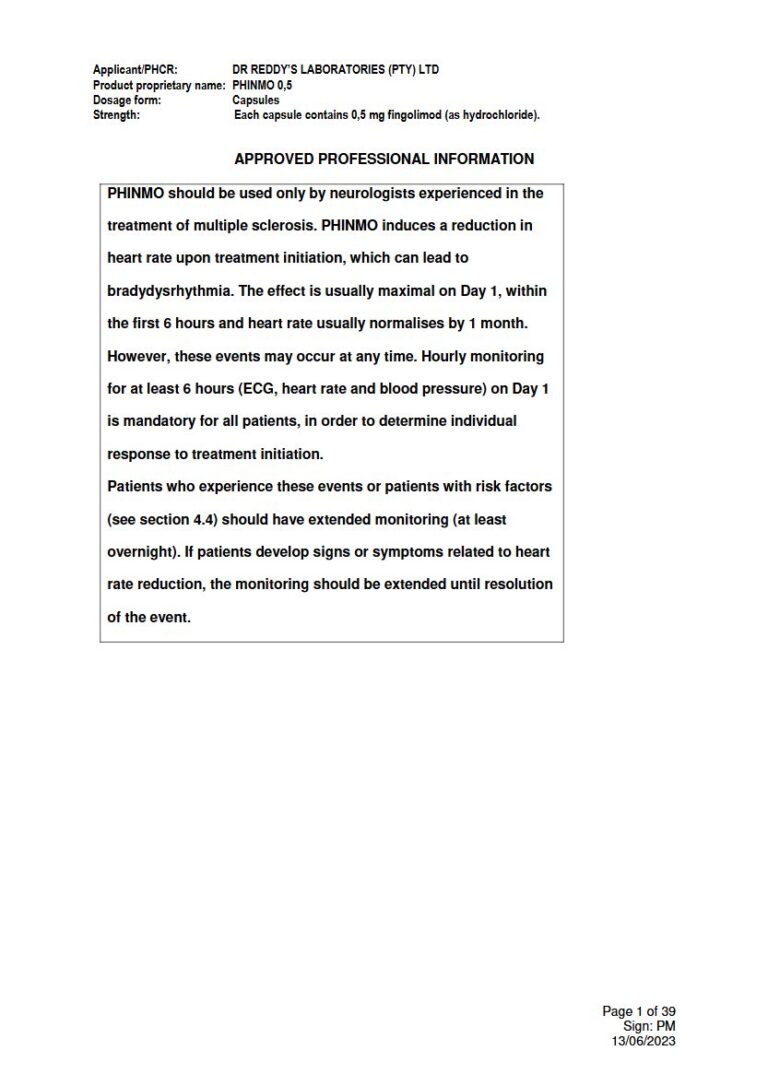
Do not exceed the recommended dosage. The recommended dose of PHINMO is one 0,5 mg capsule taken orally once daily, which can be taken with or without food. If a dose is missed treatment should be continued with the next dose as planned. On initiation of PHINMO treatment, after the first dose, all patients should be observed, with hourly pulse and blood pressure measurement, for a period of at least 6 hours for signs and symptoms of bradycardia. All patients should have an electrocardiogram performed prior to dosing and at the end of 6-hour monitoring period (see section 4.4).
For recommendations related to switching patients from other disease modifying therapies to PHINMO, see section 4.4: Prior treatment with immunosuppressive or immune-modulating therapies.
Dosing in special populations
- Renal impairment No PHINMO dose adjustments are needed in patients with renal impairment (see section 5.2).
- Hepatic impairment No PHINMO dose adjustments are needed in patients with mild or moderate hepatic impairment. PHINMO should be used with caution in patients with severe hepatic impairment (Child-Pugh class C) (see section 5.2).
- Elderly patients PHINMO should be used with caution in patients aged 65 years and over (see section 5.2).
- Diabetic patients PHINMO should be used with caution in patients with diabetes mellitus due to a potential increased risk of macular oedema (see section 4.4).
- Paediatric population PHINMO is not indicated for use in paediatric patients (see section 5.2).
Method of administration: Oral use.
4.3 Contraindications
- Hypersensitivity to fingolimod or any of the ingredients of PHINMO (see section 6.1).
- Pregnancy and lactation.
- Concomitant administration with anti-dysrhythmic medicines; Class 1a (e.g. quinidine, procainamide), Class III (e.g. amiodarone, sotalol) (see section 4.4).
- Patients who in the last 6 months had myocardial infarction, unstable angina pectoris, stroke/ transient ischemic attack, decompensated heart failure (requiring inpatient treatment), or New York Heart Association Class III/IV heart failure.
- Patients with severe cardiac dysrhythmias requiring antidysrhythmic treatment with Class Ia or Class III antidysrhythmic medicines (see section 4.4).
- Patients with second-degree Mobitz type II atrioventricular (AV) block or third-degree AV block, or sick-sinus syndrome, if they do not have a pacemaker (see section 4.4).
- Patients with a baseline QTc interval u2265 500 msec (see section 4.4).
- Women of childbearing potential not using effective contraception (see section 4.6).
4.4 Special warnings and precautions for use
Bradydysrhythmia Initiation of PHINMO treatment results in a decrease in heart rate. After the first dose, the heart rate decrease starts within an hour and the Day 1 decline is usually maximal within 6 hours and usually normalises by one month (see sections 4.4 and 4.3). With continued dosing, heart rate usually returns to baseline within one month of chronic treatment (see section 5.1). In patients receiving PHINMO 0,5 mg this decrease in heart rate, as measured by pulse, averages approximately 8 beats per minute (bpm). Heart rates below 40 bpm have been observed (see section 4.8). Patients who experienced bradycardia were generally asymptomatic but some patients experienced mild to moderate symptoms, including hypotension, dizziness, fatigue and/or palpitations, which usually resolved within the first 24 hours of treatment.
Initiation of PHINMO treatment is associated with atrioventricular conduction delays, usually first-degree atrioventricular blocks (prolonged PR interval on electrocardiogram). Second-degree atrioventricular blocks, usually Mobitz type I (Wenckebach) have been observed less frequently in patients receiving fingolimod 0,5 mg. The conduction abnormalities typically were transient, asymptomatic, usually did not require treatment and usually resolved within the first 24-hours on treatment (see section 4.8).
Cases of transient, complete AV block have been reported during post-marketing use of fingolimod (see section 4.8).
Therefore, on initiation of PHINMO treatment, it is recommended that all patients be observed, with hourly pulse and blood pressure measurement, for a period of 6 hours for signs and symptoms of bradycardia. All patients should have an electrocardiogram performed prior to dosing and at the end of the 6-hour monitoring period.
Should post-dose bradydysrhythmia-related symptoms occur, appropriate management should be initiated as necessary and the patient should be observed until the symptoms have resolved. Should a patient require pharmacological intervention during the first dose observation period, overnight monitoring in a medical facility should be instituted and the first dose monitoring strategy should be repeated after the second dose of PHINMO. Additional observation until the finding has resolved is also required:
- if the heart rate at 6 hours post-dose is < 45 bpm or is the lowest value post-dose (suggesting that the maximum pharmacodynamic effect on the heart is not yet manifest)
- or if the ECG at 6 hours after the first dose shows new onset second degree or higher AV block
- If the ECG at 6 hours after the first dose shows a QTc interval u2265 500 msec, patients should be monitored overnight.
Due to the risk of serious cardiac rhythm disturbances, PHINMO should not be used in patients with a history of symptomatic bradycardia, recurrent syncope or sino-atrial heart block. Since initiation of PHINMO treatment results in decreased heart rate and therefore a prolongation of the QT interval, PHINMO should not be used in patients with significant QT prolongation (QTc > 470 msec [adult females], QTc > 460 msec [paediatric females] or > 450 msec [adult and paediatric males]) (see section 4.3). PHINMO is best avoided in patients with relevant risk factors for QT prolongation, for example, hypokalemia, hypomagnesemia or congenital QT prolongation. Since significant bradycardia may be poorly tolerated in patients with a history of cardiac arrest, uncontrolled hypertension, history of recurrent syncope, or severe untreated sleep apnoea, PHINMO should not be used in these patients. If treatment is considered in patients for whom PHINMO is not contraindicated, advice from a cardiologist should be sought prior to initiation of treatment in order to determine the most appropriate monitoring strategy, which should last overnight.
Fingolimod has not been studied in patients with dysrhythmias requiring treatment with Class Ia (e.g. quinidine, procainamide) or Class III anti-dysrhythmic medicines (e.g., amiodarone, sotalol). Class Ia and Class III antidysrhythmic medicines have been associated with cases of Torsades de Pointes in patients with bradycardia. Since initiation of PHINMO treatment results in decreased heart rate, PHINMO should not be co-administered with these medicines.
Experience with fingolimod is limited in patients receiving concurrent therapy with beta blockers, heart rate lowering calcium channel blockers (such as verapamil or diltiazem), or other substances that may decrease heart rate (e.g. ivabradine or digoxin). Since the initiation of PHINMO treatment is also associated with slowing of the heart rate (see u201cBradydysrhythmiau201d), concomitant use of these substances during PHINMO initiation may be associated with severe bradycardia and heart block. Because of the potential additive effect on heart rate, treatment with PHINMO should not be used in patients who are concurrently treated with these substances. If treatment with PHINMO is considered, advice from a cardiologist should be sought regarding the switch to non heart-rate lowering medicines or appropriate monitoring for treatment initiation, which should last overnight (see section 4.5).
If PHINMO therapy is discontinued for more than 2 weeks after the first month of treatment the effects on heart rate and atrioventricular conduction may recur on reintroduction of PHINMO treatment and the same precautions as for the first dose should apply. Within the first two weeks of treatment, first dose procedures are recommended after an interruption of one day or more. During weeks 3 and 4 of treatment first dose procedures are recommended after treatment interruption of more than seven days.
Immunosuppressive effects Fingolimod has an immunosuppressive effect that predisposes patients to an infection risk, including opportunistic infections that can be fatal, and increases the risk of developing lymphomas and other malignancies, particularly those of the skin. Physicians should carefully monitor patients, especially those with concurrent conditions or known factors, such as previous immunosuppressive therapy. If this risk is suspected, discontinuation of treatment should be considered by the physician on a case-by-case basis (see also section 4.4 u201cInfectionsu201d and u201cBasal cell carcinoma and other cutaneous neoplasmsu201d and section 4.8 u201cLymphomasu201d).
Infections Fingolimod causes a dose dependent reduction of peripheral lymphocyte count. This is due to the reversible sequestration of lymphocytes in lymphoid tissues (see section 5.1). The immune system effects (see section 5.1) of fingolimod may increase the risk of infections including opportunistic infections (see section 4.8).
Before initiating treatment with PHINMO, a recent complete blood count (CBC) (i.e. within 6 months or after discontinuation of prior therapy) should be available. Initiation of treatment with PHINMO should be delayed in patients with severe active infection until resolution. Effective diagnostic and therapeutic strategies should be employed in patients with symptoms of infection while on therapy. Because the elimination of fingolimod after discontinuation may take up to two months, vigilance for infection should be continued throughout this period (see below subsection: Stopping PHINMO therapy).
Cases of progressive multifocal leukoencephalopathy (PML) have been reported in the post-marketing setting (see section 4.8). PML is an opportunistic infection caused by JC virus, which may be fatal or result in severe disability. Cases of PML have occurred after approximately 2-3 years of treatment, although the estimated risk appears to increase with cumulative exposure over time, an exact relationship with the duration of treatment is unknown. The incidence rate for PML appears to be higher for patients in Japan; the reasons are currently unknown. Additional PML cases have occurred in patients who had been treated previously with natalizumab, which has a known association with PML. During routine MRI (in accordance with national and local recommendations), medical practitioners should be vigilant for clinical symptoms or MRI findings that may be suggestive of PML. If PML is suspected, PHINMO treatment should be suspended until PML has been excluded. MRI findings suggestive of PML may be apparent before clinical signs or symptoms. Cases of PML, diagnosed based on MRI findings and the detection of JVC DNA in the cerebrospinal fluid in the absence of clinical signs or symptoms specific to PML, have been reported in patients treated with MS medications associated with PML, including fingolimod.
Cases of cryptococcal meningitis have been reported in the post-marketing setting after approximately 2-3 years of treatment, although an exact relationship with the duration of treatment is unknown (see section 4.8). Cryptococcal meningitis may be fatal. For this reason patients with symptoms and signs consistent with cryptococcal meningitis should undergo prompt diagnostic evaluation. If cryptococcal meningitis is diagnosed, appropriate treatment should be initiated and PHINMO should be discontinued until the patient has fully recovered.
Anti-neoplastic, immune-modulating or immunosuppressive therapies (including corticosteroids) should be co-administered with caution due to the risk of additive immunosuppressive effects (see section 4.5). Specific decisions as to the dosage and duration of treatment with corticosteroids should be based on clinical judgment. Co-administration of a short course of corticosteroids (up to 5 days as per study protocols) did not increase the overall rate of infection in patients treated with fingolimod in the Phase III clinical trials, compared to placebo. Based on these data, short courses of corticosteroids (up to 5 days) can be used in combination with PHINMO (see sections 4.8 and 4.5).
Patients receiving PHINMO should be instructed to report symptoms of infections to their medical practitioner. Suspension of dosing with PHINMO should be considered if a patient develops a serious infection and consideration of benefit-risk should be undertaken prior to re-initiation of therapy.
Patients need to be assessed for their immunity to varicella (chickenpox) prior to PHINMO treatment. It is recommended that patients without a health care professional confirmed history of chickenpox or documentation of a full course of vaccination with varicella vaccine undergo antibody testing to varicella zoster virus (VZV) before initiating PHINMO therapy. A full course of vaccination for antibody-negative patients with varicella vaccine is recommended prior to commencing treatment with PHINMO (see section 4.8). Initiation of treatment with PHINMO should be postponed for 1 month to allow full effect of vaccination to occur.
Human Papilloma Virus (HPV) infection, including papilloma, dysplasia, warts and HPV-related cancer, has been reported under treatment with PHINMO in the post-marketing setting (see section 4.8). Due to the immunosuppressive properties of fingolimod, vaccination against HPV should be considered prior to treatment initiation with PHINMO taking into account vaccination recommendations. Cancer screening, including Pap test, is recommended as per standard of care.
Vaccination Vaccination may be less effective during and for up to two months after stopping treatment with PHINMO (see below subsection: Stopping PHINMO therapy). The use of live attenuated vaccines should be avoided (see section 4.5).
Macular Oedema Macular oedema (see section 4.8) with or without visual symptoms has been reported in patients treated with fingolimod 0,5 mg, occurring predominantly in the first 3 to 4 months of therapy. An ophthalmic evaluation is therefore recommended at 3 to 4 months after treatment initiation. If patients report visual disturbances at any time while on PHINMO therapy, evaluation of the fundus, including the macula, should be carried out. Patients with history of uveitis and patients with diabetes mellitus are at increased risk of macular oedema (see section 4.8). PHINMO has not been studied in multiple sclerosis patients with concomitant diabetes mellitus. It is recommended that multiple sclerosis patients with diabetes mellitus or a history of uveitis undergo an ophthalmic evaluation prior to initiating PHINMO therapy and have follow-up evaluations while receiving PHINMO therapy. Continuation of PHINMO in patients with macular oedema has not been evaluated. A decision on whether or not PHINMO therapy should be discontinued needs to take into account the potential benefits and risks for the individual patient.
Liver function Increased hepatic enzymes, mostly alanine aminotransaminase (ALT) elevation, but also gamma glutamyl transferase (GGT) and aspartate transaminase have been reported in multiple sclerosis patients treated with fingolimod. In clinical trials, an elevation in ALT occurred in patients treated with fingolimod 0,5 mg and the medicine was discontinued if the elevation exceeded a 5-fold increase. Recurrence of ALT elevations occurred upon re-challenge in some patients, supporting a relationship to the medicine. Recent (i.e. within last 6 months) transaminase and bilirubin levels should be available before initiation of treatment with PHINMO. Patients who develop symptoms suggestive of hepatic dysfunction, such as unexplained nausea, vomiting, abdominal pain, fatigue, anorexia, or jaundice and/or dark urine during treatment, should have liver enzymes checked and PHINMO should be discontinued if significant liver injury is confirmed (see section 4.8). Although it is not known whether patients with preexisting liver disease are at increased risk to develop elevated liver function test (LFT) values when taking PHINMO, caution should be exercised when using PHINMO in patients with a history of liver disease.
Blood pressure effects Patients with hypertension uncontrolled by medication were excluded from participation in premarketing clinical trials and special care is indicated if patients with uncontrolled hypertension are treated with fingolimod. In MS clinical trials, patients treated with fingolimod 0,5 mg had an average increase of approximately 3 mmHg in systolic pressure, and approximately 1 mmHg in diastolic pressure, first detected approximately 1 month after treatment initiation, and persisting with continued treatment. In the two-year placebo-controlled study, hypertension was reported as an adverse event in patients on fingolimod 0,5 mg at a higher incidence than in patients on placebo. Therefore, blood pressure should be regularly monitored during treatment with PHINMO.
Respiratory effects Minor dose-dependent reductions in values for forced expiratory volume (FEV1) and diffusion capacity for carbon monoxide (DLCO) were observed with fingolimod treatment starting at month 1 and remaining stable thereafter. PHINMO should be used with caution in patients with severe respiratory disease, pulmonary fibrosis and chronic obstructive pulmonary disease (see section 4.8).
Posterior reversible encephalopathy syndrome Cases of posterior reversible encephalopathy syndrome (PRES) have been reported at 0,5 mg dose in clinical trials and in the post-marketing setting (see section 4.8). Symptoms reported included sudden onset of severe headache, nausea, vomiting, altered mental status, visual disturbances and seizure. Symptoms of PRES are usually reversible but may evolve into ischaemic stroke or cerebral haemorrhage. Delay in diagnosis and treatment may lead to permanent neurological sequelae. If PRES is suspected, PHINMO should be discontinued.
4.5 Interactions with other medicines
Pharmacodynamic interactions Anti-neoplastic, immunomodulatory or immunosuppressive therapies. Other anti-neoplastic, immunosuppressive or immune modulating therapies should be co-administered with caution due to the risk of additive immune system effects. Specific decisions as to the dosage and duration of concomitant treatment with corticosteroids should be based on clinical judgment (see sections 4.4 and 4.8).
Caution should also be applied when switching patients from other long-acting therapies with immune effects such as natalizumab, teriflunomide or mitoxantrone (see section 4.4: Prior treatment with immunosuppressive or immune-modulating therapies). In multiple sclerosis clinical studies the concomitant treatment of relapses with a short course of corticosteroids was not associated with an increased rate of infection.
Bradycardia-inducing substances When fingolimod as in PHINMO is used with beta blockers, there is an additional 15 % reduction in heart rate upon PHINMO initiation, an effect not seen with calcium channel blockers. Treatment with PHINMO should not be initiated in patients receiving beta blockers, heart rate lowering calcium channel blockers (such as verapamil or diltiazem), or other substances which may decrease heart rate (e.g. ivabradine or digoxin) because of the potential additive effects on heart rate. If treatment with PHINMO is considered, advice from a cardiologist should be sought regarding the switch to non heart-rate lowering medicines or appropriate monitoring for treatment initiation, which should last overnight (see section 4.4).
Vaccination During and for at least two months after treatment with fingolimod vaccination may be less effective. The use of live attenuated vaccines may carry the risk of infection and should therefore be avoided (see sections 4.8 and 4.4).
Pharmacokinetic interactions Fingolimod is primarily cleared via cytochrome P450 4F2 (CYP4F2) and possibly other CYP4F isoenzymes. In vitro studies in hepatocytes indicated that CYP3A4 may contribute to fingolimod metabolism in the case of strong induction of CYP3A4. Caution should be exercised with substances that may inhibit CYP3A4 (protease inhibitors, azole antifungals, some macrolides such as clarithromycin or telithromycin).
Potential of PHINMO and fingolimod-phosphate to inhibit the metabolism of co-medications. In vitro inhibition studies using pooled human liver microsomes and specific metabolic probe substrates demonstrated that fingolimod and fingolimod-phosphate have little or no capacity to inhibit the activity of CYP enzymes (CYP1A2, CYP2A6, CYP2B6, CYP2C8, CYP2C9 CYP2C19, CYP2D6, CYP2E1, CYP3A4/5 or CYP4A9/11 (fingolimod only)). Therefore, fingolimod as in PHINMO and fingolimod-phosphate are unlikely to reduce the clearance of medicines that are mainly cleared through metabolism by the major cytochrome P isoenzymes.
Potential of PHINMO and fingolimod-phosphate to induce its own and/or the metabolism of co-medications. Fingolimod as in PHINMO was examined for its potential to induce human CYP3A4, CYP1A2, CYP4F2 and ABCB1 (P-gp) mRNA and CYP3A, CYP1A2, CYP2B6, CYP2C8, CYP2C9, CYP2C19 and CYP4F2 activity in primary human hepatocytes. Fingolimod did not induce mRNA or activity of the different CYP enzymes and ABCB1 with respect to the vehicle control. Therefore, no clinically relevant induction of the tested CYP enzymes or ABCB1 (P-gp) by fingolimod are expected at therapeutic concentrations.
In vitro experiments did not provide an indication of CYP induction by fingolimod-phosphate.
Potential of PHINMO and fingolimod-phosphate to inhibit the active transport of co-medications. Based on in vitro data, fingolimod as in PHINMO as well as fingolimod-phosphate are not expected to inhibit the uptake of co-medications and/or biologics transported by the organic anion transporting polypeptides 1B1 and 1B3 (OATP1B1, OATP1B3) or the sodium taurocholate co-transporting polypeptide (NTCP). Similarly, they are not expected to inhibit the efflux of co-medications and/or biologics transported by the breast cancer resistance protein (BCRP), the bile salt export pump (BSEP), the multi-medicine resistance-associated protein 2 (MRP2) or P-glycoprotein (P-gp) at therapeutic concentrations.
Oral contraceptives The co-administration of fingolimod as in PHINMO with oral contraceptives (ethinylestradiol 30 micrograms and levonorgestrel 150 micrograms) did not elicit any change in oral contraceptive exposure. Fingolimod and fingolimod-phosphate exposure were consistent with those from previous studies. No interaction studies have been performed with oral contraceptives containing other progestogens. No studies with implanted or injected contraceptives have been performed.
Ciclosporin The pharmacokinetics of single-dose fingolimod as in PHINMO were not altered during co-administration with ciclosporin at steady-state, nor were ciclosporin steady-state pharmacokinetics altered by single-dose or multi-dose (28 days) fingolimod administration. These data indicate that fingolimod is unlikely to reduce or increase the clearance of medicines mainly cleared by CYP3A4 and that inhibition of CYP3A4 is unlikely to reduce the clearance of fingolimod.
Ketoconazole The co-administration of ketoconazole 200 mg twice daily at steady-state and a single dose of fingolimod 5 mg led to a modest increase in the AUC of fingolimod and fingolimod-phosphate by inhibition of CYP4F2.
Isoproterenol, atropine, atenolol and diltiazem Single-dose fingolimod and fingolimod-phosphate exposure was not altered by co-administered isoproterenol, or atropine. Likewise, the single-dose pharmacokinetics of fingolimod and fingolimod-phosphate and the steady-state pharmacokinetics of both atenolol and diltiazem were unchanged during the co-administration of the latter two medicines with fingolimod.
Carbamazepine The co-administration of carbamazepine 600 mg twice daily at steady-state and a single dose of fingolimod 2 mg reduced the AUC of fingolimod and fingolimod-phosphate, by approximately 40 %. The clinical relevance of this decrease is unknown.
St. Johnu2019s Wort and other strong CYP3A4 enzyme inducers Other strong CYP3A4 enzyme inducers, for example rifampicin, phenobarbital, phenytoin, efavirenz and St. John's Wort, may reduce the AUC of fingolimod and its metabolite at least to the same extent as carbamazepine. As this could potentially impair the efficacy, their co-administration should be used with caution. Concomitant administration with St. John's Wort is however not recommended (see section 4.4).
Population pharmacokinetics analysis of potential medicine-medicine interactions. A population pharmacokinetics evaluation, performed in multiple sclerosis patients, did not provide evidence for a significant effect of fluoxetine and paroxetine (strong CYP2D6 inhibitors) on fingolimod or fingolimod-phosphate concentrations. In addition, the following, commonly prescribed substances had no clinically relevant effect on fingolimod or fingolimod-phosphate concentrations: baclofen, gabapentin, oxybutynin, amantadine, modafinil, amitriptyline, pregabalin, corticosteroids and oral contraceptives.
4.6 Fertility, pregnancy and lactation
Fingolimod should not be used in pregnancy and lactation (see section 4.3). Safety in pregnancy and lactation has not been established. Fingolimod is teratogenic in animals.
Women of childbearing potential Fingolimod is contraindicated in women of childbearing potential not using effective contraception (see section 4.3). Before initiation of fingolimod treatment in women of childbearing potential, a negative pregnancy result must be available and patient should be counselled on the potential for serious risk to the foetus and the need for effective contraception during treatment with fingolimod. Women of childbearing potential must use effective contraception during treatment. Since it will take approximately 2 months to eliminate the compound from the body upon stopping treatment (see section 4.4) potential risk to the foetus may persist and contraception should be pursued during that period. When stopping fingolimod therapy for planning a pregnancy the possible return of disease activity should be considered (see section 4.4).
Male reproductive toxicity Fingolimod is present in seminal ejaculate. Safety regarding an increased risk of male mediated foetal toxicity has not been demonstrated.
Pregnancy Based on human experience, post-marketing data suggest that the use of fingolimod is associated with a 2-fold increased risk of major congenital malformation when administered during pregnancy compared with the general population. The following major malformations were most frequently reported:
- Congenital heart disease such as atrial and ventricular septal defects, tetralogy of Fallot
- Renal abnormalities
- Musculoskeletal abnormalities.
Breastfeeding PHINMO is contraindicated in breastfeeding (see section 4.3). Fingolimod is excreted in the milk of treated animals during lactation. Due to the potential for serious adverse reactions to fingolimod in nursing infants, women receiving PHINMO should not breastfeed.
Fertility Data from preclinical studies do not suggest that fingolimod would be associated with an increased risk of reduced fertility.
4.7 Effects on ability to drive and use machines
Fingolimod has no or negligible influence on the ability to drive and use machines. However, dizziness or drowsiness may occasionally occur when initiating treatment. The clinical status of the patient and adverse event profile of fingolimod should be borne in mind when considering the patients ability to perform tasks that require judgement, motor and cognitive skills. Driving may be impaired by such adverse events.
4.8 Undesirable effects
Summary of the safety profile In the pooled data from studies the most serious adverse reactions (ADRs) for the 0,5 mg recommended therapeutic dose of fingolimod were infections, macular oedema and transient atrio-ventricular blocks on treatment initiation. The most frequent ADRs at the 0,5 mg dose were headache, influenza, diarrhoea, sinusitis, back pain, hepatic enzyme increased and cough. The most frequent adverse event reported for fingolimod 0,5 mg leading to treatment interruption was ALT elevations.
Tabulated summary of adverse drug reactions The table below presents the frequency of ADRs reported in the pooled analysis of placebo-controlled studies. ADRs are listed according to MedDRA system organ class.
Primary system organ class Frequent Less frequent Infections and infestations Influenza Sinusitis Bronchitis Herpes zoster Tinea versicolour Pneumonia Neoplasms benign, malignant and unspecified (incl cysts and polyps) Basal cell carcinoma Melanoma Kaposiu2019s sarcoma** Cardiac Disorders Bradycardia Nervous system disorders Headache Dizziness Migraine Posterior reversible encephalopathy syndrome (PRES) Gastrointestinal Disorders Diarrhoea General disorders and administration site conditions Asthenia Musculoskeletal and connective tissue disorders Back pain Skin and subcutaneous tissue disorders Eczema Pruritus Investigations Hepatic enzyme increased (increased ALT, GGT, AST) Blood triglycerides increased Respiratory, thoracic and mediastinal disorders Cough Dyspnoea Eye disorders Vision blurred Macular oedema Vascular disorders Hypertension Blood and lymphatic system disorders Leucopenia Lymphopenia **The frequency category and risk assessment were based on an estimated exposure of more than 24,000 patients to fingolimod 0.5 mg in all clinical trials.
Adverse drug reactions from spontaneous reports and literature cases (frequency not known) The following adverse drug reactions have been derived from post-marketing experience with fingolimod via spontaneous case reports and literature cases. Because these reactions are reported voluntarily from a population of uncertain size, it is not possible to reliably estimate their frequency which is therefore categorised as not known. Adverse drug reactions are listed according to system organ classes.
Immune system disorders Hypersensitivity reactions, including rash, urticaria and angioedema upon treatment initiation. Autoimmune haemolytic anaemia. Nervous system disorders Severe exacerbation of disease after fingolimod discontinuation (see section 4.4). Gastrointestinal disorders Nausea Musculoskeletal and connective tissue disorders Myalgia, arthralgia Investigations Weight decreased
Description of selected adverse reactions Infections In multiple sclerosis clinical trials, the rates of bronchitis, herpes zoster and pneumonia were more common in fingolimod treated patients, than in placebo treated patients. Serious infections occurred at a higher rate in the fingolimod 0,5 mg group versus the placebo group. There have been fatal cases of varicella zoster infections mostly in the context of prolonged concomitant corticosteroid use (more than 5 days) for treatment of multiple sclerosis relapses, however, a causal relationship between the concomitant treatment and fatal outcome has not been established. Co-administration of a short course of corticosteroids (up to 5 days as per study protocols) did not increase the overall rate of infection in patients treated with fingolimod in the Phase III clinical trials, compared to placebo (see sections 4.4 and 4.5). There have been cases of other herpes viral infections with fatal outcome. However, a causal relationship with fingolimod has not been established. Cryptococcal infections, including isolated cases of cryptococcal meningitis, have been reported in the postmarketing setting (see section 4.4). Human papilloma virus (HPV) infection, including papilloma, dysplasia, warts and HPV-related cancer, has been reported under treatment with fingolimod in the post-marketing setting (see section 4.4). In the post-marketing setting cases of infections with opportunistic pathogens, such as viral (e.g. VZV, John Cunningham virus (JCV) causing progressive multifocal leukoencephalopathy (PML), HSV), fungal (e.g. cryptococci including cryptococcal meningitis) or bacterial (e.g. atypical mycobacterium), have been reported, some of which have been fatal (see section 4.4).
Macular Oedema In clinical trials, macular oedema occurred in patients treated with the recommended fingolimod dose of 0,5 mg and in patients treated with the higher 1,25 mg dose at a higher incidence. The majority of cases in multiple sclerosis clinical trials occurred within the first 3 to 4 months of therapy. Some patients presented with blurred vision or decreased visual acuity, but others were asymptomatic and diagnosed on routine ophthalmic examination. The macular oedema generally improved or resolved spontaneously after fingolimod discontinuation. The risk of recurrence after re-challenge has not been evaluated. Fingolimod has not been tested in multiple sclerosis patients with diabetes mellitus. In renal transplant clinical studies where patients with diabetes mellitus were included, therapy with fingolimod 2,5 mg and 5 mg resulted in a 2-fold increase in the incidence of macular oedema. Multiple sclerosis patients with diabetes mellitus are therefore expected to be at a higher risk for macular oedema (see section 4.4).
Bradydysrhythmia Initiation of fingolimod treatment results in a transient decrease in heart rate and may also be associated with atrio-ventricular conduction delays (see section 4.4). In multiple sclerosis clinical trials the mean maximal decrease in heart rate after the first dose intake was seen 4 to 5 hours post-dose, with declines in mean heart rate, as measured by pulse, of 8 beats per minute for fingolimod 0,5 mg. The second dose may result in a slight further decrease. Heart rates below 40 beats per minute have been observed in patients on fingolimod 0,5 mg. Heart rate returned to baseline within 1 month of chronic dosing. In the multiple sclerosis clinical program first-degree atrioventricular block (prolonged PR interval on electrocardiogram) was detected following medicine initiation. Second degree atrioventricular block were detected less frequently in patients on fingolimod 0,5 mg. The conduction abnormalities were typically transient, asymptomatic and resolved within 24 hours on treatment. Although most patients did not require medical intervention one patient on the 0,5 mg dose received isoprenaline for an asymptomatic second degree atrioventricular block. In the post-marketing setting, reports of transient, complete AV block have been observed during the six hour observation period following the first dose of fingolimod. In the post-marketing setting, delayed onset events, including transient asystole and unexplained death, have occurred within 24 hours of the first dose. These cases have been confounded by concomitant medications and/or pre-existing disease. The relationship of such events to fingolimod is uncertain.
Blood pressure In multiple sclerosis clinical trials fingolimod 0,5 mg was associated with a mild increase of approximately 1 mmHg on average in mean arterial pressure manifesting after approximately 1 month of treatment initiation. This increase persisted with continued treatment. Hypertension was reported at a higher incidence in patients on fingolimod than those on placebo.
Liver function Increased hepatic enzymes (mostly ALT elevation) have been reported in multiple sclerosis patients treated with fingolimod. In clinical trials patients treated with fingolimod 0,5 mg experienced an asymptomatic elevation in serum levels of ALT more frequently when compared with the placebo group. The majority of elevations occurred within 6 to 9 months. ALT levels returned to normal within approximately 2 months after discontinuation of fingolimod. In the few patients who experienced ALT elevations of u2265 5x ULN and who continued on fingolimod therapy, the ALT levels returned to normal within approximately 5 months (see section 4.4).
Respiratory System Minor dose-dependent reductions in forced expiratory volume in 1 second (FEV1) and in the diffusing capacity of the lung for carbon monoxide (DLCO) values were observed with fingolimod treatment starting at month 1 and remaining stable thereafter. At month 24, the reduction from baseline values of predicted FEV1 was higher for fingolimod 0,5 mg than for placebo, a difference that resolved after treatment discontinuation. For DLCO the reductions at month 24 were higher for fingolimod 0,5 mg than for placebo.
Vascular events Cases of ischaemic and haemorrhagic strokes have been reported at the 0,5 mg dose in clinical trials and in the post-marketing setting. In Phase III clinical trials, cases of peripheral arterial occlusive disease occurred in patients treated with fingolimod at higher doses (1,25 or 5,0 mg).
Lymphomas There have been cases of lymphoma in clinical studies and the post-marketing setting. The cases reported were heterogeneous in nature, including B-cell and T-cell lymphomas. Cases of cutaneous T-cell lymphoma (mycosis fungoides) have been observed.
4.9 Overdose
At 40 mg (i.e. 80-fold above the recommended dose) administered to healthy volunteers, 5 of 6 subjects reported mild chest tightness or discomfort which was clinically consistent with bronchoconstriction. Fingolimod can induce bradycardia. The decline in heart rate usually starts within one hour of the first dose, and is maximal within 6 hours. The negative chronotropic effect of fingolimod persists beyond 6 hours and progressively attenuates over subsequent days of treatment (see section 4.4 for details). There have been reports of slow atrioventricular conduction with isolated reports of transient, spontaneously resolving complete AV block (see sections 4.4 and 4.8). If the overdose constitutes first exposure to fingolimod it is important to observe for signs and symptoms of bradycardia, which could include overnight monitoring. Regular measurements of pulse rate and blood pressure are required and electrocardiograms should be performed (see sections 4.2 and 4.4). Neither dialysis nor plasma exchange would result in meaningful removal of fingolimod from the body.
