
Flucloxacillin 250 Mg Capsules
PDF Leaflet Revision Date: 21 November 2024
Clinical Summary
Quick overview from the medicine insert
Indication
Treatment of infections caused by susceptible Gram-positive organisms.
Dosage (summary)
Adults: 250 mg four times daily; may double in severe infections.
Special Populations
- Renal impairment
- Hepatic impairment
Pregnancy & Breastfeeding
Not established; avoid in pregnancy and breastfeeding.
Key Drug Interactions
- Probenecid
- Sulfinpyrazone
- Methotrexate
- Warfarin
- Paracetamol
Contraindications
- Hypersensitivity to flucloxacillin
- Previous flucloxacillin associated jaundice
Common side effects
- Neutropenia
- Thrombocytopenia
- Rash
- Nausea
- Diarrhea
Counselling Points
- Take 1 hour before meals
- Monitor for hypersensitivity reactions
- Avoid in severe renal impairment
Serious warnings
- Risk of anaphylaxis
- Hepatic reactions
- AGEP
Important Disclaimer
The Flucloxacillin 250 Mg Capsules professional information leaflet below is the property of Austell Pharmaceuticals and is provided on Medinsert exactly as issued, with no.. alterations or editorial changes. We make every effort to keep content current by updating documents as soon as new versions become available. Medinsert serves as a trusted access point for healthcare professionals, but does not replace official sources or clinical judgement. For more details, please read our full disclaimer. read more>>
 Healthcare Professionals Only
This content is for registered healthcare professionals
Sign in or create a free account to read the full package insert.
Free for HPCSA-registered professionals. Powered by Medinsert.
Clinical Particulars
Section 4 of the official insert — extracted exactly as issued, no alterations
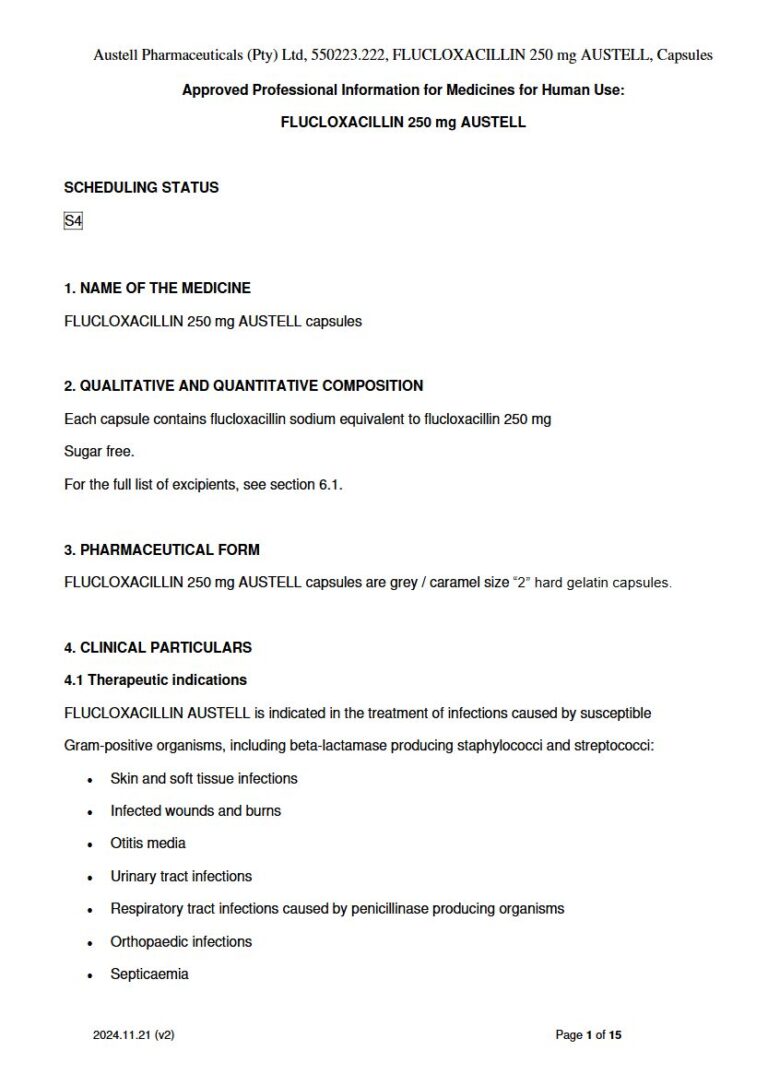
4.1 Therapeutic indications
FLUCLOXACILLIN AUSTELL is indicated in the treatment of infections caused by susceptible Gram-positive organisms, including beta-lactamase producing staphylococci and streptococci:
- Skin and soft tissue infections
- Infected wounds and burns
- Otitis media
- Urinary tract infections
- Respiratory tract infections caused by penicillinase producing organisms
- Orthopaedic infections
- Septicaemia
- Meningitis
- Endocarditis
- Enterocolitis
4.2 Posology and method of administration
The oral dose should be taken 1 hour before meals, to ensure that maximum absorption is achieved.
Adults: The usual adult dose of FLUCLOXACILLIN AUSTELL is 250 mg four times daily. Doses may be doubled in severe infections; up to 8 g daily in three or four divided doses may be given for endocarditis and osteomyelitis.
Special populations
Renal impairment: For patients with a creatinine clearance value 10 mL / min, no dose adjustment is necessary.
Paediatric population: FLUCLOXACILLIN AUSTELL is indicated for adults and must not be prescribed to children. Safety and efficacy has not been established in children.
4.3 Contraindications
- Hypersensitivity to flucloxacillin sodium or other beta-lactam antibiotics (e.g. penicillins, cephalosporins) or to any of the excipients listed in section 6.1.
- Flucloxacillin is contraindicated in patients with a previous history of flucloxacillin associated jaundice / hepatic dysfunction.
4.4 Special warnings and precautions for use
Feverish Generalised Eyrthema: The occurrence at the treatment initiation of a feverish generalised erythema associated with pustula may be a symptom of acute generalised exanthematous pustulosis (AGEP) (see section 4.8). In case of AGEP diagnosis, flucloxacillin should be discontinued and any subsequent administration of flucloxacillin contraindicated.
Impaired Renal Function: The use of flucloxacillin (like other penicillins) in patients with renal impairment does not usually require dosage reduction. In the presence of severe renal failure (creatinine clearance less than 10 mL/min), however, a reduction in dose or an extension of dose interval should be considered because of the risk of neurotoxicity.
Patients on Dialysis: Flucloxacillin is not significantly removed by dialysis and so no supplementary dosages need to be administered either during or at the end of the dialysis period.
Impaired Hepatic Function: Hepatitis and cholestatic jaundice have been reported. These reactions are related neither to the dose nor to the route of administration. Flucloxacillin should be used with caution in patients with evidence of hepatic dysfunction, patients > 50 years or patients with underlying disease all of whom are at increased risk of hepatic reactions. The onset of these hepatic effects may be delayed for up to two months post-treatment. In several cases, the course of the reactions has been protracted and lasted for some months. In very rare cases, a fatal outcome has been reported (see section 4.8).
As for other penicillins contact with the skin should be avoided as sensitisation may occur. Patients with a known history of allergy are more likely to develop a hypersensitivity reaction.
Prolonged use of an anti-infective agent may occasionally result in overgrowth of non-susceptible organisms.
Previous hypersensitivity reactions to u03b2-lactams: Before initiating therapy with flucloxacillin, careful enquiry should be made concerning previous hypersensitivity reactions to u03b2-lactams. Cross-sensitivity between penicillins and cephalosporins is well documented. Serious and occasionally fatal hypersensitivity reactions (anaphylaxis) have been reported in patients receiving u03b2-lactam antibiotics. Although anaphylaxis is more frequent following parenteral therapy, it has occurred in patients on oral therapy. These reactions are more likely to occur in individuals with a history of u03b2-lactam hypersensitivity. If anaphylaxis occurs flucloxacillin should be discontinued and the appropriate therapy instituted. Serious anaphylactic reactions may require immediate emergency treatment with adrenaline (epinephrine). Ensure adequate airway and ventilation and give 100 % oxygen. IV crystalloids, hydrocortisone, antihistamine and nebulised bronchodilators may also be required.
Newborns: Special caution is essential in the newborn because of the risk of hyperbilirubinaemia. Studies have shown that, at high dose following parenteral administration, flucloxacillin can displace bilirubin from plasma protein binding sites, and may therefore predispose to kernicterus in a jaundiced baby. In addition, special caution is essential in the newborn because of the potential for high serum levels of flucloxacillin due to a reduced rate of renal excretion.
During prolonged treatments (e.g. osteomyelitis, endocarditis), regular monitoring of hepatic and renal functions is recommended.
Patients taking Paracetamol: Caution is advised when flucloxacillin is administered concomitantly with paracetamol due to the increased risk of high anion gap metabolic acidosis (HAGMA). Patients at high risk of HAGMA are in particular those with severe renal impairment, sepsis or malnutrition especially if the maximum daily doses of paracetamol are used. After co-administration of flucloxacillin and paracetamol, a close monitoring is recommended in order to detect the appearance of acid-base disorders, namely HAGMA, including the search of urinary 5-oxoproline. If flucloxacillin is continued after cessation of paracetamol, it is advisable to ensure that there are no signals of HAGMA, as there is a possibility of flucloxacillin maintaining the clinical picture of HAGMA (see section 4.5).
4.5 Interaction with other medicines and other forms of interaction
- Probenecid and sulfinpyrazone slow down the excretion of flucloxacillin by decreasing tubular secretion.
- Other drugs, such as piperacillin, which are excreted via renal tubular secretion, may interfere with flucloxacillin elimination.
- Oral typhoid vaccine may be inactivated by flucloxacillin.
- Flucloxacillin reduces the excretion of methotrexate which can cause methotrexate toxicity.
- Flucloxacillin may reduce the response to sugammadex.
- There are cases of altered international normalised ratio (INR) in patients taking warfarin and prescribed a course of flucloxacillin. If co-administration is necessary, the prothrombin time or international normalised ratio should be carefully monitored during addition or withdrawal of flucloxacillin.
- Bacteriostatic drugs may interfere with the bactericidal action of flucloxacillin.
- Caution should be taken when flucloxacillin is used concomitantly with paracetamol as concurrent intake has been associated with high anion gap metabolic acidosis, especially in patients with risk factors. (See section 4.4.)
4.6 Fertility, pregnancy and lactation
Pregnancy: Safety and efficacy has not been established in pregnant women taking FLUCLOXACILLIN AUSTELL. should not be used by pregnant women.
Lactation: Safety and efficacy has not been established in women who are breastfeeding and taking FLUCLOXACILLIN AUSTELL. should not be used by women who are breastfeeding.
4.7 Effects on ability to drive and use machines
No studies on the effects on the ability to drive and use machines have been performed. Patients should be instructed that if they experience sedation or dizziness, they should avoid potentially hazardous tasks such as driving or operating machinery.
4.8 Undesirable effects
FLUCLOXACILLIN AUSTELL can have undesirable effects.
System Organ Class Frequency Frequent Less Frequent Not known
Blood and lymphatic system disorders Neutropenia (including agranulocytosis) and thrombocytopenia. These are reversible when treatment is discontinued. Eosinophilia, Haemolytic anaemia.
Immune system disorders Angiodema, Anaphylactic shock (exceptional with oral administration) (see Section 4.4), angioneurotic oedema. If any hypersensitivity reaction occurs, the treatment should be discontinued. (See also Skin and subcutaneous tissue disorders). Risk of Kounis syndrome and linear IgA
Metabolism and nutrition disorders Very rare case of high anion gap metabolic acidosis, when flucloxacillin is used concomitantly with paracetamol, generally in the presence of risk factors (see section 4.4.)
Gastrointestinal disorders Minor gastrointestinal disturbances. Pseudomembranous colitis. If pseudomembranous colitis develops, flucloxacillin treatment should be discontinued and appropriate therapy, e.g. oral vancomycin should be initiated.
Hepatobiliary disorders Hepatitis and cholestatic jaundice. (See Section 4.4). Changes in liver function laboratory test results (reversible when treatment is discontinued). These reactions are related neither to the dose nor to the route of administration. Hepatitis and cholestatic jaundice may be delayed for up to two months post-treatment; in several cases the course of the reactions has been protracted and lasted for some months. Hepatic events may be severe and in very rare circumstances a fatal outcome has been reported. Most reports of deaths have been in patients u226550 years and inpatients with serious underlying disease. There is evidence that the risk of flucloxacillin induced liver injury is increased in subjects carrying the HLA-B*5701 allele. Despite this strong association, only 1 in 500-1000 carriers will develop liver injury. Consequently, the positive predictive value of testing the HLA-B*5701 allele for liver injury is very low (0.12%) and routine screening for this allele is not recommended.
Skin and subcutaneous tissue disorders Rash, urticaria and purpura. Erythema multiforme, Stevens-Johnson syndrome and toxic epidermal necrolysis. (See also Immune system disorders). AGEP u2013 acute generalized exanthematous pustulosis (see section 4.4)
Musculoskeletal and connective tissue disorders Arthralgia and myalgia sometimes develop more than 48 hours after the start of the treatment.
Renal and urinary disorders Interstitial nephritis. This is reversible when treatment is discontinued.
General disorders and administration site conditions Fever sometimes develops more than 48 hours after the start of the treatment.
Reporting of suspected adverse reactions: Reporting suspected adverse reactions after authorisation of the medicine is important. It allows continued monitoring of the benefit/risk balance of the medicine. Healthcare professionals are asked to report any suspected adverse reactions to SAHPRA via the u201c6.04 Adverse Drug Reaction Reporting Formu201d, found online under SAHPRAu2019s publications: https://www.sahpra.org.za/Publications/Index/8
4.9 Overdose
Problems with overdosage are unlikely to occur. If encountered, gastrointestinal symptoms and disturbances of the fluid and electrolyte balance may be evident. They may be treated symptomatically with attention to water/electrolyte balance. FLUCLOXACILLIN AUSTELL cannot be removed from circulation by haemodialysis. Oral administration can cause gastrointestinal symptoms such as transient diarrhoea, nausea, and colic which are dose related and as a result of local irritation and not toxicity.
