
Synalar Scalp Oil 0,11 mg
PDF Leaflet Revision Date: 19 September 2023
Clinical Summary
Quick overview from the medicine insert
Indication
Psoriasis on the scalp in adults.
Dosage (summary)
Apply a thin film on the scalp, leave for 4 hours or overnight.
Special Populations
- Children
Pregnancy & Breastfeeding
Contraindicated in pregnancy; caution in breastfeeding.
Contraindications
- Hypersensitivity to fluocinolone acetonide or excipients
- Primary skin infections
- Rosacea
- Acne
- Peri-oral dermatitis
Common side effects
- Irritation at application site
- Hypersensitivity reactions
Counselling Points
- Avoid long-term continuous use
- Monitor for signs of systemic absorption
- Discontinue if hypersensitivity occurs
Serious warnings
- Potential HPA axis suppression
- Risk of systemic effects with large surface area use
Important Disclaimer
The Synalar Scalp Oil 0,11 mg professional information leaflet below is the property of Glenmark Pharmaceuticals South Africa and is provided on Medinsert exactly as issued, with no.. alterations or editorial changes. We make every effort to keep content current by updating documents as soon as new versions become available. Medinsert serves as a trusted access point for healthcare professionals, but does not replace official sources or clinical judgement. For more details, please read our full disclaimer. read more>>
 Healthcare Professionals Only
This content is for registered healthcare professionals
Sign in or create a free account to read the full package insert.
Free for HPCSA-registered professionals. Powered by Medinsert.
Clinical Particulars
Section 4 of the official insert — extracted exactly as issued, no alterations
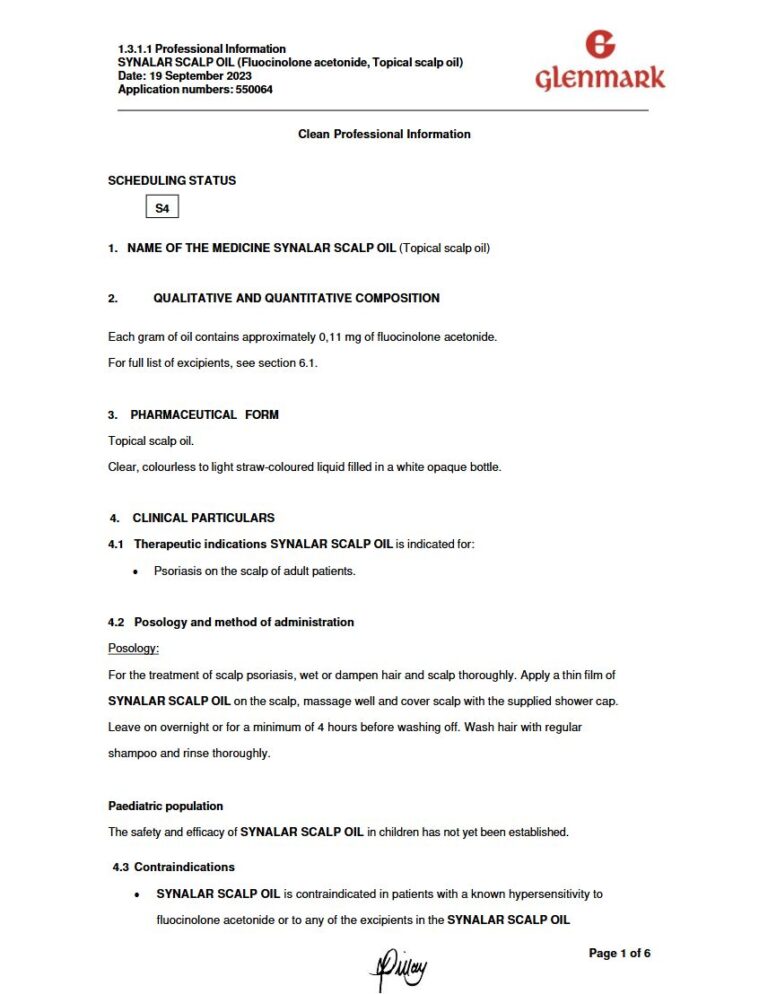
4.1 Therapeutic indications
SYNALAR SCALP OIL is indicated for:
- Psoriasis on the scalp of adult patients.
4.2 Posology and method of administration
Posology: For the treatment of scalp psoriasis, wet or dampen hair and scalp thoroughly. Apply a thin film of SYNALAR SCALP OIL on the scalp, massage well and cover scalp with the supplied shower cap. Leave on overnight or for a minimum of 4 hours before washing off. Wash hair with regular shampoo and rinse thoroughly.
Paediatric population: The safety and efficacy of SYNALAR SCALP OIL in children has not yet been established.
4.3 Contraindications
- SYNALAR SCALP OIL is contraindicated in patients with a known hypersensitivity to fluocinolone acetonide or to any of the excipients in the SYNALAR SCALP OIL formulation (see section 6.1).
- SYNALAR SCALP OIL is contraindicated in primary infections of the skin caused by bacteria, fungi or viruses (e.g. herpes, vaccinia or varicella) and in rosacea, acne, peri - oral dermatitis, nappy rash, axillae and anogenital pruritus.
- Pregnancy
4.4 Special warnings and precautions for use
General: Systemic absorption of topical corticosteroids can produce reversible hypothalamic - pituitary - adrenal (HPA) axis suppression with the potential for glucocorticosteroid insufficiency after withdrawal of treatment. Manifestations of Cushingu2019s syndrome, hyperglycemia, and glucosuria can also be produced in some patients by systemic absorption of topical corticosteroids while on treatment. Patients applying a topical steroid to a large surface area or to areas under occlusion should be evaluated periodically for evidence of HPA axis suppression. This may be done by using Adrenocorticotropic hormone (ACTH) stimulation, A.M. plasma cortisol, and urinary free cortisol tests. If HPA axis suppression is noted, an attempt should be made to withdraw the medicine, to reduce the frequency of application, or to substitute a less potent corticosteroid. Infrequently, signs and symptoms of glucocorticoid insufficiency may occur requiring supplemental systemic corticosteroids. For information on systemic supplementation, see prescribing information for those products.
Children may be more susceptible to systemic toxicity from equivalent doses due to their larger skin surface to body mass ratios. Allergic contact dermatitis to any component of topical corticosteroids is usually diagnosed by a failure to heal rather than noting a clinical exacerbation, which may occur with most topical products not containing corticosteroids. Such an observation should be corroborated with appropriate diagnostic testing.
If wheal and flare type reactions (which may be limited to pruritus) or other manifestations of hypersensitivity develop, SYNALAR SCALP OIL should be discontinued immediately and appropriate therapy instituted. If concomitant skin infections are present or develop, an appropriate antifungal or antibacterial medicine should be used. If a favourable response does not occur promptly, use of SYNALAR SCALP OIL should be discontinued until the infection has been adequately controlled.
Use in Peanut - Sensitive Individuals: Medical practitioners should use caution in prescribing SYNALAR SCALP OIL for peanut - sensitive individuals. Should signs of hypersensitivity present (wheal and flare reactions, pruritus, or other manifestations), or should disease exacerbations occur, SYNALAR SCALP OIL should be discontinued immediately and appropriate therapy instituted.
4.5 Interaction with other medicines and other forms of interaction
No data available.
4.6 Fertility, pregnancy and lactation
Pregnancy: Corticosteroids have been shown to be teratogenic in laboratory animals when administered systemically at relatively low dosage levels. Some corticosteroids have been shown to be teratogenic after dermal application in laboratory animals. The use of SYNALAR SCALP OIL is contraindicated during pregnancy.
Lactation: Systemically administered corticosteroids appear in human milk and could suppress growth, interfere with endogenous corticosteroid production, or cause other untoward effects. It is not known whether topical administration of corticosteroids could result in sufficient systemic absorption to produce detectable quantities in human milk. Because many medicines are excreted in human milk, caution should be exercised when SYNALAR SCALP OIL is administered to breastfeeding women.
4.7 Effects on ability to drive and use machines
Not relevant.
4.8 Undesirable effects
- Long term continuous treatment with topical corticosteroids should be avoided as far as possible as this may cause atrophic changes in the skin, leading to striae, thinning, loss of elasticity, dilatation of superficial blood vessels, telangiectasia and ecchymosis. These changes are particularly likely to occur on the face and when occlusive dressings are used.
- Percutaneous absorption of fluocinolone acetonide may lead to both local and systemic toxicity. The extent of percutaneous absorption may be enhanced by the use of occlusive dressings or when the product is applied to parts of the skin which are more permeable. Features of hypercorticism may also be produced. Depression of the hypothalamic - pituitary u2013 adrenal axis with consequent suppression of the adrenal gland may occur. These affects are most likely to be severe in children. Growth may be retarded and a Cushingoid state may be produced. Benign intracranial hypertension has been rarely reported.
- Irritation at the site of application may occur and hypersensitivity reactions have been reported. Treatment should be discontinued if unfavourable reactions are observed.
4.9 Overdose
Treatment is symptomatic and supportive. Topically applied SYNALAR SCALP OIL can be absorbed in sufficient amounts to produce systemic effects.
