
Easan 150 mg Powder for solution for infusion
PDF Leaflet Revision Date: 7 March 2023
Clinical Summary
Quick overview from the medicine insert
Indication
Prevention of nausea and vomiting associated with cancer chemotherapy.
Dosage (summary)
150 mg IV on Day 1, no adjustment for elderly or renal impairment.
Onset of Action / Duration
Onset: 30 mins, Duration: Not specified.
Special Populations
- Moderate hepatic impairment
- Severe hepatic impairment
- Renal impairment
Pregnancy & Breastfeeding
Not recommended in pregnancy; breastfeeding not advised.
Key Drug Interactions
- CYP3A4 inhibitors
- CYP3A4 inducers
- Warfarin
Contraindications
- Hypersensitivity to aprepitant
- Co-administration with pimozide
- Pregnancy
- Breastfeeding
- Paediatric patients
Common side effects
- Fatigue
- Headache
- Constipation
- Dyspepsia
- Hiccups
Counselling Points
- Monitor for hypersensitivity
- Use non-hormonal contraception
- Avoid in pregnancy and breastfeeding
Serious warnings
- Hypersensitivity reactions
- Infusion site reactions
- Caution in hepatic impairment
Important Disclaimer
The Easan 150 mg Powder for solution for infusion professional information leaflet below is the property of Kahma Biotech and is provided on Medinsert exactly as issued, with no.. alterations or editorial changes. We make every effort to keep content current by updating documents as soon as new versions become available. Medinsert serves as a trusted access point for healthcare professionals, but does not replace official sources or clinical judgement. For more details, please read our full disclaimer. read more>>
 Healthcare Professionals Only
This content is for registered healthcare professionals
Sign in or create a free account to read the full package insert.
Free for HPCSA-registered professionals. Powered by Medinsert.
Clinical Particulars
Section 4 of the official insert — extracted exactly as issued, no alterations
4.1 Therapeutic indications
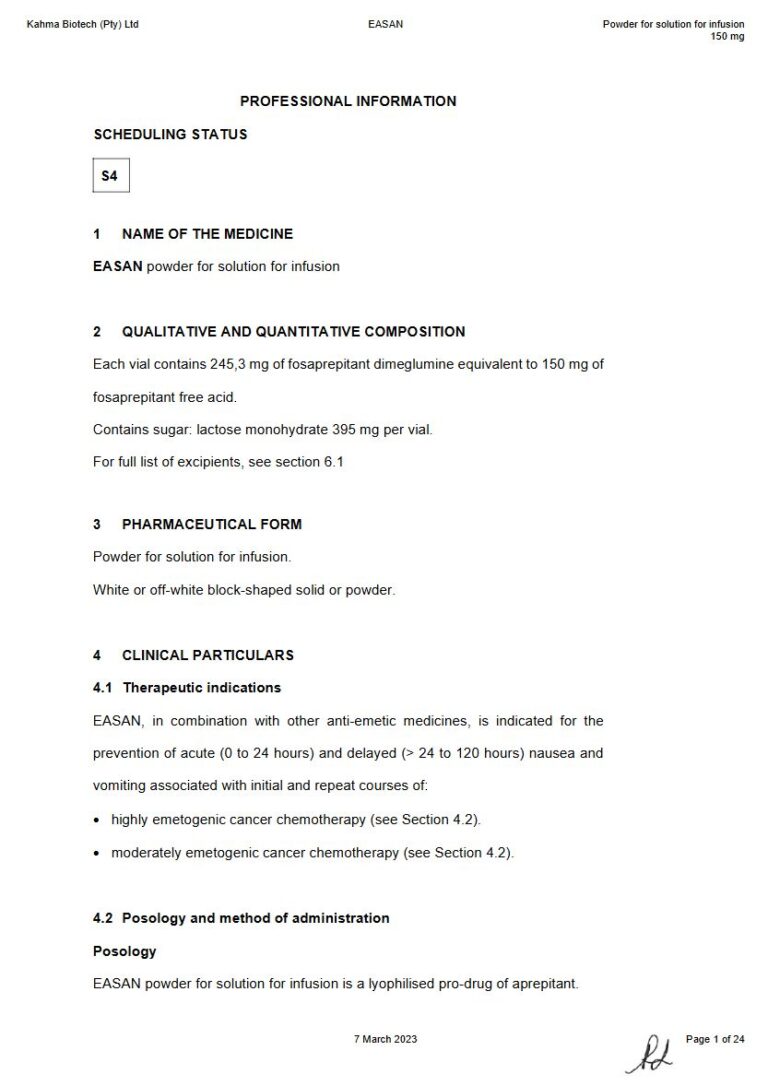
EASAN, in combination with other anti-emetic medicines, is indicated for the prevention of acute (0 to 24 hours) and delayed (> 24 to 120 hours) nausea and vomiting associated with initial and repeat courses of:
- highly emetogenic cancer chemotherapy (see Section 4.2).
- moderately emetogenic cancer chemotherapy (see Section 4.2).
4.2 Posology and method of administration
Posology
EASAN powder for solution for infusion is a lyophilised pro-drug of aprepitant. EASAN is administered on Day 1 as an infusion over 20 to 30 minutes initiated approximately 30 minutes prior to chemotherapy. EASAN should be administered in conjunction with a corticosteroid and a 5-HT3 antagonist as specified in the tables below. The professional information for the co-administered 5-HT3 antagonist must be consulted prior to initiation of treatment with EASAN.
Recommended dosing for the prevention of nausea and vomiting associated with highly emetogenic cancer chemotherapy.
Highly Emetogenic Chemotherapy Regimen
Day 1
- EASAN 150 mg IV
- None
- None
- None
Day 2
- Dexamethasone** 12 mg orally
- 8 mg orally
- 8 mg orally twice daily
- 8 mg orally twice daily
Day 3
- 5-HT3 antagonist See the professional information for the selected 5-HT3 antagonist for the appropriate dosing information.
- None
- None
- None
**Dexamethasone should be administered 30 minutes prior to chemotherapy treatment on Day 1 and in the morning on Days 2 through 4. Dexamethasone should also be administered in the evenings on Days 3 and 4. The dose of dexamethasone accounts for interactions.
Recommended dosing for the prevention of nausea and vomiting associated with moderately emetogenic cancer chemotherapy:
Moderately Emetogenic Chemotherapy Regimen
Day 1
- EASAN 150 mg IV
- Dexamethasone** 12 mg orally
- 5-HT3 antagonist See the professional information for the selected 5-HT3 antagonist for the appropriate dosing information.
**Dexamethasone should be administered 30 minutes prior to chemotherapy treatment on Day 1. The dose of dexamethasone accounts for interactions.
General information
See section 4.5 for additional information on the administration of EASAN with corticosteroids. Refer to the full prescribing information for co-administered anti-emetic medicines. No dosage adjustment is necessary for the elderly. No dosage adjustment is necessary based on age, gender, race or Body Mass Index (BMI). No dosage adjustment is necessary for patients with severe renal insufficiency (creatinine clearance 9) (see Section 4.4).
Method of administration
EASAN is for intravenous administration. For single use only. Discard any unused portion.
Preparation of EASAN for Infusion
- Inject 5 ml saline into the vial. Assure that saline is added to the vial along the vial wall in order to prevent foaming. Swirl the vial gently. Avoid shaking and jetting saline into the vial. After reconstitution, use only if the solution is a clear colourless or pale yellow to yellow solution, free from visible particles.
- Prepare an infusion bag filled with 145 ml of saline.
- Withdraw the entire volume from the vial and transfer it into an infusion bag containing 145 ml of saline to yield a total volume of 150 ml. Gently invert the bag 2 to 3 times. EASAN should be inspected visually for particulate matter and discolouration before administration whenever solution and container permit. See section 6.2 for incompatibilities and section 6.4 for storage conditions after reconstitution and dilution.
4.3 Contraindications
- Hypersensitivity to aprepitant, polysorbate 80, or to any of the excipients (see section 6.1).
- Co-administration with pimozide, terfenadine, astemizole or cisapride. Inhibition of cytochrome P450 isoenzyme 3A4 (CYP3A4) by aprepitant could result in elevated plasma concentrations of these medicines potentially causing serious or life-threatening reactions. (see Section 4.5).
- Pregnancy and breastfeeding (see Section 4.6).
- Paediatric patients, as the safety and efficacy have not been established.
4.4 Special warnings and precautions for use
Patients with moderate to severe hepatic impairment
There are limited data in patients with moderate hepatic impairment and no data in patients with severe hepatic impairment. EASAN should be used with caution in these patients (see Section 5.2).
Severe hepatic insufficiency
Severe hepatic insufficiency (Child-Pugh score > 9). There are no clinical or pharmacokinetic data in patients with severe hepatic insufficiency. Caution should be exercised when EASAN is administered in these patients.
Since EASAN is rapidly converted to aprepitant (a weak to moderate inhibitor of CYP3A4), EASAN should be used with caution in patients receiving concomitant medicines that are primarily metabolised through CYP3A4; some chemotherapy medicines are metabolised by CYP3A4 (see section 4.5).
Weak inhibition of CYP3A4 by EASAN could result in elevated plasma concentrations of these concomitant medicines (see section 4.5). Concomitant administration of EASAN with strong CYP3A4 inhibitors {e.g. ketoconazole, itraconazole, nefazodone, troleandomycin, clarithromycin, ritonavir, nelfinavir) should be approached with caution. The effect of oral aprepitant on the pharmacokinetics of orally administered CYP3A4 substrates is greater than the effect of oral aprepitant on the pharmacokinetics of intravenously administered CYP3A4 substrates (see section 4.5).
CYP3A4 interactions
EASAN should be used with caution in patients receiving concomitant active substances that are metabolised primarily through CYP3A4 and with a narrow therapeutic range, such as ciclosporin, tacrolimus, sirolimus, everolimus, alfentanil, ergot alkaloid derivatives, fentanyl, and quinidine (see Section 4.5). Additionally, concomitant administration with irinotecan should be approached with particular caution as the combination might result in increased toxicity.
Co-administration with warfarin (a CYP2C9 substrate)
In patients on chronic warfarin therapy, the International Normalised Ratio (INR) should be monitored closely for 14 days, particularly at 7 to 10 days following the use of EASAN with each chemotherapy cycle (see section 4.5).
Co-administration with hormonal contraceptives
The efficacy of hormonal contraceptives may be reduced during and for 28 days after administration of EASAN. Alternative non-hormonal back-up methods of contraception should be used during treatment with EASAN and for 2 months following the use of EASAN (see section 4.5).
Hypersensitivity reactions
Immediate hypersensitivity reactions including flushing, erythema, dyspnoea, and anaphylaxis/anaphylactic shock have occurred during or soon after infusion of fosaprepitant (as in EASAN). These hypersensitivity reactions have generally responded to discontinuation of the infusion and administration of appropriate therapy. It is not recommended to reinitiate the infusion in patients who experience hypersensitivity reactions.
Administration and infusion site reactions
Infusion site reactions (ISRs) have been reported with the use of EASAN (see section 4.8). The majority of severe ISRs, including thrombophlebitis and vasculitis, were reported with concomitant vesicant (e.g., anthracycline-based) chemotherapy administration, particularly when associated with extravasation. Necrosis was also reported in some patients with concomitant vesicant chemotherapy. Mild injection site thrombosis has been observed at higher doses without concomitant vesicant chemotherapy. EASAN should not be given as a bolus injection, but should always be diluted and given as a slow intravenous infusion. EASAN should not be administered intramuscularly or subcutaneously. If signs or symptoms of local irritation occur, the injection or infusion should be terminated and restarted in another vein.
Excipient warning
Contains lactose monohydrate. Patients with rare hereditary problems of galactose intolerance, total lactase deficiency or glucose-galactose malabsorption should not receive EASAN.
4.5 Interaction with other medicines and other forms of interaction
When administered intravenously fosaprepitant is rapidly converted to aprepitant. EASAN, given as a single dose, is a weak inhibitor of CYP3A4. Fosaprepitant (as in EASAN) does not seem to interact with the P-glycoprotein transporter, as demonstrated by the lack of interaction of oral aprepitant with digoxin. It is anticipated that fosaprepitant would cause less or no greater induction of CYP2C9, CYP3A4 and glucuronidation than that caused by the administration of oral aprepitant. Data are lacking regarding effects on CYP2C8 and CYP2C19.
Interactions with other medicines following administration of intravenous fosaprepitant as in EASAN) are likely to occur with active substances that interact with oral aprepitant. The following information was derived from studies conducted with oral aprepitant and studies conducted with intravenous single-dose fosaprepitant co-administered with dexamethasone, midazolam, or diltiazem.
Effect of fosaprepitant on the pharmacokinetics of other active substances
CYP3A4 inhibition
As a weak inhibitor of CYP3A4, the fosaprepitant (as in EASAN) 150 mg single dose can cause a transient increase in plasma concentrations of co-administered active substances that are metabolised through CYP3A4. The total exposure of CYP3A4 substrates may increase up to 2-fold on Days 1 and 2 after co-administration with a single 150 mg fosaprepitant dose. EASAN must not be used concurrently with pimozide, terfenadine, astemizole, or cisapride. Inhibition of CYP3A4 by fosaprepitant could result in elevated plasma concentrations of these active substances, potentially causing serious or life-threatening reactions. (see Section 4.3). Caution is advised during concomitant administration of EASAN and active substances that are metabolised primarily through CYP3A4 and with a narrow therapeutic range, such as ciclosporin, tacrolimus, sirolimus, everolimus, alfentanil, diergotamine, ergotamine, fentanyl, and quinidine (see Section 4.4).
Corticosteroids
Dexamethasone: The oral dexamethasone dose should be reduced by approximately 50 % when co-administered with fosaprepitant (see section 4.2). Fosaprepitant 150 mg administered as a single intravenous dose on Day 1 increased the AUC0-24hr of dexamethasone, a CYP3A4 substrate, by 100 % on Day 1, 86 % on Day 2 and 18 % on Day 3 when dexamethasone was co-administered as a single 8 mg oral dose on Days 1, 2, and 3.
Methylprednisolone: Oral aprepitant, when given as a regimen of 125 mg on Day 1 and 80 mg/day on Days 2 and 3, increased the AUC of methylprednisolone, a CYP3A4 substrate, by 1.3-fold on Day 1 and by 2.5-fold on Day 3, when methylprednisolone was co-administered intravenously as 125 mg on Day 1 and orally as 40 mg on Days 2 and 3.
Chemotherapeutic medicines
Interaction studies with fosaprepitant 150 mg and chemotherapeutic medicines have not been conducted; however, based on studies with oral aprepitant and docetaxel and vinorelbine, EASAN is not expected to have a clinically relevant interaction with intravenously administered docetaxel and vinorelbine. An interaction with orally administered chemotherapeutic medicines metabolised primarily or partly by CYP3A4 (e.g., etoposide, vinorelbine) cannot be excluded. Caution is advised and additional monitoring may be appropriate in patients receiving medicines metabolised primarily or partly by CYP3A4 (see section 4.4). Post-marketing events of neurotoxicity, a potential adverse reaction of ifosfamide, have been reported after aprepitant and ifosfamide co-administration.
Immunosuppressants
Following a single 150 mg fosaprepitant dose, a transient moderate increase for two days possibly followed by a mild decrease in exposure of immunosuppressants metabolised by CYP3A4 (e.g. ciclosporin, tacrolimus, everolimus and sirolimus) is expected. Given the short duration of increased exposure, dose reduction of the immunosuppressant based on Therapeutic Dose Monitoring is not recommended on the day of and the day after administration of EASAN.
Midazolam
Fosaprepitant 150 mg administered as a single intravenous dose on Day 1 increased the AUC0-u221e of midazolam by 77 % on Day 1 and had no effect on Day 4 when midazolam was co-administered as a single oral dose of 2 mg on Days 1 and 4. Fosaprepitant 150 mg is a weak CYP3A4 inhibitor as a single dose on Day 1 with no evidence of inhibition or induction of CYP3A4 observed on Day 4. The potential effects of increased plasma concentrations of midazolam or other benzodiazepines metabolised via CYP3A4 (alprazolam, triazolam) should be considered when co-administering these medicines with EASAN.
Diltiazem
Interaction studies with fosaprepitant 150 mg and diltiazem have not been conducted; however, the following study with 100 mg of fosaprepitant should be considered when using EASAN with diltiazem. In patients with mild to moderate hypertension, infusion of 100 mg of fosaprepitant over 15 minutes with diltiazem 120 mg 3 times daily, resulted in a 1.4-fold increase in diltiazem AUC and a small but clinically meaningful decrease in blood pressure, but did not result in a clinically meaningful change in heart rate, or PR interval.
Induction
The fosaprepitant 150 mg single dose did not induce CYP3A4 on Days 1 and 4 in the midazolam interaction study. It is anticipated that EASAN would cause less or no greater induction of CYP2C9, CYP3A4, and glucuronidation than that caused by the administration of the 3-day oral aprepitant regimen, for which a transient induction with its maximum effect 6-8 days after first aprepitant dose has been observed. The 3-day oral aprepitant regimen resulted in an about 30-35 % reduction in AUC of CYP2C9 substrates and up to a 64 % decrease in ethinyl estradiol trough concentrations. Data are lacking regarding effects on CYP2C8 and CYP2C19. Caution is advised when warfarin, acenocoumarol, tolbutamide, phenytoin or other active substances that are known to be metabolised by CYP2C9 are administered with EASAN.
Warfarin
In patients on chronic warfarin therapy, the prothrombin time (INR) should be monitored closely during treatment with and for 14 days following the use of EASAN for the prevention of chemotherapy induced nausea and vomiting (see section 4.4).
Hormonal contraceptives
The efficacy of hormonal contraceptives may be reduced during and for 28 days after administration of fosaprepitant. Alternative non-hormonal back-up methods of contraception should be used during treatment with fosaprepitant and for 2 months following the use of fosaprepitant.
5-HT3 antagonists
Interaction studies with fosaprepitant 150 mg and 5-HT3 antagonists have not been conducted; however, in clinical interaction studies, the oral aprepitant regimen did not have clinically important effects on the pharmacokinetics of ondansetron, granisetron, or hydrodolasetron (the active metabolite of dolasetron). Therefore, there is no evidence of interaction with the use of EASAN and 5-HT3 antagonists.
Effect of other medicines on the pharmacokinetics of aprepitant
Concomitant administration of fosaprepitant with active substances that inhibit CYP3A4 activity (e.g., ketoconazole, itraconazole, voriconazole, posaconazole, clarithromycin, telithromycin, nefazodone, and protease inhibitors) should be approached cautiously, as the combination is expected to result in several-fold increased plasma concentrations of aprepitant (see Section 4.4). Ketoconazole increased the terminal half-life of oral aprepitant about 3-fold.
Concomitant administration of fosaprepitant with active substances that strongly induce CYP3A4 activity (e.g., rifampicin, phenytoin, carbamazepine, phenobarbital) should be avoided as the combination could result in reductions of the plasma concentrations of aprepitant that may result in decreased efficacy. Concomitant administration of fosaprepitant with herbal preparations containing St. John's Wort (Hypericum perforatum) is not recommended. Rifampicin decreased the mean terminal half-life of oral aprepitant by 68 %.
Paediatric population
Interaction studies have only been performed in adults.
4.6 Fertility, pregnancy and lactation
Contraception in males and females
The efficacy of hormonal contraceptives may be reduced during and for 28 days after administration of EASAN. Alternative non-hormonal back-up methods of contraception should be used during treatment with EASAN and for 2 months following the last dose of EASAN (see Sections 4.4 and 4.5).
Pregnancy
Safety in pregnancy has not been established. EASAN should not be used during pregnancy.
Breastfeeding
Aprepitant is excreted in the milk of lactating rats after intravenous administration of fosaprepitant as well as after oral administration of aprepitant. It is not known whether aprepitant is excreted in human milk. Therefore, breastfeeding is not recommended during treatment with EASAN.
Fertility
The potential for effects of fosaprepitant and aprepitant on fertility has not been fully characterised because exposure levels above the therapeutic exposure in humans could not be attained in animal studies. These fertility studies did not indicate direct or indirect harmful effects with respect to mating performance, fertility, embryonic/foetal development, or sperm count and motility.
4.7 Effects on ability to drive and use machines
EASAN may affect the patientu2019s ability to drive and use machines. Dizziness and fatigue may occur following administration of EASAN (see section 4.8).
4.8 Undesirable effects
a. Summary of the safety profile
Since fosaprepitant is converted to aprepitant, those adverse experiences associated with aprepitant are also expected to occur with EASAN. The overall safety of fosaprepitant was evaluated in 1 143 individuals, and the overall safety of oral aprepitant was evaluated in approximately 6 500 individuals. Oral aprepitant The most frequent adverse reactions reported at a greater incidence in adults treated with the aprepitant regimen than with standard therapy in patients receiving HEC were: hiccups (4,6 % versus 2,9 %), alanine aminotransferase (ALT) increased (2,8 % versus 1,1 %), dyspepsia (2,6 % versus 2,0 %), constipation (2,4 % versus 2,0 %), headache (2,0 % versus 1,8 %), and decreased appetite (2,0 % versus 0,5 %). The most frequent adverse reaction reported at a greater incidence in patients treated with the aprepitant regimen than with standard therapy in patients receiving MEC was fatigue (1,4 % versus 0,9 %).
b. Tabulated summary of adverse reactions - aprepitant
The following adverse reactions were observed in a pooled analysis of the HEC and MEC studies at a greater incidence with oral aprepitant than with standard therapy in patients or in post-marketing use. The frequency categories given in the table are based on the studies in adults; the observed frequencies in the paediatric studies were similar or lower, unless shown in the table. Some less frequent ADRs in the adult population were not observed in the paediatric studies. Frequencies are defined as: frequent; less frequent and frequency unknown (cannot be estimated from the available data).
MedDRA system organ class Frequency Adverse reactions Infections and infestations Less frequent Candidiasis, staphylococcal infection Blood and lymphatic system disorders Less frequent Febrile neutropenia, anaemia Immune system disorders Frequency unknown Hypersensitivity reactions including anaphylactic reactions Metabolism and nutrition disorders Frequent Decreased appetite Less frequent Polydipsia Psychiatric disorders Less frequent Anxiety, disorientation, euphoric mood Nervous system disorders Frequent Headache Less frequent Dizziness, somnolence, cognitive disorder, lethargy, dysgeusia Eye disorders Less frequent Conjunctivitis Ear and labyrinth disorders Less frequent Tinnitus Cardiac disorders Less frequent Palpitations, bradycardia, cardiovascular disorder Vascular disorders Less frequent Hot flush/flushing Respiratory, thoracic and mediastinal disorders Frequent Hiccups Less frequent Oropharyngeal pain, sneezing, cough, postnasal drip, throat irritation Gastrointestinal disorders Frequent Constipation, dyspepsia Less frequent Eructation, nausea*, vomiting*, gastroesophageal reflux disease, abdominal pain, dry mouth, flatulence, duodenal ulcer perforation, stomatitis, abdominal distension, faeces hard, neutropenic colitis Skin and subcutaneous tissue disorders Less frequent Rash, acne, photosensitivity reaction, hyperhidrosis, seborrhoea, skin lesion, rash pruritic, Stevens-Johnson syndrome/toxic epidermal necrolysis Frequency unknown Pruritus, urticaria Musculoskeletal and connective tissue disorders Less frequent Muscular weakness, muscle spasms Renal and urinary disorders Less frequent Dysuria, pollakiuria General disorders and administration site conditions Frequent Fatigue Less frequent Asthenia, malaise, oedema, chest discomfort, gait disturbance Investigations Frequent Increased ALT Less frequent Increased AST, increased blood alkaline phosphatase, red blood cells urine positive, decreased blood sodium, decreased weight, decreased neutrophil count, glucose urine present, increased urine output *Nausea and vomiting were efficacy parameters in the first 5-days of post-chemotherapy treatment and were reported as adverse reactions only thereafter.
c. Description of selected adverse reactions
The adverse reactions profiles in the Multiple-Cycle extension of HEC and MEC studies in adults for up to 6 additional cycles of chemotherapy were generally similar to those observed in Cycle 1. In an additional active-controlled clinical study in 1 169 adult patients receiving aprepitant and HEC, the adverse reactions profile was generally similar to that seen in the other HEC studies with aprepitant. Additional adverse reactions were observed in adult patients treated with aprepitant for post-operative nausea and vomiting (PONV) and a greater incidence than with ondansetron: abdominal pain upper, bowel sounds abnormal, constipation*, dysarthria, dyspnoea, hypoaesthesia, insomnia, miosis, nausea, sensory disturbance, stomach discomfort, sub-ileus*, visual acuity reduced, wheezing. *Reported in patients taking a higher dose of aprepitant.
Fosaprepitant
In an active-controlled clinical study in adult patients receiving HEC, safety was evaluated for 1 143 patients receiving the 1-day regimen of fosaprepitant 150 mg compared to 1 169 patients receiving the 3-day regimen of aprepitant. Additionally, in a placebo-controlled clinical trial in adult patients receiving MEC, safety was evaluated for 504 patients receiving a single dose of fosaprepitant 150 mg compared to 497 patients receiving the control regimen. In a pooled analysis of 3 active-controlled clinical studies in paediatric patients (aged 6 months to 17 years) receiving either HEC or MEC and a single dose of fosaprepitant at or above the recommended 1-day regimen dose, safety was evaluated for 139 patients receiving the 1-day regimen of fosaprepitant. In the same analysis, safety was evaluated for 199 patients receiving either HEC or MEC and a single dose of fosaprepitant at or above the recommended 3-day regimen of fosaprepitant. Safety data following the administration of the 3-day IV/oral/oral regimen were also included. No data are available following the administration of a 3-day IV fosaprepitant regimen in paediatric patients. The safety profile of the 3-day IV fosaprepitant regimen in paediatric patients is expected to be similar to that of the 1-day fosaprepitant regimen as the low daily trough levels do not significantly increase the exposures on subsequent days. The safety profile of fosaprepitant in adult and paediatric patients was generally similar to that observed with aprepitant.
Tabulated list of adverse reactions u2013 fosaprepitant
The following are adverse reactions reported in adult patients receiving fosaprepitant in clinical studies or post-marketing that have not been reported with aprepitant as described above. The frequency categories in the table are based on studies in adults; the observed frequencies in the paediatric studies were similar or lower. Some adverse reactions that are frequently observed in the adult population were not observed in the paediatric studies. Infusion site reactions (ISRs) have been reported with the use of fosaprepitant (see section 4.4).
MedDRA system organ class Frequency Adverse reactions Immune system disorders Frequency unknown Hypersensitivity reactions including anaphylactic reactions/ anaphylactic shock Vascular disorders Less frequent Flushing, thrombophlebitis (predominantly, infusion-site thrombophlebitis) Skin and subcutaneous tissue disorders Less frequent Erythema, pruritus, rash, urticaria, Stevens-Johnson syndrome, toxic epidermal necrolysis General disorders and administration site conditions Less frequent Infusion site erythema, infusion site pain, infusion site pruritus, infusion site induration Frequency unknown Immediate hypersensitivity reactions including flushing, erythema, dyspnoea, anaphylactic reactions/ anaphylactic shock Investigations Less frequent Increased blood pressure
4.9 Overdose
In the event of overdose, EASAN should be discontinued and general supportive treatment and monitoring should be provided. Aprepitant cannot be removed by haemodialysis.
