
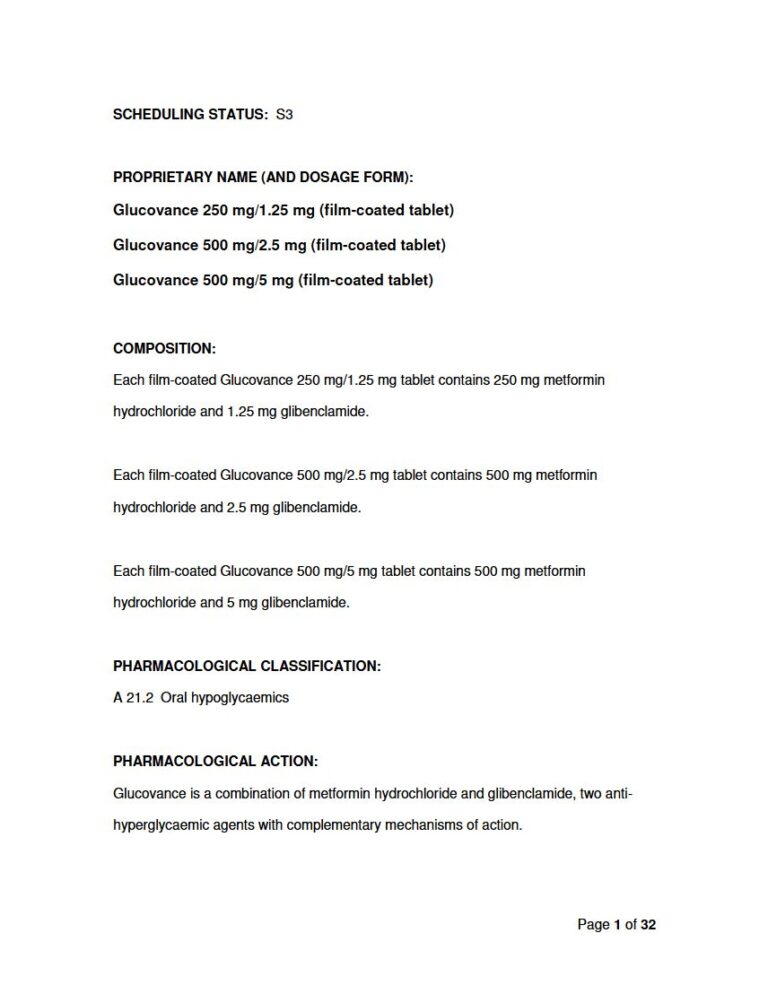
Glucovance 1.25mg. 250mg Tablet
PDF Leaflet Revision Date: 23 July 2010
Clinical Summary
Quick overview from the medicine insert
Indication
Type 2 diabetes management as initial or second-line therapy.
Dosage (summary)
Start with 1 tablet of Glucovance 250 mg/1.25 mg daily; adjust based on response.
Special Populations
- Elderly
- Renal impairment
- Hepatic impairment
Pregnancy & Breastfeeding
Not recommended during pregnancy or lactation.
Key Drug Interactions
- Miconazole
- Fluconazole
- Phenylbutazone
- Diuretics
- ACE-inhibitors
Contraindications
- Hypersensitivity to components
- Type 1 diabetes
- Renal disease
- Liver disease
- Acute alcohol intoxication
Common side effects
- Hypoglycaemia
- Nausea
- Vomiting
- Diarrhoea
- Abdominal pain
Counselling Points
- Take with meals
- Monitor blood glucose regularly
- Avoid alcohol
- Recognize hypoglycaemia symptoms
Serious warnings
- Lactic acidosis
- Risk of cardiovascular mortality
- Hypoglycaemia symptoms
Important Disclaimer
The Glucovance 1.25mg. 250mg Tablet professional information leaflet below is the property of Merck and is provided on Medinsert exactly as issued, with no.. alterations or editorial changes. We make every effort to keep content current by updating documents as soon as new versions become available. Medinsert serves as a trusted access point for healthcare professionals, but does not replace official sources or clinical judgement. For more details, please read our full disclaimer. read more>>
 Healthcare Professionals Only
This content is for registered healthcare professionals
Sign in or create a free account to read the full package insert.
Free for HPCSA-registered professionals. Powered by Medinsert.
Clinical Particulars
Section 4 of the official insert — extracted exactly as issued, no alterations
4.1 Therapeutic indications
Glucovance is indicated as initial therapy, as an adjunct to diet and exercise, to improve glycaemic control in patients with type 2 diabetes whose glycaemia cannot be satisfactorily managed with diet and exercise alone.
Glucovance is indicated as second-line therapy when diet and exercise, and initial treatment with a sulphonylurea or metformin do not result in adequate glycaemic control in patients with type 2 diabetes.
4.2 Posology and method of administration
The dosage must be adjusted to each individual case. It is recommended to initiate the treatment with a low dose, which can then be gradually increased according to results obtained. The tablets must be administered just before a meal, in one or two daily intakes in the morning and evening. Any intake must be followed by a meal with a sufficiently high carbohydrate content to prevent the onset of hypoglycaemic episodes.
Initiation of therapy: When diet and exercise alone do not result in adequate glycaemic control: 1 tablet daily of Glucovance 250 mg/1.25 mg. Glucovance 500 mg/5 mg must not be used as initial therapy due to an increased risk of hypoglycaemia. In patients inadequately controlled by monotherapy: 1 tablet daily of Glucovance 500 mg/2.5 mg.
The initial dose must not exceed the daily doses of sulphonylurea or metformin already being taken. In substitution from combination-therapy with metformin and a sulphonylurea: 1 u2013 2 tablets daily of Glucovance 500 mg/2.5 mg or Glucovance 500 mg/5 mg to be adjusted according to the previous dose of each component. The recommended initial dose must not exceed the daily dose of glibenclamide (or equivalent dose of another sulphonylurea) and metformin already being taken. Titration: A gradual increase in the dosage may aid gastro-intestinal tolerance and prevent the onset of hypoglycaemia. The dosage can be adjusted every 1 u2013 2 weeks, depending on the results. Maximum dose: A total daily dose of 4 tablets of Glucovance 500 mg/5 mg should not be exceeded. Elderly subjects: In the elderly, it is recommended to initiate treatment with one tablet daily of Glucovance 250 mg/1.25 mg. The dose should then be adjusted according to results obtained and depending on renal function parameters. Paediatric patients: Glucovance is not recommended for use in children.
4.3 Contraindications
Hypersensitivity to metformin hydrochloride, glibenclamide or other sulphonylureas and sulphonamides, or any of the excipients. Type 1 diabetes (insulin-dependent diabetes), ketosis or ketoacidosis, diabetic pre-coma. Renal disease or dysfunction (creatinine clearance < 60 ml/min); which may also result from conditions such as shock, dehydration, severe infection, intravascular administration of iodinated contrast agents. Acute or chronic disease which may cause severe tissue hypoxia such as cardiac or respiratory failure, recent myocardial infarction, shock. Major surgery. Chronic liver disease, acute alcohol intoxication, alcoholism. Pancreatitis. Porphyria.
4.4 Special warnings and precautions for use
Lactic acidosis: Lactic acidosis is a rare but serious (high mortality in the absence of prompt treatment) metabolic complication that can occur due to metformin accumulation. Reported cases of lactic acidosis in patients on metformin have occurred primarily in diabetic patients with significant renal failure. The incidence of lactic acidosis can and should be reduced by assessing other associated risk factors such as poorly controlled diabetes, ketosis, prolonged fasting, excessive alcohol intake, hepatocellular failure and any condition associated with hypoxia. Diagnosis: Lactic acidosis is characterized by acidotic breathing, abdominal pain and hypothermia followed by coma. Diagnostic laboratory findings are decreased blood pH, plasma lactate levels above 5 mmol/L, and an increased anion gap and lactate/pyruvate ratio. If metabolic acidosis is suspected, treatment should be discontinued. Lactic acidosis is a medical emergency and the patient should be hospitalized immediately.
Other warnings: Because Glucovance contains lactose, it is not recommended in cases of congenital galactosemia, glucose and galactose malabsorption syndrome or in case of lactase deficiency. Patients must be alerted to the symptoms of hypoglycaemia and must be advised to exercise caution when driving or using machinery. The administration of oral hypoglycaemics may be associated with an increased risk of cardiovascular mortality as compared to treatment with diet alone or diet with insulin although controversy exists concerning interpretation of these findings.
4.5 Interactions with other medicines
Glibenclamide related: Phenylbutazone increases the hypoglycaemic effect of sulphonylureas. It is recommended to use another anti-inflammatory agent with fewer interactions, or else warn the patient and step up self-monitoring; if necessary, adjust the dosage during treatment with the anti-inflammatory agent and after its withdrawal. An increase in the half-life of glibenclamide with possible onset of hypoglycaemic manifestations may occur with the concomitant use with fluconazole. Warn the patient and step up blood glucose self-monitoring, and possibly adjust the dosage of the antidiabetic during treatment with fluconazole and after its withdrawal.
Miconazole (systemic route, oromucosal gel) increases the hypoglycaemic effect of glibenclamide with possible onset of hypoglycaemic manifestations or even coma. Therefore, miconazole must not be combined with Glucovance (see Contra-indications). There is an increased risk of hepato-toxicity if Bosentan is given with glibenclamide and it is recommended that such use be avoided. The hypoglycaemic effect of glibenclamide may also be reduced. Cases of hypoglycaemia have been reported when the following products were used in combination with glibenclamide: antibacterial sulphonamides, fluoroquinolones, warfarin, MAOIu2019s, chloramphenicol, lipid-lowering agents such as fenofibrate, pentoxifyllin, disopyramide, clofibrate, cyclophosphamide, salicylate, propranolol and other beta-blockers. All beta-blockers, clonidine, reserpine, guanethidine and sympathomimetics mask some of the symptoms of hypoglycaemia i.e. palpitations and tachycardia. Beta-blockers may increase the incidence and severity of hypoglycaemia, decrease the body response to hypoglycaemia. Warn the patient and step-up blood glucose self-monitoring, especially at the start of treatment. Concomitant use with desmopressin leads to a reduction in antidiuretic activity.
Metformin related: Depending on the renal function, Glucovance must be discontinued 48 hours before or at the time of intravascular administration of iodinated contrast media (see Special precautions). Diuretics, especially loop diuretics, may increase the risk of lactic acidosis due to their potential to decrease renal function. Combination related: There is an increased risk of lactic acidosis in acute alcohol intoxication, particularly in cases of: fasting or malnutrition, hepatic insufficiency. There is a risk of increase in the hypoglycaemic reaction that may even lead to hypoglycaemic coma. Patients should avoid consumption of alcohol and alcohol-containing medications. (See Contra-indications) Related to all antidiabetic agents: Glucocorticosteroids, beta-2-agonists, chlorpromazine at high doses (100 mg per day) and diuretics have intrinsic hyperglycaemic activity. Frequent blood glucose monitoring must be performed if used concomitantly with Glucovance, especially at the beginning of the treatment. If necessary, adjust the Glucovance dosage during therapy with the respective medicinal product and upon its discontinuation. Concomitant use with ACE-inhibitors may decrease the blood glucose level. If necessary, adjust the dosage of Glucovance during therapy with an ACE-inhibitor and upon its discontinuation.
4.6 Fertility, pregnancy and lactation
Glucovance must not be used for the treatment of diabetes during pregnancy. It is imperative that insulin be used to achieve adequate blood glucose control. It is recommended that the patient be transferred from oral antidiabetic therapy to insulin as soon as she plans to become pregnant or if pregnancy is exposed to Glucovance. The use of Glucovance during lactation is contra-indicated.
4.7 Effects on ability to drive and use machines
Patients must be alerted to the symptoms of hypoglycaemia and must be advised to exercise caution when driving or using machinery.
4.8 Undesirable effects
The following undesirable effects may occur under treatment with Glucovance. Frequencies are defined as follows: very common: > 1/10; common u2265 1/100, < 1/10; uncommon: u2265 1/1000, < 1/100; rare: u2265 1/10 000, < 1/1000; very rare: < 1/10 000 and isolated reports.
Blood and lymphatic system disorders: These are reversible upon treatment discontinuation. Rare: leucopenia, thrombocytopenia. Very rare: agranulocytosis, haemolytic anaemia, bone marrow aplasia and pancytopenia. Metabolism and nutrition disorders: Hypoglycaemia (see u201cSpecial precautionsu201d below) Uncommon: crises of hepatic porphyria and porphyria cutanea. Very rare: lactic acidosis (see u201cWarningsu201d above). Decrease of Vitamin B 12 absorption with decrease of serum levels during long-term use of metformin. Consideration of such aetiology is recommended if a patient presents with megaloblastic anaemia. Disulfiram-like reaction with alcohol intake. Nervous system disorders: Common: taste disturbance. Eye disorders: Transient visual disturbances may occur at the start of treatment due to a decrease in glycaemia levels. Gastro-intestinal disorders: Very common: nausea, vomiting, diarrhoea, abdominal pain and loss of appetite. These undesirable effects occur more frequently during treatment initiation and resolve spontaneously in most cases. To prevent them, it is recommended that Glucovance be taken in 2 to 3 daily doses. A slow increase of the dose may also improve gastro-intestinal tolerability. Hepato-biliary disorders: Very rare: liver function test abnormalities or hepatitis requiring treatment discontinuation. Skin and subcutaneous tissue disorders: Rare: skin reactions such as pruritus, urticaria, maculopapular rash. Very rare: cutaneous or visceral allergic agniitis, erythema multiforme, exfoliative dermatitis, photosensitization, urticaria evolving in shock. A cross reactivity to sulphonamide(s) and their derivatives may occur. Investigations: Uncommon: average to moderate elevations in serum urea and creatinine concentrations. Very rare: hyponatraemia.
4.9 Overdose
High overdose or the existence of risk factors may lead to lactic acidosis due to the presence of metformin. Lactic acidosis must be treated in hospital and is a medical emergency. Lactate and metformin can be removed by haemodialysis. Overdose may precipitate hypoglycaemia due to the presence of glibenclamide. The plasma clearance of glibenclamide may be prolonged in patients suffering from liver disease. Since glibenclamide is extensively bound to proteins, it is not eliminated by dialysis. In patients with decreased level of consciousness, I.V. glucose/dextrose should be considered. Further treatment is symptomatic and supportive.
