
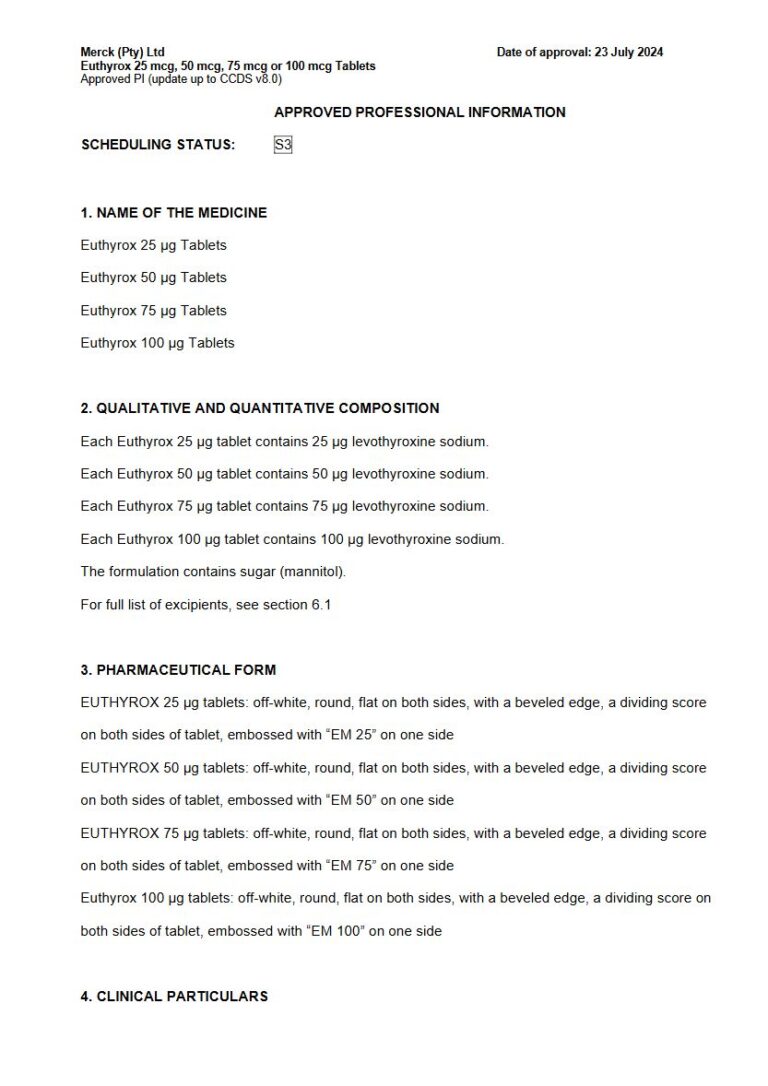
Euthyrox 25 Mcg/50 Mcg/75 Mcg/100 Mcg Tablets
PDF Leaflet Revision Date: 23 July 2024
Clinical Summary
Quick overview from the medicine insert
Indication
Treatment of hypothyroidism.
Dosage (summary)
Adults: 50-100 mcg daily, adjusted as needed. Special caution in elderly and cardiac patients.
Onset of Action / Duration
Onset: 3-5 days, Half-life: ~7 days.
Special Populations
- Elderly
- Cardiac disease
- Severe hypothyroidism
Pregnancy & Breastfeeding
Continue therapy during pregnancy; monitor TSH. Safe during breastfeeding.
Key Drug Interactions
- Anticoagulants
- Antidiabetics
- Orlistat
- PPIs
- Sevelamer
Contraindications
- Hypersensitivity to levothyroxine
- Untreated adrenal insufficiency
- Untreated thyrotoxicosis
Common side effects
- Nervousness
- Insomnia
- Tachycardia
- Diarrhoea
- Rash
Counselling Points
- Take on an empty stomach.
- Regular monitoring of thyroid function is essential.
- Report any signs of hyperthyroidism.
Serious warnings
- Risk of serious adverse effects with high doses.
- Monitor in patients with cardiac issues.
Important Disclaimer
The Euthyrox 25 Mcg/50 Mcg/75 Mcg/100 Mcg Tablets professional information leaflet below is the property of Merck and is provided on Medinsert exactly as issued, with no.. alterations or editorial changes. We make every effort to keep content current by updating documents as soon as new versions become available. Medinsert serves as a trusted access point for healthcare professionals, but does not replace official sources or clinical judgement. For more details, please read our full disclaimer. read more>>
 Healthcare Professionals Only
This content is for registered healthcare professionals
Sign in or create a free account to read the full package insert.
Free for HPCSA-registered professionals. Powered by Medinsert.
Clinical Particulars
Section 4 of the official insert — extracted exactly as issued, no alterations
4.1 Therapeutic Indications
EUTHYROX is used in the treatment of hypothyroidism.
4.2 Posology and method of administration
The dose of EUTHYROX for the treatment of hypothyroidism should be individualised on the basis of clinical response and biochemical tests and should be monitored regularly.
Adults
Initially 50 to 100 micrograms daily, preferably taken before breakfast, and adjusted at three to four week intervals by 50 micrograms until normal metabolism is steadily maintained. This may require doses of 200 to 300 micrograms daily. If too rapid an increase in metabolism is produced (causing diarrhoea, nervousness, rapid pulse, insomnia, tremors and sometimes anginal pain where there is latent myocardial ischaemia), the dosage must be reduced or withheld for a day or two, then begin again at a lower level. An initial dose of 25 microgram is appropriate when there is cardiac failure or coronary artery insufficiency. In this condition the daily dose may be increased by 25 microgram at intervals of four weeks, as needed.
Paediatric population
For neonates and infants with congenital hypothyroidism, where rapid replacement is important, the initial recommended dosage is 10 to 15 micrograms per kg body weight per day for the first 3 months. Thereafter, the dose should be adjusted individually according to the clinical findings and thyroid hormone and TSH values. Juvenile myxoedema The starting dose for children older than one year may be 2,5 micrograms to 5 micrograms / kg / day.
Special populations
In elderly patients, in patients with coronary heart disease, and in patients with severe or long-existing hypothyroidism, special caution is required when initiating therapy with EUTHYROX, that is, a low initial dose (for example 12.5 u03bcg / day) should be given which should then be increased slowly and at lengthy intervals (e.g. a gradual increment of 12.5 u03bcg / day fortnightly) with frequent monitoring of thyroid hormones. A maintenance dose lower than that required for complete correction of TSH levels may be considered.
Method of administration
The daily dose can be given in a single administration in the morning. Ingestion: as a single daily dose in the morning on an empty stomach, half an hour before breakfast, preferably with a little liquid (for example, half a glass of water). Infants receive the entire dose at once at least 30 minutes before the first meal of the day. Tablets are suspended in some water and the resultant suspension is administered with some more liquid. The suspension must be prepared freshly prior to each administration.
4.3 Contraindications
Hypersensitivity to levothyroxine or to any of the excipients listed in section 6.1. Untreated adrenal insufficiency, untreated pituitary insufficiency, and untreated thyrotoxicosis. Treatment must not be initiated in acute myocardial infarction, acute myocarditis, and acute pancarditis.
4.4 Special warnings and precautions for use
Thyroid hormones should not be given for weight reduction. In euthyroid patients, treatment with levothyroxine does not cause weight reduction.
Substantial doses may cause serious or even life-threatening undesirable effects. Levothyroxine in high doses should not be combined with certain substances for weight reduction, i.e. sympathomimetics (see section 4.9).
Before starting therapy with EUTHYROX the following diseases should be excluded or treated: coronary insufficiency, angina pectoris, arteriosclerosis, hypertension, pituitary insufficiency, adrenal insufficiency, thyroid autonomy.
In case of adrenocortical dysfunction, this should be treated before starting the therapy with levothyroxine by adequate replacement treatment to prevent acute adrenal insufficiency (see section 4.3).
When initiating levothyroxine therapy in patients at risk of psychotic disorders, it is recommended to start at a low levothyroxine dose and to slowly increase the dosage at the beginning of the therapy. Monitoring of the patient is advised. If signs of psychotic disorders occur, adjustment of the dose of levothyroxine should be considered.
Even slight drug-induced hyperthyroidism must be avoided in patients with coronary failure, cardiac insufficiency or tachycardiac dysrhythmias. Hence frequent checks of thyroid hormone parameters must be made in these cases.
In the case of secondary hypothyroidism the cause must be determined before replacement therapy is given and if necessary, replacement treatment of a compensated adrenal insufficiency must be commenced.
Where thyroid autonomy is suspected, a TRH test should be carried out or a suppression scintigram obtained before treatment.
Haemodynamic parameters should be monitored when EUTHYROX therapy is initiated in very low birth weight preterm neonates as circulatory collapse may occur due to the immature adrenal function.
In postmenopausal women with hypothyroidism and an increased risk of osteoporosis, supraphysiological serum levels of EUTHYROX should be avoided, and, therefore, thyroid function should be checked regularly.
Levothyroxine should not be used in hyperthyroid metabolic states.
Patients with panhypopituitarism or other causes predisposing to adrenal insufficiency may react unfavourably to EUTHYROX treatment and it is advisable to initiate corticosteroid therapy before giving EUTHYROX in these cases. Special care is needed when there are symptoms of myocardial insufficiency or electrocardiogram evidence of myocardial infarction.
If a switch to another levothyroxine-containing product is required, there is a need to undertake a close monitoring including a clinical and biological monitoring during the transition period due to a potential risk of thyroid imbalance. In some patients, a dose adjustment could be necessary.
Hypothyroidism and/or reduced control of hypothyroidism may occur when orlistat and levothyroxine are co-administered (see section 4.5). Patients taking levothyroxine should be advised to consult a doctor before starting or stopping or changing treatment with orlistat, as orlistat and levothyroxine may need to be taken at different times and the dose of levothyroxine may need to be adjusted. Further, it is recommended to monitor the patient by checking the hormone levels in the serum.
EUTHYROX contains mannitol and may have a laxative effect.
4.5 interaction with other medicinal products and other forms of interaction
As thyroid status influences metabolic activity and most body systems, treatment with EUTHYROX may affect other disease states and their treatment.
Protease inhibitors: Protease inhibitors may influence the effect of EUTHYROX. Close monitoring of thyroid hormone parameters is recommended. If necessary, the EUTHYROX dose has to be adjusted.
Phenytoin: Phenytoin may influence the effect of levothyroxine by displacing levothyroxine from plasma proteins resulting in an elevated fT4 and fT3 fraction. On the other hand phenytoin increases the hepatic metabolisation of levothyroxine. Close monitoring of thyroid hormone parameters is recommended.
Influence of EUTHYROX on other medicines: Antidiabetic medicines EUTHYROX may reduce the effects of medicines which lower the blood sugar. For this reason, blood glucose levels should be checked frequently during thyroid hormone therapy and the dosage of the antidiabetic medicines adapted, if necessary.
Anticoagulant medicines /Coumarin derivatives EUTHYROX displaces anticoagulant medicines from plasma protein, thereby enhancing the effects of these medicines. Patients on anticoagulant therapy therefore require careful monitoring when treatment with EUTHYROX is initiated or altered as the anticoagulant dose may need to be adjusted.
The following medicinal products intensify the effect of EUTHYROX: Salicylates, furosemide, clofibrate Salicylates, furosemide in high doses (250mg), clofibrate and other substances with a high affinity for plasma protein can displace levothyroxine sodium from plasma proteins, resulting in an elevated free-thyroxine (T4) fraction.
The following medicinal products may reduce the effect of EUTHYROX: Proton pump inhibitors (PPIs) Co-administration with PPIs may cause a decrease in the absorption of the thyroid hormones, due to the increase of the intragastric pH caused by PPIs. Regular monitoring of thyroid function and clinical monitoring is recommended, with a possible increase in the dose of thyroid hormones.
Orlistat Hypothyroidism and/or reduced control of hypothyroidism may occur when orlistat and levothyroxine are taken at the same time. This could be due to a decreased absorption of iodine salts and/or levothyroxine.
Sevelamer Sevelamer may decrease EUTHYROX absorption. Therefore, it is recommended that patients are monitored for changes in thyroid function at the start or end of concomitant treatment. If necessary, the EUTHYROX dose has to be adjusted.
Tyrosine-kinase inhibitors Tyrosine-kinase inhibitors (e.g., imatinib, sunitinib) may decrease the efficacy of EUTHYROX. Therefore, it is recommended that patients are monitored for changes in thyroid function at the start or end of concomitant treatment. If necessary, the EUTHYROX dose has to be adjusted.
Colestyramine, Colestipol Ingestion of ion exchange resins such as colestyramine inhibits the absorption of levothyroxine sodium by binding to it in the gastro-intestinal tract. EUTHYROX should therefore be taken 4-5 hours before administration of colestyramine. The same is true for colestipol.
Aluminium-containing medicines, iron-containing medicines, calcium carbonate Aluminium-containing medicines (antacids, sucralfate), iron-containing medicines and calcium carbonate have been reported to potentially decrease the effect of levothyroxine by reducing absorption of EUTHYROX from the GIT. EUTHYROX should therefore be administered at least 2 hour prior to the administration of these medicines.
Propylthiouracil, glucocorticoids, beta-sympatholytics, amiodarone and iodine-containing contrast media These substances inhibit the peripheral conversion of T4 to T3. Due to its high iodine content, amiodarone can trigger hyperthyroidism as well as hypothyroidism. Particular caution is advised in the case of nodular goitre with possibly unrecognised autonomy.
Setraline, chloroquine / proguanil These substances decrease the efficacy of EUTHYROX and increase serum TSH level.
Barbiturates Barbiturates and other medicines possessing hepatic enzyme inducing properties can increase hepatic clearance of EUTHYROX.
Oestrogens Women using oestrogen-containing contraceptives or postmenopausal women under hormone replacement therapy may have an increased need for levothyroxine.
Interaction with food Soy containing compounds can decrease the intestinal absorption of levothyroxine. Therefore, a dosage adjustment of EUTHYROX may be necessary, in particular at the beginning or after termination of nutrition with soy supplements.
4.6 Fertility, pregnancy and lactation
Pregnancy Treatment with thyroid hormones should be given consistently during pregnancy and breastfeeding. Dosage requirements may increase during pregnancy. Since elevations in serum TSH may occur as early as 4 weeks of gestation, pregnant women taking levothyroxine should have their TSH measured during each trimester, in order to confirm that the maternal serum TSH values lie within the trimester-specific pregnancy reference range. An elevated serum TSH level should be corrected by an increase in the dose of levothyroxine. Since postpartum TSH levels are similar to preconception values, the levothyroxine dosage should return to the pre-pregnancy dose immediately after delivery. A serum TSH level should be obtained 6 u2013 8 weeks postpartum. Experience has shown that there is no evidence of EUTHYROX induced teratogenicity and/or foeto-toxicity in humans at the recommended therapeutic dose levels. Excessively high dose levels of levothyroxine during pregnancy may have a negative effect on foetal and postnatal development.
Breastfeeding Levothyroxine is secreted into breast milk during lactation but the concentrations achieved at the recommended therapeutic dose level are not sufficient to cause development of hyperthyroidism or suppression of TSH secretion in the infant. However, thyroid function in mothers and infants should be monitored.
Fertility No information available.
4.7 Effects on ability to drive and use machines
No studies on the effects on the ability to drive and use machines have been performed. However, since levothyroxine is identical to the naturally occurring thyroid hormone, it is not expected that EUTHYROX has any influence on the ability to drive and use machines, if used as recommended.
4.8 Undesirable Effects
Undesirable effects are generally associated with excessive dosage or if the dose is increased too quickly at the start of treatment and correspond to symptoms of hyperthyroidism. These symptoms usually disappear after dosage-reduction or temporary withdrawal of treatment. Therapy may be carefully resumed once the symptoms have disappeared.
In case of hypersensitivity to any ingredients of Euthyrox allergic reactions particularly of the skin (rash, urticaria) and the respiratory tract may occur. Cases of angioedema have been reported.
The following symptoms have been reported, predominantly with excessive dosages and frequencies are unknown:
- Endocrine disorders: Heat intolerance, sweating, flushing, fever, weight loss
- Psychiatric disorders: Nervousness, excitability, insomnia, restlessness
- Nervous system disorders: Headache, tremors, pseudotumor cerebri
- Cardiac disorders: Tachycardia, palpitations, cardiac dysrhythmias, anginal pain
- Gastrointestinal disorders: Diarrhoea and vomiting
- Skin and subcutaneous tissue disorders: Hyperhidrosis, alopecia, rash, pruritus
- Musculoskeletal and connective tissue disorders: Muscle weakness and cramps
- Reproductive system and breast disorders: Menstrual irregularities
In the case of hypersensitivity, allergic reactions may occur.
Peadiatric population: Excessive dose may result in heat intolerance, transient hair loss, benign intracranial hypertension, craniosynotosis in infants and premature closure of epiphyses in children.
Reporting of suspected adverse reactions Reporting suspected adverse reactions after authorisation of the medicine is important. It allows continued monitoring of the benefit/risk balance of the medicine. Health care providers are asked to report any suspected adverse reactions to SAHPRA via the u201c6.04 Adverse Drug Reactions Reporting Formu201d, found online under SAHPRAu2019s publications: https://www.sahpra.org.za/Publications/Index/8
4.9 Overdosage
An elevated T3 level is a reliable indicator of overdose, more than elevated T4 or fT4 levels. After overdose the symptoms of a sharp increase in the metabolic rate occur (see section 4.8).
Depending on the extent of the overdose it is recommended that treatment with the tablets is interrupted and that tests are carried out. Symptoms consisting of intense beta-sympathomimetic effects such as tachycardia, anxiety, agitation and hyperkinesia can be relieved by betablockers. After extreme doses plasmapheresis may be of help.
In predisposed patients isolated cases of seizures have been reported when the individual dose tolerance limit was exceeded. Overdose of levothyroxine may result in symptoms of hyperthyroidism and could lead to acute psychosis, especially in patients at risk of psychotic disorders. Several cases of sudden cardiac death have been reported in patients with long years of levothyroxine abuse.
