
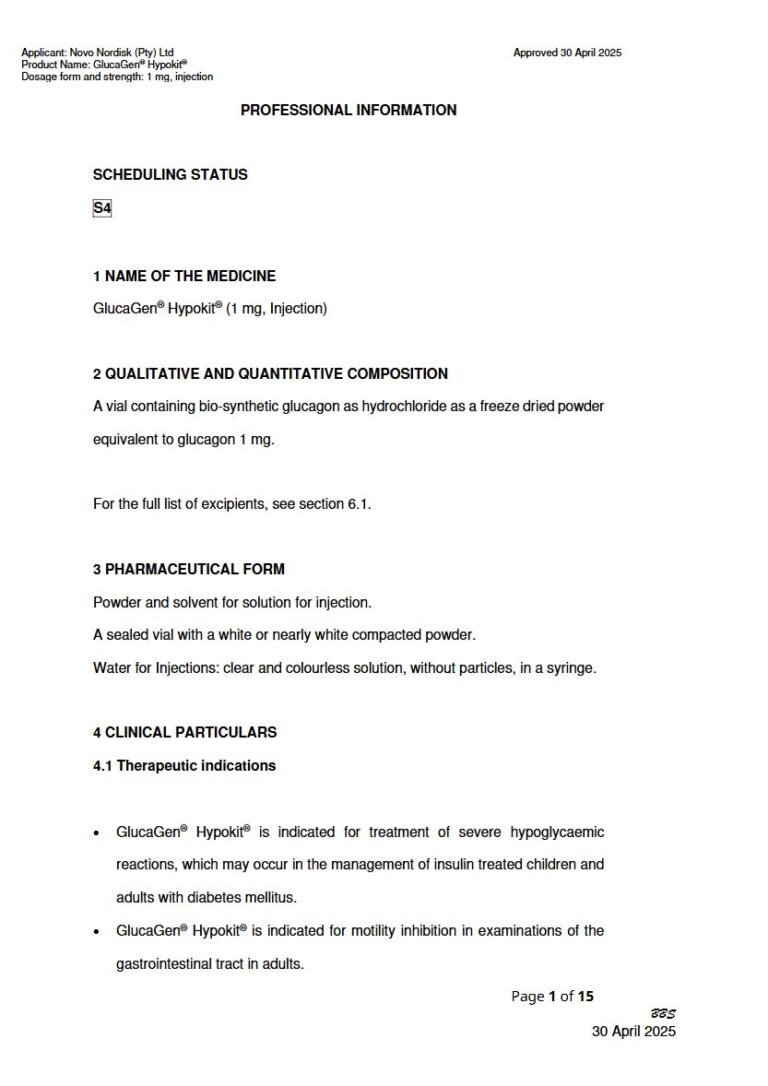
Glucagen Hypokit 1 mg Solution
PDF Leaflet Revision Date: 30 April 2025
Clinical Summary
Quick overview from the medicine insert
Indication
Treatment of severe hypoglycaemic reactions and motility inhibition in gastrointestinal examinations.
Dosage (summary)
Adults: 1 mg subcutaneously or intramuscularly for hypoglycaemia.
Onset of Action / Duration
Onset: 10 mins, Duration: varies 10-40 mins depending on route.
Special Populations
- Elderly (u2265 65 years)
- Renal impairment
- Hepatic impairment
Pregnancy & Breastfeeding
Safe to use during pregnancy and breastfeeding.
Key Drug Interactions
- Insulin
- Indomethacin
- Warfarin
- Beta-blockers
Contraindications
- Phaeochromocytoma
- Hypersensitivity to glucagon
Common side effects
- Nausea
- Vomiting
- Abdominal pain
Counselling Points
- Administer carbohydrates after regaining consciousness.
- Avoid driving after hypoglycaemic events.
Serious warnings
- Not effective in patients with depleted liver glycogen stores.
- Monitor patients with cardiac disease.
Important Disclaimer
The Glucagen Hypokit 1 mg Solution professional information leaflet below is the property of Novo Nordisk and is provided on Medinsert exactly as issued, with no.. alterations or editorial changes. We make every effort to keep content current by updating documents as soon as new versions become available. Medinsert serves as a trusted access point for healthcare professionals, but does not replace official sources or clinical judgement. For more details, please read our full disclaimer. read more>>
 Healthcare Professionals Only
This content is for registered healthcare professionals
Sign in or create a free account to read the full package insert.
Free for HPCSA-registered professionals. Powered by Medinsert.
Clinical Particulars
Section 4 of the official insert — extracted exactly as issued, no alterations
4.1 Therapeutic indications
u2022 GlucaGen u00ae Hypokit u00ae is indicated for treatment of severe hypoglycaemic reactions, which may occur in the management of insulin treated children and adults with diabetes mellitus.
u2022 GlucaGen u00ae Hypokit u00ae is indicated for motility inhibition in examinations of the gastrointestinal tract in adults.
4.2 Posology and method of administration
In the absence of oral/IV dextrose, GlucaGen u00ae Hypokit u00ae is administered subcutaneously or intramuscularly for the treatment of hypoglycaemia. On regaining consciousness, the patient should be given food rich in carbohydrate to restore the liver glycogen and prevent secondary hypoglycaemia. If the patient does not respond within 10 minutes, intravenous glucose should be given. GlucaGen u00ae Hypokit u00ae should be used immediately after preparation. There are no known incompatibilities with GlucaGen u00ae Hypokit u00ae.
Severe hypoglycaemia: Dosage for adult patients: Administer 1 mg.
Special populations
- Paediatric population (< 18 years old): GlucaGen u00ae Hypokit u00ae can be used for the treatment of severe hypoglycaemia in children and adolescents. Dosage for paediatric patients: Administer 1 mg (children above 25 kg or older than 6 - 8 years) or 0,5 mg (children below 25 kg or younger than 6 - 8 years).
- Elderly (u2265 65 years old): GlucaGen u00ae Hypokit u00ae can be used in elderly patients.
- Renal and hepatic impairment: GlucaGen u00ae Hypokit u00ae can be used in patients with renal and hepatic impairment.
Method of administration
GlucaGen u00ae Hypokit u00ae Administration Guide
4.3 Contraindications
GlucaGen u00ae Hypokit u00ae is contra-indicated in cases of phaeochromocytoma. Must not be administered to patients who are hypersensitive to glucagon or other excipients.
4.4 Special warnings and precautions for use
Due to the instability of GlucaGen u00ae Hypokit u00ae in solution, the product should be used immediately after reconstitution and must not be given as an intravenous infusion. GlucaGen u00ae Hypokit u00ae is not effective in patients with marked depletion of liver glycogen stores, as in starvation, adrenal insufficiency, or chronic hypoglycaemia.
Therapeutic indication
To prevent the relapse of hypoglycaemia, oral carbohydrates should be given to restore the liver glycogen when the patient has responded to treatment. Glucagon will not be effective in patients whose liver glycogen is depleted. For that reason, glucagon has little or no effect when the patient has been fasting for a prolonged period, or is suffering from adrenal insufficiency, chronic hypoglycaemia or alcohol induced hypoglycaemia. Glucagon, unlike adrenaline, has no effect upon muscle phosphorylase and therefore cannot assist in the transference of carbohydrate from the much larger stores of glycogen that are present in the skeletal muscle.
Diagnostic indication
Persons who have been given glucagon in connection with diagnostic procedures may experience discomfort, in particular if they have been fasting. Nausea, hypoglycaemia, and blood pressure changes have been reported in these situations. After end of a diagnostic procedure oral carbohydrates should be given to patients who have been fasting, if this is compatible with the diagnostic procedure applied. If fasting is needed post-examination or in case of severe hypoglycaemia, glucose given intravenously may be required.
GlucaGen u00ae Hypokit u00ae may increase myocardial oxygen demand, blood pressure, and pulse rate. Monitor patients with cardiac disease during use of GlucaGen u00ae Hypokit u00ae as a diagnostic aid and treat if indicated.
GlucaGen u00ae Hypokit u00ae may cause short term hyperglycaemia in patients with diabetes mellitus when used as a diagnostic aid. Monitor patients with diabetes for changes in blood glucose levels during use and treat if indicated. Caution should be observed in patients with glucagonoma when used as diagnostic aid.
Therapeutic and diagnostic indications. Glucagon reacts antagonistically towards insulin and caution should be observed if GlucaGen u00ae Hypokit u00ae is used in patients with insulinoma. Glucagon stimulates the release of catecholamines. In the presence of phaeochromocytoma, glucagon can cause the tumour to release large amounts of catecholamines, which will cause an acute hypertensive reaction.
4.5 Interaction with other medicines and other forms of interaction
Insulin: Reacts antagonistically towards GlucaGen u00ae Hypokit u00ae. Indomethacin: GlucaGen u00ae Hypokit u00ae may lose its ability to raise blood glucose or paradoxically may even produce hypoglycaemia. Warfarin: GlucaGen u00ae Hypokit u00ae may increase the anticoagulant effect of warfarin. Beta-blockers: Patients taking beta-blockers might be expected to have a greater increase in both pulse and blood pressure, an increase of which will be temporary because of glucagonu2019s short half-life. The increase in blood pressure and pulse rate may require therapy in patients with coronary artery disease. Interactions between GlucaGen u00ae Hypokit u00ae and other drugs are not known when GlucaGen u00ae Hypokit u00ae is used in the approved indications.
4.6 Fertility, pregnancy and lactation
Pregnancy
GlucaGen u00ae Hypokit u00ae does not cross the human placenta barrier. GlucaGen u00ae Hypokit u00ae can be used during pregnancy.
Lactation
GlucaGen u00ae Hypokit u00ae is rapidly cleared from the bloodstream (t u00bd = 3 u2013 6 min) thus the amount excreted in the milk of nursing mothers will be extremely small. As GlucaGen u00ae Hypokit u00ae is degraded in the digestive tract and is not absorbed in its intact form, it will not exert any metabolic effect on the child. GlucaGen u00ae Hypokit u00ae can be used during breast-feeding.
Fertility
Animal reproduction studies have not been conducted with GlucaGen u00ae Hypokit u00ae. Studies in rats have shown that glucagon does not cause impaired fertility.
4.7 Effects on ability to drive and use machines
After a hypoglycaemic event, the patientu2019s ability to concentrate and react may be impaired. The patient should not drive or operate machinery after a hypoglycaemic event. After diagnostic procedures, hypoglycaemia has been reported infrequently. Therefore driving a vehicle should be avoided until the patient has had a meal with oral carbohydrates.
4.8 Undesirable effects
Summary of the safety profile
Severe adverse reactions are very rare, although nausea, vomiting and abdominal pain may occur occasionally. Hypersensitivity reactions, including anaphylactic reactions, have been reported as u2018very rareu2019 (less than 1 case per 10 000 patients). When used in the diagnostic indication, hypoglycaemia/hypoglycaemic coma has been reported, especially in patients who have fasted. Cardiovascular adverse events, such as tachycardia and blood pressure changes have only been reported when GlucaGen u00ae Hypokit u00ae is used as an adjunct in endoscopic or radiographic procedures.
Tabulated summary of adverse reactions
Frequencies of undesirable effects considered related to GlucaGen u00ae Hypokit u00ae treatment during clinical trials and or post-marketing surveillance survey is presented in the table below. Undesirable effects that have not been observed in clinical trials but have been reported spontaneously are presented as u201cvery rareu201d. During marketed use reporting of adverse drug reactions are very rare (<1/10 000). However, post-marketing experience is subject to under reporting and this reporting rate should be interpreted in that light.
Therapeutic indication (Hypoglycaemia)
Organ system class
- Common u2265 1/100 and < 1/10
- Uncommon u2265 1/1 000 and < 1/100
- Rare u2265 1/10 000 and < 1/1 000
- Very rare < 1/10 000
- Not known (cannot be estimated from the available data)
Immune System disorders
Hypersensitivity reactions including anaphylactic reaction/shock
Gastrointestinal disorders
Nausea
Vomiting
Abdominal pain
General disorders and administration site conditions
Injection site reactions
Paediatric population: Based on data from clinical trials and post-marketing experience, the frequency, type and severity of adverse reactions observed in children are expected to be the same as in adults.
Other special populations: Based on data from clinical trials and post-marketing experience, the frequency, type and severity of adverse reactions observed in elderly patients and in patients with renal or hepatic impairment are expected to be the same as in the general population.
Diagnostic procedures
Organ system class
- Common u2265 1/100 and < 1/10
- Uncommon u2265 1/1 000 and < 1/100
- Rare u2265 1/10 000 and < 1/1 000
- Very rare < 1/10 000
- Not known (cannot be estimated from the available data)
Immune System disorders
Hypersensitivity reactions including anaphylactic reaction/shock
Metabolism and nutrition disorders
Hypoglycaemia
*1 Hypoglycaemic coma
Cardiac disorders
Tachycardia *2
Vascular disorders
Hypotension *2
Hypertension *2
Gastrointestinal disorders
Nausea
Vomiting
Abdominal pain
General disorders and administration site conditions
Injection site reactions
* 1 After a diagnostic procedure this could be more pronounced in patients that have fasted.
* 2 Cardiovascular adverse events have only been reported when GlucaGen u00ae Hypokit u00ae is used as an adjunct in endoscopic or radiographic procedures.
Paediatric population: Based on data from clinical trials and post-marketing experience, the frequency, type and severity of adverse reactions observed in children are expected to be the same as in adults on the therapeutic indication. There is no data available on the diagnostic use of GlucaGen u00ae Hypokit u00ae in children.
Other special populations: Based on data from clinical trials and post-marketing experience, the frequency, type and severity of adverse reactions observed in elderly patients and in patients with renal or hepatic impairment are expected to be the same as in the general population.
Reporting of suspected adverse reactions
Reporting suspected adverse reactions after authorisation of the medicine is important. It allows continued monitoring of the benefit/risk balance of the medicine. Health care providers are asked to report any suspected adverse reactions to SAHPRA via the u201c6.04 Adverse Drug Reactions Reporting Formu201d, found online under SAHPRAu2019s publications: https://www.sahpra.org.za/Publications/Index/8.
4.9 Overdose
In the case of overdose, the patient may experience nausea and vomiting. Due to the short half-life of glucagon, these symptoms will be transient. In case of dosages substantially above the approved range, the serum potassium may decrease and should be monitored and corrected, if needed. Treatment is symptomatic and supportive.
