
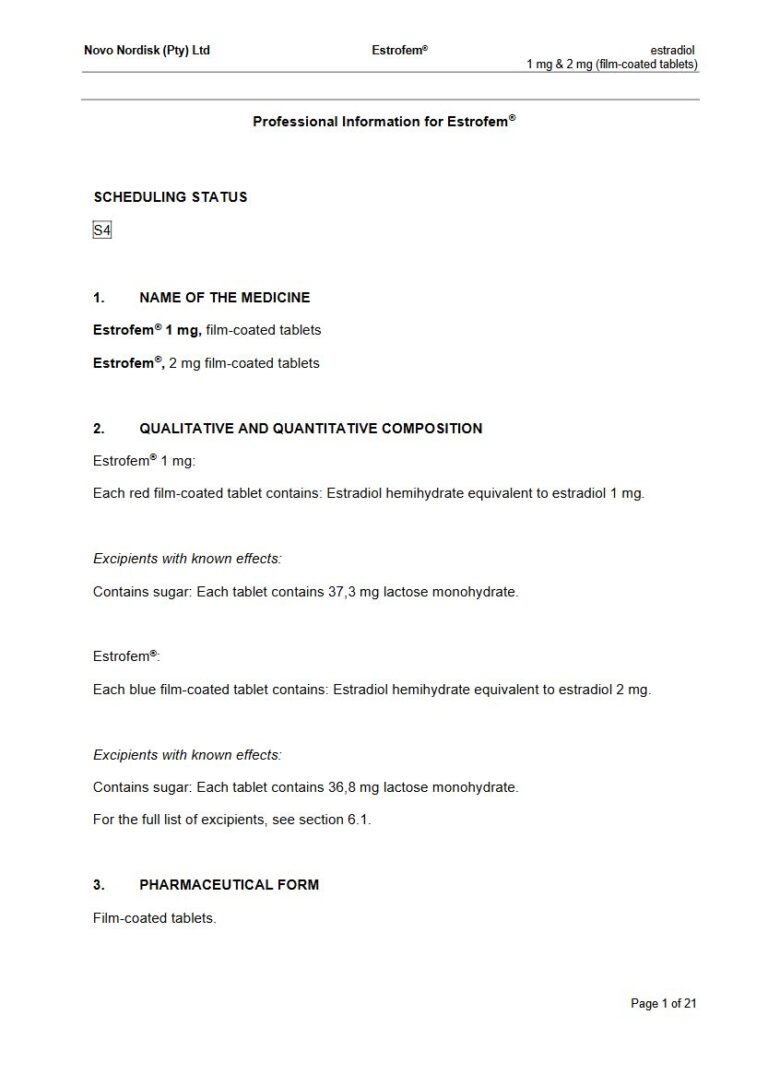
Estrofem 1 mg & 2 mg FC tablets.
PDF Leaflet Revision Date: 17 February 2025
Clinical Summary
Quick overview from the medicine insert
Indication
Treatment of symptoms due to estrogen deficiency in hysterectomised patients.
Dosage (summary)
1 mg to 2 mg daily, starting with the lowest effective dose.
Special Populations
- Elderly
- Renal impairment
- Hepatic impairment
Pregnancy & Breastfeeding
Contraindicated during pregnancy and lactation.
Key Drug Interactions
- Anticonvulsants
- Rifampicin
- St John's wort
Contraindications
- Pregnancy
- Breast cancer
- Estrogen-dependent tumors
- Undiagnosed genital bleeding
- Active liver disease
- Thromboembolic disorders
Common side effects
- Breast tenderness
- Abdominal pain
- Oedema
- Headache
Counselling Points
- Take at the same time daily
- Report any unusual breast changes
- Regular check-ups recommended
Serious warnings
- Increased risk of endometrial cancer with prolonged use
- Increased risk of venous thromboembolism
- Monitor for signs of depression
Important Disclaimer
The Estrofem 1 mg & 2 mg FC tablets. professional information leaflet below is the property of Novo Nordisk and is provided on Medinsert exactly as issued, with no.. alterations or editorial changes. We make every effort to keep content current by updating documents as soon as new versions become available. Medinsert serves as a trusted access point for healthcare professionals, but does not replace official sources or clinical judgement. For more details, please read our full disclaimer. read more>>
 Healthcare Professionals Only
This content is for registered healthcare professionals
Sign in or create a free account to read the full package insert.
Free for HPCSA-registered professionals. Powered by Medinsert.
Clinical Particulars
Section 4 of the official insert — extracted exactly as issued, no alterations
4.1 Therapeutic indications
The preparation is indicated for the treatment of symptoms due to estrogen deficiency in hysterectomised patients. Continuous treatment with Estrofem u00ae for more than five years is not recommended. Estrofem u00ae therapy may be used as an adjunct in preventing estrogen deficiency related osteoporosis in postmenopausal women at high risk of future fractures, who are intolerant of, or contraindicated for, other medicinal products approved for the prevention of osteoporosis. The experience of treating women older than 65 years is limited.
4.2 Posology and method of administration
Estrofem u00ae is administered orally. The first tablet may be taken at any time. Then continue by taking one tablet daily without interruption, preferably at the same time each day, until all the 28 tablets have been taken. Start a new pack the day after the last tablet has been taken. In women with amenorrhoea and not taking HRT, or women transferring from another estrogen only HRT product, treatment with Estrofem u00ae may be started on any convenient day. If the patient has forgotten to take a tablet, the tablet should be taken as soon as possible within the next twelve hours. Otherwise the missed tablet should be discarded and the patient is advised to continue with the next dayu2019s tablet.
Estrofem u00ae used for the treatment of symptoms due to estrogen deficiency should be given in the lowest effective dose as long as symptoms persist. It is thus recommended that treatment should begin with a lower strength preparation of estradiol. The effect can be evaluated after 2 u2013 3 months, and in the event of insufficient effect, a change to Estrofem u00ae 2 mg should be prescribed.
4.3 Contraindications
- Not for use during pregnancy.
- Known history (personal and/or family) or suspected breast cancer.
- Known or suspected estrogen dependent malignant tumours such as endometrial cancer or other hormone dependent tumours.
- Undiagnosed genital bleeding.
- Active liver disease. Acute or chronic liver disease or history of liver disease where the liver function tests have failed to return to normal.
- Thrombophlebitis, thromboembolic disorders, cerebral apoplexy or a past history of these conditions.
- Inherited thrombophilia or known thrombophilic disorders (e.g. protein C, protein S, or antithrombin deficiency).
- Previous idiopathic or current venous thromboembolism (deep venous thrombosis (DVT), pulmonary embolism).
- Active or previous arterial thromboembolic disease (e.g. angina, myocardial infarction and stroke).
- Porphyria.
- Hypertension.
- Haemoglobinopathies.
- Untreated endometrial hyperplasia.
- Known hypersensitivity to estradiol or to any of the excipients of Estrofem u00ae (see section 6.1).
- Patients with known inherited genetic mutations: BRCA1 and BRCA2 genes.
- Early menstrual periods (before the age of 12 years).
- History of non-cancerous breast diseases (atypical hyperplasia or lobular carcinoma in situ).
- Previous treatment using radiation therapy to the chest or breast.
- Previous exposure to diethylstilbestrol (DES).
4.4 Special warnings and precautions for use
Medical examination/follow-up Before initiating or re-instituting Estrofem u00ae, a complete personal and family medical history should be taken. Physical (including pelvic and breast) examinations should be guided by this and by the contraindications and warnings for use. During treatment, periodic check-ups are recommended of a frequency and nature adapted to the individual woman. Women should be advised of what changes in their breasts should be reported to their doctor or nurse. Investigations, including mammography, should be carried out in accordance with currently accepted screening practices, modified to the clinical needs of the individual.
For the treatment of post-menopausal symptoms, Estrofem u00ae should only be initiated for symptoms that adversely affect quality of life. In all cases, a careful appraisal of the risks and benefits should be undertaken at least annually and Estrofem u00ae should only be continued as long as the benefit outweighs the risk. As the experience in treating women with a premature menopause (due to ovarian failure or surgery) is limited, the evidence regarding the risks associated with Estrofem u00ae in the treatment of premature menopause is also limited. Due to the low level of absolute risk in younger women, however, the balance of benefits and risks for these women may be more favourable than in older women.
Prolonged replacement therapy with unopposed estrogens may cause overstimulation of the uterus and breasts, which eventually could give rise to pathological conditions. Prolonged replacement therapy with unopposed estrogens in postmenopausal women has been associated with endometrial carcinoma.
Conditions which need supervision: If any of the following conditions are present, have occurred previously, and/or have been aggravated during pregnancy or previous hormone treatment, the patient should be closely supervised. It should be taken into account that these conditions may recur or be aggravated during treatment with Estrofem u00ae, in particular (see section 4.3):
- Leiomyoma (uterine fibroids) or endometriosis.
- A history of, or risk factors for, thromboembolic disorders.
- Risk factors for estrogen dependent tumours, e.g. 1st degree heredity for breast cancer.
- Hypertension.
- Liver disorders (e.g. liver adenoma).
- Diabetes mellitus with or without vascular involvement.
- Cholelithiasis.
- Migraine or (severe) headache.
- Systemic lupus erythematosus.
- A history of endometrial hyperplasia.
- Epilepsy.
- Asthma.
- Otosclerosis.
Reasons for immediate withdrawal of therapy: Estrofem u00ae should be discontinued in case a contraindication is discovered and in the following situations:
- Jaundice or deterioration in liver function.
- Significant increase in blood pressure.
- New onset of migraine-type headache.
- Pregnancy.
Endometrial hyperplasia The risk of endometrial hyperplasia and carcinoma is increased when estrogens are administered alone for prolonged periods. The reported increase in endometrial cancer risk among estrogen-only users varies from 2- to 12-fold greater compared with non-users, depending on the duration of treatment and estrogen dose. After stopping treatment risk may remain elevated for at least 10 years. The addition of progestagen for at least 12 days per cycle in non-hysterectomised women greatly reduces this risk. For oral doses of estradiol more than 2 mg, the endometrial safety of added progestagens has not been studied. Unopposed estrogen stimulation may lead to pre-malignant or malignant transformation in the residual foci of endometriosis. Therefore, the addition of progestagens to Estrofem u00ae should be considered in women who have undergone hysterectomy because of endometriosis if they are known to have residual endometriosis. Breakthrough bleeding and spotting may occur during the first months of treatment in women with intact uterus. If breakthrough bleeding or spotting appears after some time on therapy, or continues after treatment has been discontinued, the reason should be investigated, which may include endometrial biopsy to exclude endometrial malignancy.
4.5 Interactions with other medicines
The metabolism of Estrofem u00ae may be increased by concomitant use of substances known to induce medicine-metabolising enzymes, specifically cytochrome P450 enzymes such as anticonvulsants (e.g. phenobarbital, phenytoin, carbamazepine) and anti-infectives (e.g. rifampicin, rifabutin, nevirapine and efavirenz). Ritonavir and nelfinavir, although known as strong inhibitors, by contrast exhibit inducing properties when used concomitantly with steroid hormones. Herbal preparations containing St Johnu2019s wort (Hypericum perforatum) may induce the metabolism of Estrofem u00ae. Clinically, increased metabolism of Estrofem u00ae may lead to decreased effect and changes in the uterine bleeding profile.
Effect of HRT with estrogens on other medicines Hormone contraceptives containing estrogens have been shown to significantly decrease plasma concentrations of lamotrigine when co-administered due to induction of lamotrigine glucuronidation. This may reduce seizure control. Although the potential interaction between hormone replacement therapy and lamotrigine has not been studied, it is expected that a similar interaction exists, which may lead to a reduction in seizure control among women taking both medicines together.
4.6 Fertility, pregnancy and lactation
Pregnancy Estrofem u00ae 1 mg is contraindicated during pregnancy. If pregnancy occurs during medication with Estrofem u00ae 1 mg, treatment should be withdrawn immediately (see section 4.3).
Lactation Estrofem u00ae 1 mg is contraindicated during lactation.
4.7 Effects on ability to drive and use machines
Estrofem u00ae has no known effect on the ability to drive or use machines.
4.8 Undesirable effects
Clinical experience: The most frequently reported adverse reactions are breast tenderness/breast pain, abdominal pain, oedema and headache.
System Organ Class Very common u2265 1/10 Common u2265 1/100 < 1/10 Uncommon u2265 1/1 000 < 1/100 Rare u2265 1/10 000 <1/1 000
Psychiatric disorders Depression Nervous system disorders Headache Eye disorders Abnormal vision (NOS - not otherwise specified) Vascular disorders Venous thromboembolism (NOS - not otherwise specified) Gastrointestinal disorders Abdominal pain or nausea Dyspepsia, vomiting, flatulence or bloating Hepatobiliary disorders Cholelithiasis Skin and subcutaneous tissue disorders Rash or urticaria Musculoskeletal and connective tissue disorders Leg cramps Reproductive system and breast disorders Breast tenderness, breast enlargement or breast pain
General disorders and administration site conditions Oedema Investigations Increased body mass Endometrial cancer In women with an intact uterus, the risk of endometrial hyperplasia and endometrial cancer increases with increasing duration of use of unopposed estrogens such as Estrofem u00ae. According to data from epidemiological studies, the best estimate of the risk is that for women not using HRT, about 5 in every 1 000 are expected to have endometrial cancer diagnosed between the ages of 50 and 65. Depending on the duration of treatment and estrogen dose, the reported increase in endometrial cancer risk among unopposed estrogen users varies from 2- to 12-fold greater compared with non-users. Adding a progestagen to estrogen-only therapy greatly reduces this increased risk.
Ovarian cancer risk Use of estrogen-only or combined estrogen-progestagen HRT has been associated with a slightly increased risk of having ovarian cancer diagnosed (see section 4.4). A meta-analysis from 52 epidemiological studies reported an increased risk of ovarian cancer in women currently using HRT compared to women who have never used HRT (RR 1,43, 95 % CI 1,31 u2013 1,56). For women aged 50 to 54 years taking 5 years of HRT, this results in about 1 extra case per 2 000 users. In women aged 50 to 54 who are not taking HRT, about 2 women in 2 000 will be diagnosed with ovarian cancer over a 5-year period.
Post-marketing experience: In addition to the above-mentioned adverse reactions, those presented below have been spontaneously reported, (cannot be estimated from the available data).
- Immune system disorders: Generalised hypersensitivity reactions (e.g. anaphylactic reaction/shock).
- Nervous system disorders: Deterioration of migraine, stroke, dizziness, depression.
- Gastrointestinal disorder: Diarrhoea.
- Skin and subcutaneous tissue disorders: Alopecia.
- Reproductive system and breast disorders: Irregular vaginal bleeding in non-hysterectomised woman.
- Investigations: Increased blood pressure.
The following adverse reactions have been reported in association with other estrogen treatment:
- Myocardial infarction, congestive heart disease.
- Venous thromboembolism, i.e. deep leg or pelvic venous thrombosis and pulmonary embolism.
- Gall bladder disease.
- Skin and subcutaneous disorders: chloasma, erythema multiforme, erythema nodosum, vascular purpura, pruritus.
- Vaginal candidiasis.
- Estrogen-dependent neoplasms benign and malignant e.g. endometrial cancer, endometrial hyperplasia or increase in size of uterine fibroids in non-hysterectomised woman.
- Insomnia.
- Epilepsy.
- Libido disorder NOS (not otherwise specified).
- Deterioration of asthma.
- Probable dementia.
- Severe depression with a higher risk of suicidal thoughts/behaviour and suicide.
4.9 Overdose
Estrofem u00ae causes side effects which are related to its estrogenic and general metabolic effects. Overdosage may cause undesirable proliferation of the uterus, sodium and water retention, enlargement of the breasts, headache, dizziness, nausea and vomiting. Treatment should be symptomatic.
