
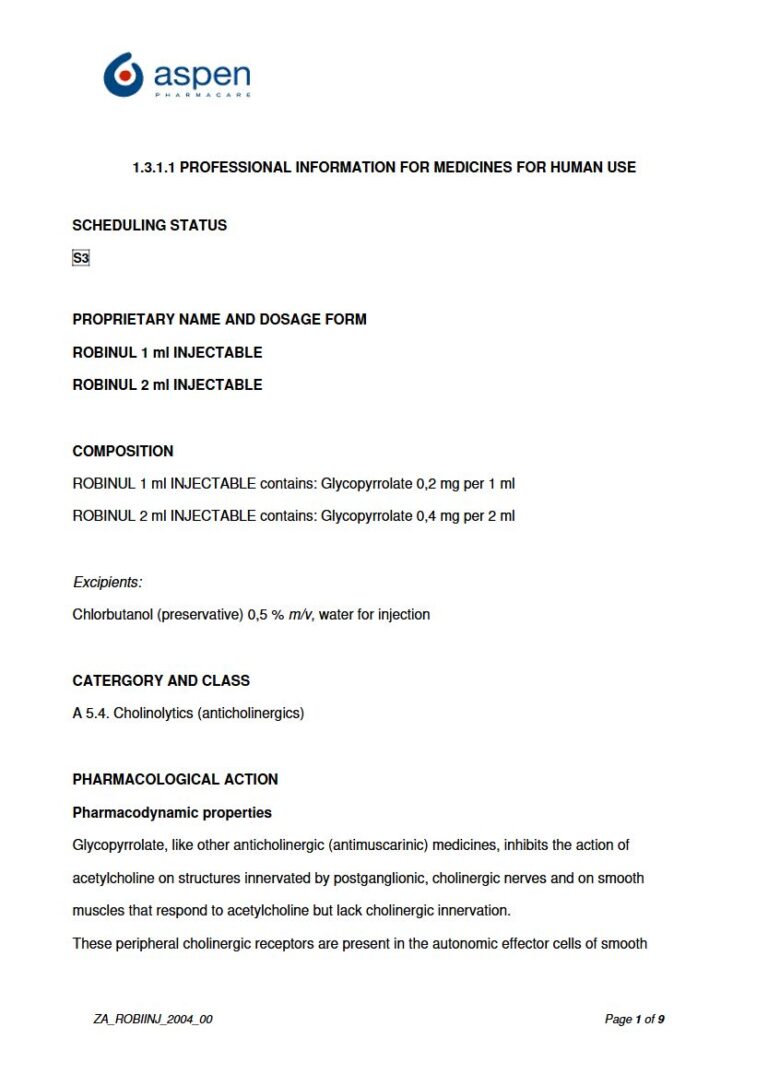
Robinul 1 Ml/2 Ml
PDF Leaflet Revision Date: 09 April 2020
Clinical Summary
Quick overview from the medicine insert
Indication
Pre-operative antimuscarinic to reduce secretions and block vagal reflexes.
Dosage (summary)
Adults: 0.004 mg/kg IM 30-60 mins pre-op; 0.1 mg IV for intra-op; 0.2 mg for neuromuscular blockade reversal.
Onset of Action / Duration
Onset: 1 min IV, Duration: 2-3 hours
Special Populations
- Elderly
- Renal impairment
- Cardiac conditions
Pregnancy & Breastfeeding
Safety not established; may be excreted in breast milk.
Key Drug Interactions
- MAOIs
- Tricyclic antidepressants
- Cholinergic medicines
Contraindications
- Hypersensitivity to glycopyrrolate
Common side effects
- Dizziness
- Blurred vision
- Dry mouth
- Tachycardia
Counselling Points
- Avoid driving until effects are known
- Monitor for signs of overheating in children
Serious warnings
- Caution in tachycardia, glaucoma, myasthenia gravis
- Risk of dysrhythmias during inhalation anesthesia
Important Disclaimer
The Robinul 1 Ml/2 Ml professional information leaflet below is the property of Pharmacare and is provided on Medinsert exactly as issued, with no.. alterations or editorial changes. We make every effort to keep content current by updating documents as soon as new versions become available. Medinsert serves as a trusted access point for healthcare professionals, but does not replace official sources or clinical judgement. For more details, please read our full disclaimer. read more>>
 Healthcare Professionals Only
This content is for registered healthcare professionals
Sign in or create a free account to read the full package insert.
Free for HPCSA-registered professionals. Powered by Medinsert.
Clinical Particulars
Section 4 of the official insert — extracted exactly as issued, no alterations
4.1 Therapeutic indications
In anaesthesia: ROBINUL INJECTABLE is indicated for use as a pre-operative antimuscarinic to reduce salivary, tracheobronchial and pharyngeal secretions to reduce the volume and free acidity of gastric secretions; and to block cardiac vagal inhibitory reflexes during induction of anaesthesia and intubation. ROBINUL INJECTABLE protects against the peripheral muscarinic effects (e.g. bradycardia and excessive secretions) of cholinergic medicines such as neostigmine and pyridostigmine given to reverse the neuromuscular blockade due to nondepolarising muscle relaxants.
4.2 Posology and method of administration
ROBINUL INJECTABLE may be administered intramuscularly, intravenously or subcutaneously, without dilution, in the following indications:
Adults:
- Pre-anaesthetic medication: The recommended dose of ROBINUL INJECTABLE is 0,004 mg (0,02 ml) per kilogram of body mass by intramuscular injection, given 30 minutes to one hour prior to the anticipated time of induction of anesthesia or at the time the preanaesthetic narcotic and/or sedative is administered.
- Intra-operative medication: ROBINUL INJECTABLE may be used during surgery to counteract anesthetic induced or vagal traction reflexes with the associated dysrhythmias (e.g. bradycardia). It should be administered intravenously as single dose of 0,1 mg (0,5 ml) and repeated as needed, at intervals of 2 to 3 minutes. The usual attempts should be made to determine the aetiology of the dysrhythmia, and the surgical or anesthetic manipulations necessary to correct parasympathetic imbalance should be performed.
- Reversal of neuromuscular blockade: The recommended dose of ROBINUL INJECTABLE is 0,2 mg(1,0 ml) for each 1,0 mg of neostigmine or 5,0 mg of pyridostigmine. In order to minimise the appearance of cardiac side effects, these substances may be administered simultaneously by intravenous injection and may be mixed in the same syringe.
Children: The recommended dosage range of ROBINUL INJECTABLE in children up to 12 years of age, is 0,004 mg to 0,008 mg (0, 02 ml to 0, 04 ml) intramuscularly per kilogram of body mass. For intraoperative use and for reversal of neuromuscular blockade, the paediatric dose is 0, 2 mg (1, 0 ml) ROBINUL INJECTABLE intravenously for each 1, 0 mg of neostigmine or 5, 0 mg of pyridostigmine.
Compatibility with other medicines: Chemical compatibility u2013 ROBINUL INJECTABLE is chemically compatible for mixing and injection with the following: 5 % and 10 % glucose in water or saline; meperidine injection; morphine sulphate; fentanyl plus droperidol injection; hydroxyzine injection. ROBINUL INJECTABLE may be administered via the tubing of a running infusion of physiological saline or lactated Ringeru2019s solution.
4.3 Contraindications
ROBINUL INJECTABLE is contraindicated in patients with hypersensitivity to glycopyrrolate or to any of the excipients in ROBINUL INJECTABLE (see COMPOSITION).
4.4 Special warnings and precautions for use
Because ROBINUL INJECTABLE causes tachycardia, extreme caution is advised in patients with existing tachycardia, thyrotoxicosis, coronary artery disease, cardiac dysrhythmias, hypertension, congestive heart failure and cardiac insufficiency. As ROBINUL INJECTABLE inhibits sweating, patients with increased temperature (especially children) should be observed closely. Caution is advised when ROBINUL INJECTABLE is used in patients with prostatic hypertrophy, paralytic ileus, pyloric stenosis and closed angle glaucoma. Anticholinergic medicines such as ROBINUL INJECTABLE can cause ventricular dysrhythmias when administered during inhalation anaesthesia especially in association with the halogenated hydrocarbons. Caution should be observed if ROBINUL INJECTABLE is used during halogenated anesthesia. If given in small incremental doses of 0,1 mg or less, the likelihood of producing ventricular dysrhythmias is reduced. Quaternary ammonium compounds in large doses have been shown to block end plate nicotinic receptors. This should be considered before using ROBINUL INJECTABLE in patients with myasthenia gravis. The renal elimination of glycopyrrolate is considerably prolonged in patients with uraemia. ROBINUL INJECTABLE should therefore be used with caution in such patients.
4.5 Interactions with other medicines
Antimuscarinic interactions: There is an increased risk of antimuscarinic side effects in patients taking medicines with antimuscarinic effects such as MAOIs, amantadine, clozapine, tricyclic antidepressants and nefopam.
Use with other medicines during anaesthesia: Glycopyrrolate as in ROBINUL INJECTABLE has been used clinically with at least the following medicines: a barbiturate (sodium thiopental), narcotic analgesics (morphine, alphaprodine hydrochloride, fentanyl), sedative/tranquiliser (droperidol, diazepam), gaseous anaesthetics (nitrous oxide), volatile liquid anesthetics (diethyl ether, halothane, methoxyflurane, enflurane), parenteral anesthetics (ketamine), peripherally-acting skeletal muscle relaxants (succinylcholine, gallamine, d-tubocurarine, pancuronium), cholinergic medicines (neostigmine, pyridostigmine) and other anticholinergics (atropine).
Chemical incompatibilities: Known chemical incompatibilities include the following injectables: sodium bicarbonate, diazepam, sodium pentobarbital, various phenothiazine, dimenhydrinate and chloramphenicol. ROBINUL INJECTABLE is also incompatible with alkalis. The stability of ROBINUL INJECTABLE, when mixed with infusion solutions and additives, is questionable above a pH of 6, owing to ester hydrolysis.
4.6 Fertility, pregnancy and lactation
The safety of ROBINUL INJECTABLE in pregnancy and lactation has not been established.
Pregnancy: Reproduction studies in rats and rabbits revealed no teratogenic effects from glycopyrrolate. However, diminished rates of conception and of survival at weaning were observed in rats, in a dose-related manner. Studies in dogs suggest that this may be due to diminished seminal secretion which is evident at high doses of glycopyrrolate.
Lactation: Glycopyrrolate may be excreted in breast milk.
4.7 Effects on ability to drive and use machines
Since adverse reactions such as dizziness, mental confusion and blurred vision have been reported in patients receiving ROBINUL INJECTABLE. Patients should not drive, use machinery or perform any tasks that require concentration, until they are certain that ROBINUL INJECTABLE does not adversely affect their ability to do so (see SIDE EFFECTS).
4.8 Undesirable effects
Immune system disorders: Less frequent: Severe allergic reaction, anaphylaxis, pseudoanaphylaxis
Psychiatric disorders: Less frequent: Mental confusion, nervousness, insomnia
Nervous system disorders: Less frequent: Headache, mental excitement (especially in the elderly), drowsiness, dizziness, giddiness, loss of taste
Eye disorders: Less frequent: Blurred vision due to midriasis, increased ocular tension, photophobia
Cardiac disorders: Less frequent: Bradycardia, tachycardia, palpitation, dysrhythmias
Respiratory, thoracic and mediastinal disorders: Less frequent: Reduced bronchial secretions
Gastrointestinal disorders: Less frequent: Nausea, vomiting, constipation, bloated feeling, dry mouth
Skin and subcutaneous tissue disorders: Less frequent: Decreased sweating, urticaria, flushing, dryness of the skin
Renal and urinary disorders: Less frequent: Urinary hesitancy and retention
Reproductive system and breast disorders: Less frequent: Impotence, suppression of lactation
General disorders and administrative site conditions: Less frequent: Weakness, pharmacologic idiosyncrasies
4.9 Overdose
Symptoms: Since ROBINUL INJECTABLE is a quaternary ammonium medicines, symptoms of overdosage are peripheral rather than central in nature (see SIDE EFFECTS).
Treatment: To combat peripheral anticholinergic effects, a quaternary ammonium anticholinesterase such as neostigmine methylsulphate may be given in a dose of 1, 0 mg for each 1, 0 mg of ROBINUL INJECTABLE known to have been administered.
