
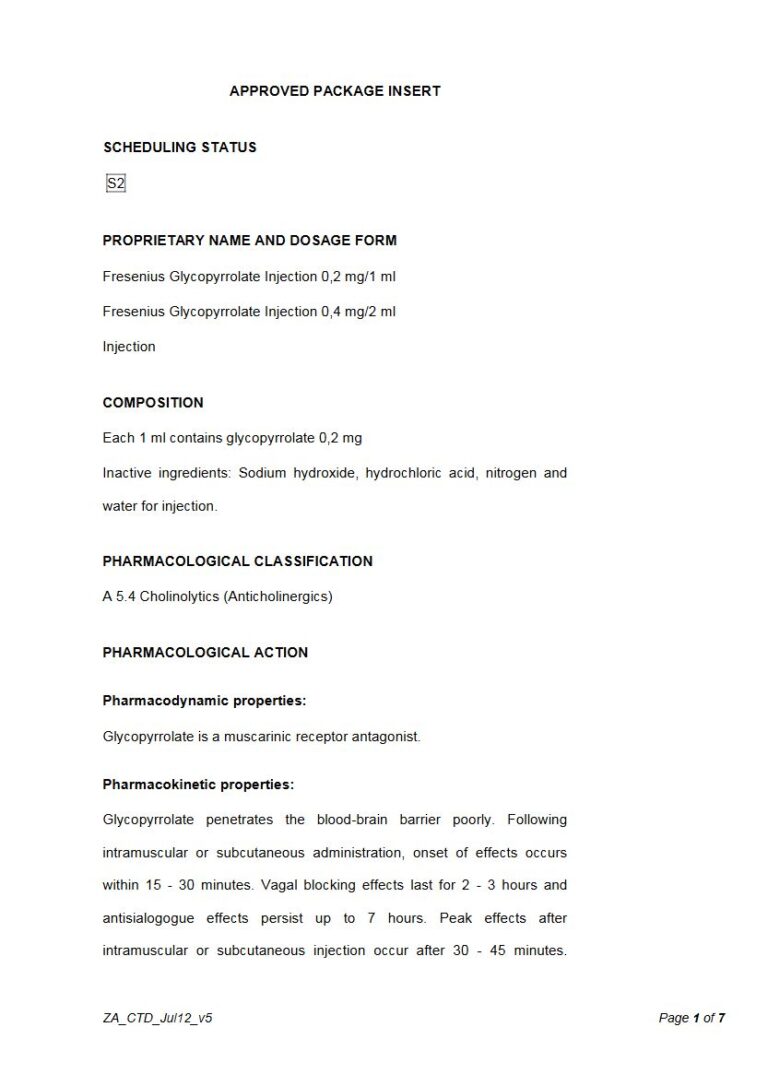
Fresenius Glycopyrrolate 0,2 mg/1 ml/0,4 mg/2 ml Injection
PDF Leaflet Revision Date: 19 April 2013
Clinical Summary
Quick overview from the medicine insert
Indication
Pre-operative use to decrease secretions and block vagal effects.
Dosage (summary)
Adults: 4 u00b5g/kg IM pre-anaesthetic; 100 u00b5g IV intraoperative; 200 u00b5g IV for neuromuscular blockade reversal.
Onset of Action / Duration
Onset: 15-30 mins, Duration: 2-7 hours
Special Populations
- Children
- Elderly
- Glaucoma
- Asthma
Pregnancy & Breastfeeding
Safety in pregnancy and lactation not established.
Key Drug Interactions
- Antimuscarinic agents
- Alkalis
Contraindications
- Hypersensitivity
- Prostatic enlargement
- Paralytic ileus
- Pyloric stenosis
Common side effects
- Dizziness
- Dry mouth
- Constipation
- Flushing
Counselling Points
- Avoid driving if dizzy
- Report any severe side effects
- Stay hydrated
Serious warnings
- Caution in glaucoma and asthma
- May impair ability to drive
Important Disclaimer
The Fresenius Glycopyrrolate 0,2 mg/1 ml/0,4 mg/2 ml Injection professional information leaflet below is the property of Fresenius Kabi Manufacturing Sa and is provided on Medinsert exactly as issued, with no.. alterations or editorial changes. We make every effort to keep content current by updating documents as soon as new versions become available. Medinsert serves as a trusted access point for healthcare professionals, but does not replace official sources or clinical judgement. For more details, please read our full disclaimer. read more>>
 Healthcare Professionals Only
This content is for registered healthcare professionals
Sign in or create a free account to read the full package insert.
Free for HPCSA-registered professionals. Powered by Medinsert.
Clinical Particulars
Section 4 of the official insert — extracted exactly as issued, no alterations
4.1 Therapeutic indications
Fresenius Glycopyrrolate Injection is used pre-operatively to decrease salivary, tracheobronchial and pharyngeal secretions; decrease gastric secretions and acidity and block the effects of vagal stimulation during anaesthesia and surgery. It also antagonises the peripheral muscarinic effects, such as bradycardia and excessive secretions of cholinergic agents used to reverse neuromuscular blockade due to non-depolarising muscle relaxants e.g. neostigmine and pyridostigmine.
4.2 Posology and method of administration
Fresenius Glycopyrrolate Injection may be administered intramuscularly, intravenously or subcutaneously, without dilution, in the following indications:
Adults :
- Pre-anaesthetic dose: 4 u03bcg (0,02 ml) per kg body mass given by intramuscular injection, 30 minutes to one hour before induction of anaesthesia. Maximum dose is 400 u03bcg.
- Intraoperative dose: 100 u03bcg (0,5 ml) given intravenously as a single dose, and repeated as needed at intervals of 2 u2013 3 minutes.
- To reverse neuromuscular blockade: 200 u03bcg (1 ml) IV for each 1 mg neostigmine or for each 5 mg pyridostigmine.
Children up to 12 years of age:
- Pre-anaesthetic dose: 4 u03bcg (0,02 ml/kg) given by intravenous or intramuscular injection. Maximum dose is 200 u03bcg.
- For intraoperative use: Similar dose as the pre-anaesthetic dose above may be given during operation if required.
- For reversal of neuromuscular blockade: 10 u03bcg/kg IV with neostigmine 50 u03bcg/kg IV [200 u03bcg (1 ml) IV for each 1 mg neostigmine or for each 5 mg pyridostigmine].
Fresenius Glycopyrrolate Injection can be mixed and injected with the following: 5 % and 10 % glucose in water or saline; pethidine injection; morphine sulphate; fentanyl plus droperidol injection; hydroxyzine injection. It can also be administered through tubing of an infusion of 0,9 % Sodium chloride or lactated Ringeru2019s solution.
4.3 Contraindications
Fresenius Glycopyrrolate Injection is contraindicated in:
- Patients with known hypersensitivity to glycopyrrolate or any of the ingredients of Fresenius Glycopyrrolate Injection.
- Patients with prostatic enlargement (in whom it may lead to urinary retention).
- Patients with paralytic ileus or pyloric stenosis.
4.4 Special warnings and precautions for use
Use with extreme caution in patients suffering from glaucoma or asthma. Fresenius Glycopyrrolate Injection should be used with caution in children and the elderly.
It should also be used with caution in the following conditions: ulcerative colitis, diarrhoea, myasthenia gravis, in patients with a fever or where the ambient temperature is high (as it can provoke hyperthermia), conditions characterised by tachycardia (thyrotoxicosis, heart failure and in cardiac surgery), myocardial infarction and hypertension as well as in coronary artery disease.
4.5 Interactions with other medicines
The effect of Fresenius Glycopyrrolate Injection may be enhanced by the concomitant administration of other medicines with antimuscarinic properties, e.g. amantadine, antihistamines, phenothiazine antipsychotics and tricyclic antidepressants. Chemical incompatibilities: Fresenius Glycopyrrolate Injection is incompatible with alkalis.
4.6 Fertility, pregnancy and lactation
Safety in pregnancy and lactation has not been established.
4.7 Effects on ability to drive and use machines
Fresenius Glycopyrrolate Injection may cause blurred vision and dizziness that may impair a patientu2019s ability to drive vehicles and operate machinery.
4.8 Undesirable effects
Psychiatric disorders
Frequency unknown: mental confusion.
Nervous system disorders
Frequency unknown: headache, nervousness, drowsiness, insomnia, dizziness.
Eye disorders
Frequency unknown: dilation of pupils (mydriasis), loss of accommodation (cycloplegia), photophobia.
Cardiac disorders
Frequency unknown: transient bradycardia followed by tachycardia, palpitations and dysrhythmias.
Respiratory, thoracic and mediastinal disorders
Frequency unknown: decreased bronchial secretions.
Gastrointestinal disorders
Frequency unknown: dry mouth with difficulty swallowing and talking, thirst, decreased tone and motility of the gastrointestinal tract leading to constipation, nausea and vomiting.
Skin and subcutaneous tissue disorders
Frequency unknown: flushing and dryness of the skin.
Renal and urinary disorders
Frequency unknown: difficulty in micturition.
Reproductive system and breast disorders
Frequency unknown: impotence and suppression of lactation.
General disorders and administrative site conditions
Frequency unknown: weakness.
4.9 Overdose
In overdose, symptoms such as hyperthermia, hypertension, increased respiratory rate, nausea and vomiting may occur. A rash may appear on the face or upper trunk. Neostigmine methylsulphate may be administered at a dose of 1,0 mg for each 1,0 mg of Fresenius Glycopyrrolate Injection that has been administered. Treatment is symptomatic and supportive.
