
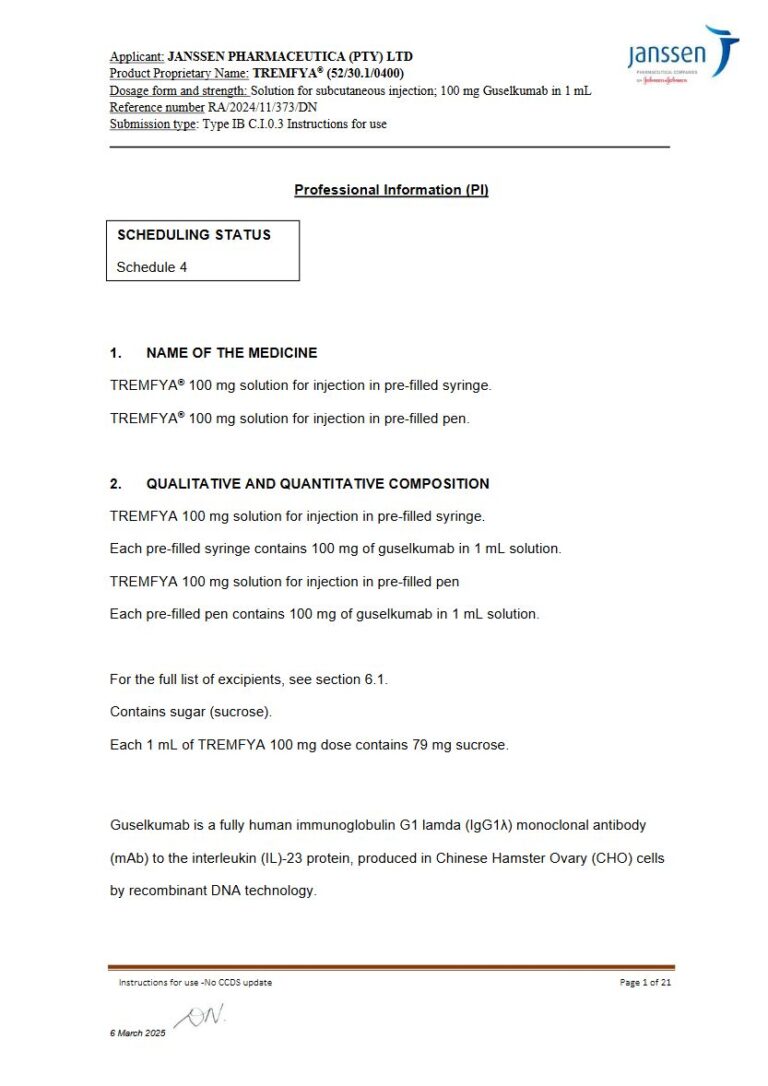
Tremfya 100 mg Solution for injection in pre-filled syringe
PDF Leaflet Revision Date: 6 March 2025
Clinical Summary
Quick overview from the medicine insert
Indication
Moderate-to-severe plaque psoriasis and active psoriatic arthritis.
Dosage (summary)
100 mg SC at week 0, week 4, then every 8 weeks; for psoriatic arthritis, consider every 4 weeks for high-risk patients.
Special Populations
- Elderly
- Renal impairment
- Hepatic impairment
Pregnancy & Breastfeeding
Contraindicated in pregnancy; avoid breastfeeding during treatment.
Key Drug Interactions
- Live vaccines
- CYP450 substrates
Contraindications
- Hypersensitivity to guselkumab
- Active infections
- Active tuberculosis
Common side effects
- Respiratory tract infections
- Headache
- Diarrhoea
- Injection site reactions
Counselling Points
- Seek medical advice for signs of infection
- Complete immunisations before starting therapy
- Do not use live vaccines
Serious warnings
- Increased risk of infections
- Serious hypersensitivity reactions
Important Disclaimer
The Tremfya 100 mg Solution for injection in pre-filled syringe professional information leaflet below is the property of Janssen Pharmaceutica and is provided on Medinsert exactly as issued, with no.. alterations or editorial changes. We make every effort to keep content current by updating documents as soon as new versions become available. Medinsert serves as a trusted access point for healthcare professionals, but does not replace official sources or clinical judgement. For more details, please read our full disclaimer. read more>>
 Healthcare Professionals Only
This content is for registered healthcare professionals
Sign in or create a free account to read the full package insert.
Free for HPCSA-registered professionals. Powered by Medinsert.
Clinical Particulars
Section 4 of the official insert — extracted exactly as issued, no alterations
4.1 Therapeutic indications
Plaque psoriasis
TREMFYA is indicated for the treatment of adults with moderate-to-severe plaque psoriasis. Safety and efficacy of TREMFYA beyond 5 years has not been established.
Psoriatic arthritis
TREMFYA, alone or in combination with methotrexate (MTX), is indicated for the treatment of active psoriatic arthritis in adult patients who have had an inadequate response or who have been intolerant to a prior disease-modifying antirheumatic drug (DMARD) therapy.
4.2 Posology and method of administration
Posology
Dosage - Adults (18 years and older)
Plaque psoriasis
The recommended dose of TREMFYA is 100 mg to be given as subcutaneous injection at week 0, week 4 and every 8 weeks thereafter.
Psoriatic arthritis
The recommended dose of TREMFYA is 100 mg by subcutaneous injection at weeks 0 and 4, followed by a maintenance dose every 8 weeks. For patients at high risk for joint damage according to clinical judgement, a dose of 100 mg every 4 weeks may be considered. Consideration should be given to discontinuing treatment in patients who have shown no response after 24 weeks of treatment.
General considerations for administration
TREMFYA is intended for use under the guidance and supervision of a medical practitioner. TREMFYA may be administered by a health care professional, or a patient may self-inject after proper training in subcutaneous injection technique. Comprehensive instructions for the administration of TREMFYA are given in the Patient Information Leaflet. Full amount of TREMFYA should be injected according to the directions provided.
Switching from other biologics to TREMFYA
TREMFYA has been shown to be safe and effective in patients with plaque psoriasis with an inadequate response to ustekinumab or adalimumab therapy. When switching to treatment with TREMFYA patients with plaque psoriasis, administer TREMFYA at week 0, week 4 and every 8 weeks thereafter.
Special populations
Paediatrics (below 18 years of age)
The safety and efficacy of TREMFYA in paediatric patients have not been evaluated; therefore, no recommendations on dosing can be made (see section 5.2, Pharmacokinetic properties).
Elderly (65 years of age and older)
Of the 3 940 plaque psoriasis and psoriatic arthritis patients exposed to TREMFYA in Phase 2 and Phase 3 clinical trials, a total of 239 patients were 65 years or older, and 19 patients were 75 years or older. No overall differences in safety or effectiveness were observed between older and younger patients who received TREMFYA in clinical studies. However, the number of patients aged 65 years and older was not sufficient to determine whether they respond differently from younger patients (see section 5.2, Pharmacokinetic Properties).
Renal and hepatic impairment
Specific studies of TREMFYA have not been conducted in patients with renal and hepatic insufficiency.
Method of administration
TREMFYA is administered by subcutaneous (SC) injection.
4.3 Contraindications
Hypersensitivity to guselkumab or to any of the excipients listed in section 6.1. Live vaccines must not be administered to patients receiving TREMFYA. Clinically important active infections irrespective of pathogen. Active tuberculosis. Pregnancy and lactation (see section 4.6, Fertility, pregnancy and lactation).
4.4 Special warnings and precautions for use
Infections
Safety and efficacy of TREMFYA in patients with HIV has not been established. TREMFYA may increase the risk of infection. Treatment with TREMFYA should not be initiated in patients with any clinically important active infection until the infection resolves or is adequately treated (see section 4.3, Contraindications). Infections have been observed in clinical trials in plaque psoriasis (23 % versus 21 % for placebo; u2264 0,2 % serious infections in both groups) and psoriatic arthritis (21 % in both TREMFYA and placebo groups; u2264 0,8 % serious infections in both groups). Instruct patients treated with TREMFYA to seek medical advice if signs or symptoms of clinically important chronic or acute infection occur. If a patient develops a clinically important or serious infection or is not responding to standard therapy, monitor the patient closely and discontinue TREMFYA until the infection resolves.
Pre-treatment evaluation for tuberculosis
In clinical studies, subjects with latent non-active tuberculosis (TB) who were concurrently treated with TREMFYA and appropriate TB prophylaxis did not develop TB. Evaluate patients for TB infection prior to initiating treatment with TREMFYA. Initiate treatment of latent non-active TB prior to administering TREMFYA. Patients receiving TREMFYA should be monitored for signs and symptoms of active TB during and after treatment. Do not administer TREMFYA to patients with active TB infection. Consider anti-TB therapy prior to initiating TREMFYA in patients with a past history of latent or active TB in whom an adequate course of treatment cannot be confirmed (see section 4.3, Contraindications).
Hypersensitivity reactions
Serious hypersensitivity reactions, including anaphylaxis, have been reported in the post-marketing setting. Some serious hypersensitivity reactions occurred several days after treatment with guselkumab, including cases with urticaria and dyspnoea. If a serious hypersensitivity reaction occurs, administration of TREMFYA should be discontinued immediately and appropriate therapy initiated.
Hepatic Transaminase Elevations
In psoriatic arthritis clinical studies, an increased incidence of liver enzyme elevations was observed in patients treated with TREMFYA q4w compared to patients treated with TREMFYA q8w or placebo (see section 4.8, Table 3). When prescribing TREMFYA q4w in psoriatic arthritis, it is recommended to evaluate the liver enzymes at baseline and thereafter according to routine patient management. If increases in alanine aminotransferase [ALT] or aspartate aminotransferase [AST] are observed and drug-induced liver injury is suspected, TREMFYA should be temporarily interrupted until the diagnosis is excluded.
Immunisations
Prior to initiating therapy with TREMFYA, consider completion of all age appropriate immunisations according to current immunisation guidelines. Do not use live vaccines in patients treated with TREMFYA (see section 4.3, Contraindications). No data are available on the response to live or inactive vaccines.
Sucrose intolerance
Contains sucrose which may have an effect on the glycaemic control of patients with diabetes mellitus. Patients with rare hereditary conditions such as fructose intolerance, glucose-galactose malabsorption or sucrase-isomaltase insufficiency should not take TREMFYA.
4.5 Interaction with other medicinal products and other forms of interaction
Interactions with CYP450 substrates
Although the activity of CYP450 enzymes can be altered by increased levels of certain cytokines (e.g., IL-1, IL-6, IL-10, TNF u03b1, interferon) during chronic inflammation, an in vitro study using human hepatocytes showed that IL-23 did not alter the expression or activity of multiple CYP450 enzymes (CYP1A2, 2B6, 2C9, 2C19, 2D6, or 3A4). In a Phase 1 study in subjects with moderate to severe plaque psoriasis, changes in systemic exposures (C max and AUC inf) of midazolam, S-warfarin, omeprazole, dextromethorphan, and caffeine after a single dose of guselkumab were not clinically relevant, indicating that medicine interactions between guselkumab and substrates of various CYP enzymes (CYP3A4, CYP2C9, CYP2C19, CYP2D6, and CYP1A2) are unlikely. There is no need for dose adjustment when co-administering guselkumab and CYP450 substrates.
Live vaccines/therapeutic infectious medicines
Live vaccines should not be given while a patient is undergoing therapy with TREMFYA (see section 4.3: Contraindications).
4.6 Fertility, pregnancy and lactation
Pregnancy
TREMFYA is contraindicated in pregnant women (see section 4.3, Contraindications). Women should use effective contraception during, and up to 12 weeks after, the last treatment with TREMFYA.
Breastfeeding
Women should not breastfeed their infants while receiving TREMFYA.
Fertility
The effect of TREMFYA on human fertility has not been evaluated. No guselkumab-related effects on fertility parameters were identified in female and male fertility studies conducted in guinea pigs.
4.7 Effects on ability to drive and use machines
No studies on the effects on the ability to drive and use machines have been performed.
4.8 Undesirable effects
Clinical studies experience in adult patients with psoriasis and psoriatic arthritis
The safety profile of TREMFYA is based on pooled Phase 2 and Phase 3 studies in 3 940 subjects, including 2 711 with plaque psoriasis and 1 229 subjects with psoriatic arthritis.
Adverse reactions
Adverse reactions to TREMFYA are presented in Table 1. Within each frequency grouping, the adverse reactions are presented within the designated system organ classes in order of decreasing frequency, using the following convention:
- Very common (u22651/10)
- Common (u22651/100, <1/10)
- Uncommon (u22651/1 000, <1/100)
Table 1: Summary of Adverse Reactions in Clinical Studies
Infections and infestations
Very common: respiratory tract infections
Uncommon: gastroenteritis, tinea infections, herpes simplex infections
Investigations
Common: increased transaminase
Uncommon: decreased neutrophil count
Nervous system disorders
Common: headache
Gastrointestinal disorders
Common: diarrhoea
Musculoskeletal and connective tissue disorders
Common: arthralgia
General disorders and administration site conditions
Common: injection site erythema
Uncommon: injection site pain
Table 2: Postmarketing data
System Organ class Adverse reaction
Immune system disorders
Uncommon: hypersensitivity
Uncommon: anaphylaxis
Skin and subcutaneous tissue disorders
Uncommon: rash and urticaria
General disorders and administration site conditions
Common: injection site reactions
Description of selected adverse reaction
Increased transaminases
In two Phase 3 psoriatic arthritis clinical studies, through the placebo-controlled period, adverse events of increased transaminases (includes increased ALT, increased AST, increased Hepatic Enzyme, increased Transaminases, abnormal Liver Function Test, Hypertransaminasaemia) were reported more frequently in the TREMFYA-treated groups (8.6% in the q4w group and 8.3% in the q8w group) than in the placebo group (4.6%). Through 1 year, adverse events of increased transaminases (as above) were reported in 12,9 % of patients in the q4w group and 11,7 % of patients in the q8w group. Based on laboratory assessments, most transaminase increases (ALT and AST) were u2264 3 x upper limit of normal (ULN). Transaminase increases from > 3 to u2264 5 x ULN and > 5 x ULN were low in frequency, occurring more often in the TREMFYA q4w group compared with the TREMFYA q8w group (Table 3). A similar pattern of frequency by severity and by treatment group was observed through the end of the 2-year Phase III psoriatic arthritis clinical study.
Table 3: Frequency of patients with transaminase increases post-baseline in two Phase III psoriatic arthritis clinical studies
Through Week 24 a Through 1 Year b
Placebo N=370 c TREMFYA 100 mg q8w N=373 c TREMFYA 100 mg q4w N=371 c TREMFYA 100 mg q8w N=373 c TREMFYA 100 mg q4w N=371 c
ALT >1 to u22643 x ULN 30.0% 28.2% 35.0% 33.5% 41.2%
>3 to u2264 5 x ULN 1.4% 1.1% 2.7% 1.6% 4.6%
>5 x ULN 0.8% 0.8% 1.1% 1.1% 1.1%
AST >1 to u22643 x ULN 20.0% 18.8% 21.6% 22.8% 27.8%
>3 to u2264 5 x ULN 0.5% 1.6% 1.6% 2.9% 3.8%
>5 x ULN 1.1% 0.5% 1.6% 0.5% 1.6%
a placebo-controlled period
b patients randomised to placebo at baseline and crossed over to TREMFYA are not included
c number of patients with at least one post-baseline assessment for the specific laboratory test within the time period
In the psoriasis clinical studies, through 1 year, the frequency of transaminase increases (ALT and AST) for the TREMFYA q8w dose was similar to that observed for the TREMFYA q8w dose in the psoriatic arthritis clinical studies. Through 5 years, the incidence of transaminase elevation did not increase by year of guselkumab treatment. Most transaminase increases were u2264 3 x ULN. In most cases, the increase in transaminases was transient and did not lead to discontinuation of treatment.
4.9 Overdose
In the event of overdosage, monitor the patient for any signs or symptoms of adverse reactions and administer appropriate symptomatic treatment immediately.
