
Hydrocortisone Cream Glenmark 2,0 mg Cream
PDF Leaflet Revision Date: 19 September 2023
Clinical Summary
Quick overview from the medicine insert
Indication
Relief of non-infected inflammatory and pruritic dermatoses.
Dosage (summary)
Apply topically as a thin film 2-3 times daily.
Special Populations
- Paediatric use not recommended
- Elderly use caution
Pregnancy & Breastfeeding
Contraindicated in pregnancy; caution in breastfeeding.
Contraindications
- Severe hypersensitivity to hydrocortisone valerate
- Pregnancy
Common side effects
- Stinging
- Skin irritation
- Eczema
- Burning skin
Counselling Points
- Do not use with occlusive dressings
- Discontinue if irritation occurs
- Reassess if no improvement in 2 weeks
Serious warnings
- Potential HPA axis suppression
- Risk of Cushing's syndrome
Important Disclaimer
The Hydrocortisone Cream Glenmark 2,0 mg Cream professional information leaflet below is the property of Glenmark Pharmaceuticals South Africa and is provided on Medinsert exactly as issued, with no.. alterations or editorial changes. We make every effort to keep content current by updating documents as soon as new versions become available. Medinsert serves as a trusted access point for healthcare professionals, but does not replace official sources or clinical judgement. For more details, please read our full disclaimer. read more>>
 Healthcare Professionals Only
This content is for registered healthcare professionals
Sign in or create a free account to read the full package insert.
Free for HPCSA-registered professionals. Powered by Medinsert.
Clinical Particulars
Section 4 of the official insert — extracted exactly as issued, no alterations
4.1 Therapeutic indications
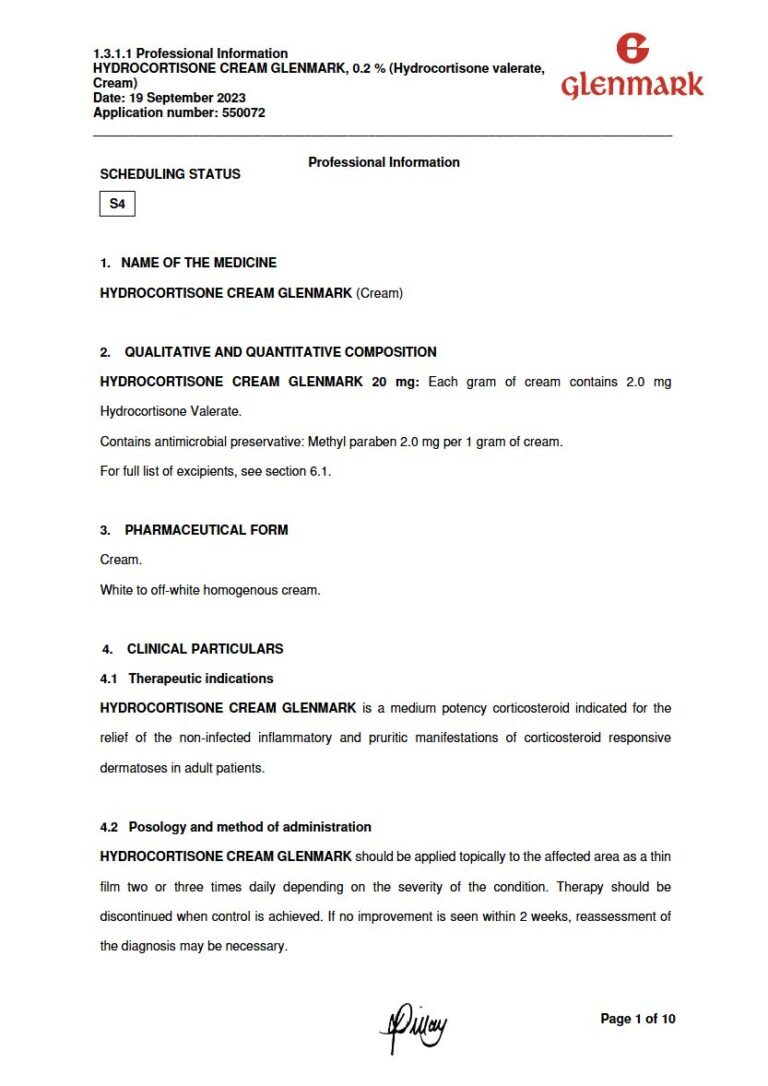
HYDROCORTISONE CREAM GLENMARK is a medium potency corticosteroid indicated for the relief of the non-infected inflammatory and pruritic manifestations of corticosteroid responsive dermatoses in adult patients.
4.2 Posology and method of administration
HYDROCORTISONE CREAM GLENMARK should be applied topically to the affected area as a thin film two or three times daily depending on the severity of the condition. Therapy should be discontinued when control is achieved. If no improvement is seen within 2 weeks, reassessment of the diagnosis may be necessary.
HYDROCORTISONE CREAM GLENMARK should not be used with occlusive dressings unless directed by a medical practitioner. HYDROCORTISONE CREAM GLENMARK should not be applied in the diaper area if the patient requires diapers or plastic pants as these garments may constitute occlusive dressing.
4.3 Contraindications
- HYDROCORTISONE CREAM GLENMARK is contraindicated in patients who have a history of severe hypersensitivity reactions to hydrocortisone valerate or to any of the other components of the preparation.
- Pregnancy
4.4 Special warnings and precautions for use
General
Systemic absorption of topical corticosteroids can produce reversible hypothalamic-pituitary-adrenal (HPA) axis suppression with the potential for glucocorticosteroid insufficiency after withdrawal of treatment. Manifestations of Cushing's syndrome, hyperglycaemia, and glucosuria can also be produced in some patients by systemic absorption of topical corticosteroids while on treatment.
Patients applying a topical steroid to a large surface area or to areas under occlusion should be evaluated periodically for evidence of HPA axis suppression. This may be done by using the ACTH stimulation, A.M. plasma cortisol, and urinary free cortisol tests.
HYDROCORTISONE CREAM GLENMARK has produced mild, reversible adrenal suppression in adult patients when used under occlusion for 5 days, 15 grams twice a day over 25-60 % body surface area or when used three times a day over 20-30 % body surface area to treat psoriasis for 3-4 weeks.
If HPA axis suppression is noted, an attempt should be made to withdraw the medicine, to reduce the frequency of application, or to substitute a less potent corticosteroid. Recovery of HPA axis function is generally prompt upon discontinuation of topical corticosteroids. Infrequently, signs and symptoms of glucocorticosteroid insufficiency may occur, requiring supplemental systemic corticosteroids. For information on systemic supplementation, see prescribing information for these products.
Paediatric patients may be more susceptible to systemic toxicity from equivalent doses due to their larger skin surface to body mass ratios. (See Paediatric Use).
If irritation develops HYDROCORTISONE CREAM GLENMARK should be discontinued and appropriate therapy instituted. Allergic contact dermatitis with corticosteroids are usually diagnosed by observing a failure to heal rather than noting a clinical exacerbation, as with most topical products not containing corticosteroids. Such an observation should be corroborated with appropriate diagnostic patch testing.
If concomitant skin infections are present or develop, an appropriate antifungal or antibacterial medicine should be used. If a favourable response does not occur promptly, use of HYDROCORTISONE CREAM GLENMARK should be discontinued until the infection has been adequately controlled.
Laboratory Tests
The following tests may be helpful in evaluating patients for HPA axis suppression: ACTH stimulation test A.M. plasma cortisol test, Urinary free cortisol test.
4.5 Interaction with other medicines and other forms of interaction
No interactions reported.
4.6 Fertility, pregnancy and lactation
Pregnancy: Corticosteroids have been shown to be teratogenic in laboratory animals when administered systemically at relatively low dosage levels. Some corticosteroids have been shown to be teratogenic after dermal application in laboratory animals. The use of HYDROCORTISONE CREAM GLENMARK is contraindicated during pregnancy.
Dermal embryofoetal developmental studies were conducted in rabbits and rats with hydrocortisone valerate cream. Hydrocortisone valerate cream was administered topically for 4 hours/day, rather than the preferred 24 hours/day, during the period of organogenesis in rats (gestational days 5-16) and rabbits (gestational days 6-19). Topical doses of hydrocortisone valerate up to 9 mg/kg/day (54 mg/m2/day) were administered to rats and 5 mg/kg/day (60 mg/m2/day) were administered to rabbits. In the absence of maternal toxicity, a significant increase in delayed skeletal ossification in foetuses was noted at 9 mg/kg/day [2.5 x the Maximum Recommended Human Dose (MRHD) based on body surface area (BSA) comparisons] in the rat study. No malformations in the foetuses were noted at 9 mg/kg/day (2.5 x MRHD based on BSA comparisons) in the rat study. Indicators of embryofoetal toxicity, significant decrease in foetal weight at 2 mg/kg/day (1 x MRHD based on BSA) and a significant increase in post-implantation loss and embryo resorption at 5 mg/kg (3 x MRHD based on BSA), were noted in the rabbit study. A significant increase in delayed skeletal ossification in foetuses was noted at 5 mg/kg/day (3 x the MRHD based on BSA comparisons) in the rabbit study.
Increased numbers of foetal malformations (e.g., cleft palate, omphalocele and clubbed feet) were noted at 5 mg/kg/day (3 x MRHD based on BSA comparisons) in the rabbit study.
Breastfeeding: Systemically administered corticosteroids appear in human milk and could suppress growth, interfere with endogenous corticosteroid production, or cause other untoward effects. It is not known whether topical administration of corticosteroids could result in sufficient systemic absorption to produce detectable quantities in human milk. Because many drugs are excreted in human milk, caution should be exercised when HYDROCORTISONE CREAM GLENMARK is administered to a nursing woman.
4.7 Effects on ability to drive and use machines
No studies on the effects on the ability to drive and use machines have been performed.
4.8 Undesirable effects
a. Summary of the safety profile
The following local adverse reactions have been reported with topical corticosteroids, and they may occur more frequently with the use of occlusive dressings.
b. Tabulated adverse reactions
Tabulated list of adverse reactions for HYDROCORTISONE CREAM GLENMARK
| System Organ Class | Frequency | Undesirable effect |
|---|---|---|
| Infections and infestations | Common | Infection, fungal infection |
| Gastrointestinal disorders | Common | Gastrointestinal disorder |
| Skin and subcutaneous tissue disorders | Very common | Stinging |
| Skin and subcutaneous tissue disorders | Common | Eczema, burning skin, skin irritation, eczema, pruritus, rash, rash maculopapular, dry skin |
| Skin and subcutaneous tissue disorders | Unknown | Itching, folliculitis, hypertrichosis, acneiform eruptions, hypopigmentation, perioral dermatitis, allergic contact dermatitis, maceration of the skin, secondary infection, skin atrophy, striae, miliaria. |
| General disorders and administration site conditions | Common | Application site reaction |
Description of selected adverse reactions: Local adverse reactions may occur with use of topical corticosteroids and may be more likely to occur with occlusive use, prolonged use or use of higher potency corticosteroids. Some local adverse reactions may be irreversible. Reactions may include atrophy, striae, telangiectasias, burning, itching, irritation, dryness, folliculitis, acneiform eruptions, hypopigmentation, perioral dermatitis, allergic contact dermatitis, secondary infection, and miliaria.
Reporting of suspected adverse reactions
Reporting suspected adverse reactions after authorisation of the medicine is important. It allows continued monitoring of the benefit/risk balance of the medicine. Health care providers are asked to report any suspected adverse reactions to SAHPR A via the u201c6.04 Adverse Drug Reactions Reporting Formu201d, found online under SAHPRAu2019s publications: https://www.sahpra.org.za/Publications/Index/8
4.9 Overdose
Topically applied HYDROCORTISONE CREAM GLENMARK can be absorbed in sufficient amounts to produce systemic effects (see section 4.3). Treatment is symptomatic and supportive.
