
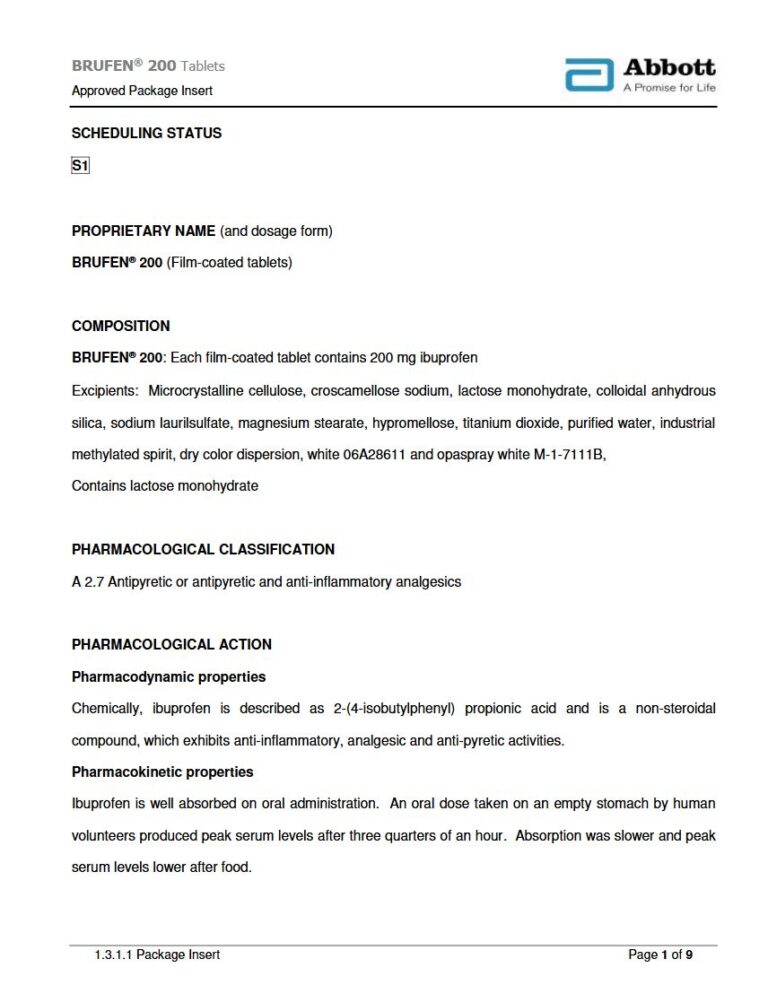
Brufen 200mg Tablets
PDF Leaflet Revision Date: 02 October 2015
Clinical Summary
Quick overview from the medicine insert
Indication
Mild to moderate pain and fever.
Dosage (summary)
Adults: 1,200 mg daily in divided doses; max 1,200 mg/day.
Onset of Action / Duration
Onset: 30 mins, Duration: 6-8 hours
Special Populations
- Elderly
- Renal impairment
- Hepatic impairment
Pregnancy & Breastfeeding
Contraindicated in third trimester; caution in lactation.
Key Drug Interactions
- Antihypertensives
- NSAIDs
- Corticosteroids
- Anti-coagulants
Contraindications
- Peptic ulceration
- History of PUB
- Hypersensitivity to NSAIDs
- Heart failure
- Renal failure
Common side effects
- Gastrointestinal disorders
- Dizziness
- Nausea
- Visual impairment
Counselling Points
- Take with food to reduce GI upset
- Avoid in late pregnancy
- Report any skin rash or allergic reactions
Serious warnings
- Risk of gastrointestinal bleeding
- Serious skin reactions
- Fluid retention in heart failure
Important Disclaimer
The Brufen 200mg Tablets professional information leaflet below is the property of Abbott Laboratories Sa and is provided on Medinsert exactly as issued, with no.. alterations or editorial changes. We make every effort to keep content current by updating documents as soon as new versions become available. Medinsert serves as a trusted access point for healthcare professionals, but does not replace official sources or clinical judgement. For more details, please read our full disclaimer. read more>>
 Healthcare Professionals Only
This content is for registered healthcare professionals
Sign in or create a free account to read the full package insert.
Free for HPCSA-registered professionals. Powered by Medinsert.
Clinical Particulars
Section 4 of the official insert — extracted exactly as issued, no alterations
4.1 Therapeutic indications
BRUFEN u00ae 200 is indicated for the treatment of mild to moderate pain of inflammatory origin and fever, including:
- Soft tissue injuries such as sprains and strains
- headache
- back pain of musculo-skeletal origin
- fever
- muscular aches and pain
- menstrual pain
- dental pain
- pain associated with migraine
- earache
4.3 Contraindications
BRUFEN u00ae 200 should not be given to patients with:
- peptic ulceration
- History of gastrointestinal perforation, ulceration or bleeding (PUB) related to previous NSAIDu2019s use.
- Active or history of recurrent ulcer, haemorrhage or perforations.
- Third trimester of pregnancy and during labour. (see PREGNANCY AND LACTATION)
- BRUFEN u00ae 200 is contraindicated in patients who are hypersensitive to ibuprofen, aspirin or any other non-steroidal anti-inflammatory agent. Because of the possibility of cross-sensitivity due to structural relationships which exist among non-steroidal anti-inflammatory medicines, acute allergic reactions may be more likely to occur in patients who have exhibited allergic reactions to these compounds.
- BRUFEN u00ae 200 is contraindicated in patients with heart failure.
- BRUFEN u00ae 200 is contraindicated in patients with renal failure.
4.4 Special warnings and precautions for use
- Caution is required in patients with a history of hypertension and/or heart failure as fluid retention and oedema have been reported in association with BRUFEN u00ae 200 therapy. In view of the BRUFEN u00ae 200 u2019s inherent potential to cause fluid retention, heart failure may be precipitated in some compromised patients.
- Elderly: The elderly have an increased frequency of adverse reactions to NSAIDs including BRUFEN u00ae 200, especially gastrointestinal perforation, ulceration and bleeding (PUBs) which may be fatal.
- The risk of gastrointestinal perforation, ulceration or bleeding (PUBs) is higher with increasing doses of BRUFEN u00ae 200, in patients with a history of ulcers, and the elderly.
- When gastrointestinal bleeding or ulceration occurs in patients receiving BRUFEN u00ae 200, treatment with BRUFEN u00ae 200 should be stopped.
- BRUFEN u00ae 200 should be given with caution to patients with a history of gastrointestinal disease (e.g. ulcerative colitis, Crohnu2019s disease, hiatus hernia, gastro-oesophageal reflux disease, angiodysplasia) as the condition may be exacerbated.
- Serious skin reactions, some of them fatal, including exfoliative dermatitis, Stevens-Johnson syndrome, and toxic epidermal necrolysis have been reported. BRUFEN u00ae 200 should be discontinued at the first appearance of skin rash, mucosal lesions, or any other sign of hypersensitivity.
- Regular use of NSAIDs such as BRUFEN u00ae 200 during the third trimester of pregnancy, may result in premature closure of the foetal ductus arteriosus in utero, and possibly, in persistent pulmonary hypertension of the new-born. The onset of labour may be delayed and its duration increased. (see PREGNANCY AND LACTATION)
- BRUFEN u00ae 200 contains lactose monohydrate and should not be given to patients with rare hereditary problems or a history of galactose intolerance, lapp lactase deficiency or glucose-galactose malabsorption.
- BRUFEN u00ae 200 should be given with care to the elderly, to patients with asthma or bronchospasm, bleeding disorders, cardiovascular disease, a history of peptic ulceration, and in liver or renal failure. Patients with congestive heart failure, cirrhosis, diuretic-induced volume depletion, or renal insufficiency require local synthesis of vasodilating prostaglandins to maintain renal perfusion, and therefore these patients are at greater risk of developing renal dysfunction due to NSAID-induced inhibition of renal prostaglandin synthesis. Care is required in those who are also receiving warfarin and other anti-coagulants.
- Patients who are sensitive to aspirin or other NSAIDs should generally not be given ibuprofen.
- Ibuprofen should be discontinued in patients who experience blurred or diminished vision, or changes in colour vision. Patients with collagen disease may be at increased risk of developing aseptic meningitis.
4.7 Effects on ability to drive and use machines
Undesirable effects such as dizziness, drowsiness, fatigue and visual disturbances are possible after taking BRUFEN u00ae 200. If affected, patients should not drive or operate machinery.
4.5 Interactions with other medicines
- Antihypertensives, beta-blockers and diuretics: BRUFEN u00ae 200 may reduce the effect of anti-hypertensives, such as ACE inhibitors, beta-blockers and diuretics.
- NSAIDs: use of two or more NSAIDs concomitantly could result in an increase in side effects.
- Corticosteroids: increased risk of gastrointestinal perforation, ulceration or bleeding (PUBs).
- Anti-coagulants: BRUFEN u00ae 200 may enhance the effects of anti-coagulants such as warfarin.
- Anti-platelet medicines and selective serotonin reuptake inhibitors (SSRIs): increased risk of gastrointestinal bleeding.
- Diuretics can also increase the risk of nephrotoxicity of BRUFEN u00ae 200.
- Digoxin: BRUFEN u00ae 200 may exacerbate cardiac failure, reduce GFR and increase plasma digoxin levels.
- Lithium: Decreased elimination of lithium.
- Ciclosporin: Increased risk of nephrotoxicity.
- Mifepristone: A decrease in the efficacy of the medicinal product can theoretically occur due to the antiprostaglandin properties of BRUFEN u00ae 200. Limited evidence suggests that coadministration of BRUFEN u00ae 200 on the day of prostaglandin administration does not adversely influence the effects of mifepristone or the prostaglandin on cervical ripening or uterine contractility and does not reduce the clinical efficacy of medicinal termination of pregnancy.
- Quinolone antibiotics: Animal data indicate that NSAIDs can increase the risk of convulsions associated with quinolone antibiotics. Patients taking BRUFEN u00ae 200 and quinolones may have an increased risk of developing convulsions.
- Aminoglycosides: BRUFEN u00ae 200 may decrease the excretion of aminoglycosides.
- Herbal extracts: Ginkgo biloba may potentiate the risk of bleeding with BRUFEN u00ae 200.
4.8 Undesirable effects
The following side-effects have been reported:
Gastrointestinal system disorders: The most commonly observed adverse events are gastrointestinal in nature. Peptic ulcers, perforation or gastrointestinal bleeding, sometimes fatal. Nausea, vomiting, diarrhoea, flatulence, constipation, dyspepsia, abdominal pain, melaena, haematemesis, ulcerative stomatitis, exacerbation of colitis and Crohnu2019s disease, gastritis.
Less frequent: abdominal discomfort or pain, nausea, vomiting, gastro-intestinal ulcers, sometimes with bleeding.
Nervous system disorder: Frequent: Dizziness, nervousness, tinnitus, drowsiness, insomnia.
Psychiatric disorder: Frequent: Depression.
Eye disorders: Visual impairment, changes in visual colour perception, toxic amblyopia.
Renal and Urinary disorders: Less frequent: Acute renal failure, cystitis, haematuria, interstitial nephritis, nephrotic syndrome.
Hepatobiliary syndrome: Less frequent: Hepatotoxicity, abnormalities in liver function tests.
Blood and lymphatic system disorders: Less frequent: Anaemia, thrombocytopenia, neutropenia, eosinophilia, agranulocytosis.
Immune disorders: Less frequent: Aseptic meningitis, angioedema and anaphylaxis.
Hypersensitivity disorders: Less frequent: Fever, rashes, exacerbation of asthma and bronchospasm.
Cardiovascular disorders: Frequency unknown: Oedema, hypertension and cardiac failure.
Skin and subcutaneous tissue disorders: Frequency unknown: Bullous reactions, including Stevens-Johnson syndrome and toxic epidermal necrolysis.
4.9 Overdose
The most likely symptoms of overdosage are epigastric pain and nausea. If recently taken, gastric lavage will remove any unabsorbed ibuprofen. Electrolytes may be corrected by intravenous infusions, if necessary. There is no specific antidote to BRUFEN u00ae 200. Treatment is symptomatic and supportive.
