
Klacid Xl 500mg Tablet
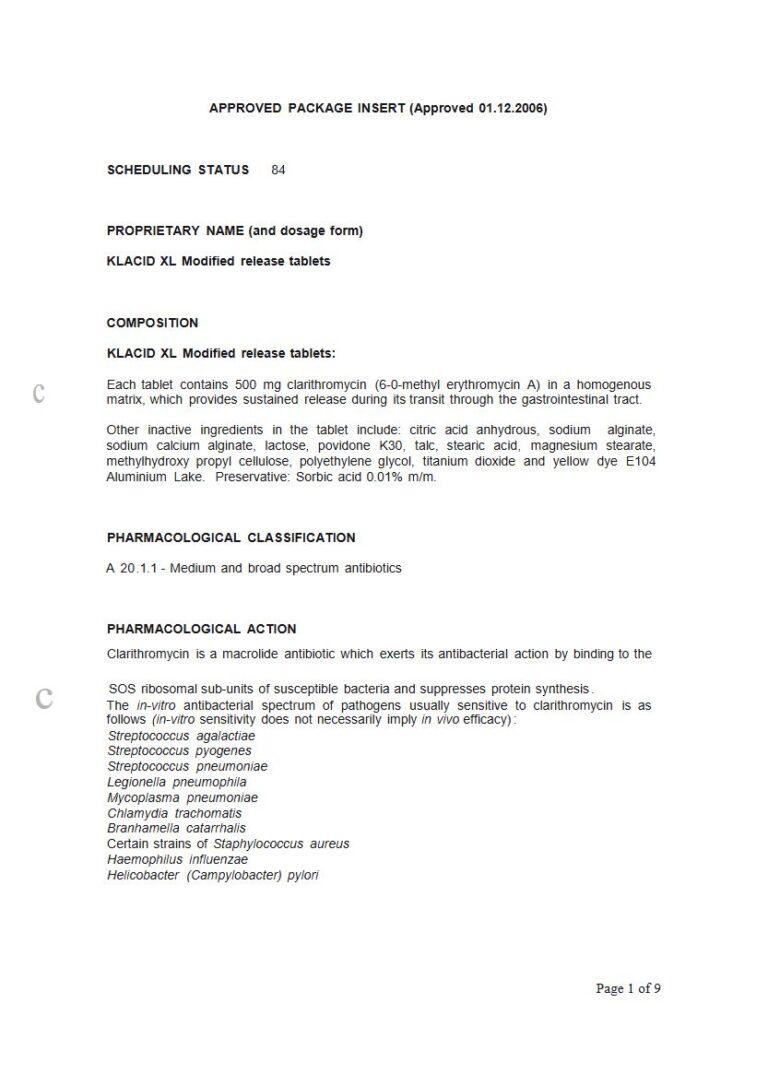
PDF Leaflet Revision Date: 01 December 2006
Clinical Summary
Quick overview from the medicine insert
Indication
Treatment of respiratory and skin infections.
Dosage (summary)
500 mg once daily with food; may increase to 1000 mg for severe infections.
Special Populations
- Renal impairment
- Hepatic impairment
Pregnancy & Breastfeeding
Not established; use with caution in pregnancy and is excreted in breast milk.
Key Drug Interactions
- Warfarin
- Colchicine
- CYP3A substrates
Contraindications
- Hypersensitivity to macrolides
- Creatinine clearance < 30 ml/min
Common side effects
- Abdominal pain
- Nausea
- Diarrhoea
- Dizziness
- Headache
Counselling Points
- Take with food
- Monitor for signs of liver dysfunction
- Avoid in severe renal impairment
Serious warnings
- Pseudomembranous colitis
- Colchicine toxicity
- QT prolongation
Important Disclaimer
The Klacid Xl 500mg Tablet professional information leaflet below is the property of Abbott Laboratories Sa and is provided on Medinsert exactly as issued, with no.. alterations or editorial changes. We make every effort to keep content current by updating documents as soon as new versions become available. Medinsert serves as a trusted access point for healthcare professionals, but does not replace official sources or clinical judgement. For more details, please read our full disclaimer. read more>>
 Healthcare Professionals Only
This content is for registered healthcare professionals
Sign in or create a free account to read the full package insert.
Free for HPCSA-registered professionals. Powered by Medinsert.
Clinical Particulars
Section 4 of the official insert — extracted exactly as issued, no alterations
4.1 Therapeutic indications
KLACID XL modified release tablets are indicated in the treatment of:
- Lower respiratory tract infections, e.g. bronchitis, pneumonia
- Upper respiratory tract infections, e.g. pharyngitis, sinusitis
- Skin and soft tissue infections, e.g. folliculitis, cellulitis, erysipelas
4.2 Posology and method of administration
The recommended dosage of KLACID XL modified release tablets in adults is 500 mg once daily with food. In more severe infections, the dosage can be increased to 1000 mg once daily (2 x 500 mg). Tablets should be swallowed whole. KLACID XL modified release tablets should not be used in patients with significant renal impairment (creatinine clearance less than 30 ml/min) as appropriate clarithromycin dosage reduction is not possible when administering this product. For patients with moderate renal function (creatinine clearance 30 to 60 ml/min), a 50% dosage reduction should be implemented resulting in a maximum dose of one KLACID XL tablet per day.
4.3 Contraindications
KLACID XL is contra-indicated in patients with known hypersensitivity to macrolide antibiotic drugs. As the dose of KLACID XL cannot be reduced from 500 mg once daily, the modified release tablets are contra-indicated in patients with a creatinine clearance of less than 30 ml/min. Concomitant administration of KLACID XL and any of the following agents is contra-indicated: astemizole, cisapride, pimozide, terfenadine and ergotamine or dihydroergotamine (see INTERACTIONS).
4.4 Special warnings and precautions for use
KLACID XL is principally excreted by the liver. Caution should be exercised in administering the antibiotic to patients with impaired hepatic function. Caution should also be exercised when administering KLACID XL to patients with moderate to severe renal impairment. There have been post-marketing reports of colchicine toxicity with concomitant use of KLACID and colchicine, especially in the elderly, some of which occurred in patients with renal insufficiency. Deaths have been reported in some such patients. (See INTERACTIONS: Colchicine)
Pseudomembranous colitis has been reported with nearly all antibacterial agents, including macrolides, and may range in severity from mild to life-threatening. Attention should be paid to the possibility of cross-resistance between KLACID XL and other macrolide medicines, as well as lincomycin and clindamycin.
4.5 Interactions with other medicines
Data available to date indicate KLACID XL is metabolised primarily by the hepatic cytochrome P450 3A (CYP3A) isozyme. This is an important mechanism determining many drug interactions. The metabolism of other drugs by this system may be inhibited by concomitant administration with KLACID XL and may be associated with elevations in serum levels of these other drugs. The following drugs or drug classes are known or suspected to be metabolised by the same CYP3A isozyme: alprazolam, astemizole, carbamazepine, cilostazol, cisapride, cyclosporine, disopyramide, ergot alkaloids, lovastatin, methylprednisolone, midazolam, omeprazole, oral anticoagulants (e.g. warfarin), pimozide, quinidine, rifabutin, sildenafil, simvastatin, tacrolimus, terfenadine, triazolam and vinblastine. Drugs interacting by similar mechanisms through other isoenzymes within the cytochrome P450 system include phenytoin, theophylline and valproate.
Results of clinical studies indicate that there was a modest but statistically significant (p 0,05) increase of circulating theophylline or carbamazepine levels when either of these drugs was administered concomitantly with KLACID XL. The use of KLACID XL in patients receiving warfarin may result in potentiation of the effects of warfarin. Prothrombin times should be monitored in these patients.
The following CYP3A based drug interactions have been observed with erythromycin products and/or with KLACID XL in post-marketing experience: Rhabdomyolysis co-incident with the co-administration of KLACID XL and the HMG-CoA reductase inhibitors, lovastatin and simvastatin, has less frequently been reported. Elevated cisapride levels have been reported in patients receiving KLACID XL and cisapride concomitantly. This may result in QT prolongation and cardiac arrhythmias including ventricular tachycardia, ventricular fibrillation and Torsades de Pointes. Similar effects have been observed in patients taking KLACID XL and pimozide concomitantly. (See CONTRA-INDICATIONS).
Macrolides have been reported to alter the metabolism of terfenadine resulting in increased levels of terfenadine, which has occasionally been associated with cardiac arrhythmias such as QT prolongation, ventricular tachycardia, ventricular fibrillation and Torsades de Pointes (see CONTRA-INDICATIONS). In one study in 14 healthy volunteers, the concomitant administration of KLACID and terfenadine resulted in a 2 to 3 fold increase in the serum level of the acid metabolite of terfenadine and in prolongation of the QT interval, which did not lead to any clinically detectable effect. Similar effects have been observed with concomitant administration of astemizole and other macrolides.
There have been post-marketed reports of Torsades de Pointes occurring with concurrent use of KLACID and quinidine or disopyramide. Serum levels of these medications should be monitored during KLACID XL therapy.
Post-marketing reports indicate that co-administration of KLACID with ergotamine or dihydroergotamine has been associated with acute ergot toxicity characterised by vasospasm, and ischaemia of the extremities and other tissues including the central nervous system. Permanent tissue damage may result.
Elevated digoxin serum concentrations have been reported in patients receiving KLACID tablets and digoxin concomitantly. Monitoring of serum digoxin levels should be considered. Colchicine is a substrate for both CYP3A and the efflux transporter, P-glycoprotein (Pgp). KLACID and other macrolides are known to inhibit CYP3A and Pgp. When KLACID and colchicine are administered together, inhibition of Pgp and/or CYP3A by KLACID may lead to increased exposure to colchicine. Patients should be monitored for clinical symptoms of colchicine toxicity (see WARNINGS). Deaths have been reported in elderly patients with renal insufficiency that have been receiving concomitant colchicine.
Simultaneous oral administration of KLACID XL tablets and zidovudine to HIV-infected adult patients may result in decreased steady-state zidovudine concentrations. Because KLACID XL appears to interfere with the absorption of simultaneously administered oral zidovudine, this interaction can be largely avoided by staggering the doses of KLACID XL and zidovudine. This interaction does not appear to occur in paediatric HIV-infected patients taking KLACID suspension with zidovudine or dideoxyinosine. Similar interaction studies with KLACID XL and zidovudine have not been conducted.
A pharmacokinetic study demonstrated that the concomitant administration of ritonavir 200 mg eight hourly and KLACID 500 mg twelve hourly resulted in a marked inhibition of the metabolism of KLACID. The KLACID Cmax increased by 31%, Cmin increased by 182% and AUC increased by 77% with concomitant administration of ritonavir. An essentially complete inhibition of the formation of 14-[R]-hydroxy-clarithromycin was noted. Because of the large therapeutic window for KLACID XL, no dosage reduction should be necessary in patients with normal renal function. However, for patients with renal impairment, the following dosage adjustments should be considered: For patients with CLcR 30 to 60 ml/min the dose of KLACID XL should be reduced by 50%, resulting in a maximum dose of one KLACID XL tablet per day. For patients with severe renal impairment (CLcR < 30 ml/min), KLACID XL should not be used as appropriate KLACID dosage reduction is not possible when administering this product. Doses of clarithromycin greater than 1 g/day should not be co-administered with ritonavir.
4.6 Fertility, pregnancy and lactation
Safety in pregnancy and lactation has not been established. The physician should not prescribe KLACID XL to pregnant women without carefully weighing the benefits against the risk, particularly during the first three months of pregnancy. KLACID XL is excreted into human breast-milk.
4.7 Effects on ability to drive and use machines
Not provided in the text.
4.8 Undesirable effects
Summary of Adverse Drug Reactions Reported During Clinical Trials with KLACID XL Tablets once daily, 500 mg (lower respiratory tract infections):
System Organ Class Frequency Adverse Drug Reactions
- Infections and infestations Common Oral candidiasis
- Gastrointestinal disorders Common Abdominal pain, Nausea, Diarrhoea
- Nervous system disorders Common Dizziness, Dysgeusia, Headache
- Investigations Common Alanine aminotransferase increased
* Reported incidence of adverse events possibly related, probably related or related in phase III clinical studies on KLACID treatment of lower respiratory tract infections involving 376 patients taking KLACID XL.
Adverse drug events reported during clinical trials with KLACID XL tablets, 500 mg: The most commonly reported adverse drug reaction was abdominal pain. Adverse events are displayed in the following tables by System Organ Class and frequency, according to the following convention: Common (>1/100 u2264 1/10).
4.9 Overdose
Reports indicate that the ingestion of large amounts of KLACID XL can be expected to produce gastrointestinal symptoms. One patient who had a history of bipolar disorder ingested 8 g of KLACID and showed altered mental status, paranoid behaviour, hypokalaemia and hypoxaemia. Adverse reactions accompanying over-dosage should be treated by the prompt elimination of unabsorbed drug and supportive measures. KLACID XL serum levels are not expected to be appreciably affected by haemodialysis or peritoneal dialysis.
