
Elaprase 6 mg/3 mL Solution
PDF Leaflet Revision Date: 03 October 2022
Clinical Summary
Quick overview from the medicine insert
Indication
Treatment of Hunter syndrome (MPS II).
Dosage (summary)
0.5 mg/kg weekly by IV infusion over 3 hours.
Special Populations
- Renal impairment
- Hepatic impairment
- Elderly patients
Pregnancy & Breastfeeding
Not recommended during pregnancy; unknown if excreted in breast milk.
Contraindications
- Hypersensitivity to idursulfase or excipients
Common side effects
- Infusion-related reactions
- Rash
- Fever
- Headache
- Nausea
Counselling Points
- Infusions should be supervised by a healthcare professional.
- Be aware of potential infusion reactions.
- Consider home infusions if tolerated well.
Serious warnings
- Risk of anaphylactic reactions
- Monitor patients with respiratory issues
Important Disclaimer
The Elaprase 6 mg/3 mL Solution professional information leaflet below is the property of Sanofi-Aventis South Africa and is provided on Medinsert exactly as issued, with no.. alterations or editorial changes. We make every effort to keep content current by updating documents as soon as new versions become available. Medinsert serves as a trusted access point for healthcare professionals, but does not replace official sources or clinical judgement. For more details, please read our full disclaimer. read more>>
 Healthcare Professionals Only
This content is for registered healthcare professionals
Sign in or create a free account to read the full package insert.
Free for HPCSA-registered professionals. Powered by Medinsert.
Clinical Particulars
Section 4 of the official insert — extracted exactly as issued, no alterations
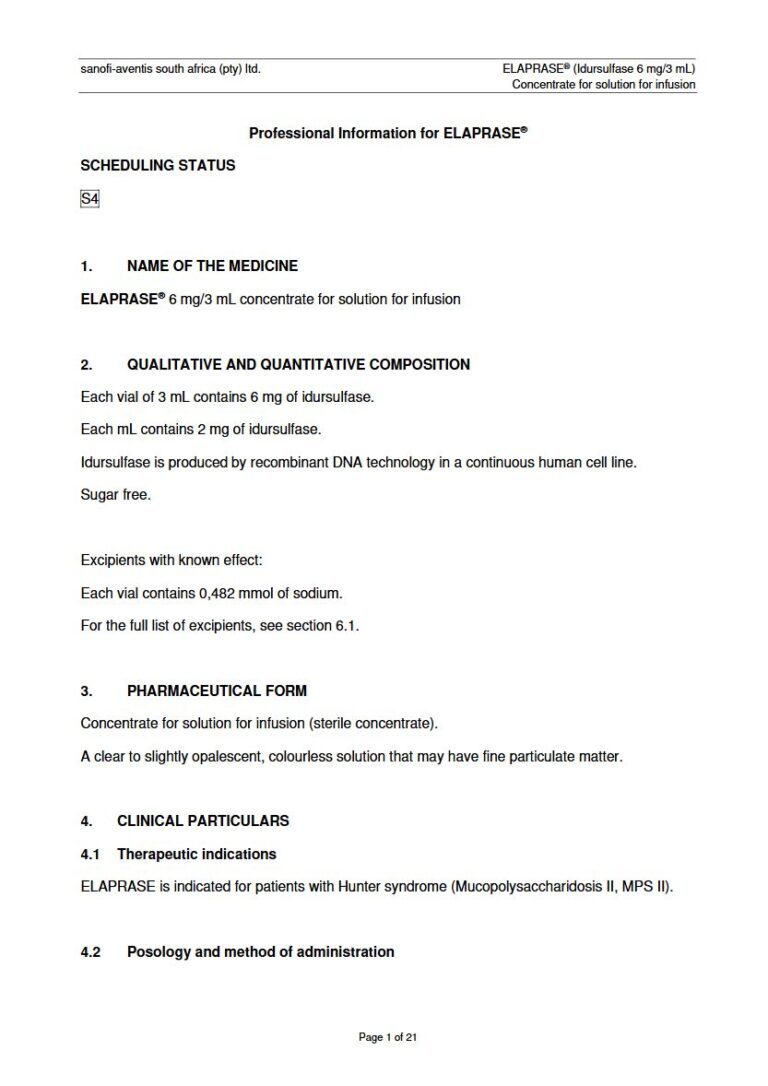
4.1 Therapeutic indications
ELAPRASE is indicated for patients with Hunter syndrome (Mucopolysaccharidosis II, MPS II).
4.2 Posology and method of administration
ELAPRASE treatment should be supervised by a medical practitioner or other health care professional experienced in the management of patients with Hunter syndrome (MPS II disease) or other inherited metabolic disorders.
Posology: ELAPRASE is administered at a dose of 0,5 mg/kg body weight every week by intravenous infusion over a 3 hour period, which may be gradually reduced to 1 hour if no infusion-associated reactions are observed (see section 4.4). For preparation and administration instructions see section 6.6. Infusion of ELAPRASE at home may be considered for patients who are tolerating their infusions well. Home infusions should be performed under the surveillance of a doctor or other health care professional.
Special populations: Patients with renal or hepatic impairment There is no clinical experience in patients with renal or hepatic insufficiency (see section 5.2). Elderly patients There is no clinical experience in patients over 65 years of age. Paediatric patients The dose for children and adolescents is 0,5 mg/kg body weight weekly. The safety and efficacy of ELAPRASE has not been established in paediatric patients less than 16 months of age.
Method of administration: For preparation and administration instructions before use, see section 6.6.
4.3 Contraindications
Hypersensitivity to the active substance or to any of the excipients (see section 6.1).
4.4 Special warnings and precautions for use
RISK OF HYPERSENSITIVITY REACTIONS Anaphylactoid/anaphylactic reactions, which have the potential to be life threatening, have been observed in some patients treated with ELAPRASE. Patients with compromised respiratory function or acute respiratory disease may be at risk of serious exacerbation of their respiratory dysfunction due to infusion related reactions. These patients require additional monitoring. Late-emergent anaphylactoid/anaphylactic reactions have been observed after ELAPRASE administration. Patients who have experienced severe and refractory anaphylactoid/anaphylactic reactions may require prolonged observation times.
Due to the potential for severe infusion reactions appropriate medical support measures should be readily available when ELAPRASE is administered. Patients treated with ELAPRASE may develop infusion-related reactions (see section 4.8). During clinical trials, the most common infusion-related reactions included cutaneous reactions (rash, pruritus, urticaria), pyrexia, headache, hypertension, and flushing. Infusion-related reactions were treated or ameliorated by slowing the infusion rate, interrupting the infusion, or by administration of medicines, such as antihistamines, antipyretics, low-dose corticosteroids (prednisone or methylprednisolone), or beta-agonist nebulisation. No patient discontinued treatment due to an infusion reaction during clinical studies.
Special care should be taken when administering an infusion in patients with severe underlying airway disease. These patients should be closely monitored and infused in an appropriate clinical setting. Caution must be exercised in the management and treatment of such patients by limitation or careful monitoring of antihistamine and other sedative medicinal product use. Institution of positive-airway pressure may be necessary in some cases. Consideration should be given to delay the infusion in patients who present with an acute febrile respiratory illness. Patients using supplemental oxygen should have this treatment readily available during infusion in the event of an infusion-related reaction.
Patients who develop IgM or IgG antibodies are at a higher risk of infusion reactions and other adverse reactions, however, IgE antibodies have not been observed. Paediatric patients with the complete deletion/large rearrangement genotype have a high probability of developing antibodies, including neutralising antibodies, in response to exposure to ELAPRASE. Patients with this genotype have a higher probability of developing infusion-related adverse events and tend to show a muted response as assessed by decrease in urinary output of glycosaminoglycans, liver size and spleen volume compared to patients with the missense genotype. Management of patients must be decided on an individual basis.
Anaphylactoid/anaphylactic reactions, which have the potential to be life threatening, have been observed in some patients treated with ELAPRASE up to several years after initiating treatment. Late emergent symptoms and signs of anaphylactoid/anaphylactic reactions have been observed as long as 24 hours after an initial reaction. If an anaphylactoid/anaphylactic reaction occurs, the infusion of ELAPRASE should be suspended immediately and appropriate treatment and observation should be initiated. The current medical standards for emergency treatment are to be observed. Patients experiencing severe or refractory anaphylactoid/anaphylactic reactions may require prolonged clinical monitoring. Patients who have experienced anaphylactoid/anaphylactic reactions should be treated with caution when re-administering ELAPRASE. Appropriately trained personnel and equipment for emergency resuscitation (including epinephrine (adrenaline)) should be available during infusions. Severe or potentially life-threatening hypersensitivity is a contraindication to rechallenge.
Sodium ELAPRASE contains 0,482 mmol sodium (or 11,1 mg) per vial. This is equivalent to 0,6 % of the WHO recommended maximum daily intake of 2 g sodium for an adult.
4.5 Interaction with other medicines and other forms of interaction
No formal interaction studies have been conducted with ELAPRASE. Based on its metabolism in cellular lysosomes, idursulfase would not be affected by cytochrome P450 mediated interactions.
4.6 Fertility, pregnancy and lactation
Safety during pregnancy and lactation has not been established.
Pregnancy There are no or limited data available from the use of ELAPRASE in pregnant women. Animal studies do not indicate direct or indirect harmful effects with respect to reproductive toxicity (see section 5.3). ELAPRASE is not recommended for use during pregnancy.
Breastfeeding It is not known if ELAPRASE is excreted in human breast milk. Available data in animals have shown excretion of idursulfase in milk (see section 5.3). A risk to newborns/infants cannot be excluded. A decision must be made whether to discontinue breastfeeding, or to discontinue/abstain from ELAPRASE treatment, taking into account the benefit of breastfeeding for the child and the benefit of treatment for the woman.
Fertility No effects on male fertility were seen in reproductive studies in male rats.
4.7 Effects on ability to drive and use machines
ELAPRASE may influence the patientu2019s ability to drive and use machines.
4.8 Undesirable effects
Adverse reactions that were reported for the 32 patients treated with 0,5 mg/kg ELAPRASE weekly in the Phase II/III 53-week placebo-controlled study, are listed in the table below with information presented by system organ class and frequency. Frequency is given as very common (u2265 1/10, u2265 10 %), common (u2265 1/100, < 1/10, between 1 % and 10 %) or uncommon (u2265 1/1 000, < 1/100, between 0,1 % and 1 %). Within each frequency grouping, undesirable effects are presented in order of decreasing seriousness. Adverse reactions were defined as treatment-emergent events with suspected causality and excluded non-serious events that were reported only once in a single patient. Treatment emergent events with an excess incidence of at least 9 % compared with placebo were also considered as adverse reactions.
The most common reactions are infusion-related reactions including cutaneous reactions (rash, pruritus, urticaria and erythema), pyrexia, flushing, wheezing, dyspnoea, headache, vomiting, abdominal pain, nausea and chest pain.
Table 1: Adverse reactions from clinical trials and post-marketing experience in patients treated with ELAPRASE.
System organ class Adverse reaction (preferred term) Immune system disorders Frequency not known: anaphylactoid reaction/anaphylactic reaction* Nervous system disorders Very common: headache Common: dizziness, tremor Cardiac disorders Common: cyanosis, dysrhythmia, tachycardia Vascular disorders Very common: flushing Common: hypertension, hypotension Respiratory, thoracic and mediastinal disorders Very common: wheezing, dyspnoea Common: hypoxia, bronchospasm, cough Uncommon: tachypnoea Gastrointestinal disorders Very common: vomiting, abdominal pain, nausea, diarrhoea Common: swollen tongue, dyspepsia Skin and subcutaneous tissue disorders Very common: urticaria, rash, pruritus, erythema Musculoskeletal and connective tissue disorders Common: arthralgia General disorders and administration site conditions Very common: pyrexia, chest pain Common: infusion site swelling, facial oedema, peripheral oedema Injury, poisoning and procedural complications Very common: infusion related reaction * Side effects reported post-marketing.
Across studies, serious adverse reactions were reported in a total of 5 patients out of 64 who received 0,5 mg/kg weekly or every other week. Four patients experienced a hypoxic episode during one or several infusions, which necessitated oxygen therapy in 3 patients with severe underlying obstructive airway disease (2 with a pre-existing tracheostomy). The most severe episode occurred in a patient with a febrile respiratory illness and was associated with hypoxia resulting in a seizure. In the fourth patient, who had less severe underlying disease, spontaneous resolution occurred shortly after the infusion was interrupted. These events did not recur with subsequent infusions using a slower infusion rate and administration of pre-infusion medicinal products, usually low-dose corticosteroids, antihistamines, and beta-agonist nebulisation. The fifth patient, who had pre-existing cardiomyopathy, was diagnosed with ventricular premature complexes and pulmonary embolism during the study.
Post-marketing There have been post-marketing reports of anaphylactoid/anaphylactic reactions. Patients with complete deletion/large rearrangement genotype have a higher probability of developing infusion related adverse events. Please see section 4.4 for further information.
4.9 Overdose
There is limited information regarding overdose with ELAPRASE. Evidence suggests that some patients may experience an anaphylactoid reaction due to overdose. See section 4.3, 4.4 and 4.8. Treatment should be symptomatic and supportive if needed.
