
Actrapid Hm Injection
Clinical Summary
Quick overview from the medicine insert
Indication
Management of diabetes mellitus in adults and children.
Dosage (summary)
Individualized based on blood glucose monitoring; typically, subcutaneous injection 30 minutes before meals.
Onset of Action / Duration
Onset: 30 minutes; Peak: 2-3 hours; Duration: 5-8 hours.
Special Populations
- Elderly patients
- Patients with renal impairment
- Patients with hepatic impairment
Pregnancy & Breastfeeding
Insulin is generally considered safe during pregnancy and lactation; however, blood glucose levels must be closely monitored.
Key Drug Interactions
- Beta-blockers may mask hypoglycemic symptoms.
- Thiazide diuretics may increase blood glucose levels.
- Alcohol can potentiate the hypoglycemic effect.
Contraindications
- Hypoglycemia
- Hypersensitivity to insulin or any of the excipients
Common side effects
- Hypoglycemia
- Weight gain
- Injection site reactions
- Allergic reactions
Counselling Points
- Instruct patients on proper injection techniques.
- Advise on recognizing signs and symptoms of hypoglycemia.
- Emphasize the importance of regular blood glucose monitoring.
- Discuss dietary considerations and meal planning.
Serious warnings
- Risk of severe hypoglycemia, especially in patients with erratic meal schedules.
- Caution in patients with cardiovascular disease.
- Monitor for signs of insulin resistance.
Important Disclaimer
The Actrapid Hm Injection professional information leaflet below is the property of Novo Nordisk and is provided on Medinsert exactly as issued, with no.. alterations or editorial changes. We make every effort to keep content current by updating documents as soon as new versions become available. Medinsert serves as a trusted access point for healthcare professionals, but does not replace official sources or clinical judgement. For more details, please read our full disclaimer. read more>>
 Healthcare Professionals Only
This content is for registered healthcare professionals
Sign in or create a free account to read the full package insert.
Free for HPCSA-registered professionals. Powered by Medinsert.
Clinical Particulars
Section 4 of the official insert — extracted exactly as issued, no alterations
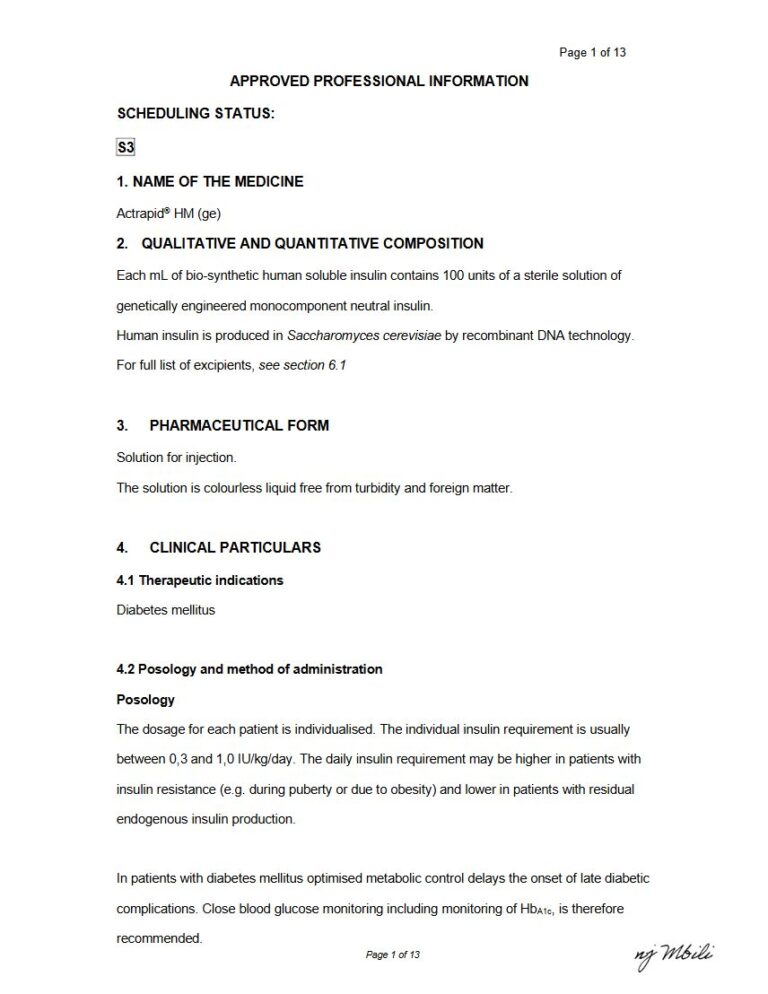
4.1 Therapeutic indications
Diabetes mellitus
4.2 Posology and method of administration
Posology
The dosage for each patient is individualised. The individual insulin requirement is usually between 0,3 and 1,0 IU/kg/day. The daily insulin requirement may be higher in patients with insulin resistance (e.g. during puberty or due to obesity) and lower in patients with residual endogenous insulin production. In patients with diabetes mellitus optimised metabolic control delays the onset of late diabetic complications. Close blood glucose monitoring including monitoring of Hb A1c, is therefore recommended.
Special populations
Concomitant diseases in the kidney, liver or affecting the adrenal, pituitary or thyroid gland can require changes in the insulin dose.
Transfer from other insulin products
Transferring a patient to a new type or brand of insulin should be done under strict medical supervision. Changes in strength, brand, type, species (animal, human, human insulin analogue) and/or method of manufacture may result in a change in dosage from that used with their previous insulin. If an adjustment is needed, it may be done with the first dose or during the first few weeks or months.
Method of administration
Actrapid u00ae HM (ge) is administered subcutaneously in the thigh or abdominal wall. If convenient the gluteal or deltoid region may also be used. Subcutaneous injection into the abdominal wall results in a faster absorption than from other injection sites. Injection sites should be rotated within the same region in order to reduce the risk of lipodystrophy and cutaneous amyloidosis. Injection into a lifted skin fold minimizes the risk of intramuscular injection. Keep the needle under the skin for at least 6 seconds to make sure the entire dose is injected. Actrapid u00ae HM (ge) may also be administered intravenously, which should only be carried out by healthcare professionals. Actrapid u00ae HM (ge) is not recommended for use in infusion pumps for continuous subcutaneous insulin infusion due to the risk of precipitation in some pump catheters. Injections using 10 ml vials and conventional syringes. Instructions for use are reflected in the Patient Information Leaflet. Actrapid vials are for use with insulin syringes with a corresponding unit scale.
Use of FlexPen:
Instructions for use and handling are reflected in the Patient Information Leaflet (Use of FlexPen). See patient instruction leaflet enclosed in FlexPen packaging. To avoid possible transmission of disease, FlexPen is for single person use only.
Injections using Actrapid HM (ge) Penfill:
Actrapid u00ae HM (ge) Penfill u00ae cartridges are designed to be used with Novo Nordisk insulin delivery system and NovoFine u00ae or NovoTwist u00ae needles. Always ensure that the injection device is assembled according to manufacturer's directions. Please refer to the instructions included with the device.
4.3 Contra-indications
- Hypoglycaemia
- Hypersensitivity to human insulin or any of the excipients
4.4 Special warnings and precautions for use
Self administering patients must not use the intravenous route. Before traveling between different time zones, the patient should be advised to consult the doctor, since this may mean that the patient has to take insulin and meals at different times.
Hyperglycaemia
Inadequate dosing or discontinuation of treatment may, especially in Type 1 diabetes (insulin dependent diabetes mellitus), lead to hyperglycaemia. The first symptoms of hyperglycaemia usually come on gradually, over a period of hours or days. They include thirst, increased frequency of urination, nausea, vomiting, drowsiness, flushed dry skin, dry mouth, loss of appetite as well as acetone odour of breath. In Type 1 diabetes, untreated hyperglycaemic events are potentially lethal.
Hypoglycaemia
Hypoglycaemia may occur if the insulin dose is too high in relation to the insulin requirement. Omission of a meal or unplanned, strenuous physical exercise may lead to hypoglycaemia. Patients, whose blood glucose control is greatly improved by e.g. intensified insulin therapy, may experience a change in their usual warning symptoms of hypoglycaemia and should be advised accordingly. A few patients who have experienced hypoglycaemic reactions after transfer from animal source insulin have reported that early warning symptoms of hypoglycaemia were less pronounced or different from those experienced with their previous insulin. Concomitant illness, especially infections and feverish conditions, usually increases the patientu2019s insulin requirement.
Injection site reactions
Injection site reactions (redness, swelling, itching, pain and haematoma at the injection site) may occur during treatment with insulin. Most reactions are transitory and disappear during continued treatment.
Skin and subcutaneous tissue disorder
Patients must be instructed to perform continuous rotation of the injection site to reduce the risk of developing lipodystrophy and cutaneous amyloidosis. There is a potential risk of delayed insulin absorption and worsened glycaemic control following insulin injections at sites with these reactions. A sudden change in the injection site to an unaffected area has been reported to result in hypoglycaemia. Blood glucose monitoring is recommended after the change in the injection site from an affected to an unaffected area, and dose adjustment of antidiabetic medicines may be considered.
Combination of Actrapid u00ae HM (ge) with pioglitazone
Cases of congestive heart failure have been reported when pioglitazone was used in combination with insulin, especially in patients with risk factors for development of congestive heart failure. This should be kept in mind if treatment with the combination of pioglitazone and insulin medicinal products is considered. If the combination is used, patients should be observed for signs and symptoms of congestive heart failure, weight gain and oedema. Pioglitazone should be discontinued if any deterioration in cardiac symptoms occurs.
Avoidance of accidental mix-ups/medicine errors
Patients must be instructed to always check the insulin label before each injection to avoid accidental mix-ups between Actrapid HM (ge) and other insulin products.
4.5 Interaction with other medicines and other forms of interaction
A number of medicines are known to interact with glucose metabolism. The following medicines may reduce the patientu2019s insulin requirements:
- Oral hypoglycaemic medicines (OHAs),
- Monoamine oxidase inhibitors (MAOI),
- Non-selective beta-blocking agents,
- Angiotensin converting enzyme (ACE) inhibitors,
- Angiotensin receptor blockers (ARBs),
- Salicylates and alcohol.
The following medicines may increase the patientu2019s insulin requirements:
- Oral contraceptives, thiazides, glucocorticoids, thyroid hormones, sympathomimetics, growth hormone and danazol.
- Beta-blocking agents may mask the symptoms of hypoglycaemia and delay recovery from hypoglycaemia.
- Octreotide may either decrease or increase insulin requirements.
- Alcohol may intensify and prolong the hypoglycaemic effect of insulin.
4.6 Fertility, pregnancy and lactation
Pregnancy
There are no restrictions on treatment of diabetes with insulin during pregnancy, as insulin does not pass the placental barrier. Intensified blood glucose control and monitoring of pregnant women with diabetes are recommended throughout pregnancy and when contemplating a pregnancy. Both hypoglycaemia and hyperglycaemia, which can occur in inadequately controlled diabetes therapy, increase the risk of malformations and deaths in utero. Insulin requirements usually fall in the first trimester and increase subsequently during the second and third trimesters. After delivery, insulin requirements normally return rapidly to pre-pregnancy values.
Breastfeeding
There are no restrictions on treatment of diabetes with insulin during breastfeeding as insulin does not pass into breast milk.
4.7 Effects on ability to drive and use machines
The patientu2019s ability to concentrate and react may be impaired as a result of hypoglycaemia. This may constitute a risk in situations where these abilities are of special importance (e.g. driving a car or operating machinery). Patients should be advised to take precautions to avoid hypoglycaemia while driving. This is particularly important in those patients who have reduced or absent awareness of the warning signs of hypoglycaemia or have frequent episodes of hypoglycaemia. The advisability of driving should be considered in these circumstances.
4.8 Undesirable effects
(a) Summary of the safety profile
Side effects observed in patients using Actrapid u00ae HM (ge) are mainly dose dependent and due to the pharmacological effect of insulin. Hypoglycaemia is the most common side effect. It may occur if the insulin dose is too high in relation to insulin requirement.
(b) Tabulated summary of adverse reactions
Frequencies of other side effects from clinical trials, which by an overall judgment are considered related to Actrapid u00ae HM (ge) are listed below. The frequencies are defined as: Very common (u2265 1/10); common (u2265 1/100, < 1/10); uncommon (u2265 1/1 000, < 1/100); rare (u2265 1/10 000, < 1/1000). Isolated spontaneous cases are presented as very rare defined as: u02c2 1/10 000.
System organ class Side effect and frequency
Metabolism and nutrition disorders Very common: Hypoglycaemia
Immune system disorders Uncommon: Urticaria, rash
Very rare: Anaphylactic reactions
Nervous system disorders Uncommon: Peripheral neuropathy (painful neuropathy)
Eye disorders Uncommon: Refraction disorders
Very rare: Diabetic retinopathy
Skin and subcutaneous tissue disorders Uncommon: Lipodystrophy
Not known: Cutaneous amyloidosis*
General disorders and administration site conditions Uncommon: Injection site reactions
Uncommon: Oedema
* Adverse reactions based on post-marketing source data
(c) Description of selected adverse reactions
Anaphylactic reactions
Symptoms of generalised hypersensitivity may include generalised skin rash, itching, sweating, gastrointestinal upset, and angio-oedema, difficulties in breathing, palpitation, reduction in blood pressure and fainting /loss of consciousness. Generalised hypersensitivity reactions are potentially life threatening.
Hypoglycaemia
The symptoms of hypoglycaemia usually occur suddenly. They may include cold sweats, cool pale skin, fatigue, nervousness or tremor, anxiety, unusual tiredness or weakness, confusion, difficulty in concentration, drowsiness, excessive hunger, vision changes, headache, nausea and palpitations. Severe hypoglycaemia may lead to unconsciousness and/or convulsions and may result in temporary or permanent impairment of brain function or even death.
Skin and subcutaneous tissue disorders
Lipodystrophy (including lipohyperthrophy, lipotrophy) and cutaneous amyloidosis may occur at the injection site as a consequence of failure to rotate injection sites within the same area. Continuous rotation of the injection site within the particular injection area may help to reduce the risk of developing these reactions.
Peripheral neuropathy (painful neuropathy)
Fast improvement in blood glucose control may be associated with a condition termed u201cacute painful neuropathyu201d which is usually reversible. This reaction is usually of transitory nature.
Eye disorders
Diabetic retinopathy
Long-term improved glycaemic control decreases the risk of progression of diabetic retinopathy. However, intensification of insulin therapy with abrupt improvement in glycaemic control may be associated with temporary worsening of diabetic retinopathy, while long-term improved glycaemic control decreases the risk of progression of diabetic retinopathy.
Refraction disorders
Refraction anomalies may occur upon initiation of Actrapid HM (ge). These symptoms are usually of transitory nature.
Reporting of suspected adverse reactions
Reporting suspected adverse reactions after authorisation of the medicine is important. It allows continued monitoring of the benefit/risk balance of the medicine. Healthcare professionals are asked to report any suspected adverse reactions via the u201c6.04 Adverse Drug Reactions Reporting Formu201d, found online under SAHPRAu2019s publications https://www.sahpra.org.za/Publications/Index/8
4.9 Overdose
A specific overdose of insulin cannot be defined; however hypoglycaemia may develop over sequential stages if too high doses relative to the patientu2019s requirements are administered:
- Mild hypoglycaemic episodes can be treated by oral administration of glucose or sugary products. It is therefore recommended that the diabetic patient constantly carries sugar-containing products.
- Severe hypoglycaemic episodes, where the patient has become unconscious, can be treated with glucagon (0,5 to 1,0 mg) given intramuscularly or subcutaneously by a trained person who has received appropriate instruction, or glucose given intravenously by a healthcare professional. Glucose must be given intravenously, if the patient does not respond to glucagon within 10 to 15 minutes.
Upon regaining consciousness, administration of oral carbohydrate is recommended for the patient in order to prevent relapse.
