
Apidra 1 mL Solution for injection
Clinical Summary
Quick overview from the medicine insert
Indication
Management of diabetes mellitus in adults and children aged 2 years and older.
Dosage (summary)
Administer subcutaneously within 15 minutes before or within 20 minutes after starting a meal. Individualized dosing based on blood glucose levels.
Onset of Action / Duration
Onset: 10-20 minutes; Peak: 1-2 hours; Duration: 3-5 hours.
Special Populations
- Elderly patients
- Patients with renal impairment
- Patients with hepatic impairment
Pregnancy & Breastfeeding
Insulin Glulisine is generally considered safe during pregnancy and lactation; however, blood glucose levels should be closely monitored.
Key Drug Interactions
- Other antidiabetic agents may enhance the hypoglycemic effect.
- Beta-blockers may mask symptoms of hypoglycemia.
- Thiazide diuretics may increase blood glucose levels.
Contraindications
- Hypersensitivity to Insulin Glulisine or any of its excipients.
- Severe hypoglycemia.
Common side effects
- Hypoglycemia
- Injection site reactions (e.g., redness, swelling)
- Weight gain
- Allergic reactions
Counselling Points
- Instruct patients on proper injection techniques.
- Advise on the importance of monitoring blood glucose levels regularly.
- Educate about recognizing and managing hypoglycemia.
Serious warnings
- Risk of hypoglycemia, especially if meals are missed or delayed.
- Patients should carry a source of glucose at all times.
- Adjustments may be necessary during illness, stress, or changes in physical activity.
Important Disclaimer
The Apidra 1 mL Solution for injection professional information leaflet below is the property of Sanofi-Aventis South Africa and is provided on Medinsert exactly as issued, with no.. alterations or editorial changes. We make every effort to keep content current by updating documents as soon as new versions become available. Medinsert serves as a trusted access point for healthcare professionals, but does not replace official sources or clinical judgement. For more details, please read our full disclaimer. read more>>
 Healthcare Professionals Only
This content is for registered healthcare professionals
Sign in or create a free account to read the full package insert.
Free for HPCSA-registered professionals. Powered by Medinsert.
Clinical Particulars
Section 4 of the official insert — extracted exactly as issued, no alterations
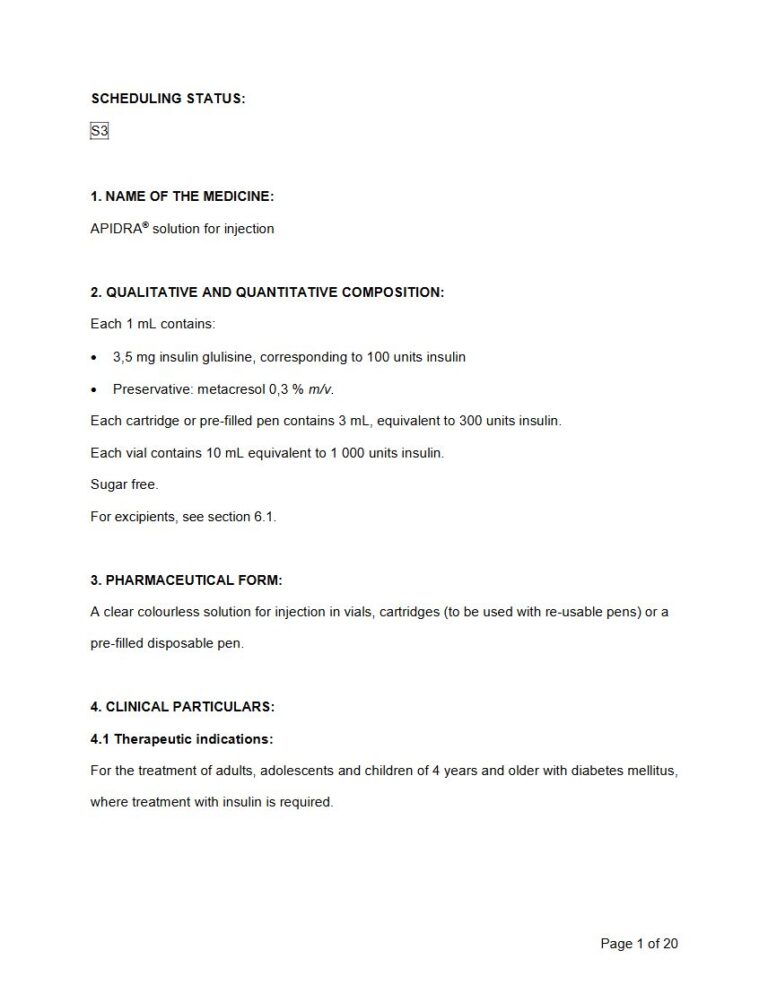
4.1 Therapeutic indications
For the treatment of adults, adolescents and children of 4 years and older with diabetes mellitus, where treatment with insulin is required.
4.2 Posology and method of administration
APIDRA should be given by injection within 15 minutes before or immediately after a meal. The dosage of APIDRA should be individualised and determined based on the healthcare professional advice in accordance with the needs of the patient. APIDRA should normally be used in regimens that include a longer-acting insulin or basal insulin analogue. Blood glucose monitoring is recommended for all patients with diabetes. Paediatric use: Safety and efficacy of APIDRA have been demonstrated in adolescents and children > 4 years of age. Geriatric use: Hypoglycaemia may be difficult to recognise in the elderly (see section 4.4). Special populations: In patients with hepatic or renal impairment, insulin requirements may be diminished (see section 4.4). Administration: APIDRA is intended for subcutaneous administration by injection or by continuous pump infusion. APIDRA can also be administered intravenously.
APIDRA should be administered subcutaneously by injection in the abdominal wall, the thigh or deltoid or by continuous infusion in the abdominal wall. Injection sites and infusion sites, within an injection area (abdomen, thigh or deltoid) must be rotated from one injection to the next to reduce the risk of lipodystrophy and cutaneous amyloidosis (see section 4.4 and 4.8). The rate of absorption, and consequently the onset and duration of action, may be affected by the injection site, exercise and other variables. General: Before first use, APIDRA must be kept at room temperature for 1 to 2 hours. APIDRA must only be used if the solution is clear, colourless, with no solid particles visible, and if it is of water-like consistency. The instructions/manuals for using APIDRA in a pump or in a disposable or reusable pen must be followed carefully. An empty vial, cartridge or disposable pen must never be reused and must be properly discarded. See section 6.6 for further detail on handling. Cartridges: APIDRA cartridges are not designed to allow any other insulin to be mixed in the cartridge. If the reusable pen malfunctions, the solution may be drawn from the cartridge into a syringe (suitable for insulin with 100 I.U./mL) and injected. Air bubbles must be removed from the cartridge before injecting. APIDRA in cartridges is only suitable for subcutaneous injections from a reusable pen. If administration by syringe, intravenous injection or infusion pump is necessary, a vial should be used.
Intravenous use: For intravenous use, APIDRA should be diluted (see section 6.6). See section 6.2 for incompatibilities. Disposable pens: APIDRA in disposable pens is only suitable for subcutaneous injections. If administration by syringe, intravenous injection or infusion pump is necessary, a vial should be used. See section 6.6 for further detail on handling. Mixing of insulins for subcutaneous injection: APIDRA can be mixed with NPH human insulin. If APIDRA is mixed with NPH human insulin, APIDRA should be drawn into the syringe first. Injection should be made immediately after mixing. Mixtures should not be administered intravenously. Continuous subcutaneous infusion pump: APIDRA may be used for Continuous Subcutaneous Insulin Infusion (CSII) in pump systems suitable for insulin infusion. Patients using CSII should be comprehensively instructed on the use of the system pump. The infusion set and reservoir used with APIDRA must be changed at least every 48 hours, using aseptic technique. These instructions may differ from general pump manual instructions (see section 6.4). It is important that patients follow the APIDRA specific instructions when using APIDRA. Failure to follow APIDRA specific instructions may lead to serious adverse events.
When used with an insulin infusion pump, APIDRA must not be mixed with diluents or any other insulin. Patients administering APIDRA by CSII must have an alternative insulin delivery system available in case of pump system failure (see section 4.4).
4.3 Contraindications
- Patients hypersensitive to insulin glulisine or any of its excipients (see section 4.2)
- Children < 4 years, as in this group, efficacy and safety have not been demonstrated.
4.4 Special warnings and precautions for use
Because of the short duration of action of APIDRA, patients with diabetes also require a longer-acting insulin to maintain adequate glucose control. Any change of insulin should be made cautiously and only under medical supervision. Changes in insulin strength, manufacturer, type (e.g. regular, neutral protamine Hagedorn (NPH), analogues), species (animal, human) or method of manufacture (rDNA versus animal-source insulin), may result in the need for a change of dosage. Concomitant oral antidiabetic treatment may need to be adjusted. Insulin requirements may be altered during intercurrent conditions such as illness, emotional disturbances or stress. Skin changes at the injection site:
Patients must be instructed to perform continuous rotation of the injection site to reduce the risk of developing lipodystrophy and localized cutaneous amyloidosis. There is a potential risk of delayed insulin absorption and worsened glycemic control following insulin injections at sites with these reactions. A sudden change in the injection site to an unaffected area has been reported to result in hypoglycemia. Blood glucose monitoring is recommended after the change in the injection site, and dose adjustment of antidiabetic medications may be considered (see section 4.8).
Hypoglycaemia: The time and occurrence of hypoglycaemia depends on the action profile of the insulins used and may therefore change when the treatment regimen is changed. Under certain conditions the warning symptoms of hypoglycaemia may be changed, less pronounced or absent, for example:
- if glycaemic control is markedly improved
- if hypoglycaemia develops gradually
- in elderly patients
- where an autonomic neuropathy is present
- in patients with a long history of diabetes
- in patients receiving concurrent treatment with certain medicinal products (see section 4.5).
Such situations may result in severe hypoglycaemia and possibly loss of consciousness, prior to the patientu2019s awareness of hypoglycaemia.
Renal impairment: The requirements for APIDRA may be reduced in patients with renal impairment (see section 5.1).
Hepatic impairment: In patients with hepatic impairment, APIDRA requirements may be diminished due to a reduced capacity for gluconeogenesis and reduced insulin metabolism.
Continuous subcutaneous infusion pump: Malfunction of the insulin pump or infusion set or handling errors can rapidly lead to hyperglycaemia, ketosis and diabetic ketoacidosis. Prompt identification and correction of the cause of hyperglycaemia or ketosis or diabetic ketoacidosis is necessary. Interim subcutaneous injections with APIDRA may be required. Patients using continuous subcutaneous insulin infusion pump therapy must be trained to administer insulin by injection and have alternate insulin delivery system available in case of pump system failure (see section 4.2).
Accidental mix-ups between APIDRA and other insulins, particularly long-acting insulins, have been reported. To avoid medication errors between APIDRA and other insulins, patients should be instructed to always check the insulin label before each injection.
APIDRA in a cartridge: APIDRA in cartridges is only suitable for subcutaneous injections from a reusable pen. If administration by syringe, intravenous injection or infusion pump is necessary, a vial should be used (see section 4.2).
APIDRA in a disposable pre-filled pen (Solostar): APIDRA in a disposable pen is only suitable for subcutaneous injections. If administration by syringe, intravenous injection or infusion pump is necessary, a vial should be used (see section 4.2). Before using the pre-filled pen, the instructions for use included in the package leaflet must be read carefully (see section 6.6).
Excipients APIDRA contains less than 1 mmol (23 mg) sodium per dose, i.e. it is essentially u2018sodium-freeu2019. APIDRA contains the preservative metacresol, which may cause allergic reactions.
Combination of APIDRA with pioglitazone: Cases of cardiac failure have been reported when pioglitazone was used in combination with insulin, especially in patients with risk factors for development of cardiac heart failure. This should be kept in mind if treatment with the combination of pioglitazone and APIDRA is considered. If the combination is used, patients should be observed for signs and symptoms of heart failure, weight gain and oedema. Pioglitazone should be discontinued if any deterioration in cardiac symptoms occurs.
4.5 Interactions with other medicines and other forms of interaction
A number of substances affect glucose metabolism and may require dose adjustment of APIDRA. Substances that may enhance the blood glucose-lowering effect and increase susceptibility to hypoglycaemia include oral antidiabetic medicines; angiotensin converting enzyme (ACE) inhibitors; disopyramide; fibrates; fluoxetine; monoamine oxidase (MAO) inhibitors; pentoxifylline; salicylates and sulfonamide antibiotics.
Substances that may reduce the blood glucose-lowering effect include: corticosteroids; danazol; diazoxide; diuretics; glucagon; isoniazid; estrogens and progestogens (e.g. in oral contraceptives); phenothiazine derivatives; somatropin; sympathomimetic medicines (e.g. epinephrine (adrenaline), salbutamol, terbutaline), thyroid hormones, protease inhibitors and atypical antipsychotic medications (e.g. clozapine). Beta-blockers, clonidine, lithium salts or alcohol may either potentiate or weaken the blood glucose-lowering effect of insulin. Pentamidine may cause hypoglycaemia, which may sometimes be followed by hyperglycaemia. In addition, under the influence of sympatholytic medicinal products such as beta-blockers, clonidine, guanethidine and reserpine, the signs of adrenergic counter-regulation may be reduced or absent.
4.6 Fertility, pregnancy and lactation
Pregnancy: Safety and efficacy in pregnancy have not been established. It is essential for patients with diabetes or a history of gestational diabetes to maintain good metabolic control before conception and throughout pregnancy. Insulin requirements may decrease during the first trimester, generally increase during the second and third trimesters and rapidly decline after delivery. Careful monitoring of glucose control is essential in such patients. Patients with diabetes must inform their doctor if they are pregnant or are contemplating pregnancy.
Breastfeeding: It is unknown whether APIDRA is excreted in human milk. Lactating women may require adjustments in insulin dose and diet.
4.7 Effects on the ability to drive and use machines
The patient's ability to concentrate and react may be impaired as a result of hypoglycaemia or hyperglycaemia or, for example, as a result of visual impairment. This may constitute a risk in situations where these abilities are of special importance (e.g. driving a car or operating machinery). Patients should be advised to take precautions to avoid hypoglycaemia whilst driving. This is particularly important in those who have reduced or absent awareness of the warning symptoms of hypoglycaemia or have frequent episodes of hypoglycaemia. It should be considered whether it is advisable to drive or operate machinery in these circumstances.
4.8 Undesirable effects
The following frequency rating has been used: Very common: (> 1/10); Common: (> 1/100, 1/1000, 1/10 000, < 1/1000); Very rare: (< 1/10 000), including rare isolated cases.
Metabolism and nutrition disorders
Very common: Hypoglycaemia Hypoglycaemia is the most frequent adverse reaction of APIDRA, and may occur if the APIDRA dose is too high in relation to the insulin requirement.
Skin and subcutaneous tissue disorders
Common: Injection site reactions and local hypersensitivity reactions Local hypersensitivity reactions (redness, swelling and itching at the site of the APIDRA injection). These reactions usually resolve in a few days to a few weeks. In some instances, these reactions may be related to factors other than APIDRA, such as irritants in a skin cleansing agent or poor injection technique.
Rare: Lipodystrophy Lipodystrophy may occur at the injection site and delay APIDRA absorption. Continuous rotation of the injection site within the given injection area may help to reduce or prevent these reactions.
General disorders and administration site conditions
Uncommon: Systemic allergic reactions Such reactions to APIDRA may for example, be associated with rash (including pruritus) over the whole body, shortness of breath, wheezing, reduction of blood pressure, rapid pulse or sweating. Severe cases of generalised allergy, including anaphylactic reaction, may be life-threatening. Medication errors have been reported in which other insulins, particularly long-acting insulins, have been accidentally administered instead of APIDRA.
Post-marketing side effects: Skin and subcutaneous tissue disorders: Lipodystrophy and cutaneous amyloidosis may occur at the injection site and delay local insulin absorption. Continuous rotation of the injection site within the given injection area may help to reduce or prevent these reactions (see section 4.4). Reporting of suspected adverse reactions: Reporting suspected adverse reactions after authorisation of the medicine is important. It allows continued monitoring of the benefit/risk balance of the medicine. Health care providers are asked to report any suspected adverse reactions to: u2022 The Pharmacovigilance Unit at Sanofi: Email: [email protected] or Tel: 011 256- 3700, or SAHPRA via the u201c6.04 Adverse Drug Reactions Reporting Formu201d found online under SAHPRAu2019s publications: https://www.sahpra.org.za/Publications/Index/8.
4.9 Overdose
Symptoms: Hypoglycaemia may occur as a result of an excess of APIDRA relative to food intake, energy exposure or both.
Management: Mild/moderate episodes of hypoglycaemia can usually be treated with oral carbohydrates. Adjustments in dosage of APIDRA, meal patterns or physical activity may be needed.
Severe episodes with coma, seizure or neurologic impairment may be treated with intramuscular/ subcutaneous glucagon or concentrated intravenous glucose. Sustained carbohydrate intake and observation may be necessary because hypoglycaemia may recur after apparent clinical recovery.
