
Trisporal 100 mg Capsules
PDF Leaflet Revision Date: 18 October 2022
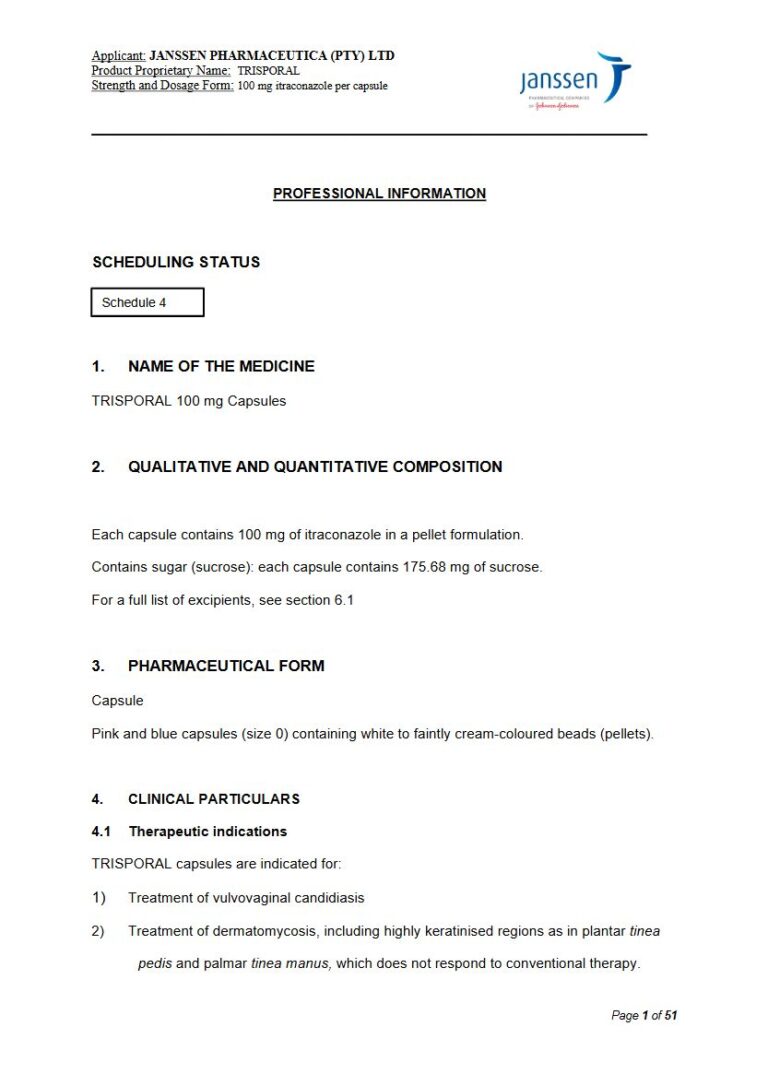
Clinical Summary
Quick overview from the medicine insert
Indication
Treatment of various fungal infections.
Dosage (summary)
200 mg twice daily for vulvovaginal candidiasis; 200 mg once daily for dermatomycosis; 200 mg once daily for onychomycosis.
Special Populations
- Hepatic impairment
- Renal impairment
- Elderly
- Paediatrics
Pregnancy & Breastfeeding
Contraindicated in pregnancy and breastfeeding.
Key Drug Interactions
- CYP3A4 inhibitors
- CYP3A4 substrates
- Antidysrhythmics
- Anticoagulants
Contraindications
- Pregnancy
- Breastfeeding
- Hypersensitivity to itraconazole
- Congestive heart failure
Common side effects
- Headache
- Abdominal pain
- Nausea
Counselling Points
- Take with food for better absorption.
- Use barrier contraception during treatment.
- Monitor for signs of liver dysfunction.
Serious warnings
- Risk of cardiac failure
- Serious hepatotoxicity
- Potential for QT prolongation
Important Disclaimer
The Trisporal 100 mg Capsules professional information leaflet below is the property of Janssen Pharmaceutica and is provided on Medinsert exactly as issued, with no.. alterations or editorial changes. We make every effort to keep content current by updating documents as soon as new versions become available. Medinsert serves as a trusted access point for healthcare professionals, but does not replace official sources or clinical judgement. For more details, please read our full disclaimer. read more>>
 Healthcare Professionals Only
This content is for registered healthcare professionals
Sign in or create a free account to read the full package insert.
Free for HPCSA-registered professionals. Powered by Medinsert.
Clinical Particulars
Section 4 of the official insert — extracted exactly as issued, no alterations
4.1 Therapeutic indications
TRISPORAL capsules are indicated for:
- Treatment of vulvovaginal candidiasis
- Treatment of dermatomycosis, including highly keratinised regions as in plantar tinea pedis and palmar tinea manus, which does not respond to conventional therapy.
- Treatment of onychomycosis caused by dermatophytes and/or yeasts and which does not respond to other therapy.
- Although proof of efficacy is limited, TRISPORAL capsules have been used in systemic aspergillosis and candidiasis, histoplasmosis, sporotrichosis, paracoccidioidomycosis and blastomycosis. However, due to the potential of significant interactions with many medicines, TRISPORAL should be used in cases resistant to other antifungal medicines.
4.2 Posology and method of administration
TRISPORAL capsules should be taken immediately after a meal for optimal absorption. The capsules must be swallowed whole. Dosage recommendations vary according to the infection treated:
Indication
- Treatment of vulvovaginal candidiasis: 200 mg twice daily or 200 mg once daily for 1 day or 3 days
- Treatment of dermatomycosis: 200 mg once daily or 100 mg once daily for 7 days or 15 days
- Treatment of dermatomycosis in highly keratinised regions as in plantar tinea pedis and palmar tinea manus: 200 mg twice daily or 100 mg once daily for 30 days
- Treatment of onychomycosis: Prior to initiating treatment, appropriate nail specimens for laboratory testing (KOH preparation, fungal culture, or nail biopsy) should be obtained to confirm the diagnosis of onychomycosis (continuous treatment) 200 mg once daily for 3 months (pulse treatment) 200 mg twice daily for 1 week. Fingernail infections: 2 pulse treatments. Toenail infections: 3 pulse treatments. Pulse treatments are always separated by a 3-week medicine-free interval.
Site of onychomycosis
- Toenails with or without fingernail involvement: Pulse 1 200 mg twice daily, Itraconazole free weeks, Pulse 2 200 mg twice daily, Itraconazole free weeks, Pulse 3 200 mg twice daily
- Fingernails only: Pulse 1 200 mg twice daily, Itraconazole free weeks, Pulse 2 200 mg twice daily
Dosages that have been used in systemic mycoses:
SYSTEMIC MYCOSES
- Treatment of aspergillosis: 200 mg once daily for 2 - 5 months. Increase dose to 200 mg twice daily in case of invasive or disseminated disease.
- Treatment of candidiasis (excluding vulvovaginal): 100 - 200 mg once daily for 3 weeks - 7 months. Increase dose to 200 mg twice daily in case of invasive or disseminated disease.
- Treatment of histoplasmosis (excluding meningeal histoplasmosis): 200 mg once daily - 200 mg twice daily (or 400 mg once daily) for 8 months.
- Treatment of sporotrichosis (lymphocutaneous and cutaneous): 100 mg once daily for 3 months.
- Treatment of paracoccidioidomycosis: 100 mg once daily for 6 months. Data on the efficacy of TRISPORAL capsules at this dosage for treatment of paracoccidioidomycosis in patients with HIV is not available.
- Treatment of chromomycosis: 100 - 200 mg once daily for 6 months.
- Treatment of blastomycosis: 100 mg once daily - 200 mg twice daily (or 400 mg once daily) for 6 months.
* The duration of treatment should be adjusted depending on the clinical response. Changes in the international and local antimicrobial resistance patterns should also be a consideration. Principles of antimicrobial stewardship should be adhered to.
Special Populations
Paediatrics: Clinical data on the use of TRISPORAL capsules in paediatric patients are limited. The use of TRISPORAL capsules in paediatric patients is not recommended (see section 4.4).
Elderly: Clinical data on the use of TRISPORAL capsules in elderly patients are limited.
Hepatic impairment: Limited data are available on the use of TRISPORAL in patients with hepatic impairment. Caution should be exercised when TRISPORAL is administered in this patient population.
Renal impairment: Limited data are available on the use of oral itraconazole in patients with renal impairment. The exposure of TRISPORAL may be lower in patients with renal insufficiency. Caution should be exercised when TRISPORAL is administered in this patient population and adjusting the dose may be considered.
Data from a small number of HIV-infected patients suggested that the response rate of histoplasmosis in HIV-infected patients is similar to non-HIV-infected patients. The clinical course of histoplasmosis in HIV-infected patients is more severe and usually requires maintenance therapy to prevent relapse. The optimal dosage regimen for treatment and maintenance therapy are unknown. Studies to investigate the efficacy and safety of TRISPORAL, including optimal dosage and duration in HIV-infected patients are ongoing.
4.3 Contraindications
TRISPORAL capsules are contraindicated in pregnant and breastfeeding women. Women of childbearing potential using TRISPORAL capsules should use barrier contraceptives until the next menstrual period following the end of TRISPORAL therapy (see section 4.6).
TRISPORAL capsules are contraindicated in patients with a known hypersensitivity to itraconazole, other azole antifungal agents or any of the excipients. Co-administration of a number of CYP3A4 substrates is contraindicated with TRISPORAL capsules. Increased plasma concentrations of these medicines, caused by coadministration with TRISPORAL, may increase or prolong both therapeutic and adverse effects that might be life-threatening. For example, increased plasma concentrations of some of these medicines can lead to QT prolongation and ventricular tachydysrhythmias including occurrences of torsade de pointes, a potentially fatal dysrhythmia. Specific examples are listed in section 4.5.
- Examples of medicines that are contraindicated for use with TRISPORAL are (also see section 4.5):
- Analgesics: levacetylmethadol (levomethadyl), methadone
- Antidysrhythmics: disopyramide, dofetilide, dronedarone, quinidine
- Antibacterials: telithromycin, in subjects with severe renal impairment or severe hepatic impairment
- Anticoagulants and Antiplatelet Medicine: ticagrelor
- Antihelminthics, Antifungals and Antiprotozoals: halofantrine, isavuconazole
- Antihistamines: astemizole, mizolastine, terfenadine
- Antimigraine Medicines: ergot alkaloids such as dihydroergotamine, ergometrine, ergotamine, methylergometrine
- Antineoplastics: irinotecan
TRISPORAL capsules are contraindicated in patients with evidence of ventricular dysfunction such as congestive heart failure (CHF) or a history of CHF except for the treatment of life-threatening systemic fungal infections (see section 4.4).
TRISPORAL has been shown to have no benefit in the prophylaxis of cryptococcal meningitis in HIV infected patients.
4.4 Special warnings and precautions for use
Cardiac effects: In a healthy volunteer study with TRISPORAL IV, a transient asymptomatic decrease of the left ventricular ejection fraction was observed; this resolved before the next infusion. The clinical relevance of these findings to the oral formulations is unknown. TRISPORAL has been shown to have a negative inotropic effect and TRISPORAL has been associated with reports of congestive heart failure. Heart failure was more frequently reported among spontaneous reports of 400 mg total daily dose than among those of lower total daily doses, suggesting that the risk of heart failure might increase with the total daily dose of TRISPORAL. TRISPORAL should not be used in patients with congestive heart failure or with a history of congestive heart failure unless the benefit clearly outweighs the risk. This individual benefit/risk assessment should take into consideration factors such as the severity of the indication, the dosing regimen (e.g. total daily dose), and individual risk factors for congestive heart failure. These risk factors include cardiac disease, such as ischaemic and valvular disease; significant pulmonary disease, such as chronic obstructive pulmonary disease; and renal failure and other oedematous disorders. Such patients should be informed of the signs and symptoms of congestive heart failure, should be treated with caution, and should be monitored for signs and symptoms of congestive heart failure during treatment; if such signs or symptoms do occur during treatment, TRISPORAL should be discontinued.
Interaction potential: Coadministration of specific medicines with itraconazole may result in changes in efficacy of itraconazole and/or the coadministered medicine, life-threatening effects and/or sudden death. medicines that are contraindicated, not recommended or recommended for use with caution in combination with itraconazole are listed in section 4.3 and section 4.5.
Porphyria: There are no data available for use of TRISPORAL in patients with porphyria and therefore should be used with caution.
Cross-hypersensitivity: The limited information regarding cross-hypersensitivity between TRISPORAL and other azole antifungal agents indicates that caution should be used in prescribing TRISPORAL capsules to patients with hypersensitivity to other azoles.
Neuropathy: If neuropathy occurs that may be attributable to TRISPORAL capsules, the treatment should be discontinued.
Hearing Loss: Transient and permanent hearing loss has been reported in patients receiving treatment with TRISPORAL. Several of these reports included concurrent administration of quinidine which is contraindicated (see section 4.3). The hearing loss usually resolves when treatment is stopped, but can persist in some patients.
Cross-resistance: In systemic candidiasis, if fluconazole-resistant strains of Candida species are suspected, it cannot be assumed that these are sensitive to itraconazole, hence it is recommended to have their sensitivity tested before the start of TRISPORAL therapy.
Interchangeability: It is not recommended that TRISPORAL capsules and itraconazole oral solution be used interchangeably. This is because itraconazole exposure is greater with the oral solution than with the capsules when the same dose of medicine is given.
Hepatic effects: Cases of serious, usually reversible idiosyncratic hepatitis, which may be fatal, have been observed. Serious hepatotoxicity, including cases of fatal acute liver failure, has occurred with the use of TRISPORAL. Most of these cases involved patients, who had pre-existing liver disease, were treated for systemic indications, had significant other medical conditions and/or were taking other hepatotoxic medicines. Some patients had no obvious risk factors for liver disease. These cases have been observed within the first week of treatment and up to 1u00bd years after continuous use of TRISPORAL.
Liver function monitoring is recommended in patients receiving TRISPORAL treatment. Patients should be instructed to promptly report to their medical practitioner signs and symptoms suggestive of hepatitis such as anorexia, nausea, vomiting, fatigue, abdominal pain or dark urine. In these patients treatment should be stopped immediately and liver function testing should be conducted. Limited data are available on the use of oral itraconazole in patients with hepatic impairment. Caution should be exercised when TRISPORAL is administered in this patient population. It is recommended that patients with impaired hepatic function be carefully monitored when taking TRISPORAL. It is recommended that the prolonged elimination half-life of itraconazole observed in the single oral dose clinical trial with TRISPORAL capsules in cirrhotic patients be considered when deciding to initiate therapy with other medications metabolised by CYP3A4.
In patients with elevated or abnormal liver enzymes or active liver disease, or who have experienced liver toxicity with other medicines, treatment with TRISPORAL is strongly discouraged. It is recommended that liver function monitoring be done in patients with pre-existing hepatic function abnormalities or those who have experienced liver toxicity with other medicines.
Reduced gastric acidity: Absorption of itraconazole from TRISPORAL capsules is impaired when the gastric acidity is reduced. In patients with reduced gastric acidity, whether from disease (e.g. patients with achlorhydria) or from concomitant medication (e.g. patients taking medicines that reduce gastric acidity), it is advisable to administer TRISPORAL capsules with an acidic beverage (such as non-diet cola). The antifungal activity should be monitored and the itraconazole dose increased as deemed necessary (see section 4.5).
Paediatrics: Clinical data on the use of TRISPORAL capsules in paediatric patients are limited. The use of TRISPORAL capsules in paediatric patients is not recommended.
Elderly: Clinical data on the use of TRISPORAL capsules in elderly patients are limited.
Renal impairment: Limited data are available on the use of oral itraconazole in patients with renal impairment. The exposure of itraconazole may be lower in patients with renal insufficiency. Caution should be exercised when TRISPORAL is administered in this patient population and adjusting the dose may be considered.
Immunocompromised patients: In some immunocompromised patients (e.g., neutropenic, human immunodeficiency virus (HIV) infected or organ transplant patients), the oral bioavailability of TRISPORAL capsules may be decreased. Therefore, the dose should be adjusted based on the clinical response in these patients.
Patients with immediately life-threatening systemic fungal infections: Due to the pharmacokinetic properties, TRISPORAL capsules are not recommended for initiation of treatment in patients with immediately life-threatening systemic fungal infections.
Patients with HIV infection: In patients with HIV infection having received treatment for a systemic fungal infection and who are considered at risk for relapse, the treating medical practitioner should evaluate the need for a maintenance treatment. Because hypochlorhydria has been reported in HIV-infected individuals, the absorption of itraconazole in these patients may be decreased.
Cystic fibrosis: In cystic fibrosis patients, a high interindividual variability in levels of itraconazole was observed with steady state dosing of itraconazole oral solution using 2,5 mg/kg bid. Steady state concentrations of > 250 ng/mL were achieved in only approximately 50 % of subjects greater than 16 years of age, but in none of the patients less than 16 years of age. If a patient does not respond to TRISPORAL capsules, consideration should be given to switching to an alternative therapy.
Sucrose: TRISPORAL contains sucrose. Patients with rare hereditary conditions such as fructose intolerance, glucose-galactose malabsorption or sucrose-isomaltase insufficiency should not take TRISPORAL capsules. Sucrose may have an effect on the glycaemic control of patients with diabetes mellitus.
4.5 Interactions with other medicines
Itraconazole is a medicine with a high interaction potential. The various types of interaction and associated general recommendations are described below. In addition, a table is provided listing examples of medicines that may interact with itraconazole, organized per medicine family for easy reference. This list of examples is not comprehensive and therefore the label of each medicine that is coadministered with itraconazole should be consulted for information related to the route of metabolism, interaction pathways, potential risks, and specific actions to be taken with regards to coadministration.
Itraconazole is mainly metabolized through CYP3A4. Other substances that either share this metabolic pathway or modify CYP3A4 activity may influence the pharmacokinetics of itraconazole. Coadministration of itraconazole with moderate or potent CYP3A4 inducers may decrease the bioavailability of itraconazole and hydroxy-itraconazole to such an extent that efficacy may be reduced. Coadministration with moderate or potent inhibitors of CYP3A4 may increase the bioavailability of itraconazole, which may result in increased or prolonged pharmacologic effects of itraconazole.
Absorption of itraconazole from the capsule formulation is reduced in subjects with reduced gastric acidity. Medicines that reduce gastric acidity impair the absorption of itraconazole from itraconazole capsules. To counteract this effect it is recommended to administer itraconazole capsules with an acidic beverage (such as non-diet cola) upon coadministration with medicines that reduce gastric acidity (see section 4.4).
Itraconazole and its major metabolite, hydroxy-itraconazole are potent CYP3A4 inhibitors. Itraconazole is an inhibitor of the medicine transporters P-glycoprotein and breast cancer resistance protein (BRCP). Itraconazole can inhibit the metabolism of medicines metabolized by CYP3A4 and can inhibit the medicine transport by P-glycoprotein and/or BCRP, which may result in increased plasma concentrations of these medicines and/or their active metabolite(s) when they are administered with itraconazole. These elevated plasma concentrations may increase or prolong both therapeutic and adverse effects of these medicines. For some medicines, coadministration with itraconazole may result in decreased plasma concentrations of the medicine or of the active moiety of the medicine. This may result in reduced efficacy of the medicine.
Following cessation of medical treatment with itraconazole, plasma concentrations decrease below the detection limit within 7 to 14 days, depending on the dose and duration of treatment. In patients with hepatic cirrhosis or in subjects receiving CYP3A4 inhibitors the plasma concentrations decline slower. This is particularly important for consideration when initiating therapy with medicines whose metabolism is affected by itraconazole.
The following general recommendations apply, unless stated differently in table.
- Contraindicated: Under no circumstances is the medicine to be coadministered with itraconazole. This applies to:
- CYP3A4 substrates for which increased plasma concentrations may increase or prolong therapeutic and/or adverse effects to such an extent that a potentially serious situation may occur. (see section 4.3)
- Not recommended: It is recommended that the use of the medicine be avoided, unless the benefits outweigh the potentially increased risks. If coadministration cannot be avoided, clinical monitoring is recommended, and the dosage of itraconazole and/or the coadministered medicine adapted as deemed necessary. When appropriate, it is recommended that plasma concentrations be measured. This applies to:
- Moderate or potent CYP3A4 inducers: not recommended from 2 weeks before and during treatment with itraconazole
- CYP3A4/P-gp/BCRP substrates for which increased or decreased plasma concentrations result in significant risk: not recommended during and up to 2 weeks after treatment with itraconazole.
- Use with caution: Careful monitoring is recommended when the medicine is coadministered with itraconazole. Upon coadministration, it is recommended that patients be monitored closely and the dosage of itraconazole and/or the coadministered medicine adapted as deemed necessary. When appropriate, it is recommended that plasma concentrations be measured. This applies to:
- Medicines that reduce gastric acidity (itraconazole caps only)
- Moderate or potent inhibitors of CYP3A4
- CYP3A4/P-gp/BCRP substrates for which increased or decreased plasma concentrations result in a clinically relevant risk
Examples of interacting medicines are listed in the table below. The medicines listed in this table are based on either medicine interaction studies or case reports, or potential interactions based on the mechanism of interaction.
4.6 Fertility, pregnancy and lactation
Pregnancy: TRISPORAL is contraindicated during pregnancy (see section 4.3). There is limited information on the use of TRISPORAL during pregnancy. During post-marketing experience, cases of congenital abnormalities have been reported. These cases include skeletal, genitourinary tract, cardiovascular and ophthalmic malformations as well as chromosomal and multiple malformations. A causal relationship with TRISPORAL has not been established. TRISPORAL has been shown to cross the placenta in the rat model. In animal studies itraconazole has shown to be teratogenic.
Women of childbearing potential: Women of childbearing potential taking TRISPORAL capsules should use contraceptive precautions. Highly effective contraception should be continued until the menstrual period following the end of TRISPORAL capsule therapy (see section 4.5).
Breastfeeding: Itraconazole is excreted in human milk. The patient should not breastfeed.
Fertility: There is no evidence of a primary influence on fertility under treatment with TRISPORAL.
4.7 Effects on ability to drive and use machines
No studies on the effects on the ability to drive and use machines have been performed. When driving vehicles and operating machinery the possibility of adverse reactions such as dizziness, visual disturbances and hearing loss (see section 4.8.), which may occur in some instances, must be taken into account.
4.8 Undesirable effects
Summary of the safety profile: The most frequently reported adverse drug reactions (ADRs) with TRISPORAL Capsules treatment identified from clinical trials and/or from spontaneous reporting were headache, abdominal pain, and nausea. The most serious ADRs were serious allergic reactions, cardiac failure/congestive heart failure/pulmonary oedema, pancreatitis, serious hepatotoxicity (including some cases of fatal acute liver failure), and serious skin reactions. Refer to subsections Clinical Trials and Post marketing experience for the frequencies and for other observed ADRs. Refer to section 4.4 Special warnings and precautions for use for additional information on other serious effects.
Clinical trials: The safety of TRISPORAL capsules was evaluated in 8 499 patients who participated in 107 open-label and double-blind clinical trials in patients with fungal infections. Of the 8 499 patients treated with TRISPORAL capsules, 2 104 patients were treated with TRISPORAL capsules during double-blind trials. Adverse reactions reported for patients treated with TRISPORAL capsules in these clinical trials are shown in Table 1. Adverse reactions are listed by system organ class and frequency. The following terms and frequencies are applied: very common (u2265 1/10); common (u2265 1/100 to < 1/10); uncommon (u2265 1/1,000 to < 1/100); rare (u2265 1/10,000 to < 1/1,000); very rare (< 1/10,000); and not known (cannot be estimated from the available data).
4.9 Overdose
In general, side effects reported with overdose have been consistent with those reported for itraconazole use (see section 4.8). In the event of an overdose, supportive measures should be employed. No specific antidote is available. Itraconazole cannot be removed by haemodialysis. It is advisable to contact a poison control center to obtain the latest recommendations for the management of an overdose.
