
Copellor 80 mg/ml Solution for injection
PDF Leaflet Revision Date: 22 May 2025
Clinical Summary
Quick overview from the medicine insert
Indication
Moderate to severe plaque psoriasis, psoriatic arthritis, axial spondyloarthritis.
Dosage (summary)
160 mg subcutaneously at Week 0, then 80 mg every 4 weeks for maintenance.
Onset of Action / Duration
Onset: 2 weeks, Duration: 4 weeks
Special Populations
- Elderly (u2265 65 years)
- Renal impairment
- Hepatic impairment
Pregnancy & Breastfeeding
Not recommended in pregnancy; avoid breastfeeding.
Key Drug Interactions
- Live vaccines
- Immunomodulatory agents
Contraindications
- Hypersensitivity to ixekizumab
- Active infections
- Live attenuated vaccines
Common side effects
- Injection site reactions
- Upper respiratory tract infections
- Nausea
Counselling Points
- Monitor for infections
- Avoid live vaccines
- Report any severe allergic reactions
Serious warnings
- Increased risk of infections
- Serious hypersensitivity reactions
- Inflammatory bowel disease exacerbation
Important Disclaimer
The Copellor 80 mg/ml Solution for injection professional information leaflet below is the property of Eli Lilly (SA) and is provided on Medinsert exactly as issued, with no.. alterations or editorial changes. We make every effort to keep content current by updating documents as soon as new versions become available. Medinsert serves as a trusted access point for healthcare professionals, but does not replace official sources or clinical judgement. For more details, please read our full disclaimer. read more>>
 Healthcare Professionals Only
This content is for registered healthcare professionals
Sign in or create a free account to read the full package insert.
Free for HPCSA-registered professionals. Powered by Medinsert.
Clinical Particulars
Section 4 of the official insert — extracted exactly as issued, no alterations
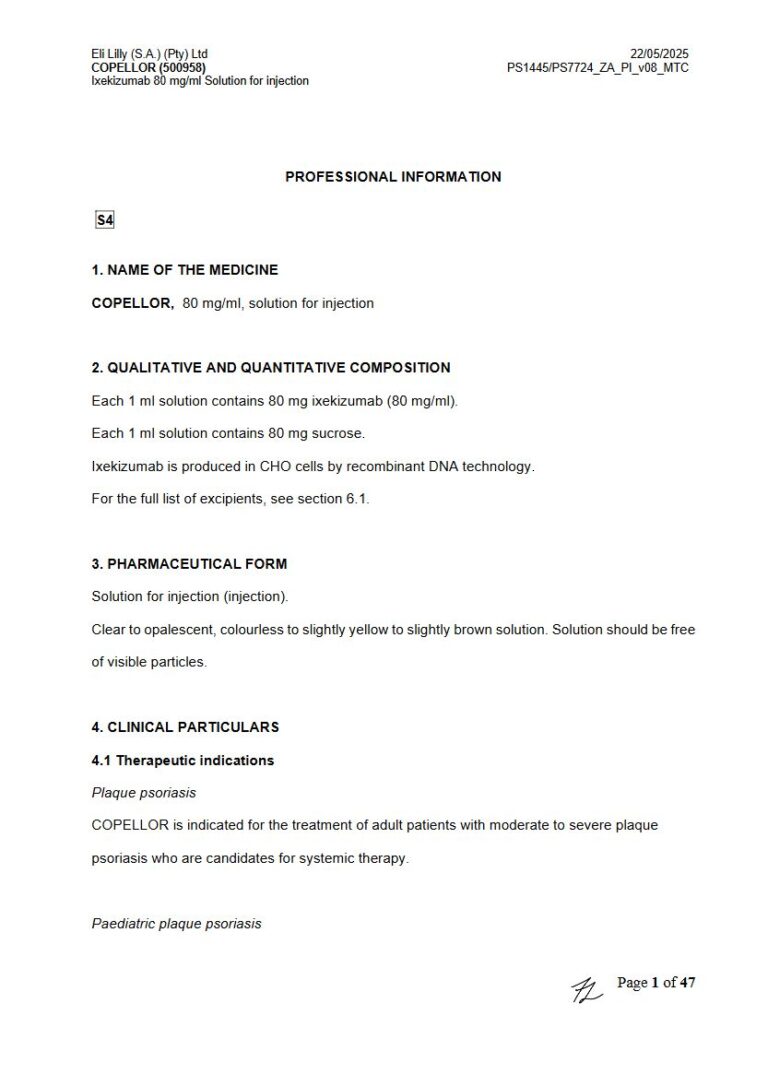
4.1 Therapeutic indications
Plaque psoriasis
COPELLOR is indicated for the treatment of adult patients with moderate to severe plaque psoriasis who are candidates for systemic therapy.
Paediatric plaque psoriasis
COPELLOR is indicated for the treatment of moderate to severe plaque psoriasis in children from the age of 6 years and above with a body weight > 50 kg who are candidates for systemic therapy.
Psoriatic arthritis
COPELLOR, alone or in combination with methotrexate, is indicated for the treatment of active psoriatic arthritis in adult patients who have responded inadequately to, or who are intolerant to one or more disease-modifying anti-rheumatic drug (DMARD) therapies.
Axial spondyloarthritis
Ankylosing spondylitis (radiographic axial spondyloarthritis)
COPELLOR is indicated for the treatment of adult patients with active ankylosing spondylitis who have responded inadequately to conventional therapy.
Non-radiographic axial spondyloarthritis
COPELLOR is indicated for the treatment of adult patients with active non-radiographic axial spondyloarthritis with objective signs of inflammation as indicated by elevated C-reactive protein (CRP) and/or magnetic resonance imaging (MRI) who have responded inadequately to nonsteroidal anti-inflammatory drugs (NSAIDs).
4.2 Posology and method of administration
This medicinal product is intended for use under the guidance and supervision of a doctor experienced in the diagnosis and treatment of conditions for which it is indicated.
Posology
Plaque psoriasis in adults
The recommended dose is 160 mg by subcutaneous injection (two 80 mg injections) at Week 0, followed by an 80 mg injection at Weeks 2, 4, 6, 8, 10 and 12, then maintenance dosing of 80 mg (one injection) every 4 weeks.
Paediatric plaque psoriasis (age 6 years and above with a body weight of > 50 kg)
Efficacy and safety data is not available in children below the age of 6 years (see section 5.1). The recommended dose given by subcutaneous injection in children with a body weight > 50 kg is 160 mg (two 80 mg injections) at Week 0, then 80 mg every 4 weeks.
Psoriatic arthritis
The recommended dose is 160 mg by subcutaneous injection (two 80 mg injections) at week 0, followed by 80 mg (one injection) every 4 weeks thereafter. For psoriatic arthritis patients with concomitant moderate to severe plaque psoriasis, the recommended dosing regimen is the same as for plaque psoriasis.
Axial spondyloarthritis (radiographic and non-radiographic)
The recommended dose is 160 mg (two 80 mg injections) by subcutaneous injection at week 0, followed by 80 mg every 4 weeks (see section 5.1 for further information). For all indications (plaque psoriasis in adults and children, psoriatic arthritis, axial spondyloarthritis) consideration should be given to discontinuing treatment in patients who have shown no response after 16 to 20 weeks of treatment. Some patients with initially partial response may subsequently improve with continued treatment beyond 20 weeks.
Special populations
Elderly (u2265 65 years)
No dose adjustment is required (see section 5.2). There is limited information in patients aged u2265 75 years.
Renal or hepatic impairment
COPELLOR has not been studied in these patient populations. No dose recommendations can be made.
Paediatric population
Paediatric plaque psoriasis (below a body weight of 25 kg and below the age of 6 years)
There is no relevant use of COPELLOR in children below a body weight of 25 kg and below the age of 6 years in the treatment of moderate to severe plaque psoriasis.
Paediatric psoriatic arthritis
The safety and efficacy of COPELLOR in children and adolescents aged 2 to less than 18 years in the treatment of psoriatic arthritis (a category of juvenile idiopathic arthritis) have not yet been established. No data are available. There is no relevant use of COPELLOR in children below 2 years for the indication of psoriatic arthritis.
Method of administration
COPELLOR is for subcutaneous administration. Injection sites may be alternated. If possible, areas of the skin that show psoriasis should be avoided as injection sites. The solution must not be shaken.
After training in subcutaneous injection technique, a patient may self-inject COPELLOR. However, the physician should ensure appropriate follow-up of patients.
4.3 Contraindications
COPELLOR is contraindicated in patients with hypersensitivity to ixekizumab or to any of the excipients in COPELLOR (see section 6.1). Clinically important active infections (e.g. active tuberculosis, see section 4.4). Patients must not receive live attenuated vaccines while on COPELLOR.
4.4 Special warnings and precautions for use
Infections
Treatment with COPELLOR is associated with an increased rate of infections such as upper respiratory tract infection, oral candidiasis, conjunctivitis, and tinea infections (see section 4.8). COPELLOR should be used with caution in patients with clinically important chronic or active infection, including the HIV-positive patients. If such an infection develops, monitor carefully and discontinue COPELLOR if the patient is not responding to standard therapy or the infection becomes serious. Do not resume COPELLOR until the infection resolves. COPELLOR should not be given to patients with active tuberculosis (TB). Prior to initiating treatment with COPELLOR, patients should be evaluated for TB infection (see section 4.3). Consider anti-TB therapy prior to initiation of COPELLOR in patients with latent TB.
Hypersensitivity
Serious hypersensitivity reactions, including some cases of anaphylaxis, angioedema, urticaria, and rarely, late (10 to 14 days following injection) serious hypersensitivity reactions including widespread urticaria, dyspnea and high antibody titres, have been reported.
If a serious hypersensitivity reaction occurs, administration of COPELLOR should be discontinued immediately and appropriate therapy initiated.
Inflammatory Bowel Disease (including Crohn's disease and ulcerative colitis)
Cases of new or exacerbations of inflammatory bowel disease have been reported with ixekizumab (see section 4.8). Ixekizumab is not recommended in patients with inflammatory bowel disease. If a patient develops signs and symptoms of inflammatory bowel disease or experiences an exacerbation of pre-existing inflammatory bowel disease, ixekizumab should be discontinued and appropriate medical management should be initiated.
Immunisations
COPELLOR should not be used with live attenuated vaccines. No data are available on the response to live or inactive vaccines (see section 5.1).
Excipients
This medicinal product contains less than 1 mmol sodium (23 mg) per 80 mg dose, that is to say essentially u201csodium - freeu201d.
4.5 Interactions with other medicinal products and other forms of interaction
In plaque psoriasis studies, the safety of COPELLOR in combination with other immunomodulatory medicines or phototherapy has not been evaluated. In population pharmacokinetic analyses, clearance of ixekizumab was not affected by concomitant administration of oral corticosteroids, NSAIDs, sulfasalazine, or methotrexate.
Cytochrome P450 substrates
Results from an interaction study in patients with moderate-to-severe psoriasis determined that 12 weeks of administration of ixekizumab with substances metabolised by CYP3A4 (i.e., midazolam), CYP2C9 (i.e., warfarin), CYP2C19 (i.e., omeprazole), CYP1A2 (i.e., caffeine) or CYP2D6 (i.e., dextromethorphan) does not have a clinically significant impact on the pharmacokinetics of these substances.
4.6 Fertility, pregnancy and lactation
The safety of COPELLOR in pregnancy and lactation has not been established.
Women of childbearing potential
Women of childbearing potential should use an effective method of contraception during treatment and for at least 10 weeks after treatment.
Pregnancy
There is a limited amount of data from the use of ixekizumab in pregnant women. Animal studies do not indicate direct or indirect harmful effects with respect to pregnancy, embryonic/foetal development, parturition or post-natal development (see section 5.3).
COPELLOR should not be given to a pregnant woman.
Breastfeeding
It is not known whether ixekizumab is excreted in human milk or absorbed systemically after ingestion. However, ixekizumab is excreted in the milk of cynomolgus monkeys. Women receiving COPELLOR should not breastfeed their infants.
Fertility
The effect of COPELLOR on human fertility has not been evaluated.
4.7 Effects on the ability to drive and use machines
There are no known effects on the ability to drive or use machines associated with the use of COPELLOR.
4.8 Undesirable effects
Summary of the safety profile
The most frequently reported adverse reactions were injection site reactions (15,5 %) and upper respiratory tract infections (16,4 %) (most frequently nasopharyngitis).
Tabulated list of adverse reactions
Within each frequency grouping, Adverse Drug Reactions (ADRs) are presented in order of decreasing seriousness. In addition, the corresponding frequency category for each adverse reaction is based on the following convention: very common (u2265 1/10); common (u2265 1/100 to < 1/10); uncommon (u2265 1/1 000 to < 1/100); rare (u2265 1/10 000 to < 1/1 000); very rare (< 1/10 000). A total of 8,956 patients have been treated with COPELLOR in blinded and open-label clinical studies in plaque psoriasis, psoriatic arthritis, axial spondyloarthritis, and other autoimmune conditions. Of these, 6 385 patients were exposed to COPELLOR for at least one year, cumulatively representing 19 833 adult patient years of exposure and 196 children cumulatively representing 207 patient years of exposure.
System Organ Class Frequency Adverse reaction
Infections and infestations Very common Upper respiratory tract infection
Common Tinea infection, Herpes simplex (mucocutaneous)
Uncommon Influenza, Rhinitis, Oral candidiasis, Conjunctivitis, Cellulitis
Blood and lymphatic system disorders Uncommon Neutropenia, Thrombocytopenia
Immune system disorders Uncommon Angioedema
Rare Anaphylaxis
Respiratory, thoracic, and mediastinal disorders Common Oropharyngeal pain
Gastrointestinal disorders Common Nausea
Uncommon Inflammatory bowel disease
Skin and subcutaneous disorders Uncommon Urticaria, Rash, Eczema
General disorders and administration site conditions Very common Injection site reactions
a See section description of selected adverse reactions
Description of selected adverse reactions
Injection site reactions
The most frequent injection site reactions observed were erythema and pain. These reactions were predominantly mild to moderate in severity and did not lead to discontinuation of COPELLOR. In the adult plaque psoriasis studies, injection site reactions were more common in patients with a body weight < 60 kg compared with the group with a body weight u2265 60 kg (25 % vs. 14 % for the combined Q2W and Q4W groups). In the psoriatic arthritis studies, injection site reactions were more common in patients with a body weight < 100 kg compared with the group with a body weight u2265 100 kg (24 % vs. 13 % for the combined Q2W and Q4W groups). In the axial spondyloarthritis studies, injection site reactions were similar in patients with a body weight < 100 kg compared with the group with a body weight u2265 100 kg (14 % vs. 9 % for the combined Q2W and Q4W groups). The increased frequency of injection site reactions in the combined Q2W and Q4W groups did not result in an increase in discontinuations in either the plaque psoriasis, the psoriatic arthritis or the axial spondyloarthritis studies.
Infections
In the placebo-controlled period of the phase III clinical studies in plaque psoriasis in adults, infections were reported in 27,2 % of patients treated with COPELLOR for up to 12 weeks compared with 22,9 % of patients treated with placebo. The majority of infections were non-serious and mild to moderate in severity, most of which did not necessitate treatment discontinuation. Serious infections occurred in 13 (0,6 %) of patients treated with COPELLOR and in 3 (0,4 %) of patients treated with placebo (see section 4.4). Over the entire treatment period infections were reported in 52,8 % of patients treated with COPELLOR (46,9 per 100 patient years). Serious infections were reported in 1,6 % of patients treated with COPELLOR (1,5 per 100 patient years). Infection rates observed in psoriatic arthritis and axial spondyloarthritis clinical studies were similar to those observed in the plaque psoriasis studies with the exception of the frequencies of the adverse reactions of influenza and conjunctivitis which were common in patients with psoriatic arthritis.
Laboratory assessment of neutropenia and thrombocytopenia
In plaque psoriasis studies, 9 % of patients receiving COPELLOR developed neutropenia. In most cases, the blood neutrophil count was u2265 1,000 cells/mm 3. Such levels of neutropenia may persist, fluctuate or be transient. 0,1 % of patients receiving COPELLOR developed a neutrophil count < 1,000 cells/mm 3. In general, neutropenia did not require discontinuation of COPELLOR. 3 % of patients exposed to COPELLOR had a shift from a normal baseline platelet value to < 150,000 platelet cells/mm 3 to u2265 75,000 cells /mm 3. Thrombocytopenia may persist, fluctuate or be transient. The frequency of neutropenia and thrombocytopenia in psoriatic arthritis and axial spondyloarthritis clinical studies is similar to that observed in the plaque psoriasis studies.
Immunogenicity
Approximately 9 to 17 % of adult plaque psoriasis patients treated with COPELLOR at the recommended dosing regimen developed anti-drug antibodies, the majority of which were low titres and not associated with reduced clinical response up to 60 weeks of treatment. However, approximately 1 % of patients treated with COPELLOR had confirmed neutralising antibodies associated with low drug concentrations and reduced clinical response. In psoriatic arthritis patients treated with COPELLOR at the recommended dosing regimen up to 52 weeks, approximately 11 % developed anti-drug antibodies, the majority of which were low titre, and approximately 8 % had confirmed neutralising antibodies. No apparent association between the presence of neutralising antibodies and impact on drug concentration or efficacy was observed.
In paediatric psoriasis patients treated with COPELLOR at the recommended dosing regimen up to 12 weeks, 21 patients (18 %) developed anti-drug antibodies, approximately half were low titer and 5 patients (4 %) had confirmed neutralizing antibodies associated with low drug concentrations. There was no association with clinical response or adverse events. In radiographic axial spondyloarthritis patients treated with COPELLOR at the recommended dosing regimen up to 16 weeks, 5,2 % developed anti-drug antibodies, the majority of which were low titer, and 1,5 % (3 patients) had neutralising antibodies (NAb). In these 3 patients, NAb-positive samples had low ixekizumab concentrations and none of these patients achieved an ASAS40 response. In non-radiographic axial spondyloarthritis patients treated with COPELLOR at the recommended dosing regimen for up to 52 weeks, 8,9 % developed anti-drug antibodies, all of which were low titer; no patient had neutralising antibodies; and no apparent association between the presence of anti-drug antibodies and drug concentration, efficacy, or safety was observed. Across all indications, an association between immunogenicity and treatment emergent adverse events has not been clearly established.
Paediatric population
The safety profile observed in children with plaque psoriasis treated with COPELLOR every 4 weeks is consistent with the safety profile in adult patients with plaque psoriasis with the exception of the frequencies of conjunctivitis, influenza, and urticaria which were common. Inflammatory bowel disease was also more frequent in paediatric patients, although it was still uncommon. In the paediatric clinical study, Crohnu2019s disease occurred in 0,9 % of patients in the COPELLOR group and 0 % of patients in the placebo group during the 12-week, placebo-controlled period. Crohnu2019s disease occurred in a total of 4 COPELLOR treated patients (2,0 %) during the combined placebo-controlled and maintenance periods of the paediatric clinical study.
Reporting of suspected adverse reactions
Reporting suspected adverse reactions after authorization of the medicine is important. It allows continued monitoring of the benefit/risk balance of the medicine. Healthcare professionals are requested to report any suspected adverse reactions to SAHPRA via the Med Safety APP (Medsafety X SAHPRA) and eReporting platform (who-umc.org) found on SAHPRA website. Alternatively, report suspected adverse reactions to the company at [email protected].
4.9 Overdose
Doses up to 180 mg have been administered subcutaneously in clinical trials without dose-limiting toxicity. Overdoses up to 240 mg, subcutaneously, as a single administration in clinical trials, have been reported without any serious adverse events. In the event of overdosage, it is recommended that the patient be monitored for any signs or symptoms of adverse reactions and appropriate symptomatic treatment be instituted immediately.
