
Fastum Gel 2.5 g per 100 g GEL
PDF Leaflet Revision Date: 29 July 2025
Clinical Summary
Quick overview from the medicine insert
Indication
Relief of localized pain and inflammation from acute musculoskeletal injuries.
Dosage (summary)
Apply 5-15 cm of gel (100-300 mg ketoprofen) once or twice daily for up to 7 days.
Special Populations
- Elderly
- Renal impairment
- Hepatic impairment
Pregnancy & Breastfeeding
Avoid in pregnancy (especially third trimester) and lactation due to unknown safety.
Key Drug Interactions
- Caution with coumarin anticoagulants
Contraindications
- Hypersensitivity to ketoprofen
- Photosensitivity history
- Third trimester of pregnancy
- Application to damaged skin
Common side effects
- Erythema
- Pruritus
- Burning sensation
Counselling Points
- Wash hands after application
- Avoid occlusive dressings
- Monitor for skin reactions
Serious warnings
- Risk of systemic effects with large quantities
- Avoid sun exposure during and 2 weeks after treatment
Important Disclaimer
The Fastum Gel 2.5 g per 100 g GEL professional information leaflet below is the property of Menarini South Africa and is provided on Medinsert exactly as issued, with no.. alterations or editorial changes. We make every effort to keep content current by updating documents as soon as new versions become available. Medinsert serves as a trusted access point for healthcare professionals, but does not replace official sources or clinical judgement. For more details, please read our full disclaimer. read more>>
 Healthcare Professionals Only
This content is for registered healthcare professionals
Sign in or create a free account to read the full package insert.
Free for HPCSA-registered professionals. Powered by Medinsert.
Clinical Particulars
Section 4 of the official insert — extracted exactly as issued, no alterations
4.1 Therapeutic indications
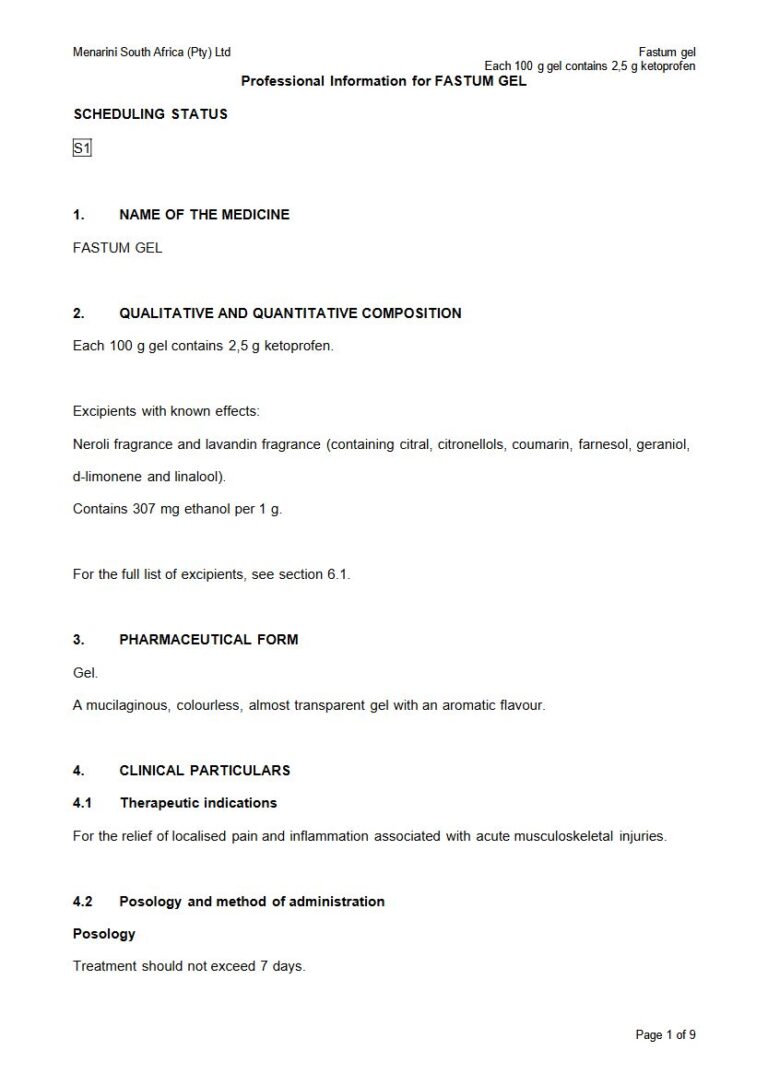
For the relief of localised pain and inflammation associated with acute musculoskeletal injuries.
4.2 Posology and method of administration
Posology Treatment should not exceed 7 days.
Persons 12 years and older: Apply to the affected area once or twice daily by gently massaging in order to help absorption. Apply 5 to 15 cm of gel with each application (100 mg to 300 mg ketoprofen).
Method of administration Topical.
4.3 Contraindications
- Hypersensitivity or history of hypersensitivity to ketoprofen or to any of the excipients listed in section 6.1.
- History of photosensitivity reactions.
- Known hypersensitivity reactions, such as asthma symptoms, allergic rhinitis and urticaria, to ketoprofen, fenofibrate, tiaprofenic acid, acetylsalicylic acid or other nonsteroidal anti-inflammatory drugs (NSAIDs).
- History of skin allergy to ketoprofen, tiaprofenic acid, fenofibrate, UV blockers or perfumes.
- Sun exposure, even in case of hazy sun, including UV light from solarium, during the treatment and 2 weeks after its discontinuation (see section 4.4).
- Application to pathologically altered skin, such as dermatosis, eczema or acne, around the eyes, to infected skin or to open wounds.
- Third trimester of pregnancy (see section 4.6).
- Safety in children has not been established.
4.4 Special warnings and precautions for use
FASTUM GEL should be used with caution in patients with reduced heart, liver or kidney function. Isolated cases of systemic adverse reactions affecting the kidneys have been reported.
FASTUM GEL should not be used with occlusive dressings.
FASTUM GEL must not come into contact with the mucous membranes and with the eyes.
The topical use of large quantities of FASTUM GEL can give rise to systemic effects, such as hypersensitivity and asthma.
Topical use of FASTUM GEL, especially if prolonged, can give rise to sensitisation phenomena or local irritation. Treatment should be interrupted if redness appears. Treatment should be discontinued immediately upon development of any skin reactions, including cutaneous reactions after co-application of octocrylene-containing products (octocrylene is an excipient used to prevent photodegradation in various cosmetics and personal care products such as shampoos, aftershaves, shower and bath gels, skin creams, lipsticks, anti-ageing creams, make-up removers and hairsprays).
It is recommended to protect treated areas by wearing clothing during treatment with FASTUM GEL and for the two weeks following its discontinuation to avoid the risk of photosensitisation. Hands should be washed thoroughly after each application of FASTUM GEL. The recommended treatment length should not be exceeded due to the risk of developing contact dermatitis and of an increase in photosensitivity reactions over time.
Patients with asthma associated with chronic rhinitis, chronic sinusitis and/or nasal polyposis have a higher risk of allergies to aspirin and/or NSAIDs than the rest of the population.
FASTUM GEL is not habit-forming. The safety and efficacy of FASTUM GEL in children have not been established (see section 4.3)
Elderly patients are particularly susceptible to the adverse effects of nonsteroidal anti-inflammatory drugs (NSAIDs).
Excipient with known effect FASTUM GEL contains neroli fragrance which in turn contains the allergens citral, citronellols, farnesol, geraniol, d-limonene and linalool, and lavandin fragrance which contains the allergens coumarin, geraniol, d-limonene and linalool. These allergens may cause allergic reactions.
FASTUM GEL contains ethanol that may cause a burning sensation on damaged skin.
4.5 Interaction with other medicines and other forms of interaction
No interactions between FASTUM GEL and other medicines have been observed. Interactions are unlikely as serum concentrations after topical administration are low.
FASTUM GEL should be used with caution in patients who are receiving coumarin anticoagulants. It is advisable to monitor patients receiving coumarin anticoagulants.
4.6 Fertility, pregnancy and lactation
Pregnancy Safety of FASTUM GEL during pregnancy has not been established. Use during the first and second trimester should be avoided. During the third trimester of pregnancy, all prostaglandin synthesis inhibitors, including ketoprofen, may cause cardiopulmonary and renal toxicity in the fetus. At the end of the pregnancy, bleeding time may be prolonged in both the mother and the child. FASTUM GEL is contraindicated during the third trimester of pregnancy (see section 4.3). Nonsteroidal anti-inflammatory drugs (NSAIDs) can also delay delivery.
Breastfeeding No data are available on the excretion of ketoprofen, as in FASTUM GEL, in breast milk. After systemic administration, traces of ketoprofen have been found in breast milk. Use of FASTUM GEL is not recommended during lactation.
4.7 Effects on ability to drive and use machines
It is unlikely for FASTUM GEL to affect the ability to drive a vehicle and operate machines.
4.8 Undesirable effects
FASTUM GEL can cause side effects, although not everybody gets them. Undesirable effects of medicines for cutaneous use may occur on the skin. Localised skin reactions have been reported (e.g. erythema, pruritus and burning sensation) which may subsequently spread beyond the area of application and, in some cases, be severe and generalised (e.g. bullous or phlyctenular eczema), in addition to hypersensitivity reactions and skin reactions (photosensitivity). The frequency and extent of these effects are significantly reduced if, during treatment and in the two weeks following treatment, exposure to sunlight, including in a solarium, is avoided.
Other systemic effects of NSAIDs: These depend on the transdermal diffusion of the active ingredient, and thus on the amount of gel applied, the area involved, the degree of skin integrity, the duration of treatment and the use of occlusive dressings (digestive and kidney effects).
The following convention is used to define the frequency of side effects: very common (u2265 1/10); common (u2265 1/100, < 1/10); uncommon (u2265 1/1 000, < 1/100); rare (u2265 1/10 000, < 1/1 000); very rare (< 1/10 000); not known (the frequency cannot be established based on the available data).
Blood and lymphatic system disorders Very rare: agranulocytosis and thrombocytopenia.
Immune system disorders Rare: sensitivity reactions. Not known: anaphylactic reactions, including anaphylactic shock, angioedema, hypersensitivity reactions.
Nervous system disorders Rare: headache. Very rare: dizziness, nervousness, depression, insomnia and drowsiness.
Eye disorders Rare: other ocular reactions. Very rare: blurred vision.
Ear and labyrinth disorders Very rare: tinnitus.
Gastrointestinal disorders Rare: peptic ulcer, gastrointestinal bleeding. Very rare: diarrhoea.
Skin and subcutaneous tissue disorders Uncommon: localised skin reactions such as erythema, eczema, pruritus and burning sensation. Rare: dermatological reactions (photosensitisation, bullous eruptions and urticaria). Cases of more severe adverse reactions, such as bullous or phlyctenular eczema which may spread beyond the area of application or become generalised, have occurred rarely. Very rare: contact dermatitis. Not known: bullous dermatitis, skin rashes.
Renal and urinary disorders Very rare: impairment of renal function including interstitial nephritis or nephrotic syndrome, new cases or worsening of existing cases of renal insufficiency. There have also been reports of isolated cases of systemic adverse reactions such as renal disorders.
General disorders and administration site conditions Not known: oedema.
Investigations Very rare: abnormalities of liver function tests.
Reporting of suspected adverse reactions Reporting suspected adverse reactions after authorisation of FASTUM GEL is important. It allows continued monitoring of the benefit/risk balance of FASTUM GEL. Health care providers are requested to report any suspected adverse drug reactions to the South African Health Products Regulatory Authority (SAHPRA) via the Med Safety APP (Medsafety X SAHPRA) and eReporting platform (who-umc.org) found on SAHPRA website.
4.9 Overdose
Overdose is unlikely with topical administration. Given the low plasma levels of ketoprofen, as in FASTUM GEL, when applied percutaneously, overdose phenomena can be ruled out. If accidentally ingested, FASTUM GEL may cause systemic undesirable effects depending on the amount ingested. However, if this occurs, treatment will be symptomatic and supportive as in cases of overdose of oral anti-inflammatory medicines.
