
Aldurazyme Injection
Clinical Summary
Quick overview from the medicine insert
Indication
Treatment of mucopolysaccharidosis type I (MPS I) in patients with a confirmed diagnosis.
Dosage (summary)
The recommended dosage is 0.58 mg/kg body weight administered as an intravenous infusion once a week.
Onset of Action / Duration
The onset of therapeutic effects may vary; however, some patients may begin to notice improvements within a few weeks of starting treatment.
Special Populations
- Pediatric patients
- Geriatric patients
- Patients with renal impairment
- Patients with hepatic impairment
Pregnancy & Breastfeeding
Laronidase should be used during pregnancy only if the potential benefit justifies the potential risk to the fetus. Caution is advised when administering to nursing mothers.
Key Drug Interactions
- No specific drug interactions have been reported; however, caution is advised when used with other medications that may affect immune function.
Contraindications
- Hypersensitivity to Laronidase or any of its excipients
- Severe allergic reactions
Common side effects
- Infusion-related reactions (e.g., fever, chills, rash)
- Headache
- Nausea
- Abdominal pain
- Fatigue
Counselling Points
- Inform patients about the potential for infusion-related reactions and the importance of reporting any unusual symptoms during or after infusion.
- Advise patients to maintain regular follow-up appointments for monitoring.
- Encourage patients to report any signs of allergic reactions.
Serious warnings
- Monitor for signs of hypersensitivity reactions during and after infusion.
- Use with caution in patients with a history of severe allergic reactions.
- Patients should be premedicated with antihistamines or corticosteroids if they have a history of infusion-related reactions.
Important Disclaimer
The Aldurazyme Injection professional information leaflet below is the property of Sanofi-Aventis South Africa and is provided on Medinsert exactly as issued, with no.. alterations or editorial changes. We make every effort to keep content current by updating documents as soon as new versions become available. Medinsert serves as a trusted access point for healthcare professionals, but does not replace official sources or clinical judgement. For more details, please read our full disclaimer. read more>>
 Healthcare Professionals Only
This content is for registered healthcare professionals
Sign in or create a free account to read the full package insert.
Free for HPCSA-registered professionals. Powered by Medinsert.
Clinical Particulars
Section 4 of the official insert — extracted exactly as issued, no alterations
4.1 Therapeutic indications
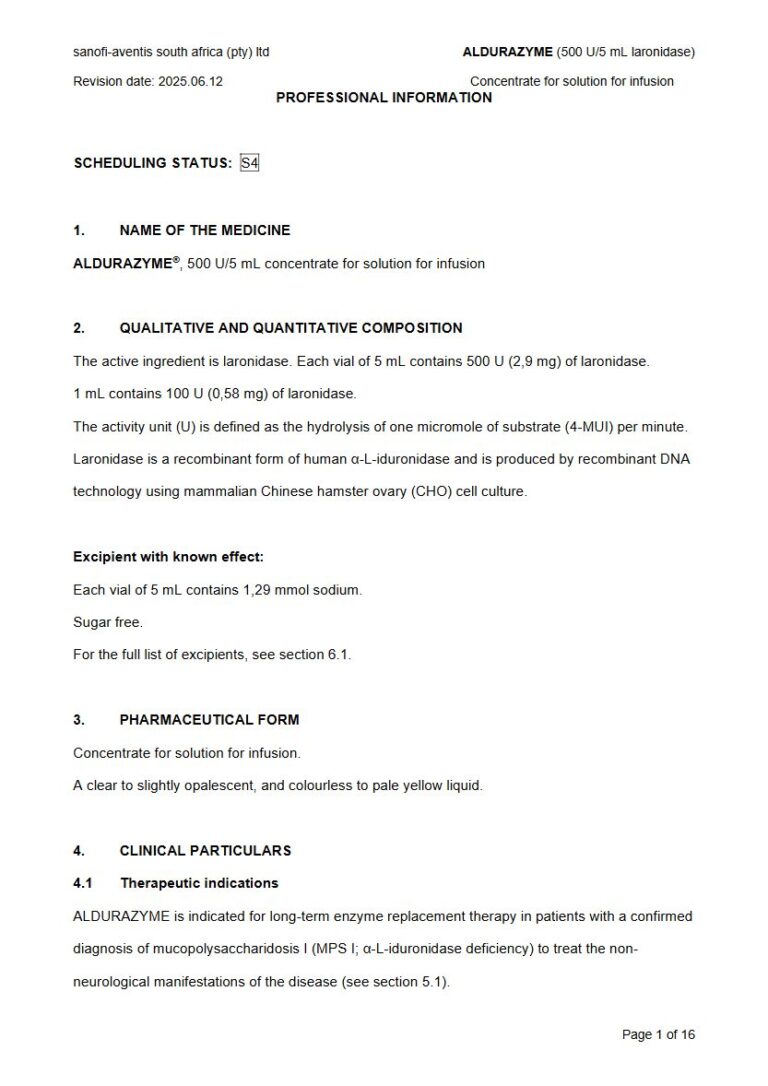
ALDURAZYME is indicated for long - term enzyme replacement therapy in patients with a confirmed diagnosis of mucopolysaccharidosis I (MPS I; u03b1 - L - iduronidase deficiency) to treat the non - neurological manifestations of the disease (see section 5.1).
4.2 Posology and method of administration
ALDURAZYME treatment should be supervised by a medical practitioner experienced in the management of patients with MPS I or other inherited metabolic diseases. Administration of ALDURAZYME should be carried out in an appropriate clinical setting where resuscitation equipment to manage medical emergencies would be readily available.
Posology
The recommended dosage regimen of ALDURAZYME is 100 U/kg body weight administered once every week as an intravenous infusion.
Special populations
Elderly patients
The safety and efficacy of ALDURAZYME in patients older than 65 years have not been established and no dosage regimen can be recommended in these patients.
Renal and hepatic insufficiency
The safety and efficacy of ALDURAZYME in patients with renal or hepatic insufficiency have not been evaluated and no dosage regimen can be recommended in these patients.
Paediatric population
The safety and effectiveness of ALDURAZYME have been established in patients 5 years of age and younger. No dose adjustment is necessary for the paediatric population. Overall, the safety and efficacy of ALDURAZYME treatment administered at 0,58 mg/kg (100 U/kg) every week in paediatric patients are consistent with that seen in adults.
Method of administration
ALDURAZYME is to be administered as an intravenous infusion. The initial infusion rate of 2 U/kg/h may be incrementally increased every fifteen minutes, if tolerated, to a maximum of 43 U/kg/h. The total volume of the administration should be delivered in approximately 3 u2013 4 hours. For information on pre - treatment, see section 4.4. For instructions on dilution of ALDURAZYME before administration, see section 6.6.
Home infusion
Infusion of ALDURAZYME at home may be considered for patients who are tolerating their infusions well and have no history of moderate or severe IARs for a few months. The decision to have a patient move to home infusion should be made after evaluation and upon recommendation by the treating medical practitioner. Home infusion infrastructure, resources and procedures, including training, must be established and available to the health care professional. Home infusion should be supervised by a health care professional who should be always available during the home infusion and for a specified time after infusion. Appropriate information should be given by the treating medical practitioner and/or nurse to the patient and/or caregiver prior to initiation of home infusion. Dose and infusion rate should remain constant while at home, and not be changed without supervision of a health care professional. If the patient experiences adverse reactions during the home infusion, the infusion process should be stopped immediately and appropriate medical treatment should be initiated (see section 4.4). Subsequent infusions may need to occur in a hospital or in an appropriate setting of outpatient care until no such adverse reaction is present.
4.3 Contraindications
Severe hypersensitivity (e.g. anaphylactic reaction) to the active ingredient or to any of the excipients listed in section 6.1 that also has occurred upon re - exposure (see sections 4.4 and 4.8).
4.4 Special warnings and precautions for use
Traceability
In order to improve the traceability of biological medicines, the name and the batch number of the administered product should be clearly recorded.
Infusion - associated reactions
Patients treated with ALDURAZYME may develop infusion - associated reactions (IARs) (including anaphylaxis), defined as any related adverse event occurring during the infusion or until the end of the infusion day (see section 4.8). Some of these IARs may be life - threatening (see below) and included respiratory failure, respiratory distress, stridor, tachypnoea, bronchospasm, obstructive airways disorder, hypoxia, hypotension, bradycardia and urticaria. Patients treated with ALDURAZYME should be closely monitored and all cases of infusion - associated reactions, delayed reactions and possible immunological reactions reported. Antibody status should be regularly monitored and reported. Severe infusion - associated reactions have been reported in patients with pre - existent severe underlying upper airway involvement and therefore specifically these patients should continue to be closely monitored and only be infused with ALDURAZYME in an appropriate clinical setting where resuscitation equipment to manage medical emergencies would be readily available. The risks and benefits of re - administering ALDURAZYME following a severe hypersensitivity or anaphylactic reaction should be considered. Extreme care should be exercised, with appropriate resuscitation measures available, if the decision is made to re - administer ALDURAZYME.
Caution should be exercised if epinephrine (adrenaline) is being considered for use in patients with MPS I due to the increased prevalence of coronary artery disease in these patients. Patients with an acute underlying illness at the time of ALDURAZYME infusion appear to be at greater risk for IARs. Careful consideration should be given to the patientu2019s clinical status prior to administration of ALDURAZYME.
Immunogenicity
Almost all patients are expected to develop IgG antibodies to laronidase, mostly within 3 months of initiation of treatment. Patients who have developed antibodies or symptoms of IARs should be treated with caution when administering ALDURAZYME (see sections 4.3 and 4.8). In clinical studies IARs were usually manageable by slowing the rate of infusion and by (pre - ) treating the patient with antihistamines and/or antipyretics (paracetamol or ibuprofen), thus enabling the patient to continue treatment. As there is little experience on resumption of treatment following prolonged interruption, use caution due to the increased risk of hypersensitivity reaction after treatment interruption. With initial administration of ALDURAZYME or upon re - administration following interruption of treatment, it is recommended that patients be administered pre - treatment medicines (antihistamines and/or antipyretics) approximately 60 minutes prior to the start of the infusion, to minimise the potential occurrence of IARs. If clinically indicated, administration of pre - treatment medicines with subsequent infusions of ALDURAZYME should be considered. In case of a mild or moderate IAR, treatment with antihistamines and paracetamol or ibuprofen should be considered and/or a reduction in the infusion rate to half the infusion rate at which the reaction occurred. In case of a single severe IAR, the infusion should be stopped until the symptoms are resolved and treatment with antihistamines and paracetamol or ibuprofen should be considered. The infusion can be restarted with a reduction of the infusion rate to u00bd u2013 u00bc the rate of the infusion at which the reaction occurred. In case of a recurrent moderate IAR or re - challenge after a single severe IAR, pre - treatment should be considered (antihistamines and paracetamol/ibuprofen and/or corticosteroids) and a reduction of the infusion rate to u00bd u2013 u00bc the rate of the infusion at which the previous reaction occurred. Severe allergic - type hypersensitivity reactions are possible. If these reactions occur, immediate discontinuation of ALDURAZYME is recommended and appropriate medical treatment should be initiated. The current medical standards for emergency treatment are to be observed. Laboratory tests for monitoring patients Evaluation of bioactivity during the clinical studies included changes in urinary glycosaminoglycan (GAG) levels, which were shown to decrease in patients treated with ALDURAZYME compared to those treated with placebo. As seen in the clinical studies, it is expected that patients will develop antibodies to ALDURAZYME. It is strongly recommended that patients be monitored periodically for IgG antibody formation. Excipients ALDURAZYME contains 30 mg sodium per vial, equivalent to 1,5 % of the WHO recommended maximum daily intake of 2 g sodium for an adult and is administered in 0,9 % sodium chloride intravenous solution (see section 6.6). To be taken into consideration by patients on a sodium - controlled diet.
4.5 Interaction with other medicines and other forms of interaction
No interaction studies have been performed. Based on its metabolism, laronidase is an unlikely candidate for cytochrome P450 - mediated interactions. ALDURAZYME should not be administered simultaneously with chloroquine or procaine due to a potential risk of interference with the intracellular uptake of laronidase.
4.6 Fertility, pregnancy and lactation
Safe use during pregnancy and lactation has not been established.
Pregnancy
There are inadequate data on the use of ALDURAZYME in pregnant women. Animal studies do not indicate direct or indirect harmful effects on pregnancy, embryonal/fetal development, parturition and postnatal development (see section 5.3). The potential risk for humans is unknown. Therefore, ALDURAZYME should not be used during pregnancy.
Breastfeeding
Laronidase may be excreted in milk. Because there are no data available in neonates exposed to laronidase via breast milk, it is recommended to stop breastfeeding during ALDURAZYME treatment.
Fertility
There are no clinical data on the effects of laronidase on fertility. Preclinical data did not reveal any significant adverse finding.
4.7 Effects on ability to drive and use machines
No studies on the effects on ability to drive a vehicle or operate machinery have been performed.
4.8 Undesirable effects
Adverse drug reactions (ADRs) to ALDURAZYME reported during the Phase 3 study and its extension in a total of 45 patients age 5 years and older and treated up to 4 years are listed below using the following categories of frequency: very common (u2265 1/10); common (u2265 1/100 to < 1/10), uncommon (u2265 1/1 000 to < 1/100), rare (u2265 1/10 000 to < 1/1 000), very rare (< 1/10 000) and frequency not known (cannot be estimated from the available data).
System organ class Preferred term Frequency
Immune system disorders anaphylactic reaction common
Psychiatric disorders restlessness common
Nervous system disorders headache very common paraesthesia, dizziness common
Cardiac disorders tachycardia common
Vascular disorders flushing very common hypotension, pallor, peripheral coldness common
Respiratory, thoracic and mediastinal disorders respiratory distress, dyspnoea, cough common cyanosis, hypoxia, tachypnoea, bronchospasm, respiratory arrest frequency not known
Gastrointestinal disorders nausea, abdominal pain very common vomiting, diarrhoea common
Skin and subcutaneous tissue disorders rash very common angioneurotic oedema, swelling of face, urticaria, pruritus, cold sweat, alopecia, hyperhidrosis erythema, facial oedema, laryngeal oedema, peripheral oedema frequency not known
Musculoskeletal and connective tissue disorders arthropathy, arthralgia, back pain, pain in extremity very common musculoskeletal pain common
General disorders and administration site conditions pyrexia, infusion site reaction very common chills, feeling hot, feeling cold, fatigue, influenza - like illness common extravasation frequency not known
Investigations increased body temperature, decreased oxygen saturation common
In a Phase 2 open - label study of 20 patients 5 years of age and younger treated for up to 52 weeks, the most common reported ADRs (> 1 patient/5 %) were: pyrexia (35 %), chills (20 %), and tachycardia, increased blood pressure, and decreased oxygen saturation (10 % each). Also, frequently reported ADRs from a Phase 1/2 open - label study of 10 patients treated for up to 3 years included angioedema, which occurred in 3 out of 10 patients. The majority of the related adverse events in the clinical trials were infusion - associated reactions (IARs) that were mild to moderate in severity. IARs were reported in 24 of 45 (53 %) patients 6 years of age and older during ALDURAZYME treatment and 7 of 20 (35 %) patients 5 years of age and younger in the Phase 3 studies, and 7 of 20 patients (35 %) in the Phase 2 study. Over time the frequency of IARs decreased. Most IARs that required intervention were managed by decreasing the infusion rate, temporarily stopping the infusion, and/or administering antipyretics and/or antihistamines. The most frequently reported IARs in the Phase 3 studies were rash, flushing, headache, pyrexia, abdominal pain, diarrhoea, nausea, vomiting, and in patients 5 years of age and younger in the Phase 2 study were pyrexia, chills, increased blood pressure, decreased oxygen saturation, and tachycardia. In general, IARs from post - marketing reporting were similar in nature to those seen in clinical trials. Overall infusion site reactions with ALDURAZYME administration are very common. During clinical trials and post - marketing experience, infusion/injection site reactions included: extravasation, swelling, pain, erythema, oedema, discomfort, urticaria, pallor, macule and warmth.
Serious adverse reactions
In the Phase 3 open - label extension study, a single patient with pre - existing airway obstruction experienced a severe anaphylactic reaction approximately 3 hours after the initiation of the infusion (at week 62 of treatment) which consisted of urticaria and airway obstruction. Resuscitation required emergency tracheostomy. This patient tested IgE - positive. In addition, a 3 - year - old severely affected patient experienced an anaphylactic reaction and respiratory arrest. Both patients discontinued ALDURAZYME treatment.
Post - marketing adverse reactions
In addition to the infusion reactions reported in clinical trials, the following infusion reactions have been reported in patients during post - marketing use of ALDURAZYME: cough, dyspnoea, decreased oxygen saturation/hypoxia, tachypnoea, cyanosis, respiratory failure, medicine specific antibody, neutralising antibodies, hypersensitivity, bradycardia and manifestations of angioedema, such as facial oedema and laryngeal oedema, pharyngeal swelling, lip swelling, swollen tongue and hypertension. Additional significant ADRs have included serious reports of infusion - associated bronchospasm that required treatment with epinephrine (adrenaline), corticosteroids and/or oxygen therapy. Some patients were successfully re - challenged. Other infusion reactions reported in patients during post - marketing use include pallor, fatigue, erythema, peripheral oedema, paraesthesia, feeling hot and feeling cold. There have been reports of extravasation in patients treated with ALDURAZYME. There have been no reports of tissue necrosis associated with extravasation.
Immunogenicity
During the clinical studies, almost all patients treated with ALDURAZYME developed IgG antibodies to ALDURAZYME, which tended to decrease over time. The presence of high IgG levels has been associated with variable urinary GAG reduction. In addition, higher ADA (anti - drug antibodies) titres were also observed in MPS I Registry patients with severe disease. Patients with persistently high ADA titres tended to have less reduction in urinary GAG. In the Phase 2 and 3 studies, 60 patients were tested for in vitro neutralising effects. Four patients (three in the Phase 3 study and one in the Phase 2 study) showed marginal to low level in vitro inhibition of laronidase enzymatic activity, which did not appear to impact clinical efficacy and/or urinary GAG reduction. In patients with clinical decline, assessing urinary GAGs, ADA and neutralising antibodies should be considered. The presence of antibodies was not consistently related to the incidence of IARs, although the onset of IARs typically coincided with the formation of IgG antibodies. Clinical trials and observational studies show only a small number of patients have tested positive for IgE antibodies. The development of IgE antibodies may be associated with hypersensitivity or anaphylactic reactions.
4.9 Overdose
Treatment is symptomatic and supportive. Inappropriate administration of ALDURAZYME (overdose and/or infusion rate higher than recommended) may be associated with adverse drug reactions. An excessively fast administration of ALDURAZYME may result in nausea, abdominal pain, headache, dizziness and dyspnoea. If signs or symptoms occur associated with overdose or an infusion rate higher than recommended, the infusion must be stopped immediately. If medically appropriate, further intervention may be indicated.
