
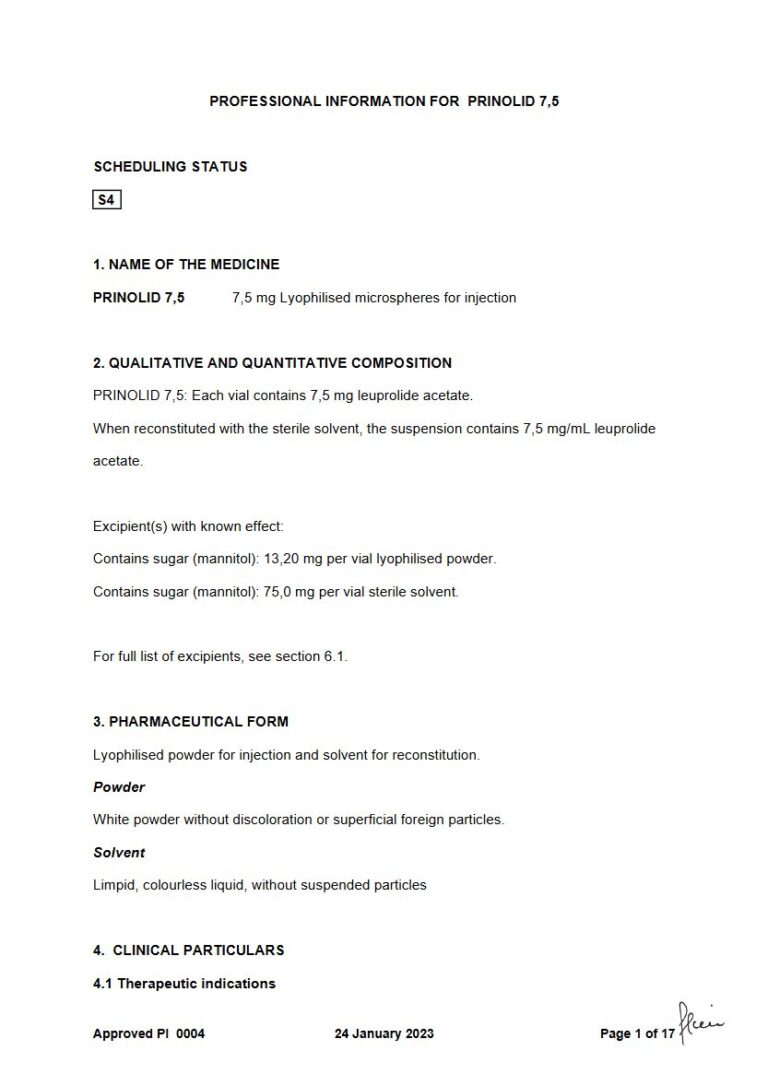
Prinolid 7,5 7,5 mg Injection
PDF Leaflet Revision Date: 24 January 2023
Clinical Summary
Quick overview from the medicine insert
Indication
Palliative treatment of advanced prostate cancer.
Dosage (summary)
1 injection (7.5 mg) every month, subcutaneously.
Special Populations
- Paediatric population
- Women
Pregnancy & Breastfeeding
Can cause fetal harm; contraindicated in pregnancy.
Key Drug Interactions
- QT prolonging medications
- Antipsychotics
- Methadone
Contraindications
- Hypersensitivity to leuprolide acetate
- Women
- Paediatric patients
- Previous orchiectomy
- Sole treatment in spinal metastases
Common side effects
- Hot flashes
- Nausea
- Fatigue
- Injection site irritation
Counselling Points
- Monitor for cardiovascular symptoms
- Consider antiandrogen therapy for initial testosterone flare
- Report any severe side effects immediately
Serious warnings
- Risk of myocardial infarction
- QT prolongation
- Pituitary apoplexy
- Hyperglycaemia
Important Disclaimer
The Prinolid 7,5 7,5 mg Injection professional information leaflet below is the property of Eurolab and is provided on Medinsert exactly as issued, with no.. alterations or editorial changes. We make every effort to keep content current by updating documents as soon as new versions become available. Medinsert serves as a trusted access point for healthcare professionals, but does not replace official sources or clinical judgement. For more details, please read our full disclaimer. read more>>
 Healthcare Professionals Only
This content is for registered healthcare professionals
Sign in or create a free account to read the full package insert.
Free for HPCSA-registered professionals. Powered by Medinsert.
Clinical Particulars
Section 4 of the official insert — extracted exactly as issued, no alterations
4.1 Therapeutic indications
PRINOLID 7,5 is indicated for the palliative treatment of advanced prostate cancer.
4.2 Posology and method of administration
Posology
The recommended dose is 1 injection (7,5 mg) every month.
Special populations
Paediatric population
No data are available.
Method of administration
PRINOLID 7,5 is administered subcutaneously and provide continuous release of leuprolide acetate over a one-, three, four- or six-month treatment period. The injection delivers the dose of leuprolide acetate as lyophilised microspheres.
General
The injection sites should be varied periodically. For information on instructions for preparation or reconstitution see section 6.6
4.3 Contraindications
- Hypersensitivity to leuprolide acetate or similar nonapeptides or to any of the excipients listed in section 6.1 or to synthetic gonadotrophin releasing hormone (Gn-RH) or Gn-RH derivatives.
- PRINOLID 7,5 is contraindicated in women and in paediatric patients, and was not studies in women or children (see section 4.6).
- In patients who previously underwent orchiectomy (as with other GnRH agonists, PRINOLID 7,5 does not result in further decrease of serum testosterone in case of surgical castration).
- As sole treatment in prostate cancer patients with spinal cord compression or evidence of spinal metastases (see also section 4.4).
4.4 Special warnings and precautions for use
Correct reconstitution
Lack of clinical efficacy may occur due to incorrect reconstitution of the product. See section 6.6 for the instructions for preparation and administration of the product and for evaluation of testosterone levels in cases of suspected or known handling errors.
Androgen deprivation therapy may prolong the QT interval
In patients with a history of or risk factors for QT prolongation and in patients receiving concomitant medicines that might prolong the QT interval (see section 4.5) medical practitioners should assess the benefit risk ratio including the potential for Torsade de pointes prior to initiating PRINOLID 7,5.
Cardiovascular diseases
Increased risk of developing myocardial infarction, sudden cardiac death and stroke has been reported in association with use of GnRH agonists in men. The risk appears low based on the reported odds ratios, and should be evaluated carefully along with cardiovascular risk factors when determining a treatment for patients with prostate cancer. Patients receiving GnRH agonists should be monitored for symptoms and signs suggestive of development of cardiovascular disease and be managed according to current clinical practice.
Transient testosterone flare
Leuprolide acetate causes a transient increase in serum concentrations of testosterone, dihydrotestosterone and acid phosphatase during the first week of treatment. Patients may experience worsening of symptoms or onset of new symptoms, including bone pain, neuropathy, haematuria, or ureteral or bladder outlet obstruction (see section 4.8). These symptoms usually subside on continuation of therapy. Additional administration of an appropriate antiandrogen should be considered beginning 3 days prior to leuprolide therapy and continuing for the first two to three weeks of treatment. This has been reported to prevent the sequelae of an initial rise in serum testosterone. Following surgical castration, PRINOLID 7,5 does not lead to a further decrease in serum testosterone levels in male patients.
Bone density
Decreased bone density has been reported in the medical literature in men who have had orchiectomy or who have been treated with GnRH agonists (see section 4.8). Antiandrogen therapy significantly increases the risk for fractures owing to osteoporosis. Only limited data is available on this issue. Fractures owing to osteoporosis were observed in 5 % of patients following 22 months of pharmacological androgen deprivation therapy and in 4 % of patients following 5 to 10 years of treatment. The risk for fractures owing to osteoporosis is generally higher than the risk for pathological fractures. Apart from long lasting testosterone deficiency, increased age, smoking and consumption of alcoholic beverages, obesity and insufficient exercise may have an influence on the development of osteoporosis.
Pituitary apoplexy
During post-marketing surveillance, cases of pituitary apoplexy (a clinical syndrome secondary to infarction of the pituitary gland) have been reported after the administration of GnRH-agonists, with a majority occurring within 2 weeks of the first dose, and some within the first hour. In these cases, pituitary apoplexy was presented as sudden headache, vomiting, visual changes, ophthalmoplegia, altered mental status, and sometimes cardiovascular collapse. Immediate medical attention is required.
Hyperglycaemia and diabetes
Hyperglycaemia and an increased risk of developing diabetes have been reported in men receiving GnRH agonists. Hyperglycaemia may represent development of diabetes mellitus or worsening of glycaemic control in patients with diabetes. Monitor blood glucose and/or glycosylated haemoglobin (HbA1c) periodically in patients receiving a GnRH agonist and manage with current practice for treatment of hyperglycaemia or diabetes.
Convulsions
Post marketing reports of convulsions have been observed in patients on leuprolide acetate therapy with or without a history of predisposing factors. Convulsions are to be managed according to the current clinical practice.
Other events
Cases of ureteral obstruction and spinal cord compression, which may contribute to paralysis with or without fatal complications, have been reported with GnRH agonists. If spinal cord compression or renal impairment develops, standard treatment of these complications should be instituted. Patients with vertebral and/or brain metastases as well as patients with urinary tract obstruction should be closely monitored during the first few weeks of therapy.
4.5 Interactions with other medicines and other forms of interaction
No pharmacokinetic interaction studies have been performed with PRINOLID 7,5. There have been no reports of any interactions of leuprolide acetate with other medicines. Since androgen deprivation treatment may prolong the QT interval, the concomitant use of PRINOLID 7,5 with medicines known to prolong the QT interval or medicines able to induce Torsade de pointes such as class IA (e.g. quinidine, disopyramide) or class III (e.g. amiodarone, sotalol, dofetilide, ibutilide) antidysrhythmic medicines, methadone, moxifloxacin, antipsychotics, etc. should be carefully evaluated (see section 4.4).
Medicine/Laboratory test interactions:
Therapy with leuprolide acetate results in suppression of the pituitary-gonadal system. Results of diagnostic tests of pituitary gonadotropic and gonadal functions conducted during and after leuprolide therapy may be affected.
4.6 Fertility, pregnancy and lactation
Leuprolide can cause foetal harm when administered to pregnant women. Major foetal abnormalities were observed in rabbits but not in rats after administration of leuprolide acetate throughout gestation. There were increased foetal mortality and decreased foetal weights in rats and rabbits. The effects on foetal mortality are expected consequences of the alterations in hormonal levels brought about by this medicine. The possibility exists that spontaneous abortion may occur.
4.7 Effects on ability to drive and use machines
No studies on the effects of PRINOLID 7,5 on the ability to drive and use machines have been performed. The ability to drive and operate machines may be impaired due to fatigue, dizziness and visual disturbances being possible side effects of treatment or resulting from the underlying disease. It is not always possible to predict to what extent PRINOLID 7,5 may interfere with the daily activities of a patient. Patients should ensure that they do not engage in the above activities until they are aware of the measure to which PRINOLID 7,5 affects them.
4.8 Undesirable effects
a. Summary of the safety profile
Adverse reactions seen with leuprolide acetate are mainly subject to the specific pharmacological action of leuprolide acetate, namely increases and decreases in certain hormone levels. PRINOLID 7,5 may cause a transient increase in serum testosterone during the first, one to two weeks of treatment. Potential exacerbation of signs and symptoms may therefore be of concern, during the first few weeks of treatment, in patients with vertebral metastases and/or urinary obstruction or haematuria. If these conditions are aggravated, it may lead to neurological problems such as weakness and/or paraesthesia of the lower limbs or worsening of urinary symptoms (see section 4.4). The most commonly reported adverse reactions are hot flashes, nausea, malaise and fatigue and transient local irritation at the site of injection. Mild or moderate hot flashes occur in approximately 58 % of patients.
b. Tabulated summary of adverse reactions
| SYSTEM ORGAN CLASS | FREQUENCY | ADVERSE REACTIONS |
|---|---|---|
| Infections and infestations | Frequent | Nasopharyngitis. |
| Less frequent | Urinary tract infection, local skin infection. | |
| Blood and lymphatic system disorders | Frequent | Haematology changes, anaemia. |
| Frequency not known | Thrombocytopenia, leucopenia | |
| Immune system disorders | Frequency not known | Anaphylactic/anaphylactoid reactions |
| Metabolism and nutrition disorders | Less frequent | Aggravated diabetes mellitus. |
| Psychiatric disorders | Less frequent | Abnormal dreams, depression, decreased libido |
| Frequency not known | Amnesia | |
| Nervous system disorders | Less frequent | Dizziness, headache, hypoaesthesia, insomnia, taste disturbance, smell disturbance, vertigo, abnormal involuntary movements. |
| Frequency not known | Convulsions, infarction of pre-existing pituitary apoplexy | |
| Eye disorders | Frequency not known | Visual disturbances |
| Cardiac disorders | Frequency not known | QT prolongation (see sections 4.4 and 4.5), palpitations |
| Vascular disorders | Frequent | Hot flushes. |
| Less frequent | Hypertension, hypotension, syncope, collapse. | |
| Frequency not known | Peripheral oedema | |
| Respiratory, thoracic and mediastinal disorders | Less frequent | Rhinorrhoea, dyspnoea |
| Frequency not known | Interstitial lung disease, pulmonary embolism | |
| Gastrointestinal disorders | Frequent | Nausea, diarrhoea, gastroenteritis/colitis, constipation, dry mouth, dyspepsia, vomiting. |
| Less frequent | Flatulence, eructation. | |
| Skin and subcutaneous tissue disorders | Frequent | Ecchymoses, erythema, pruritus, night sweats. |
| Less frequent | Clamminess, increased sweating, alopecia, skin eruption. | |
| Frequency not known | Alteration in skin sensation, chills, rash | |
| Musculoskeletal and connective tissue disorders | Frequent | Arthralgia, limb pain, myalgia, rigors, weakness. |
| Less frequent | Back pain, muscle cramps. | |
| Frequency not known | Muscular atrophy | |
| Renal and urinary disorders | Frequent | Urinary infrequency, difficulty in micturition, dysuria, nocturia, oliguria. |
| Less frequent | Bladder spasm, haematuria, aggravated urinary frequency, urinary retention. | |
| Reproductive system and breast disorders | Frequent | Breast tenderness, testicular atrophy, testicular pain infertility, breast hypertrophy, erectile dysfunction, reduced penis size. |
| Less frequent | Breast pain, gynaecomastia, impotence, testicular disorder. | |
| General disorders and administration site conditions | Frequent | Fatigue, injection site burning, injection site paraesthesia, malaise, injection site pain, injection site bruising, injection site stinging. |
| Less frequent | Injection site pruritus, injection site induration, lethargy, pain, pyrexia, injection site ulceration and necrosis. | |
| Investigations | Frequent | Increased blood creatinine phosphokinase, prolonged coagulation time. |
| Less frequent | increased alanine aminotransferase, increased blood triglycerides, prolonged prothrombin time, increased weight. |
c. Description of selected adverse reactions
Convulsions have been reported after GnRH agonist analogue administration (see section 4.4). Local adverse events reported after injection of leuprolide 7,5 mg are similar to the local adverse events associated with similar subcutaneously injected products. Generally, these localised adverse events following subcutaneous injection are mild and described as being of brief duration. Anaphylactic/anaphylactoid reactions have been reported rarely after GnRH agonist analogue administration. Changes in Bone Density Decreased bone density has been reported in the medical literature in men who have had orchiectomy or who have been treated with a GnRH analogue. It can be anticipated that long periods of treatment with leuprolide may show increasing signs of osteoporosis. Regarding the increased risk for fractures owing to osteoporosis (see section 4.4). Exacerbation of signs and symptoms of the disease Treatment with leuprolide acetate can cause exacerbations of signs and symptoms of the disease during the first few weeks. If conditions such as vertebral metastases and/or urinary obstruction or haematuria are aggravated, neurological problems such as weakness and/or paraesthesia of the lower limbs or worsening of urinary symptoms may occur.
d. Paediatric population
No information.
e. Other special population(s)
No information.
Reporting of suspected adverse reactions Reporting suspected adverse reactions after authorisation of the medicine is important. It allows continued monitoring of the benefit/risk balance of the medicine. Healthcare professionals are asked to report any suspected adverse reactions to SAHPRA via the u201c6.04 Adverse Drug Reaction Reporting Formu201d, found online under SAHPRAu2019s publications: https://www.sahpra.org.za/Publications/Index/8
4.9 Overdose
There are no reports of abuse or overdose having occurred in clinical practice with leuprolide acetate, but in the event that excessive exposure becomes a reality, observation and symptomatic supportive treatment are recommended. In clinical trials using daily subcutaneous injections of leuprolide acetate in patients with prostate cancer, doses as high as 20 mg / day for up to two years caused no adverse effects differing from those observed with the 1 mg/day dose.
