
Lucrin Depot 3,75 Mg Suspension
PDF Leaflet Revision Date: 20 October 2025
Clinical Summary
Quick overview from the medicine insert
Indication
Management of endometriosis, prostate cancer, breast cancer, and central precocious puberty.
Dosage (summary)
3.75 mg subcutaneously once a month for adults; individualized for children based on weight.
Special Populations
- Children
- Elderly
Pregnancy & Breastfeeding
Contraindicated in pregnancy and breastfeeding.
Key Drug Interactions
- QT prolonging drugs
- Bupropion
- SSRIs
Contraindications
- Hypersensitivity to leuprolide
- Undiagnosed abnormal vaginal bleeding
- Pregnancy
- Breastfeeding
Common side effects
- Hot flushes
- Weight gain
- Headache
- Nausea
- Fatigue
Counselling Points
- Use non-hormonal contraception
- Report any unusual symptoms
- Adhere to injection schedule
Serious warnings
- Risk of convulsions
- Decreased bone mineral density
- Potential exacerbation of symptoms during initial therapy
Important Disclaimer
The Lucrin Depot 3,75 Mg Suspension professional information leaflet below is the property of AbbVie and is provided on Medinsert exactly as issued, with no.. alterations or editorial changes. We make every effort to keep content current by updating documents as soon as new versions become available. Medinsert serves as a trusted access point for healthcare professionals, but does not replace official sources or clinical judgement. For more details, please read our full disclaimer. read more>>
 Healthcare Professionals Only
This content is for registered healthcare professionals
Sign in or create a free account to read the full package insert.
Free for HPCSA-registered professionals. Powered by Medinsert.
Clinical Particulars
Section 4 of the official insert — extracted exactly as issued, no alterations
4.1 Therapeutic indications
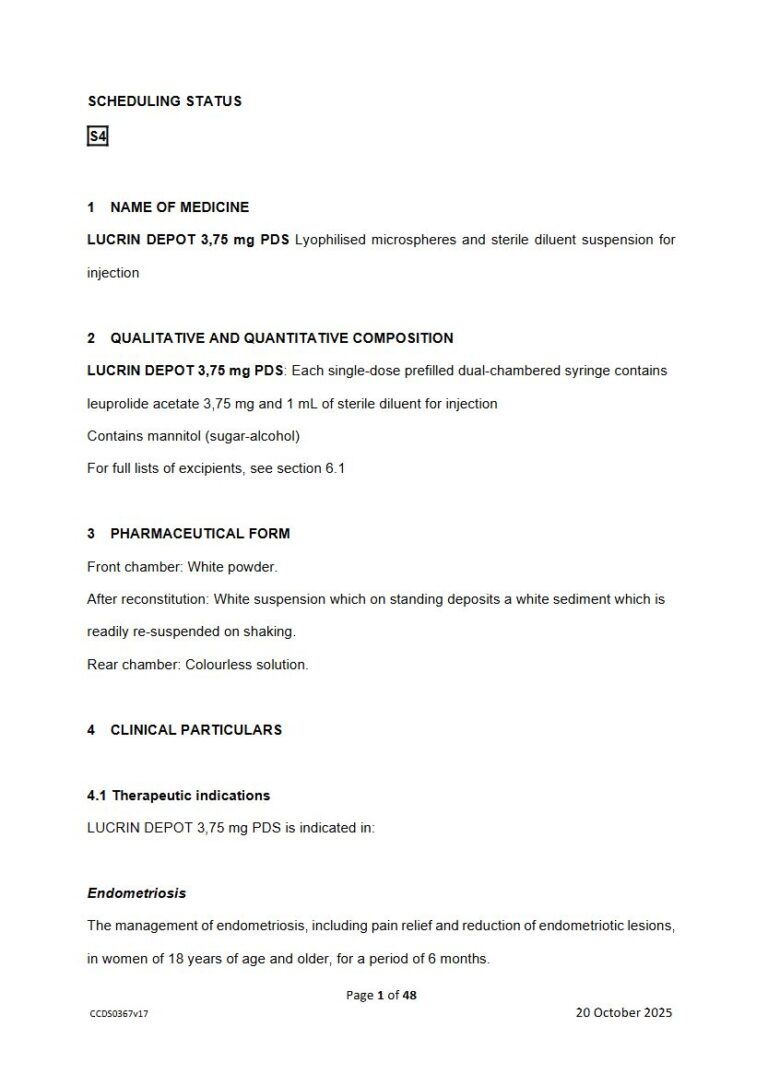
LUCRIN DEPOT 3,75 mg PDS is indicated in:
- Endometriosis
The management of endometriosis, including pain relief and reduction of endometriotic lesions, in women of 18 years of age and older, for a period of 6 months. - Prostate Cancer
The palliative treatment of advanced prostatic cancer. It offers an alternative treatment of prostatic cancer when orchiectomy or oestrogen administration is either not indicated or unacceptable to the patient. - Breast Cancer
Adjuvant therapy to surgery in breast carcinoma. - Central Precocious Puberty
Treatment of children with central precocious puberty (CPP).
4.2 Posology and method of administration
LUCRIN DEPOT 3,75 mg PDS must be administered under the supervision of a medical practitioner.
- Endometriosis
The recommended dose of LUCRIN DEPOT 3,75 mg PDS in the treatment of endometriosis is 3,75 mg. - Prostate Cancer
The recommended dose of LUCRIN DEPOT 3,75 mg PDS in the palliative treatment of advanced prostatic carcinoma is 3,75 mg administered subcutaneously once a month. In patients treated with GnRH analogues for prostate cancer, treatment is usually continued upon development of castration-resistant prostate cancer. Reference should be made to relevant guidelines. - Breast Cancer
The recommended dose of LUCRIN DEPOT 3,75 mg PDS as adjuvant therapy to surgery in breast cancer is 3,75 mg administered 4-weekly as a single intramuscular or subcutaneous injection. - Central Precocious Puberty
The recommended dose for the treatment of children with central precocious puberty must be individualised for each child based on a mg/kg ratio of medicine to body weight. Younger children require higher doses on a mg/kg ratio. For each dosage form, after one to two months of initiating therapy or changing doses, the child must be monitored with a GnRH stimulation test, determination of sex steroids and Tanner staging to confirm downregulation. Measurements of bone age for advancement should be monitored every 6 to 12 months. The dose should be titrated upward until no progression of the condition is noted either clinically and/or by laboratory parameters. The first dose found to result in adequate downregulation can probably be maintained for the duration of therapy in most children. However, there are insufficient data to guide dosage adjustment as patients move into higher weight categories after beginning therapy at very young ages and low dosages. It is recommended that adequate downregulation be verified in such patients whose weight has increased significantly while on therapy. Discontinuation of LUCRIN DEPOT 3,75 mg PDS should be considered before age 11 for females and age 12 for males.
4.3 Contraindications
LUCRIN DEPOT 3,75 mg PDS is contraindicated in:
- Patients with known hypersensitivity to leuprolide acetate or similar nonapeptides or to any of the excipients in LUCRIN DEPOT 3,75 mg PDS.
- Patients with undiagnosed, abnormal vaginal bleeding.
- Women who are or may become pregnant while receiving LUCRIN DEPOT 3,75 mg PDS (see section 4.6).
- Women who are breastfeeding (see section 4.6).
- Children demonstrating hypersensitivity to GnRH, LUCRIN DEPOT 3,75 mg PDS or excipients. Cases of anaphylaxis have been reported with the monthly formulation of LUCRIN DEPOT 3,75 mg PDS.
4.4 Special warnings and precautions for use
All Populations
During the early phase of therapy, gonadotropins and sex steroids rise above baseline because of the natural stimulatory effect of LUCRIN DEPOT 3,75 mg PDS. Therefore, an increase in clinical signs and symptoms may be observed. Worsening of pre-existing signs and symptoms during the first weeks of treatment may occur. Worsening of symptoms may contribute to paralysis with or without fatal complications.
Bone Mineral Density
Decreased bone mineral density can occur in women and in men. There is no data in men regarding reversibility after withdrawal of LUCRIN DEPOT 3,75 mg PDS. In women, bone mineral density loss may or may not be reversible after withdrawal of LUCRIN DEPOT 3,75 mg PDS (see section 4.8).
Convulsions
Postmarketing reports of convulsions have been observed in patients on LUCRIN DEPOT 3,75 mg PDS therapy. These included patients in the female and paediatric populations, patients with a history of seizures, epilepsy, cerebrovascular disorders, central nervous system anomalies or tumours, and in patients on concomitant medicines that have been associated with convulsions such as bupropion and SSRIs. Convulsions have also been reported in patients in the absence of any of the conditions mentioned above.
Women
Endometriosis
LUCRIN DEPOT 3,75 mg PDS should not be administered to patients with undiagnosed abnormal vaginal bleeding. Pregnancy must be excluded before starting with treatment. LUCRIN DEPOT 3,75 mg PDS is contraindicated in pregnancy. When used monthly at the recommended dose, LUCRIN DEPOT 3,75 mg PDS usually inhibits ovulation and stops menstruation. However, taking LUCRIN DEPOT 3,75 mg PDS does not ensure contraception. Therefore, patients should use non-hormonal methods of contraception. Patients should be advised to see their doctor if they believe they may be pregnant. If a patient becomes pregnant during treatment, LUCRIN DEPOT 3,75 mg PDS must be discontinued and the patient must be apprised of the potential risk of the foetus. During the early phase of therapy in endometriosis, sex steroids temporarily rise above baseline because of the physiologic effect of LUCRIN DEPOT 3,75 mg PDS. Therefore, an increase in the clinical signs and symptoms may be observed during the initial days of therapy, but these dissipate with continued therapy at adequate doses.
Men
Prostate Cancer
Flare effect
Worsening of signs and symptoms during the first weeks of treatment of prostate cancer may occur with LUCRIN DEPOT 3,75 mg PDS. Patients may experience a temporary increase in bone pain, which should be managed symptomatically. Cases of ureteral obstruction and spinal cord compression have been observed, which may contribute to paralysis with or without fatal complications. For patients at risk, the medical practitioner may consider initiating therapy with daily (short-acting) LUCRIN injections for the first two weeks to facilitate withdrawal of treatment if that is considered necessary. Hyperglycaemia and an increased risk of developing diabetes have been reported in men receiving GnRH agonists such as LUCRIN DEPOT 3,75. Hyperglycaemia may represent development of diabetes mellitus or worsening of glycaemic control in patients with diabetes. Monitor blood glucose and/or glycosylated haemoglobin (HbA1c) periodically in patients receiving LUCRIN DEPOT 3,75, and manage with current practice for treatment of hyperglycaemia or diabetes. Increased risk of developing myocardial infarction, sudden cardiac death and stroke has been reported in association with use of GnRH agonists such as LUCRIN DEPOT 3,75 in men. The risk appears low based on the reported odds ratios, and should be evaluated carefully along with cardiovascular risk factors when determining a treatment for patients with prostate cancer. Patients receiving LUCRIN DEPOT 3,75 should be monitored for symptoms and signs suggestive of development of cardiovascular disease and be managed according to current clinical practice. Patients with metastatic vertebral lesions and/or with urinary tract obstruction should be closely observed during the first few weeks of therapy. Potential exacerbations of signs and symptoms during the first few weeks of treatment is a concern in patients with vertebral metastases who may develop paraesthesia or paralysis and/or urinary obstruction or haematuria which, if aggravated, may lead to neurological problems such as temporary weakness and/or paraesthesia of the lower limbs or worsening of urinary symptoms.
Effect on QT/QTc Interval
LUCRIN DEPOT 3,75 mg PDS deprivation treatment may prolong the QT interval in patients with a history of, or risk factors for, QT prolongation. Torsade de pointes has been reported in association with LUCRIN DEPOT 3,75 mg PDS. The concomitant use of LUCRIN DEPOT 3,75 mg PDS with medicines known to prolong the QT interval or able to induce Torsade de pointes such as class IA (e.g. quinidine, disopyramide) or class III (e.g. amiodarone, sotalol, dofetilide, ibutilide) antidysrhythmic medicines, methadone, macrolide antibiotics, moxifloxacin, antipsychotics, etc. should be carefully evaluated.
Changes in Laboratory values during treatment
Response to leuprolide acetate, should be monitored by measuring serum levels of testosterone as well as prostate-specific antigen and prostatic acid phosphatase. In the majority of patients, testosterone levels increased above baseline during the first week, declining thereafter to baseline levels or below by the end of the second week. Castrate levels were reached within two to four weeks and once achieved were maintained for as long as the patients received their injections. Transient increases in acid phosphatase levels have occurred early in treatment. However, by the fourth week, the elevated levels usually decrease to values at or near baseline. During clinical trials isolated elevations of SGOT (ALT) were observed. In clinical trials LUCRIN DEPOT 3,75 mg PDS was associated with elevation of total cholesterol, triglycerides, lactate dehydrogenase (LDH) and phosphorous and decreases in high-density lipoprotein (HDL) and white blood cell (WBC) counts.
Children
Central Precocious Puberty
Potential exacerbations of signs and symptoms during the first few weeks of treatment is a concern in patients with rapidly advancing ventral precocious puberty.
Laboratory tests
Response to LUCRIN DEPOT 3,75 mg PDS should be monitored one to two months after the start of therapy, with a GnRH stimulation test and sex steroid levels. Measurement of bone age for advancement should be done every 6 to 12 months.
Information for parents
Prior to starting therapy with LUCRIN DEPOT 3,75 mg PDS, the parent(s) or guardian(s) must be made aware of the importance of continuous therapy. Adherence to four-week medicine administration schedules must be complied with if therapy is to be successful. Noncompliance with LUCRIN DEPOT 3,75 mg PDS regimen or inadequate dosing may result in inadequate control of the pubertal process. The consequences of poor control include the return of pubertal signs such as menses, breast development, and testicular growth. The long-term consequences of inadequate control of gonadal steroid secretion are unknown, but may include a further compromise of adult stature.
- During the first two months of therapy, a female may experience menses or spotting. If bleeding continues beyond the second month, notify the medical practitioner.
- Any irritation at the injection site should be reported to the medical practitioner immediately.
- Any unusual signs or symptoms should be reported to the medical practitioner.
Bone Mineral Density
Bone mineral density (BMD) may decrease during GnRH therapy in children with central precocious puberty. However, after cessation of treatment subsequent bone mass accrual is preserved and peak bone mass in late adolescence does not seem to be affected by treatment.
Pseudotumor cerebri/idiopathic intracranial hypertension
Pseudotumor cerebri (PTC)/idiopathic intracranial hypertension has been reported in paediatric patients receiving leuprorelin acetate, but it cannot be ruled out that it may also occur in adults. Monitor patients for signs and symptoms of PTC, including headache, papilledema, blurred vision, diplopia, loss of vision, pain behind the eye or pain with eye movement, tinnitus, dizziness, and nausea. Refer the patient to an ophthalmologist to confirm the presence of papilledema. If PTC is confirmed, treat the patient in accordance to the established treatment guidelines and permanently discontinue use of leuprorelin acetate.
Impairment of fertility
Studies in adults with LUCRIN DEPOT 3,75 mg PDS have shown reversibility of fertility suppression when the medicine was discontinued after continuous administration for period of up to 24-weeks.
4.5 Interaction with other medicines and other forms of interaction
Pharmacokinetic-based interaction studies have not been conducted with LUCRIN DEPOT 3,75 mg PDS. However, due to LUCRIN DEPOT 3,75 mg PDS being a peptide that is primarily degraded by peptidase and not by cytochrome P-450 enzymes as noted in specific studies, and due to this compound being only 46 % bound to plasma proteins, medicine interactions are not expected to occur.
Prostate Cancer
See section 4.4. Medicine/Laboratory Test Interactions Diagnostic tests of pituitary gonadotropic and gonadal function conducted during treatment and up to 4 to 8 weeks after discontinuation of LUCRIN DEPOT 3,75 mg PDS therapy may be misleading, as therapeutic doses of LUCRIN DEPOT 3,75 mg PDS result in suppression of the pituitary-gonadal system.
4.6 Fertility, pregnancy and lactation
Pregnancy
LUCRIN DEPOT 3,75 mg PDS is contraindicated during pregnancy or lactation (see section 4.3). The safety of leuprolide acetate in pregnancy has not been established.
Breastfeeding
Mothers on LUCRIN DEPOT 3,75 mg PDS should not breastfeed their infants.
4.7 Effects on ability to drive and use machines
LUCRIN DEPOT 3,75 mg PDS may cause convulsions, blurred vision or dizziness that may impair the patientu00eds ability to drive or to use machinery.
4.8 Undesirable effects
Women: The most common adverse events in women are associated with the pharmacological actions of LUCRIN on the steroidogenesis:
| SYSTEM ORGAN CLASS | ADVERSE EVENTS |
|---|---|
| Metabolism and nutrition disorders | Weight gain, weight loss |
| Psychiatric disorders | Loss or decreased libido, increased libido, affect lability |
| Nervous system disorders | Headache |
| Vascular disorders | Hot flushes, vasodilatation, hypotension |
| Skin and subcutaneous tissue disorders | Acne, seborrhoea, dry skin, urticaria, skin odour abnormal, hyperhydrosis, hair growth abnormal, hirsutism, hair disorder, eczema, nail disorder, night sweats |
| Reproductive system and breast disorders | Vaginal haemorrhage, dysmenorrhoea, menstrual disorder, breast enlargement, breast engorgement, breast atrophy, genital discharge, vaginal discharge, galactorrhoea, breast pain, metrorrhagia, menopausal symptoms, dyspareunia, uterine disorder, vulvovaginitis, menorrhagia |
| General disorders and administration site conditions | Feeling hot, irritability |
| Investigations | Bone density decreased |
Long exposure (6 to 12 months) Diabetes mellitus, glucose tolerance impaired, total cholesterol increased, LDL increased, triglycerides increased, osteoporosis
Changes in Bone Density
In controlled clinical studies, patents with endometriosis (six months of therapy) or uterine fibroids (three months of therapy) were treated with LUCRIN DEPOT 3,75 mg PDS. In endometriosis patients, vertebral bone density as measured by dual energy x-ray absorptiometry (DEXA) decreased by an average of 3,9 % at six months compared with the pretreatment value. For those patients who were tested at six or twelve months after discontinuation of therapy, mean bone density returned to within 2 % of pre-treatment. When LUCRIN DEPOT 3,75 mg PDS was administered for three months in uterine fibroid patients, vertebral trabecular bone mineral density as assessed by quantitative digital radiography (QDR) revealed a mean decrease of 2,7 % compared with baseline. Six months after discontinuation of therapy, a trend toward recovery was observed.
Table 1 presents ADRs and frequencies (very common (u22651/10); common (u22651/100 to <1/10); uncommon (u22651/1,000 to <1/100); unknown (unable to estimate frequency based upon available data) from endometriosis and breast cancer clinical studies. Cases of serious venous and arterial thromboembolism have been reported, including deep vein thrombosis, pulmonary embolism, myocardial infarction, stroke, and transient ischaemic attack. Although a temporal relationship was reported in some cases, most cases were confounded by risk factors or concomitant medication use. It is unknown if there is a causal association between the use of GnRH agonist and these events.
4.9 Overdose
In overdose, side effects would be exacerbated and exaggerated (see section 4.4 and section 4.8). Treatment is symptomatic and supportive.
