
Genprolex 5 mg, 9 mg Injection
PDF Leaflet Revision Date: 24 October 2023
Clinical Summary
Quick overview from the medicine insert
Indication
Palliative treatment of advanced prostatic cancer.
Dosage (summary)
1 mg (0.2 mL) daily subcutaneous injection.
Special Populations
- Renal impairment
- Hepatic impairment
Pregnancy & Breastfeeding
Contraindicated in pregnancy and breastfeeding.
Contraindications
- Hypersensitivity to leuprolide acetate
- Pregnant or breastfeeding women
- Undiagnosed abnormal vaginal bleeding
Common side effects
- Bone pain
- Weight gain
- Dizziness
- Nausea
- Fatigue
Counselling Points
- Inject in different sites daily
- Monitor blood glucose levels
- Report any severe side effects immediately
Serious warnings
- Risk of myocardial infarction and stroke
- Potential for pituitary apoplexy
- Monitor for hyperglycemia
Important Disclaimer
The Genprolex 5 mg, 9 mg Injection professional information leaflet below is the property of Aurogen Sa and is provided on Medinsert exactly as issued, with no.. alterations or editorial changes. We make every effort to keep content current by updating documents as soon as new versions become available. Medinsert serves as a trusted access point for healthcare professionals, but does not replace official sources or clinical judgement. For more details, please read our full disclaimer. read more>>
 Healthcare Professionals Only
This content is for registered healthcare professionals
Sign in or create a free account to read the full package insert.
Free for HPCSA-registered professionals. Powered by Medinsert.
Clinical Particulars
Section 4 of the official insert — extracted exactly as issued, no alterations
4.1. Therapeutic indications
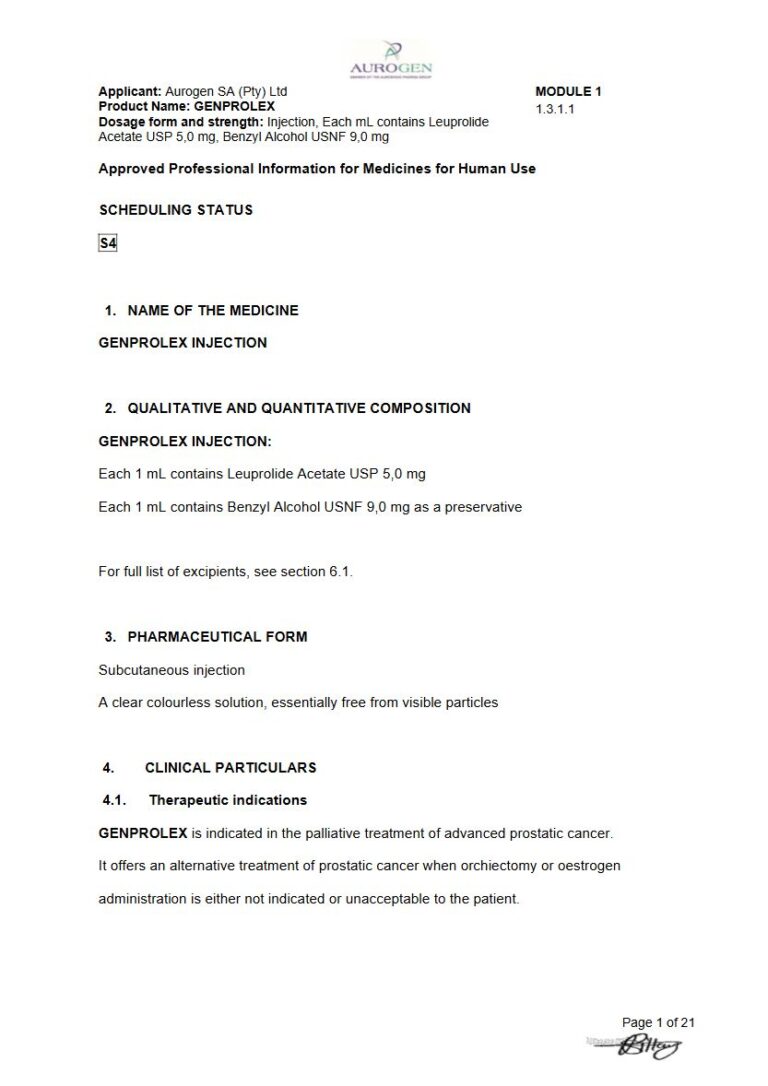
GENPROLEX is indicated in the palliative treatment of advanced prostatic cancer. It offers an alternative treatment of prostatic cancer when orchiectomy or oestrogen administration is either not indicated or unacceptable to the patient.
4.2. Posology and method of administration
Posology
The recommended dose of GENPROLEX injection is 1 mg (0,2 mL) administered as a single daily subcutaneous injection.
Method of administration
Information for patients: Directions for using GENPROLEX
a) Wash hands thoroughly with soap and water
b) Remove the plastic cover on the bottle to expose the rubber stopper. Wipe the metal ring and rubber stopper with an alcohol swab each time you use GENPROLEX. Check the liquid in the container. If it is not clear or has particles in it, DO NOT USE. Exchange it at your pharmacy for another container.
c) Pull the plunger of the syringe back until the plunger tip is at the 0,2 mL (20 unit) mark.
d) Push the needle through the centre of the rubber stopper on the GENPROLEX bottle.
e) Push the plunger all the way in to expel air into the bottle.
f) Invert the bottle and syringe. Check to make sure the tip of the needle is in the liquid. Pull the plunger slowly backwards until the syringe fills to the 0,2 mL (20 unit) mark.
g) Ensure that no air bubbles are in the syringe. If air bubbles are present, push the plunger forward to expel air into the bottle and refill the syringe to the 0,2 mL (20 unit) mark.
h) Remove the needle from the bottle. DO NOT TOUCH THE NEEDLE OR ALLOW THE NEEDLE TO TOUCH ANY SURFACE.
i) Wipe the injection site with an alcohol swab.
j) Hold the syringe in one hand. Hold the skin taut or pull up a little skin if needed, with the other hand.
k) Hold the syringe alongside the skin and slide the needle quickly just under the skin as far as it will go at a 90u00b0 angle. Inject the drug by pushing the plunger.
l) Hold an alcohol swab on your skin where the needle was inserted and pull the needle at the same angle as it was inserted.
m) To protect your skin, inject each daily dose in a different spot.
n) Use the disposable syringe only once and dispose of it carefully. As with other medicines administered chronically by subcutaneous injection, the injection site should be varied periodically.
4.3. Contraindications
GENPROLEX is contraindicated in patients hypersensitive to leuprolide acetate or similar nonapeptides or to any of the excipients listed in section 6.1. GENPROLEX should not be administered to patients who have had anaphylactic reaction to leuprolide acetate (see section 4.4). Although this formulation is not indicated for use in women, GENPROLEX is contraindicated in:
u2022 Women who are or may become pregnant while receiving GENPROLEX;
u2022 Women who are breastfeeding;
u2022 Patients with undiagnosed, abnormal vaginal bleeding.
4.4. Special warnings and precautions for use
Initially GENPROLEX causes increases in serum levels of testosterone to approximately 50 % above baseline during first week of treatment. Transient worsening of symptoms, or the occurrence of additional signs and symptoms of prostate cancer, may occasionally develop during the first few weeks of GENPROLEX treatment. A small number of patients may experience a temporary increase in bone pain, which can be managed symptomatically. Isolated cases of ureteral obstruction and spinal cord compression have been observed, which may contribute to paralysis with or without fatal complications. For patients at risk initiation of therapy with daily GENPROLEX injection for the first two weeks to facilitate withdrawal of treatment may be considered. Periodic monitoring of serum testosterone and prostate-specific antigen (PSA) levels is recommended, especially if the anticipated clinical or biochemical response to treatment has not been achieved. It should be noted that results of testosterone determinations are dependent on assay methodology. It is advisable to be aware of the type and precision of the assay methodology to make appropriate clinical and therapeutic decisions. Patients with metastatic vertebral lesions and/or with urinary tract obstruction should be closely observed during the first few weeks of therapy. Hyperglycaemia and an increased risk of developing diabetes have been reported in men receiving GnRH agonists. Hyperglycaemia may represent development of diabetes mellitus or worsening of glycaemic control in patients with diabetes. Monitor blood glucose and/or glycosylated haemoglobin (HbA1c) periodically in patients receiving a GnRH agonist and manage with current practice for treatment of hyperglycaemia or diabetes.
Increased risk of developing myocardial infarction, sudden cardiac death and stroke has been reported in association with use of GnRH agonists in men. The risk appears low based on the reported odds ratios and should be evaluated carefully along with cardiovascular risk factors when determining a treatment for patients with prostate cancer. Patients receiving a GnRH agonist should be monitored for symptoms and signs suggestive of development of cardiovascular disease and be managed according to current clinical practice.
Based on findings in animal studies, GENPROLEX may cause foetal harm when administered to a pregnant woman. In animal developmental and reproductive toxicology studies, administration of the monthly formulation of GENPROLEX on day 6 of pregnancy (sustained exposure was expected throughout the period of organogenesis) caused adverse embryo-foetal toxicity in animals at doses less than the human dose, based on body surface area, using an estimated daily dose. Pregnant patients and females of reproductive potential should not take GENPROLEX.
Effect on QT/QTc Interval
QT-prolongation has been observed during long-term androgen deprivation therapy. Medical practitioners should consider whether the benefits of androgen deprivation therapy outweigh the potential risks in patients with congenital long QT syndrome, electrolyte abnormalities, congestive heart failure, and in patients taking Class IA (e.g., quinidine, procainamide) or Class III (e.g. amiodarone, sotalol) antidysrhythmic medications.
Bone Mineral Density
Bone mineral density changes can occur during any hypoestrogenic state in women and in long-term use in prostate cancer in men. There is no data in men regarding reversibility after withdrawal of GENPROLEX. In women, bone mineral density loss may be reversible after withdrawal of GENPROLEX (see section 4.8).
Convulsions
Post-marketing reports of convulsions have been observed in patients on GENPROLEX therapy. These include patients in the female and paediatric populations, patients with a history of seizures, epilepsy, cerebrovascular disorders, central nervous system anomalies or tumours, and in patients on concomitant medications that have been associated with convulsions such as bupropion and SSRIs. Convulsions have also been reported in patients in the absence of any of the conditions mentioned above.
Laboratory Tests
Response to GENPROLEX should be monitored by measuring serum levels of testosterone and prostate-specific antigen (PSA). In the majority of patients, testosterone levels increased above baseline during the first week, declining thereafter to baseline levels or below by the end of the second week of treatment. Castrate levels were reached within two to four weeks and once attained were maintained for as long medicine as administration continued. GENPROLEX contains Benzyl alcohol. Patients with known allergies to benzyl alcohol, an ingredient of the medicine's vehicle, may present symptoms of hypersensitivity, usually local, in the form of erythema and induration at the injection site. High volumes should be used with caution and only if necessary, especially in subjects with liver or kidney impairment because of the risk of accumulation toxicity (metabolic acidosis).
4.5. Interaction with other medicines and other forms of interaction
Medicine interactions
Pharmacokinetic-based studies have not been conducted with GENPROLEX. However, due to leuprolide acetate being a peptide that is primarily degraded by peptidase and not by cytochrome Pu00b7450 enzymes as noted in specific studies, and due to this compound being only 46 % bound to plasma proteins, medicine interactions are not expected to occur.
Medicine/Laboratory Test Interactions
Administration of GENPROLEX in women in therapeutic doses results in suppression of the pituitary-gonadal system. Normal function is usually restored within 4 to 12 weeks after treatment is discontinued. Therefore, diagnostic tests of pituitary gonadotropic and gonadal functions conducted during treatment and for up to three months after discontinuation of GENPROLEX may be misleading.
4.6. Fertility, pregnancy and lactation
Pregnancy
GENPROLEX is contraindicated in women who are or may become pregnant while receiving GENPROLEX. Before starting treatment with GENPROLEX it is advisable to establish whether the patient is pregnant.
Breastfeeding
It is not known whether GENPROLEX is excreted in human milk. Therefore GENPROLEX should not be administered to breastfeeding mothers.
Fertility
Based on findings in animals and mechanism of action, GENPROLEX may impair fertility in males of reproductive potential.
4.7. Effects on ability to drive and use machines
GENPROLEX may have a moderate influence on the ability to drive and use machines. GENPROLEX may be associated with hypotension, dizziness and blurred vision. Therefore, patients must be cautious when driving or using machines and should be advised not to drive or operate machinery if they experience these symptoms (see section 4.8).
4.8. Undesirable effects
a. Summary of the safety profile
During the early phase of therapy, gonadotropins and sex steroids rise above baseline because of the natural stimulatory effect of GENPROLEX. Therefore, an increase in clinical signs and symptoms may be observed (see section 4.4). Worsening of pre-existing signs and symptoms during the first weeks of treatment may occur. Worsening of symptoms may contribute to paralysis with or without fatal complications.
b. Tabulated list of adverse reactions
The below listed adverse reactions reports on effects commonly associated with the pharmacological actions of GENPROLEX on the steroidogenesis and reported clinical and post-marketing adverse events as well as post marketing adverse events experience.
SYS TEM ORGAN CLASS FREQUENCY ADVERSE REACTIONS Infections and infestations Frequency not known- reported post marketing Infection, urinary tract infection, pharyngitis, Allergic reactions Neoplasms benign, malignant and unspecified (including cysts and polyps) Frequent Prostate tumour flare, aggravation of prostate cancer Frequency not known- reported post marketing Skin cancer Blood and lymphatic system disorders Frequency not known- reported post marketing Anaemia. Immune system disorders Frequency not known Anaphylactic reactions Endocrine disorders Frequency not known Goitre, pituitary apoplexy Metabolism and nutrition disorders Frequent Weight gain, weight loss, anorexia Frequency not known- reported post marketing Diabetes mellitus, increased appetite, hypoglycaemia, dehydration, hyperlipidaemia, hyperphosphataemia, hypoproteinaemia
4.9. Overdose
It is expected that the symptoms of overdosage of GENPROLEX will be in line with the reported adverse effects (see section 4.8). Treatment is symptomatic and supportive.
