
Lotemax Ophthalmic Suspension 5mg eye drops. suspension
PDF Leaflet Revision Date: 13 August 2020
Clinical Summary
Quick overview from the medicine insert
Indication
Treatment of allergic conjunctivitis and acute anterior chamber uveitis.
Dosage (summary)
1 drop into affected eye(s) four times daily; may increase to hourly in acute uveitis.
Special Populations
- Paediatric population
Pregnancy & Breastfeeding
Not established in pregnancy; contraindicated in breastfeeding.
Key Drug Interactions
- CYP3A inhibitors may increase systemic side effects.
Contraindications
- Viral diseases of the eye
- Hypersensitivity to ingredients
- Other corticosteroids
Common side effects
- Abnormal vision
- Burning on instillation
- Dry eye
- Itching
- Photophobia
Counselling Points
- Do not touch dropper tip to any surface
- Avoid contact lenses during use
- Consult if symptoms worsen
Serious warnings
- Prolonged use may cause glaucoma
- Risk of secondary infections
- Caution in herpes simplex history
Important Disclaimer
The Lotemax Ophthalmic Suspension 5mg eye drops. suspension professional information leaflet below is the property of Inova Pharmaceuticals and is provided on Medinsert exactly as issued, with no.. alterations or editorial changes. We make every effort to keep content current by updating documents as soon as new versions become available. Medinsert serves as a trusted access point for healthcare professionals, but does not replace official sources or clinical judgement. For more details, please read our full disclaimer. read more>>
 Healthcare Professionals Only
This content is for registered healthcare professionals
Sign in or create a free account to read the full package insert.
Free for HPCSA-registered professionals. Powered by Medinsert.
Clinical Particulars
Section 4 of the official insert — extracted exactly as issued, no alterations
4.1 Therapeutic indications
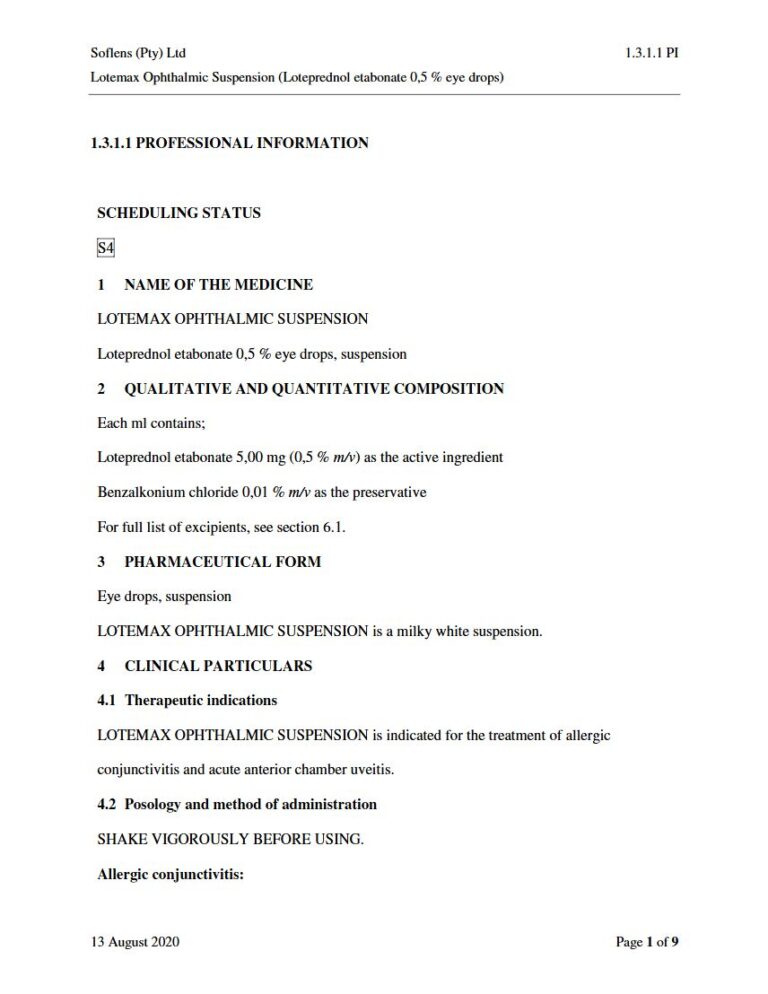
LOTEMAX OPHTHALMIC SUSPENSION is indicated for the treatment of allergic conjunctivitis and acute anterior chamber uveitis.
4.2 Posology and method of administration
SHAKE VIGOROUSLY BEFORE USING.
Allergic conjunctivitis:
Apply one drop of LOTEMAX OPHTHALMIC SUSPENSION into the conjunctival sac of the affected eye(s) four times daily. Treatment for allergic conjunctivitis should not exceed six weeks.
Acute anterior chamber uveitis:
Apply one drop of LOTEMAX OPHTHALMIC SUSPENSION into the conjunctival sac of the affected eye(s) four times daily. During the initial treatment within the first week, the dosing may be increased up to one drop every hour, if necessary.
4.3 Contraindications
LOTEMAX OPHTHALMIC SUSPENSION is contraindicated in viral diseases of the cornea and conjunctiva including epithelial herpes simplex keratitis (dendritic keratitis), vaccinia, varicella, and also in mycobacterial infections of the eye and fungal diseases of ocular structures. LOTEMAX OPHTHALMIC SUSPENSION is also contraindicated in individuals with known or suspected hypersensitivity to any of the ingredients of this preparation (see 6.1 List of excipients) and to other corticosteroids.
4.4 Special warnings and precautions for use
Warnings
Prolonged use of corticosteroids may result in glaucoma with damage to the optic nerve, defects in visual acuity and fields of vision, and in posterior subcapsular cataract formation. Steroids should be used with caution in the presence of glaucoma. Prolonged use of corticosteroids may suppress the host response and thus increase the hazard of secondary ocular infections. In those diseases causing thinning of the cornea or sclera, perforations have been known to occur with the use of topical steroids. In acute purulent conditions of the eye, steroids may mask the infection or enhance existing infections. Use of ocular steroids may prolong the course and may exacerbate the severity of many viral infections of the eye (including herpes simplex). Employment of a corticosteroid medication in the treatment of patients with a history of herpes simplex requires great caution. The use of steroids after cataract surgery may delay healing and increase the incidence of bleb formation.
Paediatric population
As the possibility of adverse effects on the corneal permeability and the danger of disruption of the corneal epithelium with prolonged or repeated usage of benzalkonium chloride preserved ophthalmological preparations cannot be excluded, regular ophthalmological examination is required. Caution should be exercised in the use of benzalkonium chloride preserved topical medication over an extended period in patients with extensive ocular surface disease.
The safety and effectiveness of LOTEMAX OPHTHALMIC SUSPENSION in paediatric patients have not been established.
Special precautions
For ophthalmic use only. The initial prescription and renewal of the medication order beyond 14 days should be made by a medical doctor only after examination of the patient with the aid of magnification, such as slit lamp biomicroscopy and, where appropriate, fluorescein staining. If signs and symptoms fail to improve after two days, the patient should be re-evaluated. If LOTEMAX OPHTHALMIC SUSPENSION is used for 10 days or longer, intraocular pressure should be monitored even though it may be difficult in children and uncooperative patients (see Warnings). Caution is advised on the use of LOTEMAX OPHTHALMIC SUSPENSION in patients with glaucoma. Fungal infections of the cornea are particularly prone to develop coincidentally with long-term local steroid application. Fungus invasion must be considered in any persistent corneal ulceration where a steroid has been used or is in use. Fungal cultures should be taken when appropriate. This product is sterile when packaged. Patients should be advised not to allow the dropper tip to touch any surface, as this may contaminate the suspension. If pain develops, redness, itching or inflammation become aggravated, the patient should be advised to consult a medical doctor. As with all ophthalmic preparations containing benzalkonium chloride, the patients should be advised not to wear contact lenses when using LOTEMAX OPHTHALMIC SUSPENSION.
4.5 Interaction with other medicines and other forms of interaction
Co-treatment with CYP3A inhibitors, including cobicistat-containing products, is expected to increase the risk of systemic side-effects. The combination should be avoided unless the benefit outweighs the increased risk of systemic corticosteroid side-effects, in which case patients should be monitored for systemic corticosteroid side-effects.
4.6 Fertility, pregnancy and lactation
Pregnancy
Safety of LOTEMAX OPHTHALMIC SUSPENSION in pregnancy has not been established. Teratogenic effects: Loteprednol etabonate has been shown to be embryotoxic and teratogenic when administered to animals.
Breastfeeding
Systemic steroids appear in human milk and could suppress growth, interfere with endogenous corticosteroid production or cause other untoward effects. Mothers on treatment with LOTEMAX OPHTHALMIC SUSPENSION should not breastfeed their babies.
4.8 Undesirable effects
Eye disorders
Very common (u22651/10) to common (u22651/100<1/10): Ocular side-effects occurring in 5 u2013 15 % of the patients treated with loteprednol etabonate ophthalmic suspension (0,2 % - 0,5 %) in clinical studies include abnormal vision / blurring, burning on instillation, chemosis, discharge, dry eye, epiphora, foreign body sensation, itching, infection and photophobia. Other ocular side-effects occurring in less than 5 % of patients include conjunctivitis, corneal abnormalities, eyelid erythema, keratoconjunctivitis, ocular irritation / pain / discomfort, papillae and uveitis. Some of these events were similar to the underlying ocular disease being studied. The following side-effects have been reported but the frequencies are unknown: Reactions associated with ophthalmic steroids include elevated intraocular pressure, which may be associated with optic nerve damage, visual acuity and field defects, posterior subcapsular cataract formation, secondary ocular infection from pathogens including herpes simplex, and perforation of the globe where there is thinning of the cornea or sclera.
Vascular disorders
Very common (u22651/10) Headache
Respiratory, thoracic and mediastinal disorders
Very common (u22651/10) Rhinitis and pharyngitis
Reporting of suspected adverse reactions
Reporting suspected adverse reactions after authorisation of the medicine is important. It allows continued monitoring of the benefit-risk of the medicine. Health care providers are asked to report any suspected adverse reactions to the Holder of the Certificate of registration using the following e-mail address: [email protected], or directly to SAHPRA using an ADR reporting form or the e- reporting portal available on SAHPRAu2019s website: https://www.sahpra.org.za/health-products-vigilance/
4.9 Overdose
See 4.4 Special warnings and precautions for use and 4.8 Undesirable effects. Treatment is supportive and symptomatic.
