
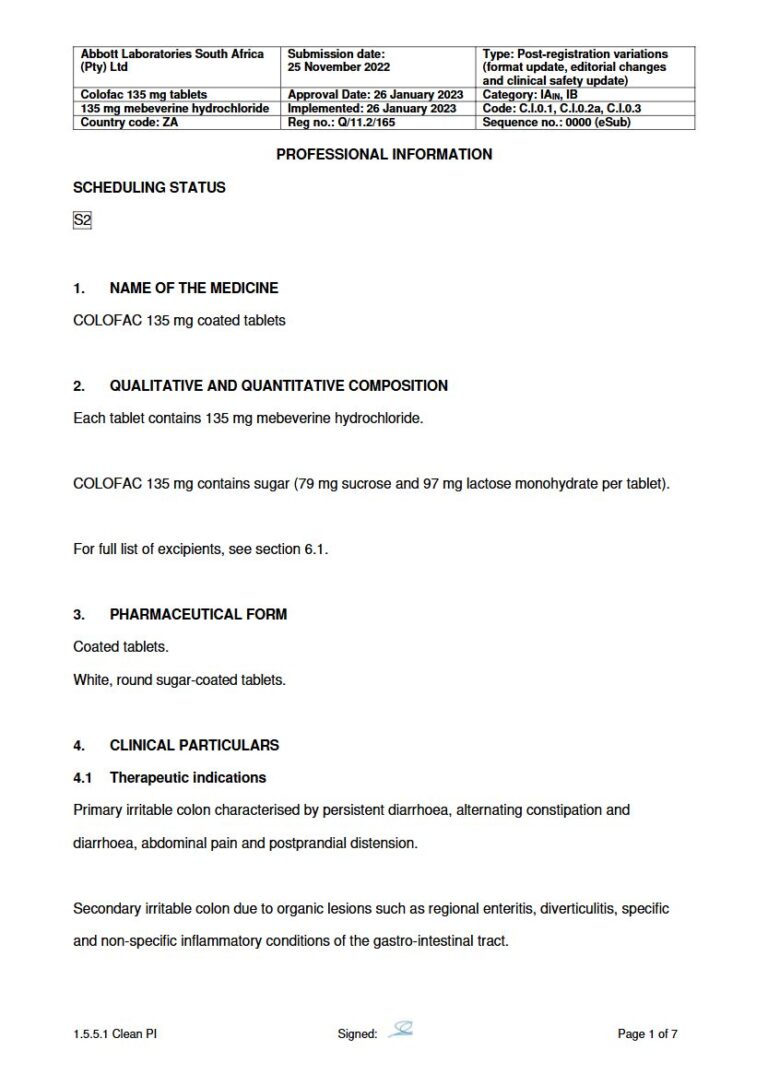
Colofac 135 mg Coated tablets.
PDF Leaflet Revision Date: 26 January 2023
Clinical Summary
Quick overview from the medicine insert
Indication
Irritable bowel syndrome with abdominal pain.
Dosage (summary)
1 tablet three times daily before meals.
Special Populations
- Patients with lactose intolerance
- Patients with sucrose intolerance
Pregnancy & Breastfeeding
Not recommended in pregnancy; unknown if excreted in breast milk.
Key Drug Interactions
- No significant interactions with alcohol
Contraindications
- Hypersensitivity to mebeverine or excipients
Common side effects
- Dizziness
- Headache
- Diarrhoea
- Constipation
Counselling Points
- Take with sufficient water
- Do not chew tablets
- Report any allergic reactions
Serious warnings
- Safety in pregnancy not established
- May cause dizziness
Important Disclaimer
The Colofac 135 mg Coated tablets. professional information leaflet below is the property of Abbott Laboratories South Africa and is provided on Medinsert exactly as issued, with no.. alterations or editorial changes. We make every effort to keep content current by updating documents as soon as new versions become available. Medinsert serves as a trusted access point for healthcare professionals, but does not replace official sources or clinical judgement. For more details, please read our full disclaimer. read more>>
 Healthcare Professionals Only
This content is for registered healthcare professionals
Sign in or create a free account to read the full package insert.
Free for HPCSA-registered professionals. Powered by Medinsert.
Clinical Particulars
Section 4 of the official insert — extracted exactly as issued, no alterations
4.1 Therapeutic indications
Primary irritable colon characterised by persistent diarrhoea, alternating constipation and diarrhoea, abdominal pain and postprandial distension. Secondary irritable colon due to organic lesions such as regional enteritis, diverticulitis, specific and non-specific inflammatory conditions of the gastro-intestinal tract.
4.2 Posology and method of administration
Posology
Take one (1) tablet three (3) times daily, preferably before meals. After a period of a few weeks when the desired effect has been obtained, the dosage may be gradually reduced. As atropine-like effects are absent, COLOFAC 135 mg is not contraindicated in patients with glaucoma or prostatic hypertrophy.
Method of administration
For oral use. The coated tablets should be swallowed with a sufficient amount of water (at least 100 mL water). The coated tablets should not be chewed because of the unpleasant taste.
4.3 Contraindications
Hypersensitivity to mebeverine hydrochloride or any excipients listed in section 6.1.
4.4 Special warnings and precautions for use
The safety of COLOFAC 135 mg in pregnancy has not been established (see section 4.6).
Excipients
COLOFAC 135 mg contains sucrose. Patients with rare hereditary conditions such as fructose intolerance, glucose-galactose malabsorption or sucrase-isomaltase insufficiency should not take COLOFAC 135 mg. COLOFAC 135 mg contains lactose monohydrate. Patients with rare hereditary problems of galactose intolerance, total lactase deficiency or glucose-galactose malabsorption should not take COLOFAC 135 mg.
4.5 Interaction with other medicines and other forms of interaction
No interaction studies have been performed, except with alcohol. In vitro and in vivo studies in animals have demonstrated the absence of any interaction between mebeverine hydrochloride and ethanol.
4.6 Fertility, pregnancy and lactation
Pregnancy
The safety of COLOFAC 135 mg in pregnancy has not been established. COLOFAC 135 mg is not recommended during pregnancy.
Breastfeeding
It is unknown whether mebeverine or its metabolites are excreted in breast milk. The excretion of mebeverine in milk has not been studied in animals. COLOFAC 135 mg should not be used during breastfeeding.
Fertility
There are no clinical data on male or female fertility, however animal studies do not indicate harmful effects of mebeverine.
4.7 Effects on ability to drive and use machines
No studies on the effects on the ability to drive and use machines have been performed. COLOFAC 135 mg may cause dizziness, which should be taken into account before patients drive or use machines.
4.8 Undesirable effects
After the administration of COLOFAC 135 mg cases of depression, headache, dizziness, diarrhoea and constipation (most probably not attributable to the medicine) were reported.
The following adverse reactions have been reported spontaneously during post-marketing use. A precise frequency cannot be estimated from available data. Allergic reactions mainly but not exclusively limited to the skin have been observed.
Immune system disorders: Hypersensitivity (anaphylactic reactions).
Skin and subcutaneous tissue disorders: Urticaria, angioedema, face oedema, exanthema.
Reporting of suspected adverse reactions
Reporting suspected adverse reactions after authorisation of the medicine is important. It allows continued monitoring of the benefit/risk balance of the medicine. Health care providers are asked to report any suspected adverse reactions to SAHPRA via the u201c6.04 Adverse Drug Reaction Reporting Formu201d, found online under SAHPRAu2019s publications: https://www.sahpra.org.za/Publications/Index/8
4.9 Overdose
Theoretically CNS excitability may occur in cases of overdose. In cases where mebeverine was taken in overdose, symptoms were either absent or mild and usually rapidly reversible. Observed symptoms of overdose were of a neurological and cardiovascular nature. No specific antidote is known and symptomatic treatment is recommended.
