
Memantine Unichem 10 10 mg FC tablets
PDF Leaflet Revision Date: 24 January 2022
Clinical Summary
Quick overview from the medicine insert
Indication
Treatment of moderately severe to severe Alzheimer's disease.
Dosage (summary)
Start with 5 mg/day, titrate to 20 mg/day over 4 weeks.
Special Populations
- Elderly
- Renal impairment
- Hepatic impairment
Pregnancy & Breastfeeding
Not established; avoid breastfeeding.
Key Drug Interactions
- Avoid NMDA antagonists
- May enhance L-dopa effects
- May reduce barbiturate effects
Contraindications
- Hypersensitivity
- Children under 18
Common side effects
- Confusion
- Dizziness
- Agitation
- Constipation
Counselling Points
- Monitor for CNS effects
- Take at the same time daily
- Avoid driving if affected
Serious warnings
- Not for severe renal impairment
- Caution in patients with convulsions
Important Disclaimer
The Memantine Unichem 10 10 mg FC tablets professional information leaflet below is the property of Unichem Sa and is provided on Medinsert exactly as issued, with no.. alterations or editorial changes. We make every effort to keep content current by updating documents as soon as new versions become available. Medinsert serves as a trusted access point for healthcare professionals, but does not replace official sources or clinical judgement. For more details, please read our full disclaimer. read more>>
 Healthcare Professionals Only
This content is for registered healthcare professionals
Sign in or create a free account to read the full package insert.
Free for HPCSA-registered professionals. Powered by Medinsert.
Clinical Particulars
Section 4 of the official insert — extracted exactly as issued, no alterations
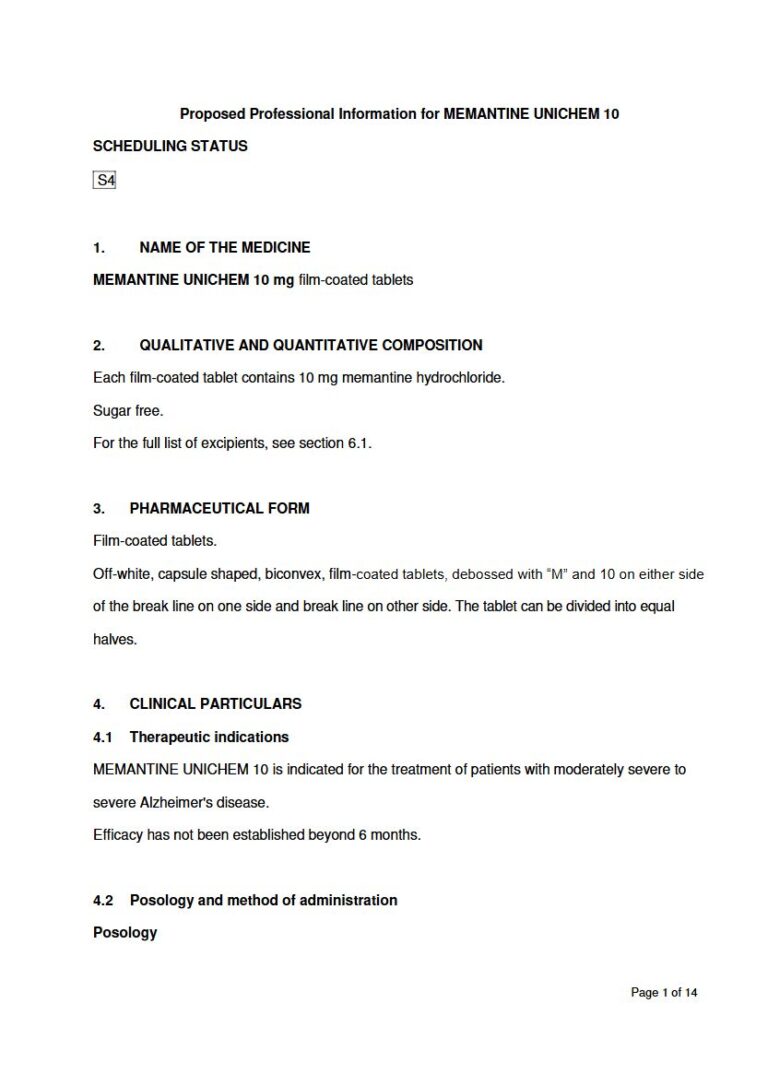
4.1 Therapeutic indications
MEMANTINE UNICHEM 10 is indicated for the treatment of patients with moderately severe to severe Alzheimer's disease. Efficacy has not been established beyond 6 months.
4.2 Posology and method of administration
Posology
Treatment should be initiated and supervised by a medical practitioner experienced in the diagnosis and treatment of Alzheimer's dementia. Therapy should only be started if a caregiver is available who will regularly monitor medicine intake by the patient. Diagnosis should be made according to current guidelines.
Adults: The maximum daily dose is 20 mg per day. In order to reduce the risk of side effects, the maintenance dose is achieved by upward titration of 5 mg per week over the first 3 weeks as follows: Treatment should be started with 5 mg per day (half a tablet in the morning) during the 1st week. In the 2nd week 10 mg per day (half a tablet twice a day), and in the 3rd week 15 mg per day is recommended (one tablet in the morning and half a tablet in the afternoon). From the 4th week on, treatment can be continued with the recommended maintenance dose of 20 mg per day (one tablet twice a day).
Special populations
Elderly: The recommended dose for patients > 65 years of age is 20 mg per day (10 mg twice a day) as described above.
Renal impairment: In patients with normal to mildly impaired renal function (serum creatinine levels of up to 130 u03bcmol/L) no dose reduction is needed. In patients with moderate renal impairment (creatinine clearance 40 u2013 60 mL/min/1,73 m2) the dose should be reduced to 10 mg per day. No data are available for patients with severely reduced kidney function (see section 4.4).
Hepatic impairment: There are no data on the use of MEMANTINE UNICHEM 10 in patients with hepatic impairment.
Method of administration
MEMANTINE UNICHEM 10 tablets should be taken orally once a day and should be taken at the same time every day. The tablets can be taken with or without food.
4.3 Contraindications
- Hypersensitivity to memantine hydrochloride or to any of the excipients listed in section 6.1.
- Children and adolescents under the age of 18 years, as safety and efficacy have not been established.
4.4 Special warnings and precautions for use
MEMANTINE UNICHEM 10 therapy is not recommended for patients with severe renal impairment (creatinine clearance less than 9 mL/min/1,73 m2) as no data are available (see section 4.2). Under alkaline conditions the rate of elimination of MEMANTINE UNICHEM 10 is reduced (see section 5.2). Factors that may raise urine pH therefore may necessitate careful monitoring of the patient. These factors include drastic changes in diet, e.g. from a diet rich in meat products to a vegetarian diet, or a massive ingestion of alkalising gastric buffers. Urine pH may also be elevated by states of renal tubular acidosis (RTA) or severe infections of the urinary tract with Proteus bacteria. Caution is recommended in patients at risk of convulsions, former history of convulsions or patients with predisposing factors for epilepsy. Concomitant use of N-methyl-D-aspartate (NMDA)-antagonists, such as amantadine, ketamine or dextromethorphan, with MEMANTINE UNICHEM 10 should be avoided. These compounds act at the same receptor system as MEMANTINE UNICHEM 10, and therefore side effects (mainly central nervous system (CNS)-related) may be more frequent or more pronounced (see section 4.5). Limited data are available on patients with recent myocardial infarction, uncompensated congestive heart failure (NYHA III-IV) and uncontrolled hypertension. These patients should be closely supervised.
4.5 Interaction with other medicines and other forms of interaction
- The effects of L-dopa, dopaminergic agonists and anticholinergics may be enhanced by concomitant treatment with MEMANTINE UNICHEM 10.
- The effects of barbiturates and neuroleptics may be reduced during concomitant treatment with MEMANTINE UNICHEM 10.
- MEMANTINE UNICHEM 10 may alter the effects of the antispasmodic medicines dantrolene and baclofen, and a dosage adjustment may be necessary.
- Use of other NMDA antagonists such as amantadine, ketamine or dextromethorphan with MEMANTINE UNICHEM 10 should be avoided, as it may increase the incidence and severity of pharmacotoxic psychosis (see section 4.4).
- There is one published case report on a possible risk also for the combination of MEMANTINE UNICHEM 10 and phenytoin.
- Medicines such as cimetidine, ranitidine, procainamide, quinidine, quinine and nicotine, that use the same renal cationic transport system as amantadine, may interact with MEMANTINE UNICHEM 10 leading to a potential risk of increased plasma levels.
- MEMANTINE UNICHEM 10 decreases the area under the curve (AUC) and peak plasma concentration (Cmax) of hydrochlorothiazide by 20 %.
- In post-marketing experience, isolated cases with international normalised ratio (INR) increases have been reported in patients concomitantly treated with warfarin. Although no causal relationship has been established, close monitoring of prothrombin time or INR is advisable for patients concomitantly treated with oral anticoagulants.
- In single-dose pharmacokinetic (PK) studies in young healthy patients, no relevant interaction of memantine with glyburide/metformin or donepezil was observed.
- In a clinical study in young healthy patients, no relevant effect of memantine on the pharmacokinetics of galantamine was observed.
- Memantine did not inhibit CYP 1A2, 2A6, 2C9, 2D6, 2E1, 3A, flavin containing monooxygenase, epoxide hydrolase or sulphation in vitro.
4.6 Fertility, pregnancy and lactation
The safety and efficacy of MEMANTINE UNICHEM 10 have not been established in pregnant and lactating women.
Pregnancy
There are no or limited amount of data from the use of memantine, as in MEMANTINE UNICHEM 10 in pregnant women. Animal studies indicate a potential for reducing intrauterine growth at exposure levels, which are identical or slightly higher than at human exposure. The potential risk for humans is unknown.
Breastfeeding
It is not known whether memantine, as in MEMANTINE UNICHEM 10 is excreted in human breast milk but, taking into consideration the lipophilicity of the substance, this probably occurs. Women taking MEMANTINE UNICHEM 10 should not breastfeed.
4.7 Effects on ability to drive and use machines
MEMANTINE UNICHEM 10 may change reactivity and outpatients should be warned to take special care when driving a vehicle or operating machinery. Moderate to severe Alzheimer's disease also usually causes impairment of driving performance and compromises the ability to use machinery.
4.8 Undesirable effects
Infections and infestations
Less frequent: Fungal infections.
Immune system disorders
Frequent: Hypersensitivity.
Blood and lymphatic system disorders
Frequency unknown: Thrombocytopenia.
Endocrine disorders
Frequency unknown: Acute pancreatitis1, hypoglycaemia.
Metabolism and nutrition disorders
Less frequent: Anorexia.
Frequency unknown: Hyperlipidaemia.
Psychiatric disorders
Frequent: Agitation, hallucinations2, insomnia, somnolence.
Less frequent: Depression.
Frequency unknown: Psychotic reactions1.
Nervous system disorders
Frequent: Confusion, dizziness, headache, balance disorders.
Less frequent: Anxiety, abnormal gait, seizures.
Frequency unknown: Dyskinesia, neuroleptic malignant syndrome, tardive dyskinesia, carpal tunnel syndrome, restlessness.
Cardiac disorders
Less frequent: Cardiac failure.
Frequency unknown: Atrioventricular block, prolonged QT interval, supraventricular tachycardia, tachycardia.
Vascular disorders
Frequent: Hypertension.
Less frequent: Venous thrombosis/ thromboembolism.
Frequency unknown: Cerebral infarction, intracranial haemorrhage, claudication.
Respiratory, thoracic and mediastinal disorders
Frequent: Coughing, dyspnoea.
Less frequent: Bronchitis, upper respiratory tract infection.
Frequency unknown: Aspiration pneumonia.
Gastrointestinal disorders
Frequent: Constipation.
Less frequent: Vomiting, diarrhoea, nausea.
Frequency unknown: Ileus, colitis, dysphagia, gastritis, gastro-oesophageal reflux.
Hepatobiliary disorders
Frequent: Elevated liver function tests.
Frequency unknown: Hepatic failure, hepatitis.
Skin and subcutaneous tissue disorders
Frequency unknown: Stevens-Johnson syndrome.
Musculoskeletal and connective tissue disorders
Less frequent: Hypertonia (increased muscle tone), arthralgia, back pain.
Frequency unknown: Bone fracture.
Renal and urinary disorders
Frequent: Urinary incontinence.
Less frequent: Cystitis, urinary tract infection.
Frequency unknown: Acute renal failure.
Reproductive system and breast disorders
Less frequent: Increased libido.
Frequency unknown: Impotence.
General disorders and administrative site conditions
Frequent: Inflicted injury.
Less frequent: Peripheral oedema, tiredness, fatigue, influenza-like syndrome, pain.
Frequency unknown: Chest pain, malaise.
1 Isolated cases reported in post-marketing experience.
2 Hallucinations have mainly been observed in patients with severe Alzheimeru2019s disease. Alzheimer's disease has been associated with depression, suicidal ideation and suicide. In post-marketing experience these reactions have been reported in patients treated with MEMANTINE UNICHEM 10.
4.9 Overdose
See section 4.8.
Symptoms
Relatively large overdoses (200 mg and 105 mg/day for 3 days, respectively) have been associated with either only symptoms of tiredness, weakness and/or diarrhoea or no symptoms. In the overdose cases below 140 mg or unknown dose, the patients revealed symptoms from central nervous system (confusion, drowsiness, somnolence, vertigo, agitation, aggression, hallucination and gait disturbance) and/or of gastrointestinal origin (vomiting and diarrhoea). In the most extreme case of overdose, the patient survived the oral intake of a total of 2 000 mg memantine with effects on the central nervous system (coma for 10 days, and later diplopia and agitation). The patient received symptomatic treatment and plasmapheresis. The patient recovered without permanent sequelae. In another case of a large overdose, the patient also survived and recovered. The patient had received 400 mg memantine orally. The patient experienced central nervous system symptoms such as restlessness, psychosis, visual hallucinations, proconvulsiveness, somnolence, stupor and unconsciousness.
Treatment
Treatment of overdosage should be symptomatic and supportive. No specific antidote for intoxication or overdose is available. Standard clinical procedures to remove active substance material, e.g. activated charcoal (interruption of potential entero-hepatic recirculation), acidification of urine or forced diuresis should be used as appropriate. In case of signs and symptoms of general central nervous system (CNS) overstimulation, careful symptomatic clinical treatment should be considered.
