
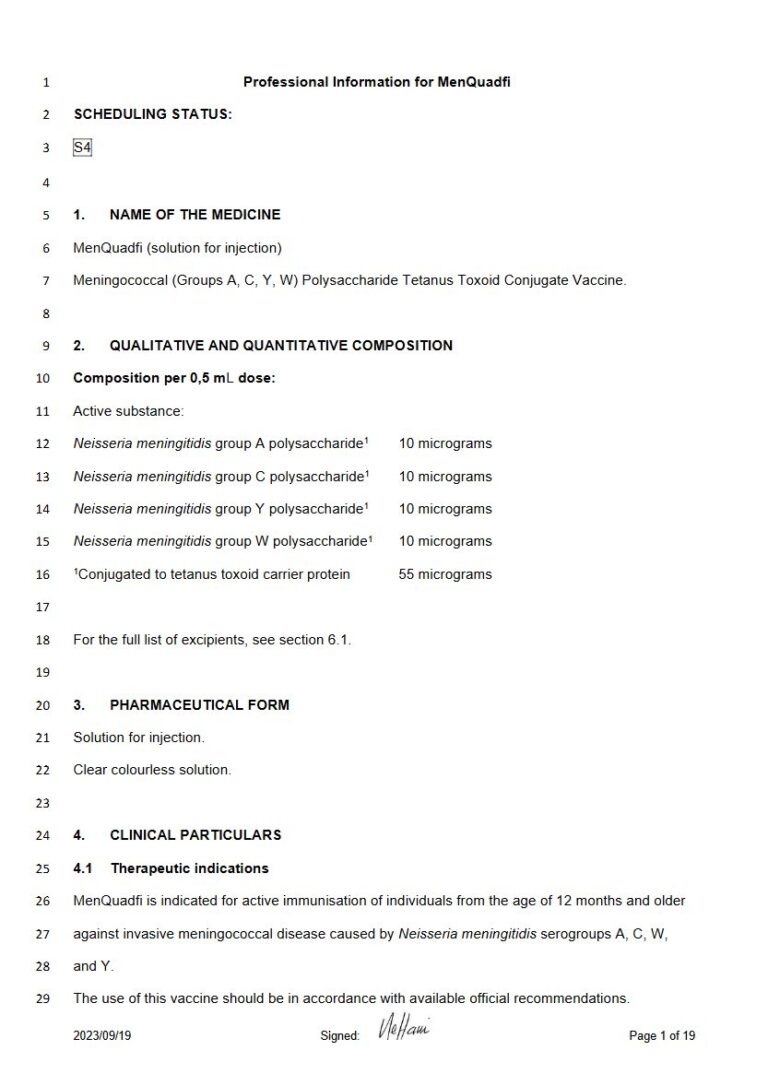
Menquadfi 10 µg, 55 µg Solution for injection
PDF Leaflet Revision Date: 19 September 2023
Clinical Summary
Quick overview from the medicine insert
Indication
Active immunisation against invasive meningococcal disease caused by Neisseria meningitidis serogroups A, C, W, and Y.
Dosage (summary)
One single dose (0.5 mL) for individuals 12 months and older.
Special Populations
- Immunocompromised
- Elderly
Pregnancy & Breastfeeding
Use in pregnancy only if benefits outweigh risks; unknown if excreted in breast milk.
Key Drug Interactions
- Co-administer with separate syringes
- May affect immune response in immunosuppressive therapy
Contraindications
- Hypersensitivity to active substances or excipients
- Previous adverse reaction to similar vaccines
Common side effects
- Injection site pain
- Myalgia
- Fever
- Irritability
Counselling Points
- Monitor for allergic reactions post-vaccination
- Record vaccine name and batch number for traceability
Serious warnings
- Risk of anaphylaxis
- Do not administer subcutaneously or intravascularly
Important Disclaimer
The Menquadfi 10 µg, 55 µg Solution for injection professional information leaflet below is the property of Sanofi-Aventis South Africa and is provided on Medinsert exactly as issued, with no.. alterations or editorial changes. We make every effort to keep content current by updating documents as soon as new versions become available. Medinsert serves as a trusted access point for healthcare professionals, but does not replace official sources or clinical judgement. For more details, please read our full disclaimer. read more>>
 Healthcare Professionals Only
This content is for registered healthcare professionals
Sign in or create a free account to read the full package insert.
Free for HPCSA-registered professionals. Powered by Medinsert.
Clinical Particulars
Section 4 of the official insert — extracted exactly as issued, no alterations
4.1 Therapeutic indications
MenQuadfi is indicated for active immunisation of individuals from the age of 12 months and older against invasive meningococcal disease caused by Neisseria meningitidis serogroups A, C, W, and Y. The use of this vaccine should be in accordance with available official recommendations.
4.2 Posology and method of administration
Posology
Primary vaccination:
- Individuals 12 months of age and older: One single dose (0,5 mL).
Booster vaccination:
- A single 0,5 mL dose of MenQuadfi may be used to boost subjects who have previously received a meningococcal vaccine containing the same serogroups (see section 5.1).
- Long-term antibody persistence data following vaccination with MenQuadfi are available up to 7 years after vaccination (see sections 4.4 and 5.1).
Other paediatric population
The safety and immunogenicity of MenQuadfi in individuals under 12 months of age have not yet been established.
Method for administration
For intramuscular injection only, preferably in the deltoid region or anterolateral thigh depending on the recipient's age and muscle mass. For instructions on handling of the vaccine before administration, see section 6.6.
4.3 Contraindications
Hypersensitivity to the active substances or to any of the excipients listed in section 6.1 or after previous administration of the vaccine or a vaccine containing the same components.
4.4 Special warnings and precautions for use
Traceability
In order to improve the traceability of biological medicinal products, the name and the batch number of the administered product should be clearly recorded.
MenQuadfi should not be administered subcutaneously, intravascularly or intradermally.
It is good clinical practice to precede vaccination by a review of the medical history (especially with regard to previous vaccination and possible occurrence of undesirable effects) and a clinical examination.
Hypersensitivity
As with all injectable vaccines, appropriate medical treatment and supervision should always be readily available in case of an anaphylactic event following administration of the vaccine.
Intercurrent illness
Vaccination should be postponed in individuals suffering from an acute severe febrile illness. However, the presence of a minor infection, such as cold, should not result in the deferral of vaccination.
Syncope
Syncope (fainting) and other anxiety u2010 related reactions can occur following or even before any vaccination as a psychogenic response to the needle injection. Procedures should be in place to prevent falling or injury and to manage syncope.
Thrombocytopenia and coagulation disorders
MenQuadfi should be given with caution to individuals with thrombocytopenia or any coagulation disorder that would contraindicate intramuscular injection, unless the potential benefit clearly outweighs the risk of administration.
Protection
MenQuadfi will only protect against Neisseria meningitidis groups A, C, W, and Y. The vaccine will not protect against any other Neisseria meningitidis groups.
As with any vaccine, vaccination with MenQuadfi may not protect all vaccine recipients. Waning of serum bactericidal antibody titres against serogroup A when using human complement in the assay (hSBA) has been reported for MenQuadfi and other quadrivalent meningococcal vaccines. The clinical relevance of this observation is unknown. However, if an individual is expected to be at particular risk of exposure to serogroup A and received a dose of MenQuadfi more than approximately one year previously, consideration may be given to administering a booster dose.
Lower hSBA geometric mean titres (GMTs) against serogroup A have been observed after a single dose of MenQuadfi was administered to toddlers who previously received serogroup C meningococcal conjugate vaccine (MenC-CRM) during infancy. Nevertheless, seroprotection rates were comparable between treatment groups (see section 5.1). The clinical relevance of this observation is unknown. This aspect might be considered for individuals at high risk for MenA infection who received MenC-CRM vaccine in their first year of life.
Immunodeficiency
It may be expected that in patients receiving immunosuppressive persons treatment or patients with immunodeficiency, an adequate immune response may not be elicited (see section 4.5). Persons with familial complement deficiencies (for example, C5 or C3 deficiencies) and receiving treatments that inhibit terminal complement activation (for example, eculizumab) are at increased risk of invasive disease caused by Neisseria meningitidis groups A, C, W, and Y, even if they develop antibodies following vaccination with MenQuadfi. No data on immunocompromised patients are available.
Tetanus immunisation
Immunisation with MenQuadfi vaccine does not substitute for routine tetanus immunisation. Co-administration of MenQuadfi with a tetanus toxoid-containing vaccine does not impair the response to tetanus toxoid or impact the safety.
Sodium content
This medicine contains less than 1 mmol sodium (23 mg) per dose that is to say essentially u2018sodium-freeu2019.
4.5 Interaction with other medicines and other forms of interaction
Use with other vaccines
Injection sites on separate limbs and separate syringes must be used in the case of concomitant administration.
For ages 12 u2013 23 months, MenQuadfi can be co-administered with the measles-mumps-rubella vaccine (MMR) and varicella vaccine (V), combined diphtheria - tetanus - acellular pertussis (DTaP) vaccines, including combination DTaP vaccines with hepatitis B (HBV), inactivated poliovirus (IPV) or Haemophilus influenzae type b (Hib) such as DTaP-IPV-HB-Hib (Hib conjugated to tetanus toxoid) vaccine and 13-valent pneumococcal polysaccharide conjugated vaccine (PCV-13).
For ages 10 u2013 17 years, MenQuadfi can be co-administered with diphtheria, tetanus, pertussis (acellular, component) vaccine (adsorbed, reduced antigen(s) content) (Tdap) and human papillomavirus vaccine (recombinant, adsorbed) (HPV).
There was no impact on the immune response to MenQuadfi when a meningococcal serogroup B vaccine was co-administered.
MenQuadfi can be administered concomitantly with PCV-13. Lower hSBA GMTs on day 30 post- dose for serogroup A has been observed when given concomitantly. The clinical relevance of this observation is unknown. As a precaution in children 12 u2013 23 months of age at high risk for serogroup A disease, consideration might be given for administration of MenQuadfi and PCV-13 vaccines separately.
Meningococcal vaccine nau00efve children aged 10 u2013 17 years had non inferior response for PT and lower antibody responses to FHA, PRN and FIM when Tdap vaccine was administered concomitantly with MenQuadfi and HPV compared to co-administration with HPV vaccine alone. The clinical implications of the observed pertussis antigen responses also observed with the existing quadrivalent meningococcal conjugate vaccines are unknown.
Concomitant vaccines should always be administered at separate injection sites and preferably contralateral.
Concomitant administration of MenQuadfi and other vaccines than those listed above has not been studied.
Use with systemic immunosuppressive medicinal products
It may be expected that in patients receiving immunosuppressive treatment an adequate immune response may not be elicited (see also section 4.4).
4.6 Fertility, pregnancy and lactation
Pregnancy
There is limited amount of data on the use of MenQuadfi in pregnant women. Animal studies do not indicate direct or indirect harmful effects with respect to reproductive toxicity (see section 5.3). MenQuadfi should be used during pregnancy only if the expected benefits for the mother outweigh the potential risks, including those for the foetus.
Breastfeeding
It is unknown whether MenQuadfi is excreted in human milk. MenQuadfi should only be used during breast-feeding when the possible advantages outweigh the potential risks.
Fertility
A developmental and reproductive toxicity study was performed in female rabbits. There were no effects on mating performances or female fertility. No study was conducted on male fertility (see section 5.3).
4.7 Effects on ability to drive and use machines
MenQuadfi has no or negligible influence on the ability to drive and use machines. However, some of the effects mentioned under section 4.8 u201cUndesirable effectsu201d may temporarily affect the ability to drive or use machines.
4.8 Undesirable effects
Summary of the safety profile
The safety of a single dose of MenQuadfi in individuals 12 months of age and older was evaluated in seven randomized, active-controlled, multi-centre pivotal studies. In these studies, 6 308 subjects received either a primary dose (N=5 906) or a booster dose (N=402) of MenQuadfi and were included in the safety analyses. This included 1 389 toddlers aged 12 through 23 months of age, 498 children aged 2 through 9 years, 2 289 adolescents aged 10 through 17 years, 1 684 adults aged 18 through 55 years, 199 older adults aged 56 through 64 years, and 249 elderly aged 65 years and older. Of these, 392 adolescents received MenQuadfi co-administered with Tdap and HPV, and 589 toddlers received MenQuadfi co-administered with MMR+V (N=189), DTaP-IPV-HB-Hib (N=200) or PCV-13 (N=200).
The most frequently reported adverse reactions within 7 days after vaccination with a single dose of MenQuadfi alone in toddlers 12 through 23 months of age were irritability (36,7 %) and injection site tenderness (30,6 %) and in ages 2 years and above were injection site pain (38,7 %) and myalgia (30,5 %). These adverse reactions were mostly mild or moderate in intensity.
Rates of adverse reactions after a booster dose of MenQuadfi in adolescents and adults at least 15 years of age were comparable to those seen in adolescents and adults who received a primary dose of MenQuadfi.
Rates of adverse reactions within 7 days following vaccination among or toddlers were comparable when MMR+V were given concomitantly with without MenQuadfi, and when DTaP-IPV-HB-Hib was given with or without MenQuadfi. Overall, the rates of adverse reactions were higher in toddlers who received PCV-13 given concomitantly with MenQuadfi (36,5 %) than in toddlers who received PCV-13 alone (17,2 %).
In one additional clinical study, adolescents and adults 13 u2013 26 years of age primed with MenQuadfi 3 u2013 6 years previously received MenQuadfi co-administered with meningococcal serogroup B (MenB) vaccine, Trumenba (N=93) or Bexsero (N=92). Rates and intensity of systemic reactions within 7 days following vaccination tended to be higher when MenQuadfi was given concomitantly with MenB vaccine than when MenQuadfi was given alone. The most common solicited systemic reaction was myalgia, of mild intensity, which was experienced more frequently in adolescents and adults who received MenQuadfi and MenB vaccine concomitantly (Trumenba, 65,2 %; Bexsero, 63 %) compared to those who received MenQuadfi alone (32,8 %).
Tabulated list of adverse reactions
The following adverse reactions, as listed below, have been identified from clinical studies conducted with MenQuadfi when given alone to subjects 2 years of age and older. The safety profile observed in toddlers aged 12 through 23 months is presented in the paediatric population section.
The adverse reactions are listed according to the following frequency categories:
Very common (u22651/10); Common (u2265 1/100 to <1/10); Uncommon (u22651/1 000 to <1/100); Rare (u22651/10 000 to <1/1 000).
Within each frequency grouping, adverse reactions are presented in order of decreasing seriousness.
4.9 Overdose
Overdose with MenQuadfi is unlikely due to its presentation as a single dose vial. In the event of overdose, monitoring of vital functions and possible symptomatic treatment is recommended.
