
Vari Miconazole 20 mg ORAL GEL
PDF Leaflet Revision Date: 24 August 2023
Clinical Summary
Quick overview from the medicine insert
Indication
Treatment of fungal infections of the mouth and fungal stomatitis associated with dentures.
Dosage (summary)
Adults/children >2 years: 2.5 mL four times daily; Infants 4-24 months: 1.25 mL four times daily.
Special Populations
- Infants <4 months
- Patients with impaired liver function
Pregnancy & Breastfeeding
Not recommended during pregnancy or breastfeeding due to lack of safety data.
Key Drug Interactions
- Warfarin
- Oral hypoglycaemics
- Phenytoin
- CYP3A4 substrates
Contraindications
- Hypersensitivity to miconazole
- Infants <4 months
- Impaired liver function
Common side effects
- Dysgeusia
- Nausea
- Vomiting
- Dry mouth
- Oral discomfort
Counselling Points
- Apply gel after meals
- Do not swallow immediately
- Monitor for choking in infants
Serious warnings
- Risk of choking in infants
- Serious skin reactions
- Hypersensitivity reactions
Important Disclaimer
The Vari Miconazole 20 mg ORAL GEL professional information leaflet below is the property of Barrs Pharmaceutical Industries and is provided on Medinsert exactly as issued, with no.. alterations or editorial changes. We make every effort to keep content current by updating documents as soon as new versions become available. Medinsert serves as a trusted access point for healthcare professionals, but does not replace official sources or clinical judgement. For more details, please read our full disclaimer. read more>>
 Healthcare Professionals Only
This content is for registered healthcare professionals
Sign in or create a free account to read the full package insert.
Free for HPCSA-registered professionals. Powered by Medinsert.
Clinical Particulars
Section 4 of the official insert — extracted exactly as issued, no alterations
4.1 Therapeutic indications
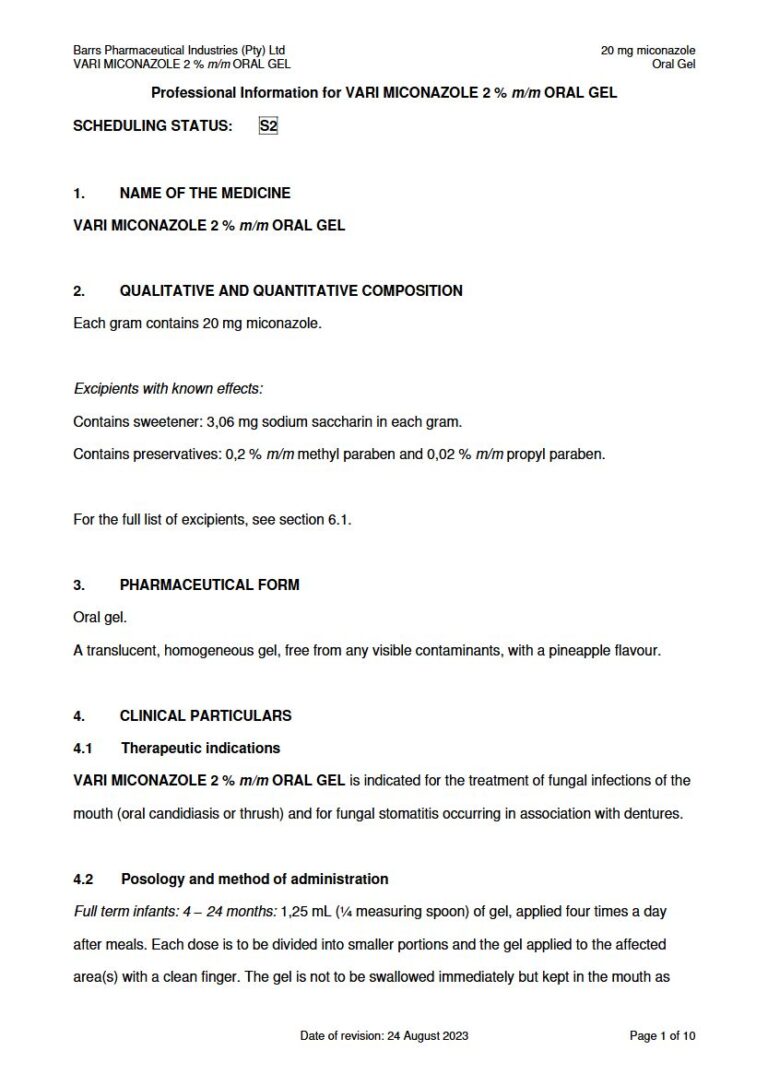
VARI MICONAZOLE 2 % m/m ORAL GEL is indicated for the treatment of fungal infections of the mouth (oral candidiasis or thrush) and for fungal stomatitis occurring in association with dentures.
4.2 Posology and method of administration
Full term infants: 4 u2013 24 months: 1,25 mL (u00bc measuring spoon) of gel, applied four times a day after meals. Each dose is to be divided into smaller portions and the gel applied to the affected area(s) with a clean finger. The gel is not to be swallowed immediately but kept in the mouth as long as possible. Adults and children 2 years of age and older: 2,5 mL (u00bd measuring spoon) of gel, applied four times a day after meals. The gel is not to be swallowed immediately but kept in the mouth as long as possible. VARI MICONAZOLE 2 % m/m ORAL GEL should be spread evenly over the affected areas of the oropharyngeal mucosa and tongue taking care to properly cover oral ulcerations and other lesions. Apply after meals. The application of VARI MICONAZOLE 2 % m/m ORAL GEL should be repeated three to four times daily depending upon the severity of the infection. Apply the gel regularly until all signs of the infection have disappeared. Continue using for another two days after the infection has cleared. For the treatment of oral lesions, VARI MICONAZOLE 2 % m/m ORAL GEL must be kept in contact with the affected areas as long as possible. This can be achieved by retaining the gel in the mouth for the maximum time possible before swallowing. In fungal stomatitis, associated with dentures, apply the gel to the lesions in the evening and leave on overnight. For oral candidiasis, dental prostheses should be removed at night and brushed with the gel. Instructions for use and handling: To open the tube, unscrew the cap and pierce the seal of the tube with the pin on top of the cap.
4.3 Contraindications
- Hypersensitivity to miconazole or to any of the excipients listed in section 6.1.
- Infants less than 4 months of age, in cases where the swallowing reflex has not fully developed yet or in prematurely born infants under the age of 6 months.
- Patients with impaired liver function.
- Co-administration with the following medicines metabolised by CYP3A4 (see section 4.5):
- Substrates that prolong QT-interval including astemizole, bepridil, cisapride, dofetilide, halofantrine, mizolastine, pimozide, quinidine, sertindole and terfenadine.
- Ergot alkaloids.
- HMG-CoA reductase inhibitors such as simvastatin and lovastatin.
- Triazolam and midazolam.
- Use of VARI MICONAZOLE 2 % m/m ORAL GEL in combination with warfarin (metabolised by CYP2C9).
4.4 Special warnings and precautions for use
Avoid contact with the eyes. Choking in infants and young children It is important to take into consideration the variability of the maturation of the swallowing function in infants, especially when giving VARI MICONAZOLE 2 % m/m ORAL GEL to infants between the ages of 4 u2013 6 months. The lower age limit should be increased to 6 months of age for infants who are pre-term, or infants exhibiting slow neuromuscular development. Caution should be exercised, particularly in infants and young children (aged 4 months u2013 2 years), that the gel does not obstruct the throat. The gel should therefore not be applied to the back of the throat. The full dose should be divided into smaller doses and applied into the mouth with a clean finger. Observe the patient for possible choking. Also, due to the risk of choking, the gel must not be applied to the nipple of a breastfeeding woman for administration to an infant. Oral anti-coagulants Miconazole is systemically absorbed and is known to inhibit CYP2C9 and CYP3A4 (see section 5.2) which can lead to prolonged effects of warfarin. Bleeding events, some with fatal outcomes, have been reported with concurrent use of VARI MICONAZOLE 2 % m/m ORAL GEL and warfarin (see section 4.3 and section 4.5). Phenytoin Phenytoin levels should be monitored when used concomitantly with VARI MICONAZOLE 2 % m/m ORAL GEL (see section 4.5). Oral hypoglycaemics VARI MICONAZOLE 2 % m/m ORAL GEL may cause an enhanced hypoglycaemic effect when used with oral hypoglycaemics (e.g. sulfonylureas). Appropriate measures should be taken (see section 4.5). Severe hypersensitivity reactions, including anaphylaxis and angioedema, have been reported during treatment with VARI MICONAZOLE 2 % m/m ORAL GEL and with other miconazole formulations (see section 4.8). If a reaction suggesting hypersensitivity or irritation should occur, the treatment should be discontinued. Serious skin reactions (e.g. toxic epidermal necrolysis and Stevens-Johnson syndrome) have been reported in patients receiving VARI MICONAZOLE 2 % m/m ORAL GEL (see section 4.8). It is recommended that patients be informed about the signs of serious skin reactions, and that use of VARI MICONAZOLE 2 % m/m ORAL GEL be discontinued at the first appearance of skin rash.
4.5 Interaction with other medicines and other forms of interaction
When using any concomitant medicine, the corresponding label should be consulted for information on the route of metabolism. VARI MICONAZOLE 2 % m/m ORAL GEL can inhibit the metabolism of medicines metabolised by the CYP3A4 and CYP2C9 enzyme systems. This can result in prolongation or increase of the effect of these medicines, including an increase in side effects. Refer to section 4.3 for co-administration of certain medicines that are subject to metabolism by CYP3A4. Concomitant use of VARI MICONAZOLE 2 % m/m ORAL GEL is contraindicated with the following (see section 4.3):
- Substrates that prolong QT-interval including astemizole, dofetilide, halofantrine, mizolastine, pimozide, quinidine, sertindole and terfenadine.
- Ergot alkaloids.
- HMG-CoA reductase inhibitors such as simvastatin and lovastatin.
- Triazolam and midazolam.
- Oral anti-coagulants (e.g. warfarin) (see section 4.3).
- Oral hypoglycaemics (e.g. sulfonylureas).
- Phenytoin.
- HIV protease inhibitors (e.g. ritonavir and saquinavir).
- Certain antineoplastic medicines (e.g. the vinca alkaloids, busulfan and docetaxel).
- Certain calcium channel blockers (e.g. dihydropyridines and verapamil).
- Certain immunosuppressants (e.g. ciclosporin, tacrolimus, sirolimus).
- Other medicines including alfentanil, alprazolam, brotizolam, buspirone, carbamazepine, cilostazol, disopyramide, ebastine, methylprednisolone, midazolam IV, reboxetine, rifabutin, sildenafil and trimetrexate.
4.6 Fertility, pregnancy and lactation
Pregnancy VARI MICONAZOLE 2 % m/m ORAL GEL should not be used during pregnancy as the safety and efficacy have not been established. Breastfeeding There are no data available on the excretion of miconazole in human milk; therefore, VARI MICONAZOLE 2 % m/m ORAL GEL should not be used in patients who are breastfeeding. Fertility There are no fertility data available.
4.7 Effects on ability to drive and use machines
VARI MICONAZOLE 2 % m/m ORAL GEL has no influence on the ability to drive vehicles or use machines.
4.8 Undesirable effects
Immune system disorders: Less frequent: Allergic conditions, including angioneurotic oedema and anaphylactic reactions. Nervous system disorders: Frequent: Dysgeusia. Respiratory, thoracic and mediastinal disorders: Less frequent: Choking. Gastrointestinal disorders: Frequent: Nausea, regurgitation of food, vomiting, diarrhoea, dry mouth, oral discomfort. Hepato-biliary disorders: Frequent: Hepatitis. Skin and subcutaneous tissue disorders: Less frequent: Lyell syndrome (toxic epidermal necrolysis), Stevens-Johnson syndrome, urticaria, rash. General disorders and administration site conditions: Frequent: Product taste abnormal. Post-marketing experience: Immune system disorders: Hypersensitivity reactions. Gastrointestinal disorders: Stomatitis, tongue discolouration. Skin and subcutaneous tissue disorders: Angioedema, acute generalised exanthematous pustulosis (AGEP), drug reaction with eosinophilia and systemic symptoms (DRESS). Reporting of suspected adverse reactions Reporting suspected adverse reactions after authorisation of VARI MICONAZOLE 2 % m/m ORAL GEL is important. It allows continued monitoring of the benefit/risk balance of VARI MICONAZOLE 2 % m/m ORAL GEL. Healthcare providers are asked to report any suspected adverse reactions to SAHPRA via the u201c6.04 Adverse Drug Reaction Reporting Formu201d, found online under SAHPRAu2019s publications: https://www.sahpra.org.za/Publications/Index/8
4.9 Overdose
Symptoms: Overdoses may lead to gastrointestinal symptoms such as vomiting and diarrhoea. Treatment: Treatment is symptomatic and supportive. No specific antidote for VARI MICONAZOLE 2 % m/m ORAL GEL is available.
