
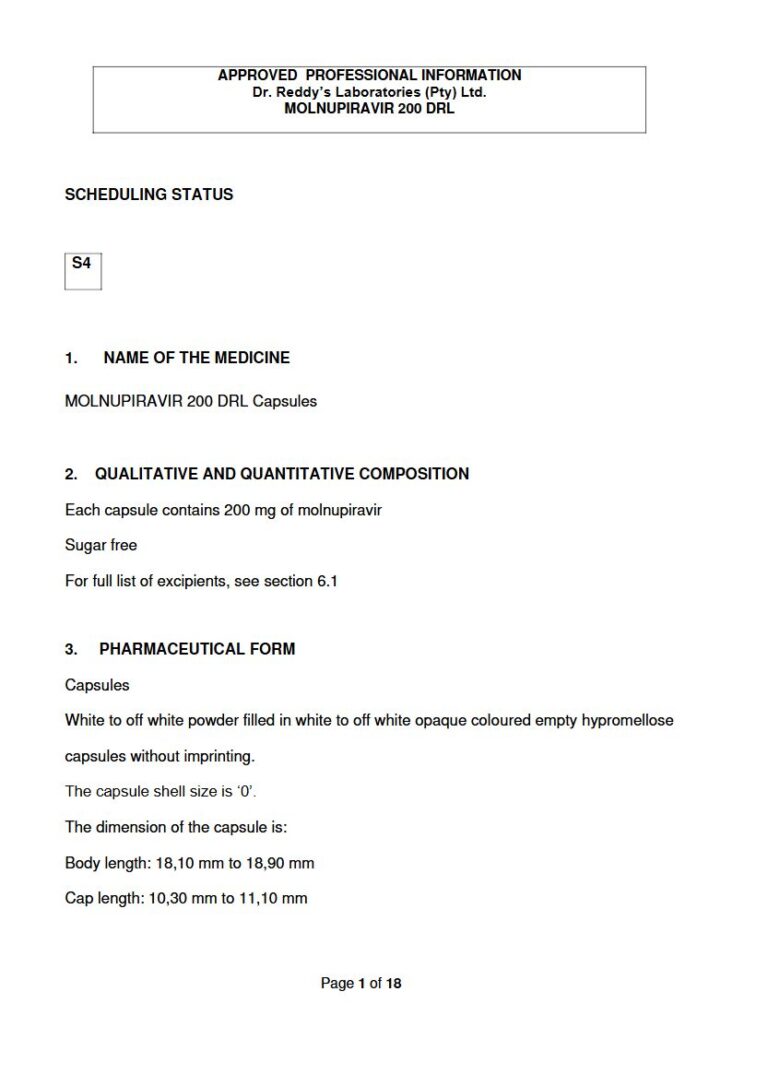
Molnupiravir 200 Drl 200 mg Capsule
PDF Leaflet Revision Date: 25 July 2023
Clinical Summary
Quick overview from the medicine insert
Indication
Treatment of mild to moderate COVID-19 in adults at risk for severe illness.
Dosage (summary)
800 mg (4 capsules) every 12 hours for 5 days.
Special Populations
- Elderly
- Hepatic impairment
- Renal impairment
Pregnancy & Breastfeeding
Not recommended during pregnancy; use contraception during treatment and for 4 days after. Breastfeeding not recommended during treatment and for 4 days after.
Contraindications
- Hypersensitivity to molnupiravir or excipients
Common side effects
- Diarrhoea
- Nausea
- Dizziness
Counselling Points
- Take as soon as possible after diagnosis; do not double doses for missed doses.
Important Disclaimer
The Molnupiravir 200 Drl 200 mg Capsule professional information leaflet below is the property of Dr Reddy’S Laboratories and is provided on Medinsert exactly as issued, with no.. alterations or editorial changes. We make every effort to keep content current by updating documents as soon as new versions become available. Medinsert serves as a trusted access point for healthcare professionals, but does not replace official sources or clinical judgement. For more details, please read our full disclaimer. read more>>
 Healthcare Professionals Only
This content is for registered healthcare professionals
Sign in or create a free account to read the full package insert.
Free for HPCSA-registered professionals. Powered by Medinsert.
Clinical Particulars
Section 4 of the official insert — extracted exactly as issued, no alterations
4.1 Therapeutic indications
MOLNUPIRAVIR 200 DRL capsules is indicated for treatment of mild to moderate coronavirus disease 2019 (COVID-19) in adults with a positive SARS-COV-2 diagnostic test, who do not require supplemental oxygen due to COVID-19 and who have at least one risk factor for developing severe illness (see section 5.1 Clinical Studies).
4.2 Posology and method of administration
Posology: The recommended dosage is as follows:
Adults: 800 mg (four (4) capsules of 200 mg) administered orally every 12 hours for 5 days. Should a patient require hospitalisation after starting treatment with MOLNUPIRAVIR 200 DRL, the patient may complete the full 5-day treatment course per the healthcare provideru2019s discretion. The safety and efficacy of molnupiravir, as in MOLNUPIRAVIR 200 DRL, when administered for periods longer than 5 days have not been established. MOLNUPIRAVIR 200 DRL should be administered as soon as possible after a diagnosis of COVID-19 has been made and within 5 days of symptom onset in adults who are at risk for progression to severe COVID-19, including hospitalisation or death. Certain medical conditions or other factors may place individual patients at increased risk for progression to severe COVID-19 (see section 5.1 Clinical Studies).
Missed dose
If the patient misses a dose of MOLNUPIRAVIR 200 DRL within 10 hours of the time it is usually taken, the patient should take as soon as possible and resume the normal dosing schedule. If a patient misses a dose by more than 10 hours, the patient should not take the missed dose and instead take the next dose at the regularly scheduled time. The patient should not double the dose to make up for a missed dose.
Special Populations
Elderly: No dose adjustment of MOLNUPIRAVIR 200 DRL is required based on age (see section 5.2 Gender, Race and Age).
Hepatic impairment: No dose adjustment is required for patients with hepatic impairment (see section 5.2 Hepatic Impairment).
Renal impairment: The pharmacokinetics of molnupiravir, as in MOLNUPIRAVIR 200 DRL, and n-hydroxycytidine (NHC) has not been evaluated in patients with eGFR less than 30 mL/min or on dialysis.
Method of administration: MOLNUPIRAVIR 200 DRL is given orally with or without food. The capsules should be swallowed whole with a sufficient amount of fluid (e.g., a glass of water). The capsules should not be opened, crushed or chewed.
4.3 Contraindications
- Hypersensitivity to the active substance, molnupiravir, or to any of the excipients of MOLNUPIRAVIR 200 DRL listed in section 6.1.
4.4 Special warnings and precautions for use
None. Sodium MOLNUPIRAVIR 200 DRL contains less than 1 mmol sodium (23 mg) per dose of 4 capsules, that is to say essentially 'sodium-free'.
4.5 Interaction with other medicines and other forms of interaction
No drug interactions have been identified based on the limited available data. Clinical drug-drug interaction trials of MOLNUPIRAVIR 200 DRL with concomitant medications have not been conducted. Molnupiravir is hydrolysed to NHC prior to reaching systemic circulation. Uptake and metabolism of NHC are mediated by the same pathways involved in endogenous pyrimidine metabolism. NHC is not a substrate of major drug metabolising enzymes or transporters. Neither molnupiravir nor NHC are inhibitors or inducers of major drug metabolising enzymes or transporters. Therefore, the potential for molnupiravir or NHC to interact with concomitant medications is considered unlikely.
4.6 Fertility, pregnancy and lactation
Pregnancy: Advise women of childbearing potential to use effective contraception for the duration of treatment and for 4 days after the last dose of MOLNUPIRAVIR 200 DRL. Risk Summary: Based on animal data, molnupiravir, as in MOLNUPIRAVIR 200 DRL, may cause foetal harm when administered to pregnant women. There are no available data on the use of molnupiravir, as in MOLNUPIRAVIR 200 DRL, in pregnant women to evaluate the risk of major birth defects, miscarriage or adverse maternal or foetal outcomes. The use of MOLNUPIRAVIR 200 DRL is not recommended during pregnancy. In an animal reproduction study, oral administration of molnupiravir to pregnant rats during the period of organogenesis resulted in embryofoetal lethality and teratogenicity at 8 times the human NHC exposures at the recommended human dose (RHD) and reduced foetal growth at u2265 3 times the human NHC exposure at the RHD. Oral administration of molnupiravir to rabbits during the period of organogenesis resulted in reduced foetal body weights at 18 times the human NHC exposure at the RHD (see section 5.3 Development).
Breastfeeding: It is unknown whether molnupiravir, as in MOLNUPIRAVIR 200 DRL, or any of the components of molnupiravir are present in human milk, affect human milk production, or have effect on the breastfed infant. NHC was detected in the plasma of nursing pups from lactating rats administered molnupiravir. Based on the potential for adverse reactions on the infant from MOLNUPIRAVIR 200 DRL, breastfeeding is not recommended during treatment and for 4 days after the last dose of MOLNUPIRAVIR 200 DRL.
Fertility: There were no effects on female or male fertility in rats at NHC exposures approximately 2 and 6 times respectively, the exposure in humans at the recommended human dose (RHD) (see section 5.3).
4.7 Effects on ability to drive and use machines
MOLNUPIRAVIR 200 DRL may cause dizziness which may lead to impairment of the ability to drive or operate machinery.
4.8 Undesirable effects
Summary of safety profile: The most common adverse reactions in patients treated with 800 mg molnupiravir every 12 hours for 5 days in a Phase 3 clinical trial were diarrhoea (2 %), nausea (1 %), and dizziness (1 %) all of which were Grade 1 (mild) or Grade 2 (moderate) in severity.
Tabulated list of adverse reactions: The adverse reactions are listed below by MedDRA system organ class.
Table 1: Tabulated list of adverse reactions
System organ class Frequency Adverse Reaction
Immune System Disorders Less frequent Hypersensitivity, angioedema
Nervous system disorders Frequent Dizziness, headache
Gastrointestinal disorders Frequent Diarrhoea, nausea Less frequent Vomiting
Skin and subcutaneous tissue disorders Less frequent Erythema, rash, urticaria
Reporting of suspected adverse reactions: Reporting suspected adverse reactions after authorisation of the medicine is important. It allows continued monitoring of the benefit/risk balance of the medicine. Health care providers are asked to report any suspected adverse reactions to SAHPRA via the u201c6.04 Adverse Drug Reactions Reporting Formu201d, found online under SAHPRAu2019s publications: https://www.sahpra.org.za/Publications/Index/8
4.9 Overdose
There is no human experience of overdosage with MOLNUPIRAVIR 200 DRL. Treatment of overdose with MOLNUPIRAVIR 200 DRL should consist of general supportive measures including the monitoring of the clinical status of the patient. Haemodialysis is not expected to result in effective elimination of NHC.
