
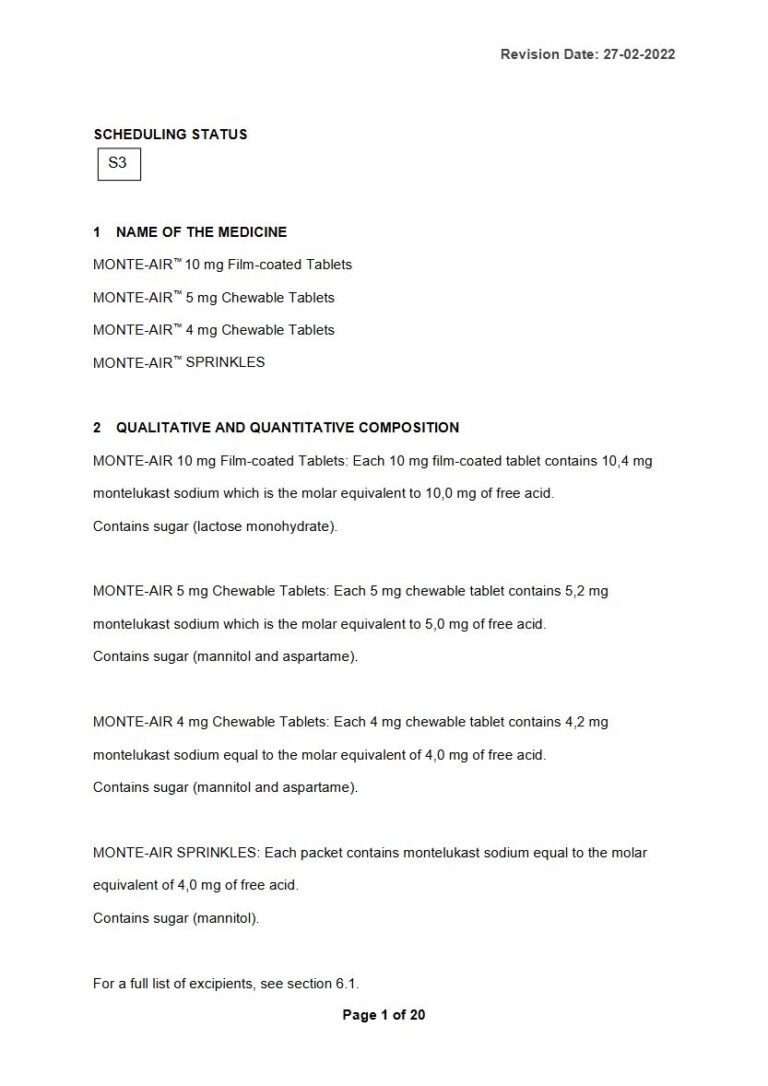
Monte-Air 4mg. 5 mg. 10 mg FC Tablets. Chewable Tablets
PDF Leaflet Revision Date: 27 February 2022
Clinical Summary
Quick overview from the medicine insert
Indication
Prophylaxis and chronic treatment of atopic asthma.
Dosage (summary)
Adults: 10 mg once daily; Children 6-14 years: 5 mg once daily; Children 2-5 years: 4 mg once daily or SPRINKLES.
Onset of Action / Duration
Onset: 1 day, Duration: 24 hours
Special Populations
- Elderly
- Renal impairment
- Hepatic impairment
Pregnancy & Breastfeeding
Safety in pregnancy and lactation not established; breastfeeding not recommended.
Key Drug Interactions
- Phenobarbital
- Gemfibrozil
- Warfarin
Contraindications
- Hypersensitivity to montelukast
- Children <2 years
- Children <6 years for 5 mg tablets
- Children <15 years for 10 mg tablets
Common side effects
- Headache
- Dizziness
- Fatigue
- Abdominal pain
- Insomnia
Counselling Points
- Take daily as prescribed
- Continue during asthma worsening
- Monitor for mood changes
- Avoid aspirin if hypersensitive
Serious warnings
- Neuropsychiatric events
- Eosinophilia
- Not for acute asthma attacks
Important Disclaimer
The Monte-Air 4mg. 5 mg. 10 mg FC Tablets. Chewable Tablets professional information leaflet below is the property of Organon South Africa and is provided on Medinsert exactly as issued, with no.. alterations or editorial changes. We make every effort to keep content current by updating documents as soon as new versions become available. Medinsert serves as a trusted access point for healthcare professionals, but does not replace official sources or clinical judgement. For more details, please read our full disclaimer. read more>>
 Healthcare Professionals Only
This content is for registered healthcare professionals
Sign in or create a free account to read the full package insert.
Free for HPCSA-registered professionals. Powered by Medinsert.
Clinical Particulars
Section 4 of the official insert — extracted exactly as issued, no alterations
4.1 Therapeutic indications
MONTE-AIR 10 mg Film-coated Tablets are indicated in adults and children 15 years of age and older for the prophylaxis and chronic treatment of atopic asthma. In those adult asthmatic patients, in whom MONTE-AIR is indicated in asthma, MONTE-AIR may also provide some symptomatic relief of seasonal allergic rhinitis. MONTE-AIR 5 mg Chewable Tablets are indicated in paediatric patients over 6 years of age for the prophylaxis and chronic treatment of atopic asthma. MONTE-AIR 4 mg Chewable Tablets and MONTE-AIR SPRINKLES are indicated in paediatric patients 2 to 5 years of age for the prophylaxis and chronic treatment of atopic asthma.
4.2 Posology and method of administration
MONTE-AIR should be taken once daily in the evening. MONTE-AIR can be taken with or without food.
MONTE-AIR 10 mg Film-coated Tablets
- Adults and Children 15 years of age and older with atopic asthma: One 10 mg film-coated tablet daily. Clinical studies in adults 15 years of age and older did not demonstrate additional clinical benefit to montelukast doses above 10 mg once daily.
MONTE-AIR 5 mg Chewable Tablets
- Paediatric patients 6 to 14 years of age with atopic asthma: One 5 mg chewable tablet daily.
MONTE-AIR 4 mg Chewable Tablets
- Paediatric patients 2 to 5 years of age with atopic asthma: One 4 mg chewable tablet daily.
MONTE-AIR SPRINKLES
- Paediatric patients 2 to 5 years of age with atopic asthma: One packet of SPRINKLES daily. MONTE-AIR SPRINKLES can be administered either directly into the mouth, or mixed with a spoonful of cold or room temperature soft food (e.g. apple sauce). The packet should only be opened directly before use, and the full dose of MONTE-AIR SPRINKLES must be administered immediately (within 15 minutes). Once mixed with food, MONTE-AIR SPRINKLES must not be stored for future use. MONTE-AIR SPRINKLES are not intended to be dissolved in liquid. However, liquids may be taken subsequent to administration.
A therapeutic effect of MONTE-AIR on parameters of asthma control occurs within one day. Patients should be advised to continue taking MONTE-AIR while their asthma is controlled, as well as during periods of worsening asthma. No dosage adjustment is necessary for the elderly, paediatric patients, for patients with renal insufficiency, or mild-to-moderate hepatic impairment.
Therapy with MONTE-AIR in relation to other treatments for asthma
- MONTE-AIR can be added to a patientu2019s existing treatment regimen.
Reduction in Concomitant Therapy
- Bronchodilator Treatments: MONTE-AIR can be added to the treatment regimen of patients who are not adequately controlled on bronchodilator alone. When a clinical response is evident (usually after the first dose), the patientu2019s bronchodilator therapy may be reduced as tolerated.
- Inhaled Corticosteroids: A reduction in the corticosteroid dose can be made as tolerated. The dose should be reduced gradually with medical supervision. MONTE-AIR should not be abruptly substituted for inhaled corticosteroids.
4.3 Contraindications
- Hypersensitivity to montelukast or to any component of MONTE-AIR.
MONTE-AIR 10 mg Film-coated Tablets
- Children below the age of 15 years as safety and efficacy have not been demonstrated.
MONTE-AIR 5 mg Chewable Tablets
- Children below the age of 6 years, as safety and efficacy have not been demonstrated.
MONTE-AIR 4 mg Chewable Tablets and SPRINKLES
- Children below the age of 2 years, as safety and efficacy have not been demonstrated.
4.4 Special warnings and precautions for use
MONTE-AIR is not indicated in the reversal of bronchospasm in acute asthma attacks, including status asthmaticus as the efficacy of MONTE-AIR has not been established for the treatment of acute asthma attacks.
Eosinophilic conditions
Patients on therapy with MONTE-AIR may present with eosinophilia, sometimes presenting with clinical features of vasculitis consistent with Churg-Strauss syndrome, a condition which is often treated with systemic corticosteroid therapy. These events usually, but not always, have been associated with the reduction of oral corticosteroid therapy. Medical practitioners should be on the alert for patients presenting with eosinophilia, vasculitic rash, worsening of pulmonary symptoms, cardiac complications, and/or neuropathy.
Neuropsychiatric events
Neuropsychiatric events have been reported in adult, adolescent and paediatric patients taking MONTE-AIR. Post-marketing reports with MONTE-AIR use include agitation, aggressive behaviour or hostility, anxiousness, depression, disorientation, disturbance in attention, abnormal dreams, hallucinations, insomnia, irritability, memory impairment, restlessness, somnambulism, suicidal ideation and behaviour (including suicide), tic and tremor. Patients and medical practitioners should be alert for neuropsychiatric events. Patients should be instructed to notify their medical practitioners if these changes occur. Medical practitioners should carefully evaluate the risks and benefits of continuing treatment with MONTE-AIR if such events occur.
Hypersensitivity to aspirin
Patients with a known hypersensitivity to aspirin should continue avoiding aspirin and non-steroidal anti-inflammatory drugs (NSAIDs) while taking MONTE-AIR. Although MONTE-AIR is effective in improving airway function in asthmatics, it has not been demonstrated to reduce the bronchoconstrictor response to aspirin or other NSAIDs in aspirin-sensitive asthmatic patients.
Hepatic impairment
The metabolism of montelukast may be decreased in patients with mild to moderate hepatic impairment and clinical evidence of cirrhosis. The half-life may be slightly prolonged; however, dosage adjustment is not necessary. No data are available for patients with severe hepatic impairment.
General
MONTE-AIR is not indicated for use in the reversal of bronchospasm in acute asthma attacks, including status asthmaticus. Patients should be advised to have appropriate rescue medication available. During acute exacerbations of asthma, therapy with MONTE-AIR can be continued. Patients should be advised to take MONTE-AIR daily as prescribed, even if they are asymptomatic, as well as during periods of worsening of asthma, and to contact their medical practitioners if their asthma is not well controlled. Medical attention should be sought if more than the prescribed maximum number of inhalations of short-acting bronchodilator treatment for a 24-hour period, are needed. MONTE-AIR should not be used as monotherapy for the prophylactic treatment of exercise-induced bronchospasm. Patients should continue with their usual inhaled preventer therapy and have a short-acting inhaled beta agonist available for rescue, should they experience exacerbations of asthma after exercise.
MONTE-AIR should not be abruptly substituted for inhaled or oral corticosteroids. The dose of the corticosteroid therapy may be gradually tapered, under medical supervision. To ensure safe and appropriate use, patients should be advised to read the section on u201cWarnings and precautionsu201d in the Patient Information Leaflet.
MONTE-AIR 10 mg Film-coated Tablets
Galactose intolerance
MONTE-AIR 10 mg Film-coated Tablets contains lactose. Patients with the rare hereditary conditions of galactose intolerance e.g. galactosaemia, Lapp lactose deficiency or glucose-galactose malabsorption should not take MONTE-AIR 10 mg Film-coated tablets.
MONTE-AIR 4 mg and 5 mg Chewable Tablets
Phenylalanine
Phenylketonurics: Phenylketonuric patients should be informed that the chewable tablets contain phenylalanine (a component of aspartame): 0,842 mg per 5 mg chewable tablet and 0,674 mg per 4mg chewable tablet. It may be harmful for patients with phenylketonuria.
4.5 Interaction with other medicines and other forms of interaction
MONTE-AIR may be administered together with other therapies routinely used in the prophylaxis and chronic treatment of atopic asthma, and seasonal allergic rhinitis. In medicine interaction studies, the recommended clinical dose of montelukast did not have clinically important effects on the pharmacokinetics of the following medicines: Theophylline, prednisone, prednisolone, oral contraceptives (ethinyl oestradiol/norethindrone 35 mcg /1 mg), digoxin and warfarin.
The area under the plasma concentration - time curve (AUC) for montelukast was decreased approximately 40 % in subjects with co-administration of phenobarbitone. No dosage adjustment for MONTE-AIR is recommended. Clinical monitoring is recommended when potent hepatic enzyme inducers (such as ritonavir, phenytoin, phenobarbitone, rifampicin, or St Johnu2019s wort are given with MONTE-AIR).
In vitro studies have shown that montelukast is an inhibitor of isoenzyme CYP2C8. However, data from an interaction study involving montelukast and rosiglitazone (a substrate representative of medicines primarily metabolised by isoenzyme CYP2C8) demonstrated that montelukast did not significantly inhibit isoenzyme CYP2C8 in vivo. Therefore, MONTE-AIR is not anticipated to alter the metabolism of medicines metabolised by isoenzyme (CYP2C8) (e.g. paclitaxel, rosiglitazone, and repaglinide.)
In vitro studies have shown that montelukast is a substrate of CYP2C8, CYP2C9, and CYP3A4. Data from an interaction study involving montelukast and gemfibrozil (an inhibitor of both CYP2C8 and CYP2C9) demonstrated that gemfibrozil increased the systemic exposure of montelukast by 4,4-fold. Co-administration of itraconazole, a strong CYP3A4 inhibitor, with gemfibrozil and montelukast did not further increase the systemic exposure of montelukast. The effect of gemfibrozil on systemic exposure of montelukast is not considered to be clinically meaningful based on clinical safety data with doses greater than the 10 mg approved dose in adults (e.g., 200 mg/day to adult patients for 22 weeks, and up to 900 mg/day to patients for approximately one week) where clinically important adverse experiences were not observed. Therefore, no dosage adjustment of MONTE-AIR is required upon co-administration with gemfibrozil. Based on in vitro data, important interactions with other known inhibitors of CYP2C8 (e.g., trimethoprim) are not anticipated. In addition, co-administration of montelukast with itraconazole alone resulted in no significant increase in the systemic exposure of montelukast.
4.6 Pregnancy and lactation
Pregnancy
The safety of MONTE-AIR in pregnant and lactating women has not been established. Available data from published prospective and retrospective cohort studies with montelukast use in pregnant women evaluating major birth defects have not established a drug-associated risk. Available studies have methodologic limitations, including small sample size, in some cases retrospective data collection, and inconsistent comparator groups.
Breastfeeding
It is not known if MONTE-AIR is excreted in human milk. Women using MONTE-AIR should not breastfeed their infants.
4.7 Effects on ability to drive and use machines
MONTE-AIR may cause side effects such as dizziness or drowsiness, which may affect the ability to drive. Patients should therefore be advised not to drive or operate machinery until their individual susceptibility to MONTE-AIR is known.
4.8 Undesirable effects
Side effects generally did not require discontinuation of therapy. The following medicine related adverse reactions in placebo-controlled clinical studies were reported in patients with asthma treated with MONTE-AIR and at a greater incidence than in patients treated with placebo. The adverse reactions are listed by system organ class and frequency category.
Frequency categories: Very common (u22651/10); Common (u22651/100 to u02c21/10); Uncommon (u22651/1 000 to u02c21/100); rare (u2265 1/10 000 to u02c21/1 000)
Adult and Adolescent Patients 15 years and older (two 12 week studies; n=795)
System Organ Class Adverse Reaction Frequency
Ear and labyrinth disorders - - Eye disorders Blepharospasm Uncommon a Gastrointestinal disorders Abdominal pain Uncommon Abdominal pain upper Uncommon Bowel movement irregularity Uncommon a Diarrhoea Uncommon Dry mouth Uncommon Dyspepsia Uncommon Flatulence Uncommon Nausea Uncommon Salivary hypersecretion Uncommon a Vomiting Uncommon General disorders and administration site conditions Chest pain Uncommon a Fatigue Uncommon Irritability Uncommon a Immune System disorders - - Investigations Alanine aminotransferase increased Uncommon Aspartate aminotransferase increased Uncommon White blood cell count decreased Uncommon Metabolism and nutrition disorders Increased appetite Uncommon a Musculoskeletal and connective tissue disorders Arthralgia Uncommon Back pain Uncommon a Muscle spasms Uncommon a Muscular weakness Uncommon a Myalgia Uncommon a Pain in extremity Uncommon a Nervous system disorders Dizziness Uncommon Headache Common Hypersomnia Uncommon Somnolence Uncommon Tremor Uncommon a Psychiatric disorders Insomnia Uncommon Libido decreased Uncommon a Renal and urinary disorders - - Respiratory, thoracic and mediastinal disorders Asthma Uncommon Cough Uncommon a Dysphonia Uncommon a Dyspnoea Uncommon a Oropharyngeal pain Uncommon a Postnasal drip Uncommon a Respiratory tract congestion Uncommon a Rhinitis allergic Uncommon a Skin and subcutaneous tissue disorders Acne Uncommon a Night sweats Uncommon a Rash Uncommon Rash pruritic Uncommon a Vascular disorders Hypertension Uncommon a
Paediatric Patients 6 to 14 years old (one 8 week study; n=201)
Paediatric Patients 2 to 5 years old (one 12 week study; n=461)
System Organ Class Adverse Reaction Frequency Adverse Reaction Frequency Ear and labyrinth disorders Vertigo Uncommon a Eye disorders Mydriasis Uncommon a Gastrointestinal disorders Abdominal discomfort Uncommon a Diarrhoea Uncommon a Flatulence Uncommon a General disorders and administration site conditions Thirst Common Immune System disorders Decreased immune responsiveness Uncommon a Investigations Aspartate aminotransferase increased Uncommon Eosinophil count increased Uncommon a Haematocrit decreased Uncommon Haemoglobin decreased Uncommon White blood cell count decreased Uncommon a Metabolism and nutrition disorders - - - - Musculoskeletal and connective tissue disorders Back pain Uncommon a Myalgia Uncommon a Nervous system disorders Dizziness Uncommon a Headache Common Headache Uncommon a Paraesthesia Uncommon a Tremor Uncommon a Psychiatric disorders Insomnia Uncommon Mood swings Uncommon a Renal and urinary disorders Enuresis Uncommon a Respiratory, thoracic and mediastinal disorders Asthma Uncommon a Dysphonia Uncommon a Epistaxis Uncommon a Skin and subcutaneous tissue disorders Pruritus generalised Uncommon a Vascular disorders Hypertension Uncommon a
With prolonged treatment in clinical trials with a limited number of patients for up to 2 years for adults, and up to 6 months for paediatric patients 6 to 14 years of age, the safety profile did not change. Patients on therapy with MONTE-AIR may present with systemic eosinophilia, sometimes presenting with clinical features of vasculitis consistent with Churg-Strauss syndrome (see section 4.4).
Post-Marketing Experience
The following side effects have been reported in post-marketing use: Infections and infestations: upper respiratory tract infections Blood and lymphatic system disorders: increased bleeding tendency, thrombocytopenia Immune system disorders: hypersensitivity reactions including anaphylaxis, hepatic eosinophilic infiltration Psychiatric disorders: abnormal dreams, dysphemia (stuttering), hallucinations, agitation including aggressive behaviour or hostility, anxiousness, depression, disorientation, disturbance in attention, insomnia, memory impairment, obsessive-compulsive symptoms, psychomotor hyperactivity (including irritability, restlessness, and tremor) somnambulism, suicidal ideation and behaviour (suicidality), tic Nervous system disorders: dizziness, drowsiness, paraesthesia/hypoaesthesia, seizure Cardiac disorders: palpitations Respiratory, thoracic and mediastinal disorders: epistaxis, pulmonary eosinophilia, and Churg-Strauss syndrome Gastrointestinal disorders: diarrhoea, dyspepsia, nausea, vomiting Hepatobiliary disorders: increased alanine aminotransferase (ALT) and aspartate aminotransferase (AST), hepatitis (including cholestatic, hepatocellular and mixed-pattern liver injury) Skin and subcutaneous tissue disorders: angioedema, bruising, erythema multiforme, erythema nodosum, pruritus, rash, urticaria Musculoskeletal and connective tissue disorders: arthralgia, myalgia, including muscle cramps Renal and urinary disorders: enuresis in children General disorders and administration sites conditions: oedema, pyrexia, asthenia/fatigue
4.9 Overdose
There were no adverse experiences reported in the majority of overdosage reports. The most frequently occurring adverse experiences included abdominal pain, somnolence, thirst, headache, vomiting and psychomotor hyperactivity.
In chronic asthma studies, MONTE-AIR has been administered at doses up to 200 mg/day to adult patients for 22 weeks and in short-term studies, up to 900 mg/day to patients for approximately one week without clinically important adverse experiences. No specific information is available on the treatment of overdosage with MONTE-AIR. Treatment is symptomatic and supportive. It is not known whether montelukast is dialysable by either peritoneal or haemodialysis.
