
Bcg Vaccine AJV Injection
Clinical Summary
Quick overview from the medicine insert
Indication
Prevention of tuberculosis in high-risk populations, particularly in infants and young children.
Dosage (summary)
Administer 1 ml intradermally, typically given at birth or as soon as possible after birth, with a second dose if indicated.
Onset of Action / Duration
The immune response develops within 2 to 3 weeks after vaccination.
Special Populations
- Infants
- Immunocompromised patients
- Individuals with a history of allergic reactions to components of the vaccine
Pregnancy & Breastfeeding
The vaccine is generally considered safe during pregnancy; however, it should be administered only if the benefits outweigh the risks. Caution is advised during lactation.
Key Drug Interactions
- Live vaccines may have reduced efficacy if administered simultaneously or within a short interval.
- Immunosuppressive therapies may reduce the effectiveness of the vaccine.
Contraindications
- Severe allergic reaction to any component of the vaccine.
- Active tuberculosis infection.
- Severe immunodeficiency (e.g., HIV with low CD4 count).
Common side effects
- Local reactions at the injection site (e.g., redness, swelling, tenderness)
- Fever
- Lymphadenopathy
- Rarely, systemic allergic reactions
Counselling Points
- Inform caregivers about the importance of vaccination in preventing tuberculosis.
- Advise on potential side effects and when to seek medical attention.
- Encourage completion of the vaccination schedule as recommended.
Serious warnings
- Monitor for signs of allergic reactions post-vaccination.
- Patients with compromised immune systems should be evaluated before vaccination.
- Do not administer to individuals with active tuberculosis.
Important Disclaimer
The Bcg Vaccine AJV Injection professional information leaflet below is the property of The Biovac Institute and is provided on Medinsert exactly as issued, with no.. alterations or editorial changes. We make every effort to keep content current by updating documents as soon as new versions become available. Medinsert serves as a trusted access point for healthcare professionals, but does not replace official sources or clinical judgement. For more details, please read our full disclaimer. read more>>
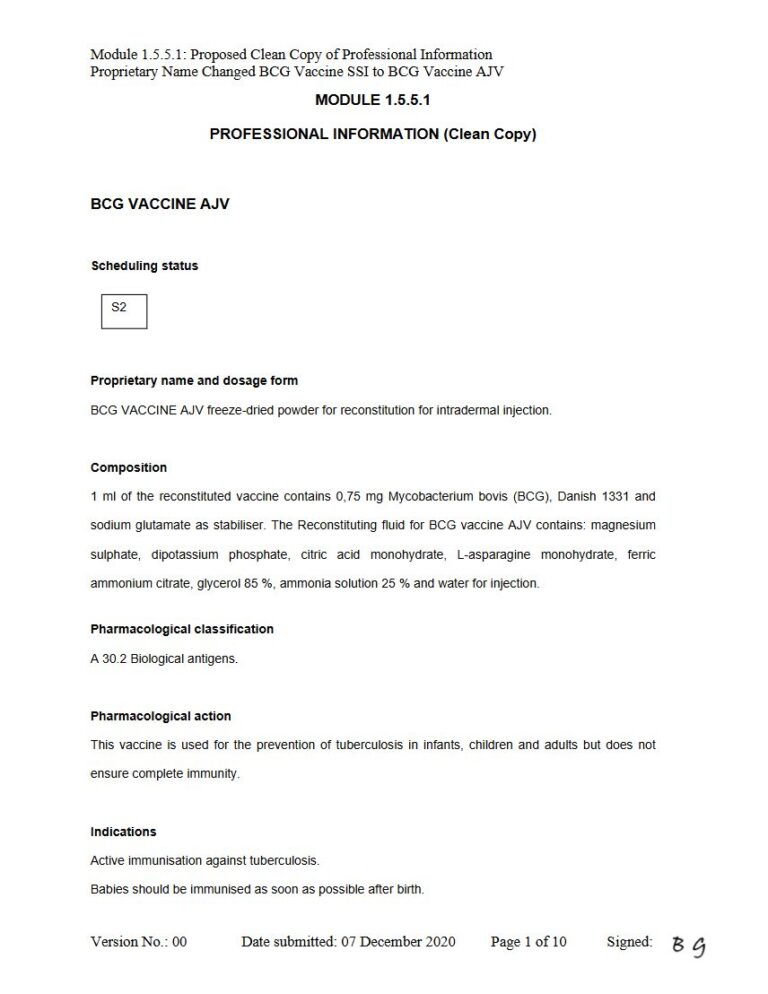 Healthcare Professionals Only
This content is for registered healthcare professionals
Sign in or create a free account to read the full package insert.
Free for HPCSA-registered professionals. Powered by Medinsert.
Clinical Particulars
Section 4 of the official insert — extracted exactly as issued, no alterations
4.1 Therapeutic indications
Active immunisation against tuberculosis. Babies should be immunised as soon as possible after birth.
4.2 Posology and method of administration
Children below 1 year of age: 0,05 ml of the reconstituted vaccine strictly by intradermal injection. 0,1 ml of the reconstituted vaccine should be given to children 1 year or older, and adults, strictly by intradermal injection.
Method of Administration: The injection site should be clean and dry. If antiseptics (such as alcohol) are applied to swab the skin, they should be allowed to evaporate completely before the injection is given. Eczema is not a contraindication, but the site of vaccination should be lesion-free. BCG VACCINE AJV must be administered by personnel trained in the intradermal technique. The injection must be given slowly, strictly intradermally, into the arm, into the upper layer of skin of the right arm in the region over the distal insertion of the deltoid muscle onto the humerus (approx. one third down the upper arm), as follows:
- the skin is stretched between thumb and forefinger,
- almost parallel with the skin surface, the needle is slowly inserted (bevel upwards) approximately 2 mm into the superficial layers of the dermis,
- the needle should be visible through the epidermis during insertion,
- the injection is given slowly,
- a raised, blanched bleb is a sign of correct injection,
- slight induration, erythema and tenderness at the injection site are followed by a local lesion,
- some weeks later this lesion evolves into a small ulcer,
- after some months this ulcer heals leaving a small, flat scar,
- the injection site is best left uncovered to facilitate healing. The ulcer should be encouraged to dry, and abrasion (by tight clothes, for example) should be avoided.
BCG Vaccine AJV should be administered with a 1 ml syringe with mL subgraduations fitted with a fine short needle with a short bevel (25 G/0,50 mm or 26 G/0,45 mm). Jet injectors or multiple puncture devices should not be used to administer the vaccine.
Reconstitution: Only Diluted Sauton Medium may be used for reconstitution of BCG VACCINE AJV. The rubber stopper must not be wiped with antiseptic or detergent. If alcohol is used to swab the rubber stopper of the vial, it must be allowed to evaporate before the stopper is penetrated with the syringe needle. The vaccine should be visually inspected before and after reconstitution for any foreign particles before administration. The Reconstituting fluid for BCG VACCINE AJV must be cooled to < 8 u00b0C before use. Transfer 1 ml Reconstituting fluid for BCG VACCINE AJV with a sterile syringe with a long needle into the vial containing the vaccine. Carefully invert the vial a few times to resuspend the freeze-dried BCG thoroughly, which will produce a homogenous, slightly opaque and colourless suspension. Gently swirl the vial of resuspended vaccine before drawing up each subsequent dose. Avoid vigorous shaking. Thoroughly mixed the vaccine is a homogenous, slightly opaque and colourless suspension. For the multidose vial a separate sterile syringe and needle must be used for each injection. As the product contains living micro-organisms, special precautions for its disposal should be taken. Any suspended vaccine remaining at the end of an immunisation session (maximum 6 hrs) should be discarded. It is recommended that the vials with unused content and the needles/syringes used to administer the vaccine should be disposed in a waste container for hospital waste.
4.3 Contraindications
BCG VACCINE AJV must not be administered to persons known to be hypersensitive to any component of the vaccine. BCG VACCINE AJV should not be given in individuals:
- with congenital or acquired immunodeficiency, including symptomatic HIV disease (clinical symptomatic AIDS),
- known to be HIV-infected, even if they show no symptoms of HIV-infection,
- on concurrent treatment with immunosuppressive medicines or radiotherapy; this also includes infants exposed to immunosuppressive treatment in utero or via breastfeeding for as long as postnatal influence of the immune status of the infant remains possible (e.g. maternal treatment with TNF u03b1 -antagonists),
- whose immune status is in question, and
- with malignant conditions (e.g. lymphoma, leukaemia, Hodgkinu2019s disease or other tumours of the reticulo-endothelial system).
The effect of BCG vaccination may be exaggerated in these individuals and a generalised BCG-infection is possible. BCG VACCINE AJV may be given where benefits outweigh risks for vaccination such as infants born to known HIV-infected women, but:
- whose HIV infection is negative (i.e. laboratory confirmed), or
- whose HIV infection is unknown and demonstrate no clinical signs or symptoms suggestive of HIV infection.
Close follow up of infants known to be born to HIV-infected mothers and who received BCG VACCINE AJV at birth is recommended in order to provide early identification and treatment of any BCG-related complications. BCG VACCINE AJV must not be given to patients receiving anti-tuberculosis drugs. Infants who are born to mothers who are on anti u2013 tuberculosis treatment should not be given BCG VACCINE AJV; they should be put on tuberculosis prophylaxis and followed up for vaccination with BCG VACCINE AJV later. This includes infants born to mothers who have extensive resistant and multi-drug resistant (XDR & MDR) tuberculosis.
4.4 Special warnings and precautions for use
If BCG vaccination is deemed necessary after an individual has received immunosuppressive agents, such as antineoplastic chemotherapy or high dose systemic corticosteroid therapy, the advice of a specialist must be sought before the vaccination is performed due to the risk of a disseminated BCG infection.
Special precautions: Vaccination should be postponed in patients suffering from an acute illness, high fever and in serious skin disease. Expert medical advice should be obtained concerning correct treatment of such reactions. Measures to treat anaphylaxis, including adrenaline, should be immediately available. Whenever possible, vaccinated persons should be observed for allergic reactions for up to 20 minutes after immunisation. Tuberculin-positive persons do not require the vaccine. Administration of the vaccine to such persons may result in a severe local reaction. Administering the vaccine too deeply increases the risk of a discharging ulcer, abscess formation and regional lymphadenitis.
4.5 Interactions with other medicines
Other vaccines can be given at the same time as BCG VACCINE AJV, but must be given in different areas of the body. Other live vaccines must either be given at the same time or normally not less than 4 weeks after BCG vaccination. Further vaccinations in the arm used for the BCG vaccination must not be given for 3 months due to risk of regional lymphadenitis. M. bovis Danish strain 1331 is susceptible to the most used anti-tuberculous preparations. Minimum Inhibitory Concentration (MIC) for isoniazid is 0,4 mg/l (Bactec 460). There is no consensus as to whether M. bovis should be classified as susceptible, intermediately resistant or resistant to isoniazid when MIC is 0,4 mg/l. Based on the criteria for M. tuberculosis the strain can be considered low level resistant. The MIC values (as determined by the Bactec 460 method) for selected anti-tuberculosis agents against the BCG Danish strain 1331 are as follows:
- Anti-tuberculosis agent Minimum inhibitory concentration (MIC)
- Isoniazid 0,4 mg/l
- Streptomycin 2,0 mg/l
- Rifampicin 2,0 mg/l
- Ethambutol 2,5 mg/l
BCG Danish strain 1331 is resistant towards pyrazinamide.
4.6 Fertility, pregnancy and lactation
Safety in pregnancy has not been established. BCG vaccination during lactation is believed to pose no risk to the breast-feeding child.
4.7 Effects on ability to drive and use machines
BCG VACCINE AJV has no or negligible influence on the ability to drive and use machines.
4.8 Undesirable effects
A local reaction is normal after BCG. A small tender red swelling appears at the site of the injection which gradually changes to a small vesicle. An ulcer may appear 2 to 4 weeks after vaccination. An adherent dressing is not recommended. The reaction usually subsides within two to five months and in practically all children leaves a superficial scar 2-10 mm in diameter. In a minority of neonates, a scar may not be seen, due to the immaturity of the immune system. Transient enlargement of the regional lymph nodes (< 1 cm) is normal. Enlargement of axillary lymph nodes may be seen less frequently in the months following immunisation. Suppurative lymphadenitis may occur less frequently. This is a benign condition which heals spontaneously, although often only slowly.
Side-effects:
- Infections and Infestations
- Less frequent: Osteomyelitis, Suppurative lymphadenitis, Injection site abscess.
- Blood and the lymphatic system disorders
- Less frequent: Enlargement of axillary lymph nodes > 1 cm may appear following immunisation.
- Immune system disorders
- Less frequent: Anaphylactic reaction, Allergic reaction.
- Nervous system disorders
- Less frequent: Headache.
- Skin and subcutaneous tissue disorders
- Less frequent: Lupus types of reaction and keloid formation may occur.
- Musculoskeletal, connective tissue and bone disorders
- Less frequent: Osteitis.
- General disorders and administrative site conditions
- Less frequent: Inadvertent subcutaneous injection produces abscess formation and may lead to ugly retracted scars.
- Disseminated BCG disease may occur, particularly in immuno-suppressed individuals.
- Less frequent: Fever, injection site ulceration, injection site discharge.
4.9 Overdose
Overdose increases the risk of undesirable BCG complications, such as severe local reaction, abscess formation, suppurative lymphadenitis and may lead to excessive scar formation. The abscess should be encouraged to dry and abrasion (by tight clothes, for example) avoided. If the abscess persists, seek expert medical advice. If a disseminated infection occurs, systemic anti-tubercular treatment with a suitable anti-tuberculosis drug must be considered. Expert medical advice should be obtained on management and treatment. Though anaphylactoid reactions are extremely rare, facilities for their management must always be available. Treatment is symptomatic and supportive.
