
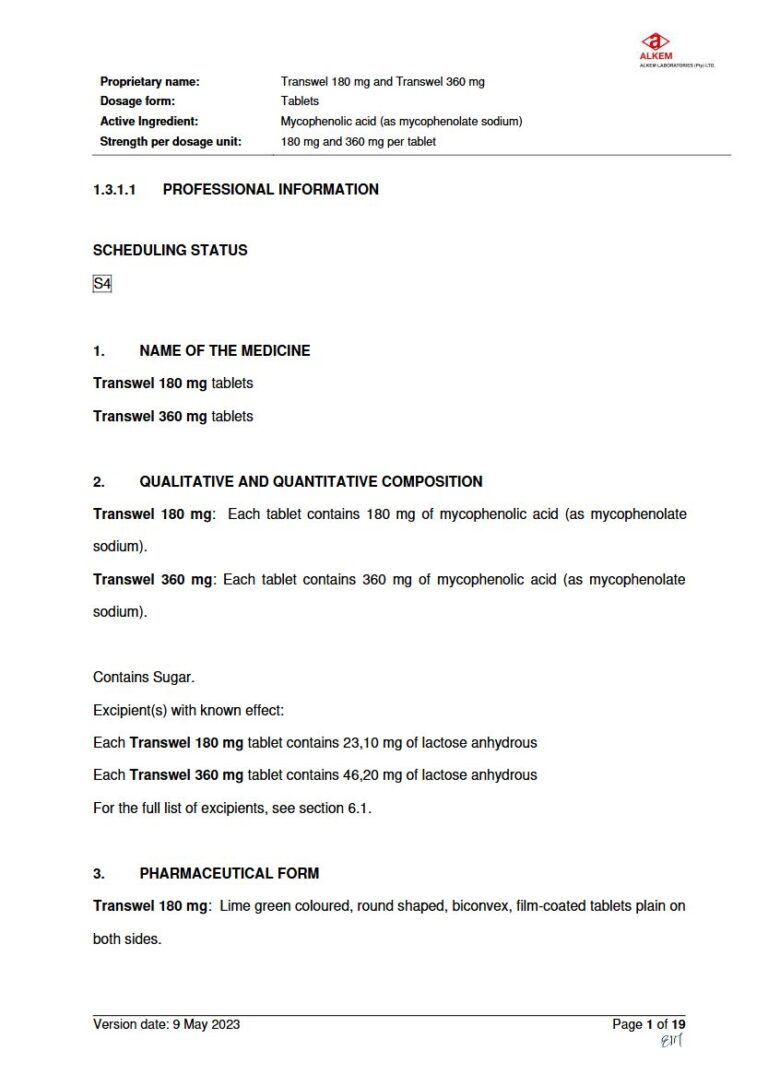
Transwel 180 & 360 180mg, 360mg Tablet
PDF Leaflet Revision Date: 9 May 2023
Clinical Summary
Quick overview from the medicine insert
Indication
Prevention of acute organ transplant rejection in renal transplant patients.
Dosage (summary)
720 mg (four 180 mg or two 360 mg tablets) twice daily.
Special Populations
- Elderly
- Renal impairment
- Paediatric population
Pregnancy & Breastfeeding
Contraindicated in pregnancy and breastfeeding; teratogenic effects noted.
Key Drug Interactions
- Acyclovir
- Cholestyramine
- Antacids
- Azathioprine
- Rifampicin
Contraindications
- Hypersensitivity to mycophenolic acid
- Pregnancy
- Lactation
Common side effects
- Infections
- Diarrhoea
- Fatigue
- Headache
- Neutropenia
Counselling Points
- Use effective contraception
- Report infections or bleeding
- Avoid live vaccines
Serious warnings
- Carcinogenicity
- Teratogenicity
- Increased infection risk
Important Disclaimer
The Transwel 180 & 360 180mg, 360mg Tablet professional information leaflet below is the property of Alkem Laboratories and is provided on Medinsert exactly as issued, with no.. alterations or editorial changes. We make every effort to keep content current by updating documents as soon as new versions become available. Medinsert serves as a trusted access point for healthcare professionals, but does not replace official sources or clinical judgement. For more details, please read our full disclaimer. read more>>
 Healthcare Professionals Only
This content is for registered healthcare professionals
Sign in or create a free account to read the full package insert.
Free for HPCSA-registered professionals. Powered by Medinsert.
Clinical Particulars
Section 4 of the official insert — extracted exactly as issued, no alterations
4.1 Therapeutic indications
Transwel is indicated in combination with ciclosporin for microemulsion and corticosteroids for the prevention of acute organ transplant rejection in adult patients receiving allogenic renal transplants.
4.2 Posology and method of administration
Treatment with Transwel should be initiated and maintained by appropriately qualified transplant specialists. Transwel should be initiated in de novo patients within 48 hours following transplantation.
Posology: The recommended dose is 720 mg (four 180 mg or two 360 mg Transwel tablets) administered twice daily (1440 mg daily dose).
Treatment during rejection episodes: Renal transplant rejection does not lead to changes in mycophenolic acid (MPA) pharmacokinetics, dosage reduction or interruption of Transwel is not required.
Special Populations: Elderly: No dose adjustment is required in this population. Renal impairment: No dose adjustments are needed in patients experiencing delayed renal graft function post-operatively. Patients with severe chronic renal impairment (glomerular filtration rate < 25 ml/min/1.73 m2) should be carefully followed up. Paediatric population: Safety and efficacy in paediatrics have not been established.
Method of administration: Transwel can be taken with or without food and should be swallowed whole with a glass of water. Tablets should not be crushed in order to retain the integrity of the enteric coating.
4.3 Contraindications
Transwel is contra-indicated in:
- Patients with hypersensitivity to mycophenolic acid, mycophenolate sodium, mycophenolate mofetil or any other component of Transwel.
- Pregnancy and lactation.
4.4 Special warnings and precautions for use
WARNING 1: CARCINOGENICITY Increased susceptibility to infection and the possible development of lymphoma and other malignancies, especially of the skin, may result from immune-suppression. Only medical practitioners experienced in immune-suppressive therapy and management of renal, cardiac or hepatic transplant patients should prescribe Transwel. Patients receiving the medicines should be managed in facilities equipped and staffed with adequate laboratory and supportive medical resources. The medical practitioner responsible for maintenance therapy should have complete information requisite for the follow-up of the patient.
WARNING 2: TERATOGENICITY Mycophenolic acid is powerfully teratogenic and mutagenic. Congenital malformation and spontaneous abortions have been reported with use of mycophenolic acid in pregnancy. Woman of childbearing potential must have two negative serum or urine pregnancy tests with a sensitivity of at least 25 mlU/ml; the second test should be performed 8-10 days after the first one and immediately before starting treatment with Transwel. Repeat pregnancy tests should be performed during routine follow-up visits.
Woman of childbearing potential should use two reliable forms of contraception simultaneously, including at least one highly effective method, before beginning Transwel therapy, during therapy, and for six weeks following discontinuation of therapy; unless abstinence is the chosen method of contraception. Sexually active men are recommended to use condoms during treatment and for at least 90 days after cessation of treatment. Condom use applies both for reproductively competent and vasectomised men, because the risk associated with the transfer of seminal fluid also to men who have had a vasectomy. Female partners of male patients are recommended to use highly effective contraception during treatment and for a total of 90 days after the last dose of Transwel.
Cases of pure red cell aplasia (PRCA) have been reported in patients treated with Transwel in combination with other immunosuppressive medicines. The mechanism for Transwel derivative induced PRCA is unknown; the relative contribution in an immunosuppressive regimen are also unknown. PRCA was found to be reversible with dose reduction or cessation of treatment. In transplant patients, however, reduced immunosuppression may place the graft at risk. Changes to Transwel therapy should only be undertaken under appropriate supervision in transplant recipients in order to minimise the risk of graft rejection (see Section 4.8).
Transwel should not be indiscriminately interchanged or substituted because of their different pharmacokinetic profiles. Patients should not donate blood during therapy or for at least 6 weeks following discontinuation of mycophenolate. Men should not donate semen during therapy or for at least 90 days following discontinuation of mycophenolate. Patients on Transwel therapy should limit their exposure to sunlight and UV light by wearing protective clothing and using sunscreen with high protection factor. There is an increased risk of developing lymphomas and other malignancies, particularly of the skin in patients receiving Transwel as part of an immunosuppressive regimen, which appears to be related to the intensity and duration of immunosuppression rather than to the use of any specific medicine.
Serious Infections: There can also be an increased susceptibility to infection, including opportunistic infections, fatal infections and sepsis during over suppression of the immune system. Patients receiving Transwel should be advised to immediately report any evidence of infection, unexpected bruising or bleeding to their medical practitioner.
New and Reactivated Viral Infections: There is also an increased risk of activation of latent viral infections. These include polymavirus associated nephropathy (PVAN), JC virus-associated progressive multifocal leukoencephalopathy (PML), sometimes fatal, cytomegalovirus (CMV) infections, reactivation of hepatitis B (HBV) or hepatitis C (HCV), and BK virus-associated nephropathy which can lead to renal graft loss. Monitoring infected patients for signs of active HBV or HCV is recommended.
Neutropenia: Patients receiving Transwel should have complete blood counts (CBC), weekly during the first month, twice monthly for the second and third months of treatment, then once a month through the remainder of the first year. Neutropenia should be monitored in these patients, as it may be related to Transwel itself, concomitant medicines, viral infections, or some combination of these causes. Treatment with Transwel may need to be stopped if severe neutropenia develops.
Vaccinations: During treatment with Transwel, vaccinations may be less effective and the use of live attenuated vaccines should be avoided due to the increased risk of infection. Intra-uterine devices should be used with caution in patients who are on Transwel treatment for the same reason.
Hereditary Deficiency: Transwel is an IMPDH (inosine monophosphate dehydrogenase) inhibitor, therefore, it should be avoided in patients with rare hereditary deficiency of hypoxanthine-guanine phosphoribosyltransferase (HGPRT) such as Lesch-Nyhan and Kelley-Seegmiller syndrome.
Effect on digestive system: Because MPA derivatives have been associated with an increased incidence of digestive system adverse events, including infrequent cases of gastrointestinal tract ulceration and haemorrhage and perforation, Transwel should be administered with caution in patients with active serious digestive system disease.
Elderly: Elderly patients may be at an increased risk of adverse events compared to younger patients.
Excipients: Patients with rare hereditary problems of galactose intolerance, total lactase deficiency or glucose-galactose malabsorption should not take Transwel.
4.5 Interaction with other medicines and other forms of interaction
Antiviral medicines (Acyclovir or valacyclovir, or ganciclovir or valganciclovir): Increases in MPAG and acyclovir plasma concentrations were observed when Transwel was administered concomitantly with these medicines, compared to their plasma concentrations when administrated alone. MPAG plasma concentrations as well as the plasma concentrations of these antivirals are increased in the presence of renal impairment when administered alone, therefore, the potential exists for these medicines to compete for tubular secretion, thus resulting in further increases in concentration when administered concomitantly.
Cholestyramine: Cholestyramine and concomitant use of Transwel may decrease the plasma concentration of MPA as a result of interruption of enterohepatic recirculation of MPAG possibly caused by intestinal binding with cholestyramine resulting in reduced Transwel efficacy.
Antacids: Antacids with magnesium and aluminium hydroxides may decrease the absorption of Transwel.
Azathioprine: Concomitant administration of azathioprine and Transwel is not recommended due to both having the potential to cause bone marrow suppression.
Ciclosporin: When studied in stable renal transplant patients, ciclosporin pharmacokinetics were unaffected by steady state dosing of Transwel.
Tacrolimus: In a calcineurin cross-over study in stable renal transplant patients, steady-state Transwel pharmacokinetics were measured during both ciclosporin and tacrolimus treatment. Mean MPA AUC was 19 % higher (90 % CI: -3, +47), whereas mean MPAG AUC was about 30 % lower (90 % CI: 16, 42) on tacrolimus compared to ciclosporin treatment.
Probenecid: Medicines such as probenecid that undergo renal secretion may increase the plasma concentrations of the metabolites of Transwel.
Live vaccines: Live vaccines should not be given to patients with impaired immune response. The antibody response to other vaccines may be diminished.
Rifampicin: Rifampicin decreases exposure to mycophenolate (in patients not also taking ciclosporin); MPA concentrations should be monitored when rifampicin and Transwel are used together.
Oral contraceptives: Oral contraceptives undergo oxidative metabolism while Transwel is metabolised by glucuronidation. Efficacy of the oral contraceptive may be adversely affected by the Transwel.
Antibacterial medicines: In liver transplant patients the bioavailability of MPA was reduced by concomitant administration of tobramycin and cefuroxime, apparently through inhibition of enterohepatic recycling of MPA by the antibacterial medicines. Norfloxacin, metronidazole or a combination of the two, reduced exposure to MPA and MPAG when given to healthy subjects receiving Transwel. A similar reduction in concentration was noted with ciprofloxacin or amoxicillin and clavulanic acid.
4.6 Fertility, pregnancy and lactation
Women of childbearing potential: Women of childbearing potential should have a negative pregnancy test within 1 week of starting Transwel treatment. Women on Transwel treatment should use effective contraception from at least 4 weeks prior to starting therapy, until 6 weeks after stopping treatment of Transwel.
Pregnancy: Transwel is contra-indicated in pregnancy. The use of Transwel in pregnancy is associated with an increased risk of first trimester pregnancy loss and an increased risk of congenital malformations (see section 4.3 and section 4.4).
Breastfeeding: Transwel is contra-indicated during breast feeding.
4.7 Effects on ability to drive and use machines
Patients should avoid operating hazardous machines or driving motor vehicles, as Transwel may cause somnolence and drowsiness.
4.8 Undesirable effects
A. Summary of the safety profile Malignancies: Patients receiving immunosuppressive regimens involving combinations of medicines, including MPA, are at increased risk of developing lymphomas and other malignancies, particularly of the skin (see section 4.4).
Opportunistic infections: All transplant patients are at increased risk of opportunistic infections; the risk increased with total immunosuppressive load (see section 4.4). The most frequent opportunistic infections in new renal transplant patients receiving Transwel with other immunosuppressants were cytomegalovirus (CMV), candidiasis and herpes simplex. CMV infection (serology, viraemia or disease) was reported frequently in new and less frequent in maintenance renal transplant patients.
Elderly: Elderly patients may generally be at increased risk of adverse drug reactions due to immunosuppression.
B. Tabulated list of the adverse reactions Adverse reactions reported are shown below. Frequencies were defined using the following convention: frequent, less frequent, frequency unknown:
Class/ Frequency Adverse reactions
Infestation and Infections Frequent: Viral, bacterial and fungal infections, upper respiratory tract infection, pneumonia Less frequent: Wound infection, sepsis, osteomyelitis Frequency unknown: Meningitis, infectious endocarditis, infection, polymavirus associated nephropathy (PVAN), especially due to BK virus.
Blood and the lymphatic system disorders Frequent: Anaemia (including hypochromic anaemia), leucopoenia and thrombocytopenia. Less frequent: lymphocele, lymphopenia, neutropenia and lymphacenopathy. Frequency unknown: Aplastic anaemia, bone marrow depression (sometimes fatal), and pure red cell aplasia.
Endocrine disorders Less Frequent: Diabetes mellitus, parathyroid disorder and Cushingu2019s syndrome.
Metabolism and nutrition disorders Less frequent: Anorexia, diabetes mellitus, hypercholesterolemia, hypophosphataemia and hyperlipidaemia.
Psychiatric disorders Less frequent: Abnormal dreams, delusional perception.
Nervous system disorders Frequent: Headache. Less frequent: Tremor and insomnia. Cases of progressive multifocal leukoencephalopathy (PML), sometimes fatal.
Eye disorders Less frequent: Conjunctivitis and blurred vision.
Class/ Frequency Adverse reactions
Ear and labyrinth disorders Less frequent: Deafness.
Cardiovascular disorders Less frequent: Ventricular extrasystoles and tachycardia.
Respiratory disorders Frequent: Cough. Less frequent: Pulmonary congestion, pulmonary oedema, wheezing. Frequency unknown: Tuberculosis and atypical mycobacterial infection.
Hepato-biliary disorders Frequent: hepatic function tests abnormal.
Gastrointestinal disorders Frequent: Diarrhoea, abdominal distension, abdominal pain, flatulence, gastritis, loose stools, nausea, vomiting, constipation and dyspepsia. Less frequent: Abdominal tenderness, eructation, halitosis, ileus, peptic ulcer, subileus, tongue discolouration, gastrointestinal haemorrhage, dry mouth, lip ulceration, parotid duct obstruction, gastro-oesophageal reflux disease, gum hyperplasia, oesophagitis, peritonitis and pancreatitis. Frequency unknown: Colitis and intestinal perforation, cytomegalovirus (CMV) gastritis and duodenal ulcer.
Skin and subcutaneous tissue disorders Less Frequent: Alopecia and confusion.
Musculoskeletal disorders Less frequent: Arthritis back pain and muscle cramps.
Reproductive system disorders Less frequent: Impotence.
Class/ Frequency Adverse reactions
Renal and urinary disorders Frequent: Increased blood creatinine. Less Frequent: Haematuria, renal tubular necrosis, urethral stricture.
General disorders Frequent: Fatigue and fever. Less frequent: Flu-like syndrome, oedema lower limb, pain, thirst, weakness.
Neoplasms benign and malignant Less frequent: Skin papilloma, basal cell carcinoma, Kaposiu2019s sarcoma, squamous cell carcinoma, lymphoproliferative disorder.
4.9 Overdose
There has been no reported experience of overdosage with Transwel. Although dialysis may be used to remove inactive metabolites MPAG, it would not be expected to remove clinically significant amounts of the active moiety MPA. This is in large part due to the very high plasma protein binding of MPA, 97 %. By interfering with enterohepatic circulation of MPA, bile acid sequestrants, such as cholestyramine, may reduce the systemic MPA exposure. Treatment is symptomatic and supportive.
