
Norflex 100 Mg Tablets
PDF Leaflet Revision Date: 24 June 2021
Clinical Summary
Quick overview from the medicine insert
Indication
Relief of pain due to muscle spasm and mild to moderate pain/fever.
Dosage (summary)
Adults: 2 tablets 3-4 times daily.
Special Populations
- Elderly
- Renal impairment
- Hepatic impairment
Pregnancy & Breastfeeding
Not recommended in pregnancy or breastfeeding.
Key Drug Interactions
- CNS depressants
- Anticoagulants
- Other anticholinergics
Contraindications
- Prostatic enlargement
- Closed angle glaucoma
- Severe liver impairment
Common side effects
- Dry mouth
- Drowsiness
- Nausea
- Constipation
Counselling Points
- Avoid alcohol and CNS depressants.
- Caution when driving or operating machinery.
- Consult if no relief is obtained.
Serious warnings
- Do not use for more than 10 days without consulting a doctor.
- Risk of hyperpyrexia in high ambient temperatures.
Important Disclaimer
The Norflex 100 Mg Tablets professional information leaflet below is the property of Inova Pharmaceuticals and is provided on Medinsert exactly as issued, with no.. alterations or editorial changes. We make every effort to keep content current by updating documents as soon as new versions become available. Medinsert serves as a trusted access point for healthcare professionals, but does not replace official sources or clinical judgement. For more details, please read our full disclaimer. read more>>
 Healthcare Professionals Only
This content is for registered healthcare professionals
Sign in or create a free account to read the full package insert.
Free for HPCSA-registered professionals. Powered by Medinsert.
Clinical Particulars
Section 4 of the official insert — extracted exactly as issued, no alterations
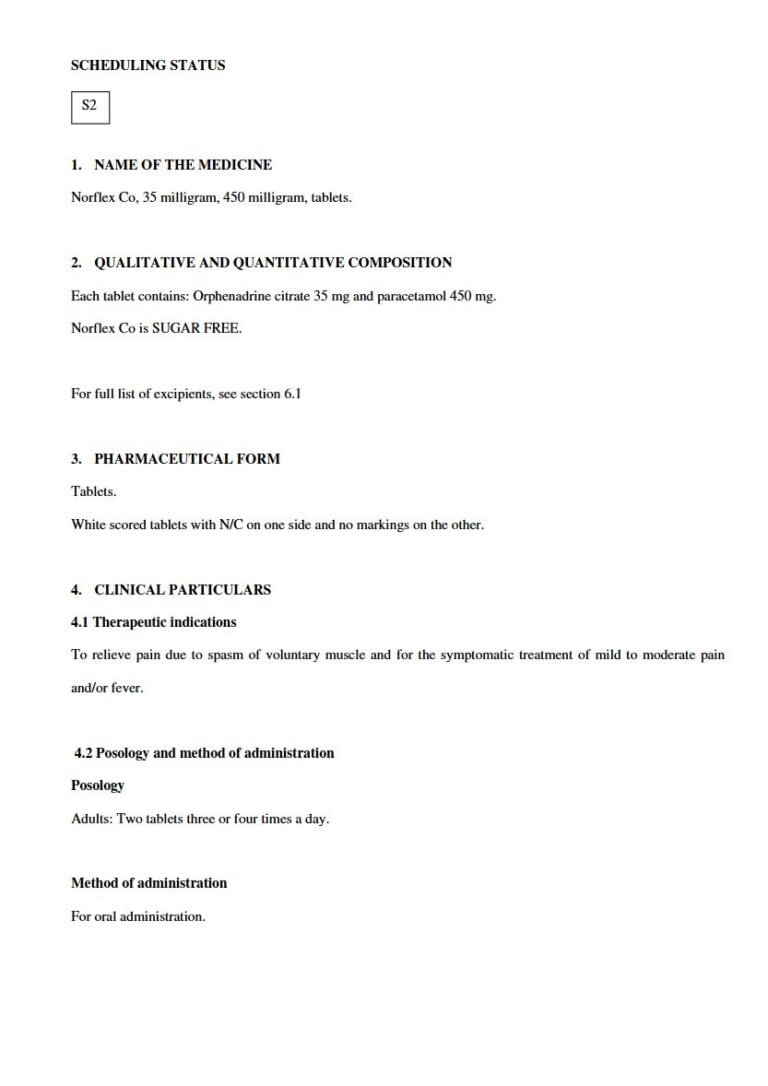
4.1 Therapeutic indications
To relieve pain due to spasm of voluntary muscle and for the symptomatic treatment of mild to moderate pain and/or fever.
4.2 Posology and method of administration
Posology
Adults: Two tablets three or four times a day.
Method of administration
For oral administration.
4.3 Contraindications
Norflex Co should be used with caution in the presence of tachycardia, urinary retention and myasthenia gravis. It is contraindicated in patients with prostatic enlargement and should be used with caution in elderly men. It is also contraindicated in patients suffering from paralytic ileus or pyloric stenosis where its use may lead to obstruction. It should not be given to patients with closed angle glaucoma or to patients with a narrow angle between the iris and the cornea since it may raise intra-ocular pressure. The risk is greater in patients over 40 years of age. It should not be given to patients, especially children, when the ambient temperature is high, due to the risk of provoking hyperpyrexia. It should be used cautiously in patients with fever. It should be used with caution in conditions characterised by tachycardia such as thyrotoxicosis, cardiac insufficiency or failure and in cardiac surgery. Safe use in pregnancy has not been established; therefore, Norflex Co should not be used in pregnant women. Sensitivity to any of the ingredients. Severe liver function impairment.
4.4 Special warnings and precautions for use
Do not use continuously for more than 10 days without consulting your doctor. Orphenadrine citrate should be used with caution in patients with tachycardia, cardiac decompensation, coronary insufficiency or cardiac dysrhythmias. Paracetamol should be used with caution in patients with hepatic or renal dysfunction. Concomitant treatment with other medicines that contain orphenadrine or paracetamol is not recommended. Safety of continuous long-term therapy with orphenadrine has not been established. Therefore if orphenadrine is prescribed for prolonged use, periodic monitoring of blood, urine and liver function is recommended. Consult a doctor if no relief is obtained from the recommended dosage.
Orphenadrine has been abused for supposed euphoriant effect.
Use in the elderly
The elderly should be advised to take a reduced dosage as they may be more susceptible to anti-cholinergic side effects at regular doses.
4.5 Interactions with other medicines and other forms of interactions
The effect of anti-cholinergic agents may be enhanced by the concomitant administration of other medicines with anti-cholinergic properties such as amantadine, some antihistamines, butyrophenones, phenothiazines and tricyclic antidepressants. Concomitant use with alcohol or other CNS depressants should be avoided. Anticoagulant dosage may require reduction if paracetamol medication is prolonged. Paracetamol absorption is increased by medicines that increase gastric emptying, e.g. metoclopramide, and decreased by medicines that decrease gastric emptying, e.g. propantheline, antidepressants with anticholinergic properties and narcotic analgesics. Paracetamol may increase chloramphenicol concentrations. The likelihood of paracetamol toxicity may be increased by the concomitant use of enzyme inducing medicines such as alcohol or anticonvulsant medicines.
4.6 Fertility, pregnancy and lactation
Pregnancy
Norflex Co is not recommended for use during pregnancy.
Breastfeeding
Norflex Co should not be taken during lactation as orphenadrine and paracetamol are excreted into breast milk.
Fertility
No data available.
4.7 Effects on ability to drive and use machines
Orphenadrine may impair the ability of the patient to engage in potentially hazardous activities such as operating machinery or driving a motor vehicle; ambulatory patients should therefore be cautioned accordingly.
4.8 Undesirable effects
Adverse effects are mainly due to the anti-cholinergic action of orphenadrine and are usually associated with higher doses.
MedDRA SOC List
Orphenadrine
Nervous system disorders
Persons with Downu2019s syndrome appear to have an increased susceptibility, whereas those with albinism may be resistant. Insomnia has been reported, mental confusion, especially in the elderly.
Eye disorders
Dilation of the pupils, loss of accommodation and photophobia, increased intraocular pressure.
Cardiac disorders
Transient bradycardia followed by tachycardia, with palpitations and dysrhythmias.
Gastrointestinal disorders
Dryness of the mouth with difficulty in swallowing, desire to urinate with the inability to do so, as well as reduction in the tone and motility of the gastro-intestinal tract leading to constipation, occasional vomiting, giddiness, weakness, nausea, drowsiness and staggering may occur. Retrostemal pain may occur due to increased gastric reflux.
Respiratory, thoracic and mediastinal disorders
Reduced bronchial secretion may be associated with the formation of mucous plugs.
Skin and subcutaneous tissue disorders
Flushing and dryness of skin.
The effect of anticholinergic medicines may be enhanced by the concomitant administration of other medicines with anticholinergic properties such as amantadine, some antihistamines, butyrophenones and phenothiazines and tricyclic antidepressants.
Paracetamol
Blood and lymphatic system disorders
Neutropenia, pancytopenia and leucopenia.
Gastrointestinal disorders
Dyspepsia, nausea, allergic reactions.
Skin and subcutaneous tissue disorders
Skin rashes and other allergic reactions may occur. The rash is usually erythematous or urticarial, but sometimes more serious and may be accompanied by fever and mucosal lesions.
Reporting suspected adverse effects
Reporting suspected adverse reactions after authorisation of the medicine is important. It allows continued monitoring of the benefit/risk balance of the medicine. Healthcare providers are asked to report any suspected adverse reactions to SAHPRA via the u201c6.04 Adverse Drug Reactions Reporting Formu201d, found online under SAHPRAu2019s publications: https://www.sahpra.org.za/Publications/Index/8.
4.9 Overdosage
Symptoms and signs
Orphenadrine overdosage: Known symptoms of overdose with orphenadrine include tachycardia, excitement, confusion and delirium leading to coma. Convulsions, dilated pupils and urinary retention may occur.
Paracetamol overdosage: Toxic symptoms following an overdose with paracetamol include vomiting, abdominal pain, hypotension, sweating, central stimulation with exhilaration and convulsions in children, drowsiness, respiratory depression, cyanosis and coma. In adults, hepatotoxicity may occur after ingestion of a single dose of paracetamol 10 to 15 g; a dose of 25 g or more is potentially fatal. Symptoms during the first two days of acute poisoning by paracetamol do not reflect the potential seriousness of the intoxication. Major manifestations of liver failure such as jaundice, hypoglycaemia and metabolic acidosis may take at least three days to develop.
Treatment
Prompt treatment is essential even when there are no obvious symptoms. In cases of overdosage, methods of reducing absorption of ingested medicine are important. Prompt administration of activated charcoal 50 g in 150 mL of water and 150 mL sorbitol 50 % solution by mouth may reduce absorption. It is recommended that intravenous fluids such as normal saline be given concurrently. Gastric lavage is indicated if the patient is unwilling or unable to drink an activated charcoal/sorbitol mixture. If the history suggests that paracetamol 150 mg/kg body weight or 15 g total or more has been ingested, administer the following antidote: Intravenous acetylcysteine 20 %: Administer acetylcysteine immediately without waiting for positive urine test or plasma level results if 8 hours or less since overdose ingestion. Initial dose 150 mg/kg over 15 minutes, followed by continuous infusion of 50 mg/kg in glucose 5 % 500 mL over four hours and 100 mg/kg in glucose 5 % 1 L over 16 hours. If more than eight hours have elapsed since the overdose was taken, the antidote may be less effective. Convulsions and delirium respond to relatively large doses of diazepam, preferably by mouth. Adequate hydration of the patient is important.
