
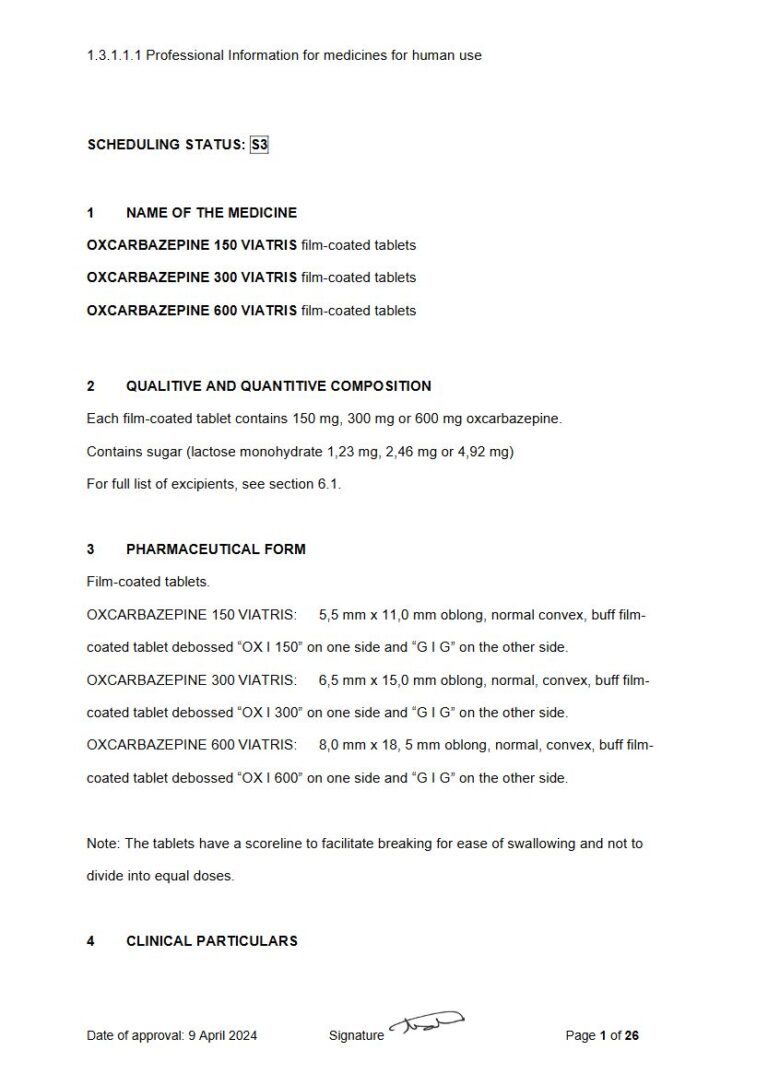
Oxcarbazepine 150 mg/300 mg/600 mg Film-Coated Tablets
PDF Leaflet Revision Date: 9 April 2024
Clinical Summary
Quick overview from the medicine insert
Indication
Treatment of partial and generalized seizures.
Dosage (summary)
Initial: 600 mg/day, may increase to 2400 mg/day based on response.
Special Populations
- Elderly
- Renal impairment
- Hepatic impairment
Pregnancy & Breastfeeding
Risk of congenital malformations; not recommended during breastfeeding.
Key Drug Interactions
- Hormonal contraceptives may be less effective.
- CYP2C19 inhibitors may require dose adjustments.
Contraindications
- Hypersensitivity to oxcarbazepine or excipients.
Common side effects
- Somnolence
- Dizziness
- Diplopia
- Nausea
- Fatigue
Counselling Points
- Monitor for signs of hypersensitivity.
- Avoid alcohol.
- Gradual withdrawal recommended.
Serious warnings
- Risk of serious skin reactions.
- Hyponatraemia monitoring required.
- Risk of seizure aggravation.
Important Disclaimer
The Oxcarbazepine 150 mg/300 mg/600 mg Film-Coated Tablets professional information leaflet below is the property of Viatris South Africa and is provided on Medinsert exactly as issued, with no.. alterations or editorial changes. We make every effort to keep content current by updating documents as soon as new versions become available. Medinsert serves as a trusted access point for healthcare professionals, but does not replace official sources or clinical judgement. For more details, please read our full disclaimer. read more>>
 Healthcare Professionals Only
This content is for registered healthcare professionals
Sign in or create a free account to read the full package insert.
Free for HPCSA-registered professionals. Powered by Medinsert.
Clinical Particulars
Section 4 of the official insert — extracted exactly as issued, no alterations
4.1 Therapeutic indications
OXCARBAZEPINE VIATRIS is indicated for the treatment of partial seizures with or without secondary generalised seizures and generalised tonic-clonic seizures. OXCARBAZEPINE VIATRIS is suitable both for use in monotherapy and for use in combination with other anti-epileptic medicines in adults and children from the age of 6 years and older.
4.2 Posology and method of administration
Posology
Both in mono- and combination therapy, the treatment with OXCARBAZEPINE VIATRIS is started with a clinically effective dose divided into two administrations. The dose may be increased, depending on the patientu2019s clinical response. If other anti-epileptic medicines (AEMs) are replaced by OXCARBAZEPINE VIATRIS, the dose of the other anti-epileptic medicines should be reduced gradually while the therapy with OXCARBAZEPINE VIATRIS is being started. In cases of adjunct therapy, it may be necessary to lower the dose of the other anti-epileptic medicines and/or increase the dose of OXCARBAZEPINE VIATRIS more slowly on account of an increased total amount of anti-epileptic medicines (see section 4.5). OXCARBAZEPINE VIATRIS can be taken with or without food.
Therapeutic drug monitoring
The therapeutic effect of oxcarbazepine is primarily exerted through the active metabolite 10-monohydroxy derivative (MHD) of oxcarbazepine (see section 5). Plasma level monitoring of oxcarbazepine or MHD is not routinely warranted. However, may be useful in situations where an alteration in MHD clearance is to be expected (see section 4.4). If any of these situations apply, the dose of OXCARBAZEPINE VIATRIS may be adjusted (based on plasma levels measured 2 - 4 hours post dose) to maintain peak MHD plasma levels < 35 mg/litre.
Adults:
Monotherapy
Recommended initial dose OXCARBAZEPINE VIATRIS should be started with a dose of 600 mg/day (8 u2013 10 mg/kg/day) divided into 2 doses. Maintenance dose If clinically indicated, the dose may be increased from the initial dose in increments of a maximum of 600 mg/day at intervals of approximately a week until the desired clinical response is achieved. The therapeutic effects are achieved with doses between 600 mg/day and 2400 mg/day. Maximum recommended dose Under controlled hospitalised conditions, dose increases up to 2400 mg/day over 48 hours have taken place. Most adult patients are controlled on dosages of 900 - 1200 mg/day.
Adjunctive therapy:
Recommended initial dose OXCARBAZEPINE VIATRIS should be started with a dose of 600 mg/day (8 u2013 10 mg/kg/day) divided into two doses. Maintenance dose If clinically indicated, the dose may be increased from the initial dose in increments of a maximum of 600 mg/day at intervals of approximately a week until the desired clinical response is achieved. Therapeutic effects are achieved with doses between 600 mg/day and 2400 mg/day. Maximum recommended dose Daily doses of 600 to 2400 mg/day have been shown to be effective in studies with controlled adjunctive therapy, although most patients were not able to tolerate the dose of 2400 mg/day without a reduction of the other anti-epileptics. This is mainly due to the occurrence of adverse events affecting the central nervous system. Daily doses above 2400 mg/day have not been studied systematically in clinical trials.
Elderly (65 years or above):
An adjustment of the dosage is recommended in elderly patients based on decreased renal function. Close monitoring of sodium levels is required in patients at risk of hyponatraemia (see section 4.4).
Children:
Recommended initial dose In mono- and adjunctive therapy OXCARBAZEPINE VIATRIS should be started with a dose of 8 u2013 10 mg/kg/day divided into 2 doses. Maintenance dose The target maintenance dose of OXCARBAZEPINE VIATRIS for adjunctive therapy is 30 - 46 mg/kg/day and should be achieved over two weeks. Therapeutic effects are seen with a median maintenance dose of approximately 30 mg/kg/day. Maximum recommended dose If clinically indicated, the dose may be increased from the initial dose in increments of a maximum of 10 mg/kg/day at intervals of approximately a week up to a maximum dose of 46 mg/kg/day in order to achieve the desired clinical response. Safety of OXCARBAZEPINE VIATRIS has not been established in children below 6 years of age.
Patients with hepatic impairment:
In patients with mild to moderate hepatic impairment an adjustment of the dose is not necessary. OXCARBAZEPINE VIATRIS has not been studied in patients with severe hepatic impairment; caution should therefore be exercised in patients with severe impairment of liver function (see section 5.2).
Patients with renal impairment:
In patients with impaired renal function (creatinine clearance less than 30 ml/min), the therapy with OXCARBAZEPINE VIATRIS should be initiated with half the normal starting dose (300 mg/day). This dose should be increased slowly at intervals of at least a week until the desired clinical response is achieved (see section 5.2). It may be necessary to monitor the increase in dosage more carefully in patients with renal impairment.
Method of administration
OXCARBAZEPINE VIATRIS must only be used in children who are able to swallow tablets. If they are unable to swallow tablets an oral suspension must be used.
4.3 Contraindications
Known hypersensitivity to oxcarbazepine or eslicarbazepine or to any of the excipients.
4.4 Special warnings and precautions for use
Hypersensitivity: Class I (immediate) hypersensitivity reactions including rash, pruritus, urticaria, angioedema and reports of anaphylaxis have been reported. Cases of anaphylaxis and angioedema involving the larynx, glottis, lips and eyelids have been reported in patients after taking the first or subsequent doses of OXCARBAZEPINE VIATRIS. If a patient develops these reactions after treatment with OXCARBAZEPINE VIATRIS, the medicine should be discontinued and an alternative treatment started.
Patients who develop hypersensitivity reactions to carbamazepine should be informed that they have an approximately 25 - 30 % chance of hypersensitivity reactions (e.g. severe skin reactions) with OXCARBAZEPINE VIATRIS (see section 4.8). Hypersensitivity reactions, including multi-organ hypersensitivity reactions, may also occur in patients without a history of hypersensitivity to carbamazepine. Such reactions can affect the skin, liver, blood and lymphatic system or other organs, either individually or together in the context of a systemic reaction (see section 4.8). If signs and symptoms suggestive of hypersensitivity reactions (e.g. severe skin reactions) occur, the administration of OXCARBAZEPINE VIATRIS should be withdrawn immediately.
Dermatological effects: Serious dermatological reactions, including Stevens-Johnson syndrome, toxic epidermal necrolysis (Lyellu2019s syndrome) and erythema multiforme, have been reported in association with the use of OXCARBAZEPINE VIATRIS. Patients with serious dermatological reactions may require hospitalisation, as these conditions may be life-threatening and very rarely be fatal. OXCARBAZEPINE VIATRIS associated cases occurred in both children and adults. The median time to onset was 19 days. Several isolated cases of recurrence of the serious skin reaction when rechallenged with OXCARBAZEPINE VIATRIS were reported. Should a patient develop a skin reaction with OXCARBAZEPINE VIATRIS, consideration should be given to discontinuing OXCARBAZEPINE VIATRIS and prescribing another anti-epileptic medicine. Patients should be made aware of early toxic signs of the above-mentioned reactions, e.g. fever, rash, lesions in the mouth, bruising, purpura. They should be advised to contact their doctor immediately if such a reaction appears.
Risk of seizure aggravation: Risk of seizure aggravation has been reported with OXCARBAZEPINE VIATRIS. The risk of seizure aggravation is seen especially in children but may also occur in adults. In case of seizure aggravation, OXCARBAZEPINE VIATRIS should be discontinued.
Hyponatraemia: Serum sodium concentrations below 125 mmol/l, which are mostly asymptomatic and do not require an adjustment of the therapy, have been confirmed in 2,7 % of the patients who were treated with oxcarbazepine. Experience with clinical trials shows that the sodium level recovered after the oxcarbazepine dose was reduced, was stopped, or after the patient was treated conservatively (e.g. restricted fluid intake). It is recommended that the sodium level in the serum be monitored before the beginning of treatment and during treatment in the following cases: patients with pre-existing renal abnormalities associated with a low sodium value, patients receiving concomitant treatment with sodium-lowering medicines (e.g. diuretics, desmopressin) and NSAIDs (e.g indomethacin). The sodium level in the serum should be measured after about two weeks, and subsequently at monthly intervals during the first three months of treatment, or otherwise in accordance with clinical need. These risk factors can apply particularly for older patients. For patients who are stabilised on OXCARBAZEPINE VIATRIS and begin with sodium-lowering medicines, the same approach for measurement of the sodium value may be followed. In general, if clinical symptoms occur that may indicate hyponatraemia during treatment with OXCARBAZEPINE VIATRIS, measurement of the serum sodium level may be considered. In other patients the serum sodium level may be measured as part of the routine laboratory tests. All patients with cardiac insufficiency and secondary heart failure should have regular weight measurements to determine occurrence of fluid retention. In case of fluid retention or worsening of the cardiac condition, serum sodium levels should be checked. If hyponatraemia is observed, water restriction is an important counter-measurement. As OXCARBAZEPINE VIATRIS may, less frequently, lead to impairment of cardiac conduction, patients with pre-existing conduction disturbances (e.g. atrioventricular-block, arrhythmia) should be followed carefully.
Hypothyroidism: Hypothyroidism is an adverse reaction (with u201cless frequentu201d frequency, see section 4.8). Considering the importance of thyroid hormones in children's development after birth, thyroid function monitoring is recommended in the paediatric age group while on OXCARBAZEPINE VIATRIS therapy.
Hepatic function: Cases of hepatitis have been reported less frequently, which in most of the cases resolved favourably. When a hepatic event is suspected, liver function should be evaluated and discontinuation of OXCARBAZEPINE VIATRIS should be considered. Caution should be exercised when treating patients with severe hepatic impairment (see section 4.2 and 5.2).
Renal function: In patients with impaired renal function (creatinine clearance less than 30 ml/min), caution should be exercised during OXCARBAZEPINE VIATRIS treatment especially with regard to the starting dose and up titration of the dose. Plasma level monitoring of MHD may be considered (see section 4.2 and 5.2).
Haematological effects: Agranulocytosis, aplastic anaemia and pancytopenia have been seen in patients treated with OXCARBAZEPINE VIATRIS (see section 4.8). However, due to the very low incidence of these conditions and confounding factors (e.g. underlying disease, concomitant medication), causality cannot be established. If during treatment, low or decreased white blood cell or platelet counts are observed, the patient and the complete blood count should be monitored closely. OXCARBAZEPINE VIATRIS should be discontinued if any evidence of significant bone-marrow depression appears.
Suicidal ideation and behaviour: Suicidal ideation and behaviour have been reported in patients treated with anti-epileptic medicines in several indications. A meta-analysis of randomised placebo-controlled trials of anti-epileptic medicines, including OXCARBAZEPINE VIATRIS, has shown a small increased risk of suicidal ideation and behaviour. The mechanism of this risk is not known. Therefore, patients should be monitored for signs of suicidal ideation and behaviour and appropriate treatment should be considered. Patients (and caregivers of patients) should be advised to seek medical advice should signs of suicidal ideation or behaviour emerge.
Hormonal contraceptives: Female patients of childbearing age should be warned that the concurrent use of OXCARBAZEPINE VIATRIS and hormonal contraceptives may render the latter ineffective (see section 4.5). Additional non-hormonal forms of contraception are recommended when OXCARBAZEPINE VIATRIS is used.
Alcohol: Patients treated with OXCARBAZEPINE VIATRIS should abstain from alcohol on account of a possible additive sedative effect.
Withdrawal: OXCARBAZEPINE VIATRIS should be withdrawn gradually to minimise the potential of increased seizure frequency. If OXCARBAZEPINE VIATRIS has to be discontinued abruptly, e.g. owing to severe adverse reactions, the change-over to another anti-epileptic preparation should be affected under cover of suitable medication (e.g. diazepam i.v., rectal; phenytoin i.v.) and under close supervision. OXCARBAZEPINE VIATRIS should be given only under medical supervision.
Monitoring of plasma levels
Although correlations between dosage and plasma levels of oxcarbazepine, and between plasma levels and clinical efficacy or tolerability are rather tenuous, monitoring of the plasma levels may be useful in the following situations in order to rule out noncompliance or in situations where an alteration in MHD clearance is to be expected, including:
u2022 changes in renal function (see renal impairment in section 4.2).
u2022 pregnancy (see sections 4.6).
u2022 concomitant use of liver enzyme-inducing medicines (see section 4.5).
4.5 Interactions with other medicines
Enzyme inhibition: Oxcarbazepine, as OXCARBAZEPINE VIATRIS, has been studied in human liver microsomes in order to determine its capacity to inhibit the major P450 cytochromes, which are responsible for the metabolism of other medicines. The results show that oxcarbazepine and its pharmacologically active metabolite (the monohydroxy derivative, MHD) inhibit CYP2C19. Therefore, interactions may occur if high doses of OXCARBAZEPINE VIATRIS are administered concomitantly with medicines that are metabolised by CYP2C19 (e.g. phenobarbitone, phenytoin, see below). In some patients treated with OXCARBAZEPINE VIATRIS and medicines that are metabolised by CYP219 a reduction of the co-administered medicine may be necessary. In human liver microsomes oxcarbazepine and MHD have little or no capacity to function as inhibitors of the following enzymes: CYP1A2, CYP2A6, CYP2C9, CYP2D6, CYP2E1, CYP4A9 and CYP4A11.
Enzyme induction: Oxcarbazepine and MHD induce in vitro and in vivo the cytochromes CYP3A4 and CYP3A5, which are responsible for the metabolism of dihydropyridine calcium antagonists, oral contraceptives and anti-epileptics (e.g. carbamazepine). This can result in lowered plasma concentration of these medicines (see below). Such level of decrease in plasma concentrations may also be observed in other medicines mainly metabolised by CYP3A4 and CYP3A5, for example immunosuppressants (e.g. ciclosporin).
In vitro, MHD is a weak inducer of UDP-glucuronyl transferase. As a result, it is unlikely in vivo that it has an effect on medicines that are mainly excreted by conjugation via UDP-glucuronyl transferases (e.g valproic acid, lamotrigine). Even in view of the weak induction potential of OXCARBAZEPINE VIATRIS and MHD, a higher dose of concomitantly used medicines which are metabolised via CYP3A4 or via conjugation (UDPGT) may be necessary. In the event of discontinuation of the OXCARBAZEPINE VIATRIS therapy a reduction in the dose of the co-medication may be necessary.
In induction studies carried out with human hepatocytes it was confirmed that oxcarbazepine and MHD are weak inducers of isoenzymes of the 2B and 3A4 CYP. The ability of oxcarbazepine/MHD to induce other isoenzymes is not known.
Anti-epileptic medicines: Possible interactions between OXCARBAZEPINE VIATRIS and other anti-epileptic medicines (AEMs) have been studied in clinical trials. The effect of these interactions on the mean AUCs and C min are summarised in the following table: Summary of interactions between OXCARBAZEPINE VIATRIS and anti-epileptic medicines
Co - administered anti-epileptic medicine Influence of OXCARBAZEPINE VIATRIS on the concentration of the AEM Influence of AEM on the MHD concentration
Carbamazepine 0 u2013 22 % reduction (30 % increase of carbamazepine-epoxide) 40 % reduction
Clobazam Not studied No influence
Felbamate Not studied No influence
Phenobarbitone 14 u2013 15 % increase 30 u2013 31 % reduction
Phenytoin 0 u2013 40 % increase 29 u2013 35 % reduction
Valproic acid No influence 0 u2013 18 % reduction
In vivo the plasma levels of phenytoin increased by up to 40 % when OXCARBAZEPINE VIATRIS was given in doses higher than 1200 mg/day. It may therefore be necessary during adjunctive therapy with OXCARBAZEPINE VIATRIS doses higher than 1200 mg/day to reduce the phenytoin dose. The increase in the level of phenobarbitone is limited (15 %) when this medicine is given in combination with OXCARBAZEPINE VIATRIS. Strong inducers of cytochrome P450 enzymes and/or UGT (such as rifampicin, carbamazepine, phenytoin and phenobarbitone) have led to reduced plasma concentrations of MHD (29 u2013 40 %). No auto-induction has been observed with OXCARBAZEPINE VIATRIS.
Hormonal contraceptives: OXCARBAZEPINE VIATRIS has been shown to influence two components of oral contraceptives: ethinyloestradiol (EE) and levonorgestrel (LNG). The mean AUC values of EE and LNG were reduced by 48 u2013 52 % and 32 u2013 52 % respectively. No studies have been carried out with other oral or implantation contraceptives. Therefore, the concomitant use of OXCARBAZEPINE VIATRIS and hormonal contraceptives may render the latter ineffective (see section 4.4).
Calcium antagonists: After repeated concomitant use with OXCARBAZEPINE VIATRIS the AUC values of felodipine were reduced by 28 %. Despite this, the plasma concentration remained within the recommended therapeutic range. Verapamil lowered the plasma concentration of MHD by 20 %. This reduction of the plasma MHD was not considered clinically relevant.
Other medicine interactions: Cimetidine, erythromycin and dextropropoxyphene had no effect on the pharmacokinetics of MHD, while viloxazine caused a slight alteration in the plasma concentration of MHD (approximately 10 % higher after repeated concomitant administration). The results with warfarin provide no evidence of interactions with single or repeated doses of OXCARBAZEPINE VIATRIS. The use of OXCARBAZEPINE VIATRIS in combination with monoamine oxidase inhibitors (MAOIs) is not recommended. Before administering OXCARBAZEPINE VIATRIS, MAOIs should be discontinued for a minimum of 2 weeks, or longer if the clinical situation permits. The combination of lithium and OXCARBAZEPINE VIATRIS might cause enhanced neurotoxicity.
4.6 Fertility, pregnancy and lactation
Pregnancy: Safety in pregnancy has not been established. Data from a limited number of pregnancies indicate that OXCARBAZEPINE VIATRIS can cause serious congenital malformations (e.g. cleft palate) when it is used during pregnancy. In animal studies, increased embryo mortality, delayed growth and malformations were observed. Taking these data into consideration:
- If women being treated with OXCARBAZEPINE VIATRIS become pregnant, plan to become pregnant or if starting treatment with OXCARBAZEPINE VIATRIS during pregnancy is considered necessary, the possible benefits of the medicine must be carefully weighed against the possible risk of foetal malformations (e.g. cleft palate). This is particularly important during the first three months of pregnancy.
- Minimum effective doses should be given.
- In women of childbearing age OXCARBAZEPINE VIATRIS should be administered as monotherapy if possible. Patients should be informed of the possibility of an increased risk of malformations, and they must be offered the chance of antenatal screening.
- During pregnancy, anti-epileptic treatment must not be interrupted, since the aggravation of the illness is detrimental to both the mother and the foetus.
Monitoring and prevention: Anti-epileptic medicines such as OXCARBAZEPINE VIATRIS may contribute to folic acid deficiency, a possible contributory cause of foetal abnormality. Folic acid supplementation is recommended before and during pregnancy. Due to physiological changes during pregnancy, plasma levels of the active metabolite of oxcarbazepine, the 10-monohydroxyderivative (MHD), may gradually decrease throughout pregnancy. It is recommended that clinical response should be monitored carefully in women receiving OXCARBAZEPINE VIATRIS treatment during pregnancy and determination of changes in MHD plasma concentrations should be considered to ensure that adequate seizure control is maintained throughout pregnancy. Postpartum MHD plasma levels may also be considered for monitoring especially in the event that medication was increased during pregnancy.
In the newborn child: Abnormal bleeding caused by anti-epileptic substances such as OXCARBAZEPINE VIATRIS has been reported in neonates. As a precaution, vitamin K1 should be administered in the last few weeks of pregnancy and to the neonate.
OXCARBAZEPINE VIATRIS and its active metabolite MHD cross the placenta. Neonatal and maternal plasma MHD concentrations were comparable in one case.
Lactation: Oxcarbazepine and its active metabolite MHD pass into breast milk. The ratio of the concentrations in milk and plasma is 0,5 for the two compounds. The effect on the infant exposed to OXCARBAZEPINE VIATRIS in this way is unknown. Therefore OXCARBAZEPINE VIATRIS should not be given during breastfeeding.
Infertility: There are no human data on fertility. In rats, fertility in both sexes was unaffected by oxcarbazepine or MHD at oral doses up to 150 and 450 mg/kg/day, respectively. However, disruption of oestrous cyclicity and reduced numbers of corpora lutea, implantations and live embryos were observed in female animals at the highest dose of MHD.
4.7 Effects on ability to drive and use machines
The use of OXCARBAZEPINE VIATRIS is associated with adverse events such as dizziness, somnolence, ataxia, diplopia, blurred vision, visual disturbances, hyponatraemia and depressed level of consciousness were reported with OXCARBAZEPINE VIATRIS (for the complete list of Undesirable effects, see section 4.8), especially at the start of treatment or in connection with dose adjustments (more frequently during the up-titration phase). Patients should therefore be informed that their physical and mental abilities required for operating machinery or driving a vehicle might be impaired.
4.8 Undesirable effects
The most commonly reported adverse reactions are somnolence, headache, dizziness, diplopia, nausea, vomiting and fatigue occurring in more than 10 % of patients. In clinical trials, adverse events (AEs) were generally mild to moderate in severity, of transient nature and occurred predominantly at the start of treatment. The safety profile is based on adverse events (AEs) from clinical trials assessed as related to oxcarbazepine. In addition, clinically meaningful reports on adverse experiences from named patient programs and post-marketing experience were taken into account.
Blood and lymphatic system disorders
Less frequent Leucopenia, bone marrow depression, aplastic anaemia, agranulocytosis, pancytopenia, thrombocytopenia, neutropenia.
Immune system disorders
Less frequent Anaphylactic reactions, hypersensitivity.
Endocrine disorders
Frequent Weight increased. Less frequent Hypothyroidism.
Metabolism and nutrition disorders
Frequent Hyponatraemia. Less frequent Inappropriate ADH secretion like syndrome with signs and symptoms of lethargy, nausea, dizziness, decrease in serum (blood) osmolality, vomiting, headache, confusional state or other neurological signs and symptoms.
Psychiatric disorders
Frequent Agitation (e.g. nervousness), affect lability, confusional state, depression, apathy.
Nervous system disorders
Frequent Somnolence, headache, dizziness, ataxia, tremor, nystagmus, disturbance in attention, amnesia. Speech disorders (including dysarthria); more frequent during up titration of OXCARBAZEPINE VIATRIS dose.
Eye disorders
Frequent Diplopia, vision blurred, visual disturbance.
Ear and labyrinth disorders
Frequent Vertigo.
Cardiac disorders
Less frequent Atrioventricular block, arrhythmia.
Vascular disorders
Less frequent Hypertension.
Gastrointestinal disorders
Frequent Vomiting, nausea, diarrhoea, abdominal pain, constipation. Less frequent Pancreatitis and/or lipase and/or amylase increase.
Hepatobiliary disorders
Less frequent Hepatitis.
Skin and subcutaneous tissue disorders
Frequent Rash, alopecia, acne. Less frequent Urticaria, drug rash with eosinophilia and systemic symptoms (DRESS), acute generalised exanthematous pustulosis (AGEP). Stevens-Johnson syndrome, toxic epidermal necrolysis (Lyellu2019s syndrome), angioedema, erythema multiforme (see section 4.4).
Musculoskeletal, connective tissue and bone disorders
Less frequent There have been reports of decreased bone mineral density, osteopenia, osteoporosis and fractures in patients on long-term therapy with OXCARBAZEPINE VIATRIS. The mechanism by which OXCARBAZEPINE VIATRIS affects bone metabolism has not been identified.
Systemic lupus erythematosus
General disorders and administrative site conditions
Frequent Fatigue, asthenia.
Investigations
Less frequent Hepatic enzymes increased, blood alkaline phosphatase increased, decrease in T4 (with unclear clinical significance).
Injury, poisoning and procedural complications
Less frequent Fall.
4.9 Overdose
The symptoms of overdose are somnolence, dizziness, nausea, vomiting, hyperkinesias, hyponatraemia, ataxia and nystagmus. There is no specific antidote. The treatment should be symptomatic and supportive. Removal of the medicine by gastric lavage and/or inactivation by administering activated charcoal should be considered.
