
Oxyrest 5 mg Tablets
PDF Leaflet Revision Date: 01 November 2019
Clinical Summary
Quick overview from the medicine insert
Indication
Relief of symptoms associated with neurogenic bladder and nocturnal enuresis.
Dosage (summary)
Adults: 1 tablet 2-3 times daily, max 4 times. Elderly: 0.5 tablet twice daily, max 1 tablet twice daily.
Onset of Action / Duration
Onset: 30 mins, Duration: 6-8 hours
Special Populations
- Elderly
- Children over 5
- Renal impairment
- Hepatic impairment
Pregnancy & Breastfeeding
Safety not established; contraindicated in lactation.
Key Drug Interactions
- Anticholinergics
- CYP3A4 inhibitors
- Alcohol
Contraindications
- Hypersensitivity
- Closed-angle glaucoma
- Gastrointestinal obstruction
- Pregnancy
- Lactation
Common side effects
- Dizziness
- Dry mouth
- Constipation
- Blurred vision
- Somnolence
Counselling Points
- Avoid alcohol
- Caution with driving
- Seek medical attention for visual changes
Serious warnings
- Risk of heat prostration
- Cognitive impairment in elderly
- Potential for closed-angle glaucoma
Important Disclaimer
The Oxyrest 5 mg Tablets professional information leaflet below is the property of Ipharma and is provided on Medinsert exactly as issued, with no.. alterations or editorial changes. We make every effort to keep content current by updating documents as soon as new versions become available. Medinsert serves as a trusted access point for healthcare professionals, but does not replace official sources or clinical judgement. For more details, please read our full disclaimer. read more>>
 Healthcare Professionals Only
This content is for registered healthcare professionals
Sign in or create a free account to read the full package insert.
Free for HPCSA-registered professionals. Powered by Medinsert.
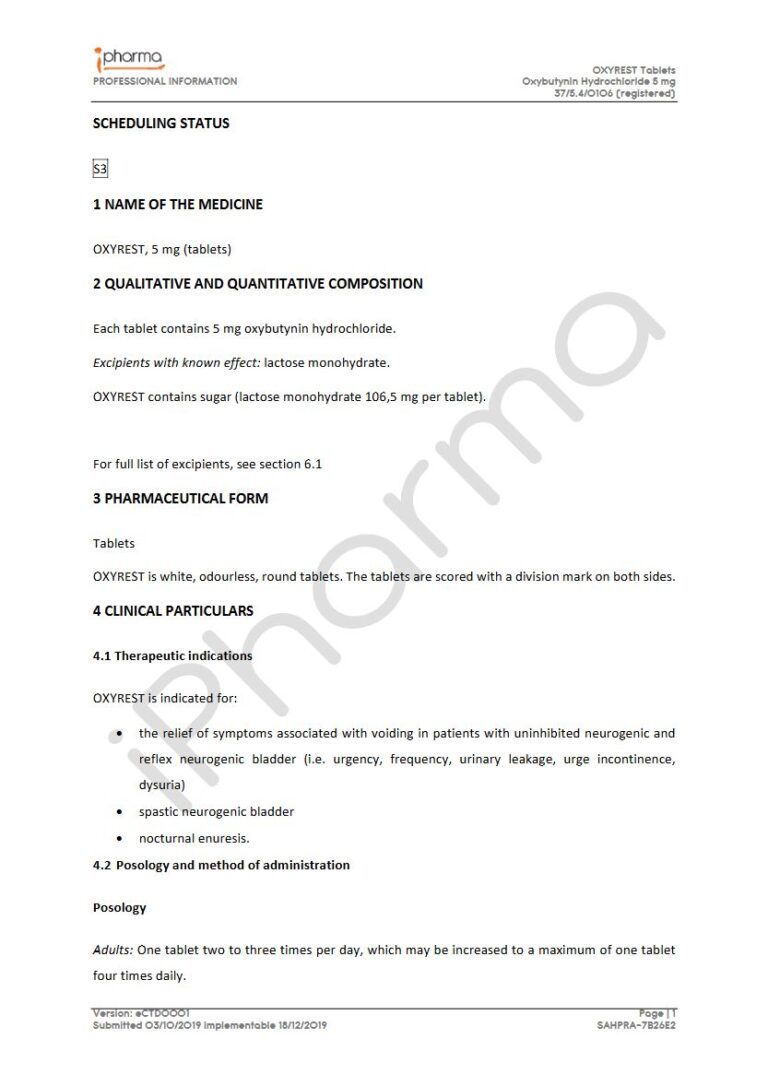
Clinical Particulars
Section 4 of the official insert — extracted exactly as issued, no alterations
4.1 Therapeutic indications
OXYREST is indicated for:
- the relief of symptoms associated with voiding in patients with uninhibited neurogenic and reflex neurogenic bladder (i.e. urgency, frequency, urinary leakage, urge incontinence, dysuria)
- spastic neurogenic bladder
- nocturnal enuresis.
4.2 Posology and method of administration
Posology
Adults:
One tablet two to three times per day, which may be increased to a maximum of one tablet four times daily.
Elderly patients:
Initially, half a tablet twice daily, increased to one tablet twice daily.
Children over 5 years:
Initially, half a tablet twice daily, increased to one tablet twice to three times daily according to response.
4.3 Contraindications
- Hypersensitivity to oxybutynin or any of the other ingredients of OXYREST.
- Patients with closed-angle glaucoma or shallow anterior chamber; partial or complete obstruction of the gastrointestinal tract, paralytic ileus or pyloric stenosis, intestinal atony of the elderly or debilitated person, megacolon, toxic megacolon complicating ulcerative colitis, severe colitis and myasthenia gravis; patients with obstructive uropathy; patients with unstable cardiovascular status in acute haemorrhage; patients with hypotonic neurogenic bladder; patients with prostatic enlargement.
- Pregnancy and lactation as safety has not been established (see section 4.6).
4.4 Special warnings and precautions for use
If OXYREST is administered in the presence of high environmental temperature, it can cause heat prostration due to reduced sweating, especially in children. Use with caution in patients with fever.
The anticholinergic properties of OXYREST may be enhanced with concomitant use with other anticholinergics such as amantadine, some antihistamines, phenothiazines, tricyclic antidepressants, atropine and butyrophenones (see section 4.5).
OXYREST should be used with caution in the frail elderly and children who may be more sensitive to the effects of OXYREST and in patients with autonomic neuropathy, severe gastrointestinal motility disorders, hepatic or renal disease.
Due to the risk of cognitive impairment, OXYREST should be used with caution in elderly patients.
Administration of large doses to patients with ulcerative colitis may suppress intestinal motility to the point of producing a paralytic ileus and precipitate or aggravate u201ctoxic megacolonu201d, a serious complication of the disease. Diarrhoea may be an early symptom of incomplete intestinal obstruction, especially in patients with ileostomy or colostomy.
OXYREST should be used with caution in conditions characterised by tachycardia such as thyrotoxicosis, congestive heart failure, cardiac arrhythmia, coronary heart disease, hypertension, and in cardiac surgery. Tachycardia, cognitive disorders and symptoms of prostatic hypertrophy may be aggravated by OXYREST. Use with caution in elderly men.
There have been reports of anticholinergic CNS effects such as hallucinations, agitation, confusion and somnolence. It is recommended to monitor patients during the first few months after initiating therapy with OXYREST and when the dosage is increased. The dose of OXYREST should be reduced or therapy discontinued if anticholinergic effects occur. Children may be more sensitive to CNS and psychiatric adverse reactions.
Patients should be advised to seek medical attention immediately if they experience sudden loss of visual acuity or ocular pain as OXYREST can cause closed-angle glaucoma.
Dental caries, parodontosis or oral candidiasis may result due to reduced salivary secretions caused by OXYREST.
Administer with caution to patients with hiatus hernia associated with reflux oesophagitis or patients who are concurrently taking medicinal products (such as bisphosphonates) that can cause or exacerbate oesophagitis.
OXYREST contains sugar (lactose monohydrate). Patients with rare hereditary problems of galactose intolerance, total lactase deficiency or glucose-galactose malabsorption should not take OXYREST.
4.5 Interaction with other medicines and other forms of interaction
The anticholinergic effects of OXYREST may be increased by concurrent use of other anticholinergics or medicines with anticholinergic activity such as:
- amantadine and other anticholinergic anti-parkinsonian medicines (e.g. biperiden, levodopa)
- antihistamines
- antipsychotics (e.g. phenothiazines, butyrophenones, clozapine)
- quinidine
- digoxin
- tricyclic antidepressants
- atropine and related compounds like atropinic antispasmodics and dipyridamole
OXYREST reduces gastric motility which may affect the absorption of other medicines.
Oxybutynin, as contained in OXYREST, is metabolised by cytochrome P450 isoenzyme CYP3A4. The concomitant use of a CYP3A4 inhibitor can inhibit oxybutynin metabolism and increase oxybutynin exposure.
OXYREST may antagonise pro-kinetic therapies such as cisapride, domperidone and metoclopramide.
The efficacy of cholinesterase inhibitors may be reduced by the concomitant use of OXYREST.
OXYREST may cause drowsiness which may be aggravated by alcohol intake. Patients should be advised not to use alcohol while on OXYREST therapy.
4.6 Fertility, pregnancy and lactation
Pregnancy
Safety of OXYREST has not been established in pregnancy (see section 4.3).
Breastfeeding
A small amount of oxybutynin, as contained in OXYREST, is excreted into breast milk. OXYREST should not be used during lactation (see section 4.3).
4.7 Effects on ability to drive and use machines
OXYREST may cause drowsiness and blurred vision. Patients must be cautioned regarding activities that may require mental alertness, such as operating a motor vehicle or other machinery or performing hazardous work while taking OXYREST.
4.8 Undesirable effects
Infections and infestations:
Frequency unknown: urinary tract infection.
Immune system disorders:
Frequency unknown: hypersensitivity, severe allergic reactions or medicine idiosyncrasies including urticaria and dermal manifestations.
Endocrine disorders:
Frequency unknown: suppression of lactation.
Psychiatric disorders:
Frequent: confusional state. Frequency unknown: agitation, anxiety, hallucinations, nightmares, paranoia, cognitive disorders in elderly, symptoms of depression, dependence to oxybutynin (in patients with history of medicine or substance abuse), insomnia.
Nervous system disorders:
Frequent: dizziness, headache, somnolence. Frequency unknown: cognitive disorders, convulsions, drowsiness, disorientation, weakness.
Eye disorders:
Frequent: vision blurred, dry eyes. Frequency unknown: closed-angle glaucoma, mydriasis, ocular hypertension, photophobia, cycloplegia.
Cardiac disorders:
Frequency unknown: tachycardia, palpitations, arrhythmia.
Vascular disorders:
Frequent: flushing which may be more marked in children.
Respiratory, thoracic and mediastinal disorders:
Frequency unknown: decreased bronchial secretions (associated with the formation of mucous plugs).
Gastrointestinal disorders:
Frequent: constipation, nausea, dry mouth, diarrhoea, vomiting. Less frequent: abdominal discomfort, anorexia, decreased appetite, dysphagia. Frequency unknown: gastroesophageal reflux disease, pseudo-obstruction in patients at risk (elderly or patients with constipation and treated with other medicines that decrease intestinal motility), difficulty in swallowing and talking, thirst, retrosternal pain due to increased gastric reflux.
Skin and subcutaneous tissue disorders:
Frequent: dry skin. Frequency unknown: angioedema, rash, urticaria, hypohidrosis, photosensitivity.
Renal and urinary disorders:
Frequent: urinary retention. Frequency unknown: difficulty in micturition.
Reproductive system and breast disorders:
Frequency unknown: impotence.
General disorder and administration site conditions:
Frequency unknown: heat stroke.
Reporting of suspected adverse reactions
Reporting suspected adverse reactions after authorisation of the medicine is important. It allows continued monitoring of the benefit/risk balance of the medicine. Healthcare providers are asked to report any suspected adverse reactions to SAHPRA via the u201c6.04 Adverse Drug Reactions Reporting Formu201d, found online under SAHPRAu2019s publications: https://www.sahpra.org.za/Publications/Index/8.
4.9 Overdose
Symptoms of overdosage: The peripheral effects may become more pronounced with overdosage. Other symptoms such as hyperthermia, hypertension, increased respiratory rate, and nausea and vomiting may occur. A rash may appear on the face and upper trunk. Toxic doses may also cause central nervous system stimulation marked by restlessness, confusion, excitement, ataxia, incoordination, paranoid and psychotic reactions, hallucinations and delirium and occasionally seizures. With severe intoxication, central stimulation may give way to CNS depression, coma, circulatory and respiratory failure.
Treatment of overdosage: Treatment is symptomatic and supportive. Diazepam may be given intravenously to control marked excitement and convulsions; phenothiazines should not be given as they may exacerbate the anti-muscarinic effects of OXYREST. Anti-dysrhythmics are not recommended if dysrhythmia develops; propranolol may be given intravenously for tachycardia. Hypoxia and acidosis should be corrected and sodium bicarbonate may be given even if acidosis is not present. Treat fever symptomatically with tepid sponging or ice packs.
Urinary retention can be managed by bladder catheterisation. Mechanical ventilation may be required in the event of paralysis of the respiratory muscles.
