
Granupas 5,52 g Powder for oral solution.
PDF Leaflet Revision Date: 28 May 2021
Clinical Summary
Quick overview from the medicine insert
Indication
Treatment of Multidrug Resistant TB (MDR-TB).
Dosage (summary)
Adults: 8-12 g daily in 2-3 doses; <50 kg: 4-8 g daily.
Special Populations
- Renal impairment
- Hepatic impairment
Pregnancy & Breastfeeding
Contraindicated in pregnancy and breastfeeding.
Key Drug Interactions
- Isoniazid
- Uricosuric medicines
- Ethionamide
- Anticoagulants
- Rifampicin
Contraindications
- Hypersensitivity
- Moderate/severe renal impairment
- Severe hepatic impairment
- Severe heart failure
- Gastroduodenal ulcer
- Hypothyroidism
- Phenylketonuria
Common side effects
- Nausea
- Vomiting
- Diarrhoea
- Abdominal pain
- Anorexia
Counselling Points
- Take after meals to reduce gastric irritation.
- Monitor for signs of liver toxicity.
- Avoid in pregnancy and breastfeeding.
Serious warnings
- Risk of hepatotoxicity
- Caution in renal impairment
- Caution in heart failure
Important Disclaimer
The Granupas 5,52 g Powder for oral solution. professional information leaflet below is the property of Ipharma and is provided on Medinsert exactly as issued, with no.. alterations or editorial changes. We make every effort to keep content current by updating documents as soon as new versions become available. Medinsert serves as a trusted access point for healthcare professionals, but does not replace official sources or clinical judgement. For more details, please read our full disclaimer. read more>>
 Healthcare Professionals Only
This content is for registered healthcare professionals
Sign in or create a free account to read the full package insert.
Free for HPCSA-registered professionals. Powered by Medinsert.
Clinical Particulars
Section 4 of the official insert — extracted exactly as issued, no alterations
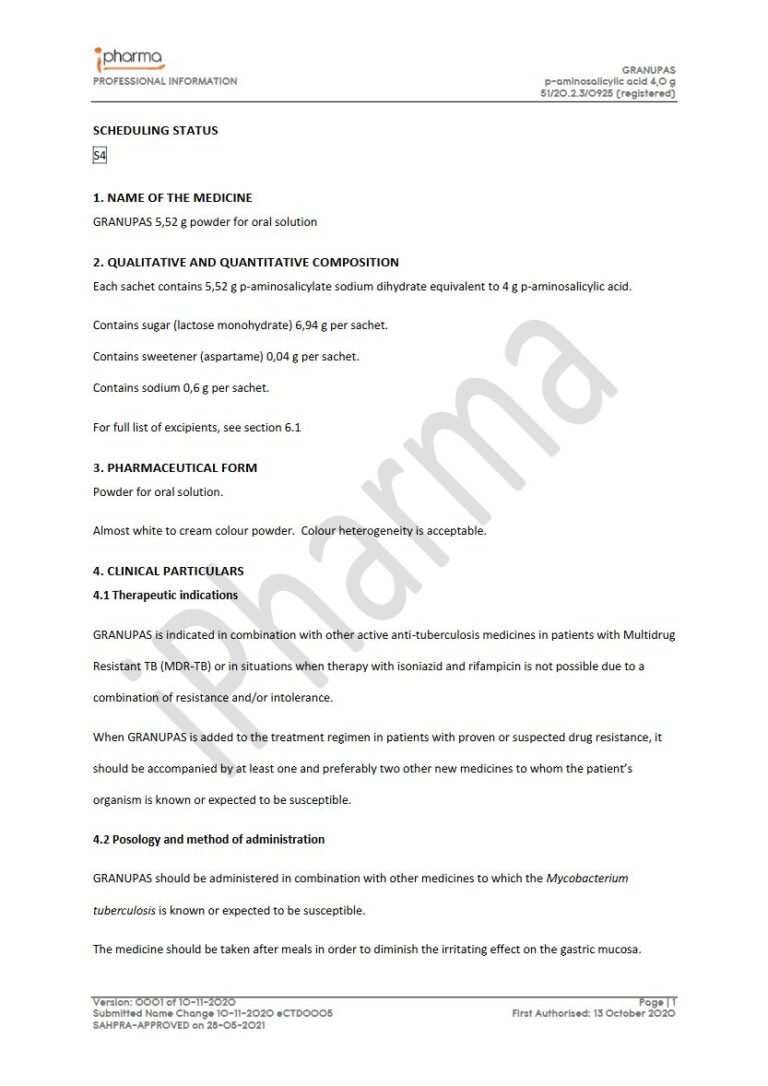
4.1 Therapeutic indications
GRANUPAS is indicated in combination with other active anti-tuberculosis medicines in patients with Multidrug Resistant TB (MDR-TB) or in situations when therapy with isoniazid and rifampicin is not possible due to a combination of resistance and/or intolerance. When GRANUPAS is added to the treatment regimen in patients with proven or suspected drug resistance, it should be accompanied by at least one and preferably two other new medicines to whom the patientu2019s organism is known or expected to be susceptible.
4.2 Posology and method of administration
GRANUPAS should be administered in combination with other medicines to which the Mycobacterium tuberculosis is known or expected to be susceptible. The medicine should be taken after meals in order to diminish the irritating effect on the gastric mucosa.
The content of one sachet should be dissolved by mixing it with 100 mL of cooled, boiled water. The prepared solution should be used immediately.
Adults: A daily dose of 8 to 12 g, divided into 2 to 3 single doses. For patients with a body weight of less than 50 kg and patients with difficulty tolerating the medicine, the dose should be decreased to 4 - 8 g a day.
Children: Children are administered a dose of 200 u2013 300 mg/kg/day, divided into 2 to 4 single doses. The maximum dose is 12 g a day. There are no literature data indicating any risk associated with the use of GRANUPAS and Reyeu2019s syndrome in children under the age of 16 years.
Patients with hepatic insufficiency: There is no data regarding the need for dose reduction, however liver function should be monitored (see section 4.3).
Patients with mild renal insufficiency (creatinine clearance <80 mL/min): The dose of 8 g a day is divided in 2 single doses.
4.3 Contraindications
- Hypersensitivity to p-aminosalicylate sodium, other salicylates, or any of the excipients of GRANUPAS
- Moderate (CrCl 30 - 59 mL/min) and severe renal impairment (CrCl <30 mL/min) (see section 4.2)
- Severe hepatic impairment (Child - Pugh C) (see section 4.4)
- Severe heart failure (The American Heart Associationu2019s classification Stage D) (see section 4.4)
- Gastroduodenal ulcer and/or gastrointestinal bleeding or perforations (see section 4.4)
- Hypothyroidism (Myxoedema)
- Amyloidosis
- Phenylketonuria (see section 4.4)
- Pregnancy and lactation (see section 4.6)
4.4 Special warnings and precautions for use
Renal impairment: GRANUPAS should be given with caution to patients with mild (60 to <90 mL/min) renal impairment. Patients with moderate (CrCl 30 - 59 mL/min) and severe (CrCl <30 mL/min) renal impairment will retain sodium due to the high sodium content of GRANUPAS (see section 2). Patients with severe renal disease (15 to <30 mL/min) will accumulate p-aminosalicylate sodium and its acetyl metabolite, but will continue to acetylate, thus leading exclusively to the inactive acetylated form; deacetylation, if any, is not significant. GRANUPAS is contraindicated in patients with moderate renal impairment (CrCl 30 - 59 mL/min) and severe renal disease (CrCl <30 mL/min) (see section 4.3). It is not known if GRANUPAS is removed by dialysis.
Hepatic impairment: GRANUPAS should be given with care to patients with Child - Pugh A and B hepatic impairment. GRANUPAS is contraindicated in patients with severe hepatic impairment (Child - Pugh C) (see section 4.3). Patient with hepatic disease may not tolerate GRANUPAS as well as normal patients. GRANUPAS may cause hepatitis. The first symptoms usually appear within three months of the start of therapy. A rash is the most frequent symptom followed by fever and much less frequently by gastrointestinal disturbances such as anorexia, nausea or diarrhoea. Premonitory symptoms may precede jaundice by a few days to several weeks, with half of the adverse reactions occurring during the third, fourth or fifth weeks. Treatment should be discontinued immediately at the first sign of a rash, fever or other premonitory signs of intolerance. If recognised in the premonitory stage, the reaction is reported to u201csettleu201d in 24 hours and no jaundice ensues. Failure to recognise the reaction can result in a mortality of up to 21%. The patient must be monitored carefully during the first three months of therapy. No studies of GRANUPAS re-challenge have been reported. In the case of confirmed moderate or severe medicine-induced hepatotoxicity, treatment should be stopped and not restarted.
Heart failure: High sodium concentrations may exacerbate congestive heart failure because of fluid accumulation and overload. Caution is advised when GRANUPAS is administered to patients with heart failure (American Heart Associationu2019s classification Stage A to C). In patients with severe heart failure (American Heart Associationu2019s classification Stage D) use of GRANUPAS is contraindicated (see section 4.3).
G6PD deficiency: Caution is advised when GRANUPAS is administered to patients with Glucose-6-phosphate dehydrogenase (G6PD) deficiency. GRANUPAS may cause haemolytic anaemia in these patients.
Gastric ulcer: GRANUPAS may cause gastric irritation and should be administered with care to patients with gastric ulcer.
Hypersensitivity reactions: Patients sensitive to other salicylates, including methyl salicylate, or other compounds containing p-amino phenyl group (sulphonamides and dyes) may also be sensitive to GRANUPAS.
Hypothyroidism: Prolonged therapy at high doses may induce goitre and hypothyroidism. This should be taken into account in tuberculosis patients with decreased thyroid gland function. Thyroid functions should be regularly monitored.
Vitamin B12: GRANUPAS may cause reduction of vitamin B12 absorption. In these cases, it is recommended to administer vitamin B12 in parenteral form (see section 4.5).
Information about the ingredients: Sodium: Patients who have been advised to restrict their daily dietary sodium intake are not recommended to use GRANUPAS. Aspartame: Each sachet of GRANUPAS contains 0,04 g of the sweetener aspartame. Aspartame is hydrolysed in the gastrointestinal tract when orally ingested. One of the major hydrolysis products is phenylalanine and can be harmful for patients with phenylketonuria. Patients with phenylketonuria must not use GRANUPAS (see section 4.3). Neither non-clinical nor clinical data are available to assess aspartame use in infants below 12 weeks of age.
Lactose: GRANUPAS contains lactose. Patients with the rare hereditary conditions of galactose intolerance e.g. galactosaemia, Lapp lactase deficiency, total lactase deficiency or glucose-galactose malabsorption should not take GRANUPAS. Lactose may have an effect on the glycaemic control of patients with diabetes mellitus.
4.5 Interaction with other medicines and other forms of interaction
Isoniazid: GRANUPAS may produce a reduction in the acetylation of isoniazid, especially in patients who are rapid acetylators. The effect is dose related.
Uricosuric medicines (probenecid and sulfinpyrazone): Uricosuric medicines may increase toxicity by delaying renal excretion of GRANUPAS, thereby enhancing the plasma concentration of the medicine.
Ethionamide: Co-administration of GRANUPAS and ethionamide may intensify adverse reactions of GRANUPAS, mainly the gastrointestinal and hepatic side effects, including jaundice, hepatitis, nausea, vomiting, diarrhoea, abdominal pain or anorexia. Ethionamide should be withdrawn if these effects are significant.
Aminobenzoates: Concurrent administration with aminobenzoates is not recommended since it may antagonise the bacteriostatic effect of GRANUPAS.
Anticoagulants: Concurrent anticoagulant administration with GRANUPAS may increase the anticoagulant effects. Dosage adjustments may be necessary.
Rifampicin: GRANUPAS may impair the absorption of rifampicin. Patients should be advised to take GRANUPAS and rifampicin at least 6 hours apart.
Vitamin B12: GRANUPAS may impair the absorption of vitamin B12 from the gastrointestinal tract. Clinically significant erythrocyte abnormalities may develop after depletion; patients on therapy of more than one month should be considered for maintenance B12. A malabsorption syndrome may develop in patients on GRANUPAS but is usually not complete. The complete syndrome includes steatorrhoea, an abnormal small bowel pattern on an x-ray, villus atrophy, decreased cholesterol, and reduced D-xylose and iron absorption. Triglyceride absorption is always normal.
Digoxin: GRANUPAS may decrease the gastrointestinal absorption of digoxin. Serum digoxin levels should be monitored in patients on concomitant therapy.
Laboratory tests: GRANUPAS has been reported to interfere technically with the serum determinations of albumin by dye-binding, AST and ALT by the azoene dye method and with qualitative urine tests for ketones, bilirubin, urobilinogen or porphobilinogen using Ehrlichu2019s reagent. GRANUPAS may interfere with tests for glucosuria using copper reagents.
4.6 Fertility, pregnancy and lactation
Pregnancy: Safety and efficacy have not been established in pregnancy and lactation. GRANUPAS should not be given to a pregnant woman (see section 4.3). GRANUPAS may affect synthesis of RNA, DNA and proteins, and can also influence the function of the foetal thyroid gland. Administration in the first three months of pregnancy can cause malformations of the foetus.
Breastfeeding: GRANUPAS is excreted in breast milk and should not be used by mothers breastfeeding their infants (see section 4.3).
4.7 Effects on ability to drive and use machines
Patients should not drive or use machines until they know how GRANUPAS affects them.
4.8 Undesirable effects
Infections and infestations: Less frequent: Syndrome resembling infectious mononucleosis (fever, headache, skin rash, sore throat, unusual tiredness or weakness)
Blood and the lymphatic system disorders: Less frequent: Leukopenia, haemolytic anaemia (in patients with G6PD deficiency), megaloblastic anaemia due to vitamin B12 deficiency
Immune system disorders: Frequent: Hypersensitivity reactions (fever, skin rash or itching, bronchospasm, eosinophilia) Less frequent: Hypersensitivity reactions (arthralgia, lymphadenopathy, hepatosplenomegaly, jaundice, encephalopathy, leukopenia, agranulocytosis, thrombocytopenia, pericarditis, hypoglycaemia, optic neuritis, eosinophylic pneumonia and reduction in prothrombin)
Endocrine disorders: Less frequent: Goitre and hypothyroidism
Metabolism and nutrition disorders: Less frequent: Vitamin B12 deficiency, iron deficiency, depressed cholesterol
Psychiatric disorders: Less frequent: Psychosis. Psychiatric disorders were observed during treatment of MDR-TB with combination of anti-tuberculosis medicines. Patients on MDR-TB therapy of more than one month should be considered for maintenance Vitamin B12.
Vascular disorders: Less frequent: Vasculitis
Gastrointestinal disorders: Frequent: Nausea, vomiting, diarrhoea, abdominal pain, anorexia
Hepato-biliary disorders: Less frequent: Jaundice, hepatitis, steatorrhoea
Musculoskeletal, connective tissue and bone disorders: Less frequent: Joint pain
Renal and urinary disorders: Less frequent: Crystalluria (may be prevented by the maintenance of urine at a neutral or alkaline pH)
Reporting of suspected adverse reactions: Reporting suspected adverse reactions after authorisation of the medicine is important. It allows continued monitoring of the benefit/risk balance of the medicine. Healthcare providers are asked to report any suspected adverse reactions to SAHPRA via the u201c6.04 Adverse Drug Reactions Reporting Formu201d, found online under SAHPRAu2019s publications: https://www.sahpra.org.za/Publications/Index/8
4.9 Overdose
Symptoms: nausea, vomiting, diarrhoea and psychosis may develop.
Treatment: to delay absorption, activated charcoal is indicated within one hour of taking overdose and vital signs should be monitored. Treatment is symptomatic and supportive. It is unknown if p-aminosalicylate sodium is removed by dialysis.
