
Reopara 10 mg Solution for Infusion
PDF Leaflet Revision Date: 20 January 2026
Clinical Summary
Quick overview from the medicine insert
Indication
Short-term treatment of mild to moderate pain and fever.
Dosage (summary)
1g per administration up to 4 times daily for adults >50 kg; 15 mg/kg for adults <50 kg.
Onset of Action / Duration
Onset: 15 mins, Duration: 4-6 hours
Special Populations
- Renal impairment
- Hepatic impairment
- Elderly
Pregnancy & Breastfeeding
Use in pregnancy only if necessary; caution in breastfeeding due to excretion in milk.
Key Drug Interactions
- Probenecid
- Salicylamide
- Anticoagulants
- Phenytoin
- Flucloxacillin
Contraindications
- Hypersensitivity to paracetamol
- Severe hepatocellular insufficiency
- Decompensated liver disease
Common side effects
- Nausea
- Vomiting
- Hypotension
- Rash
- Anaphylaxis
Counselling Points
- Do not exceed recommended dose
- Monitor for signs of liver damage
- Inform about potential skin reactions
Serious warnings
- Risk of severe liver damage in overdose
- Serious skin reactions possible
Important Disclaimer
The Reopara 10 mg Solution for Infusion professional information leaflet below is the property of Qhayisa 2014 Trading And Projects Pty Ltd T/A Gdr Pharma Tulbagh Gardens and is provided on Medinsert exactly as issued, with no.. alterations or editorial changes. We make every effort to keep content current by updating documents as soon as new versions become available. Medinsert serves as a trusted access point for healthcare professionals, but does not replace official sources or clinical judgement. For more details, please read our full disclaimer. read more>>
 Healthcare Professionals Only
This content is for registered healthcare professionals
Sign in or create a free account to read the full package insert.
Free for HPCSA-registered professionals. Powered by Medinsert.
Clinical Particulars
Section 4 of the official insert — extracted exactly as issued, no alterations
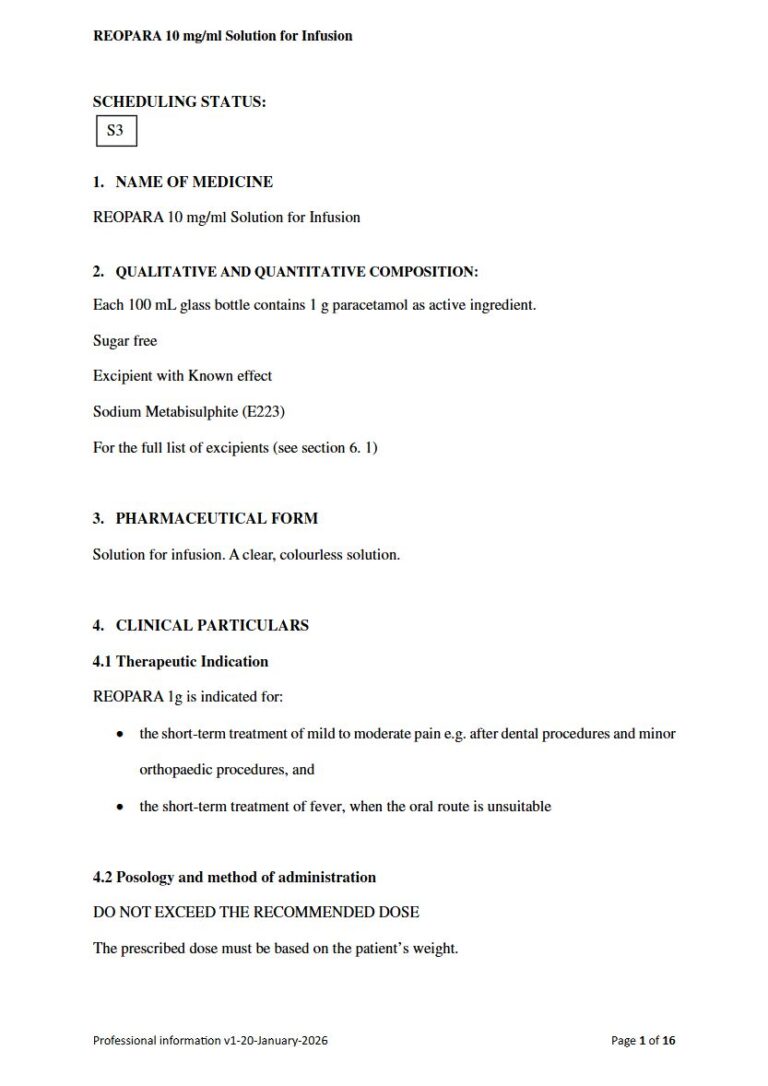
4.1 Therapeutic Indication
REOPARA 1g is indicated for:
- the short-term treatment of mild to moderate pain e.g. after dental procedures and minor orthopaedic procedures, and
- the short-term treatment of fever, when the oral route is unsuitable
4.2 Posology and method of administration
DO NOT EXCEED THE RECOMMENDED DOSE
The prescribed dose must be based on the patientu2019s weight.
Unintentional overdose can lead to serious liver damage and death (see section 4.9). Healthcare providers are reminded that it is essential to follow both the weight-related dose recommendations and to consider individual patient risk factors for hepatotoxicity, including hepatocellular insufficiency, chronic alcoholism, chronic malnutrition (low reserves of hepatic glutathione), and dehydration. (See section 4.8)
Recommended dosage in adult patients
The recommended dose in adult patients weighing more than 50 kg is: REOPARA 1g per administration (i.e. one 100 ml bottle) up to 4 times a day. The minimum interval between each administration must be 4 hours. The maximum daily dose must not exceed 4 g in 24 hours.
The recommended dose in adult patients weighing less than 50 kg and more than 33 kg (approximately 11 years old) is: REOPARA 1g: 15 mg/kg per administration (i.e. 1,5 ml solution per kg) up to 4 times per day. The minimum interval between each administration must be 4 hours. For these adult underweight patients, the maximum daily dose must not exceed 60 mg/kg and must not exceed 3 g in 24 hours.
Recommended dosage in paediatric and adolescent patients
The 100 ml bottle is restricted to adults, adolescents, and children weighing more than 33 kg.
DOSING IS BASED ON PATIENT WEIGHT
Dosing recommendations are presented in the table below.
Patient weight (non-oedematous weight) Paracetamol dose (10 mg/ml) per administration Minimum interval between each administration Maximum daily dose*
> 50 kg 1 g (i.e. 100 ml bottle) up to 4 times a day 4 hours Must not exceed 4 g in 24 hours
* The maximum daily dose takes into account all the medicines containing paracetamol. The dosage should be calculated on non-oedematous weight.
Recommended dosage in patients with renal impairment
It is recommended to leave a minimum interval of 6 hours between each administration in patients with severe renal impairment (creatinine clearance u2264 30ml/min) (see Section 5.2).
Recommended dosage in patients with hepatic impairment
In patients with impaired hepatic function, the dose must be reduced or the dosing interval prolonged. The maximum daily dose should not exceed 60 mg/kg/day (not exceeding 2 g/day) in the following situations:
- adults weighing less than 50 kg
- chronic or compensated active hepatic disease, especially those with mild to moderate hepatocellular insufficiency
- Gilbertu2019s syndrome (familial hyperbilirubinaemia)
- chronic alcoholism
- chronic malnutrition (low reserves of hepatic glutathione)
- dehydration
Method of administration: General
For all patients, REOPARA 1g is to be administered as a 15-minute intravenous infusion.
4.3 Contraindications
REOPARA 1g is contraindicated in:
- Cases of hypersensitivity to paracetamol or to paracetamol hydrochloride (pro-drug of paracetamol) or to any of the excipients.
- Cases of severe hepatocellular insufficiency or decompensated active liver disease including alcoholic hepatitis.
4.4 Special warnings and precautions for use
REOPARA 1g Solution for Infusion contains paracetamol which may be fatal in overdose. In the event of over dosage or suspected overdose and notwithstanding the fact that the person may be asymptomatic, the nearest doctor, hospital or Poison Centre must be contacted immediately. It is recommended to use a suitable oral analgesic treatment as soon as this administration route is possible.
In order to avoid the risk of overdose, check that other medicines administered (including prescription and non-prescription medicines) do not contain paracetamol. Doses of REOPARA 1g in excess of those recommended may cause very severe liver damage. Clinical symptoms and signs of liver damage are usually seen first after two days of paracetamol overdose. Maximum liver damage symptoms are usually observed after 4 to 6 days. Treatment with antidote should be given as soon as possible (see Section 4.9).
REOPARA 1g can cause serious skin reactions such as acute generalised exanthematous pustulosis (AGEP), Stevens-Johnson syndrome (SJS), and toxic epidermal necrolysis (TEN), which can be fatal. Patients should be informed about the signs of serious skin reactions and use of the medicine should be discontinued at the first appearance of skin rash or any other sign of hypersensitivity.
REOPARA 1g should be used with caution in cases of:
- Hepatocellular insufficiency, including Gilbertu2019s syndrome (familial hyperbilirubinaemia), (see section 4.2 and 5.2).
- Severe renal insufficiency (creatinine clearance u2264 30ml/min) (see section 4.2 and section 5.2).
- Glucose 6 Phosphate Dehydrogenase (G6PD) deficiency (may lead to haemolytic anaemia).
- Chronic alcoholism, excessive alcohol intake (3 or more alcoholic drinks every day).
- Anorexia, bulimia or cachexia, chronic malnutrition (low reserves of hepatic glutathione).
- Dehydration, hypovolaemia.
Patients suffering from hepatitis or alcoholism, or recovering from any form of liver disease should not use excessive quantities of REOPARA 1g. Use with caution in renal disease.
Excipients with Known Effects:
- This product contains Sodium Metabisulphite (E223), which may rarely cause severe hypersensitivity reactions, including bronchospasm.
4.5 Interaction with other medicines and other forms of interaction
Effect of other medicines on REOPARA 1g:
- Probenecid causes an almost 2-fold reduction in clearance of paracetamol by inhibiting its conjugation with glucuronic acid. A reduction of the REOPARA 1g dose should be considered when administered concomitantly with probenecid.
- Salicylamide may prolong the elimination half-life of paracetamol as contained in REOPARA 1g.
- Caution should be paid to the concomitant use of REOPARA 1g and enzyme-inducing substances as these substances increase the risk of paracetamol induced liver injury. These substances include but are not limited to: barbiturates, isoniazid, anticoagulants, zidovudine, amoxicillin + clavulanic acid, and ethanol (see section 4.9).
- Phenytoin administered concomitantly with REOPARA 1g may result in decreased paracetamol effectiveness and an increased risk of hepatotoxicity. Patients receiving phenytoin therapy should avoid large and/or chronic doses of paracetamol. Patients should be monitored for evidence of hepatotoxicity.
- Flucloxacillin: Caution is advised when paracetamol is administered concomitantly with flucloxacillin due to the increased risk of high anion gap metabolic acidosis (HAGMA), particularly in patients with a risk factor for glutathione deficiency such as severe renal impairment, sepsis, malnutrition and chronic alcoholism. Close monitoring is recommended in order to detect the appearance of acid base disorders, namely HAGMA, including the search of urinary 5-oxoproline.
Effect of REOPARA 1g on other medicines:
- REOPARA 1g may increase the chance of unwanted effects when administered with other medicines.
- Anticoagulants: Concomitant use of REOPARA 1g (4 g per day for at least 4 days) with coumarins including warfarin may lead to variations in INR values. In this case, increased monitoring of INR values should be conducted during the period of concomitant use as well as for 1 week after REOPARA 1g treatment has been discontinued.
4.6 Fertility, pregnancy and lactation
Pregnancy: Clinical experience of intravenous administration of Paracetamol as in REOPARA 1g is limited. However, epidemiological data from the use of oral therapeutic doses of paracetamol indicate no undesirable effects on the pregnancy or on the health of the foetus/newborn infant. Prospective data on pregnancies exposed to overdose did not show an increase in malformation risk.
Reproductive studies with the intravenous form of paracetamol have not been performed in animals. However, studies with the oral route did not show any teratogenic or foetotoxic effects. Nevertheless, REOPARA 1g should only be used during pregnancy after a careful benefit-risk assessment. In this case, the recommended dosage and duration must be strictly observed.
Breastfeeding: After oral administration, paracetamol is excreted into breast milk in small quantities. Rash in nursing infants has been reported. Caution should be used when administering REOPARA 1g to women who are breastfeeding.
4.7 Effects on ability to drive and use machines
REOPARA 1g has no influence on the ability to drive and use machines.
4.8 Undesirable effects
The following adverse reactions have been reported during clinical use and post-marketing surveillance. The exact incidence for some events cannot be reliably estimated; these are reported as Frequency not known.
System Organ Class Frequent Less Frequent Frequency not known
Blood and lymphatic system disorders - Thrombocytopenia, agranulocytosis, leucopenia, pancytopenia, neutropenia, anaemia - Cardiac disorders - Hypotension Tachycardia
Gastrointestinal disorders - - Nausea, vomiting Hepatobiliary disorders - Increased levels of hepatic, Hepatitis, pancreatitis Fulminant hepatitis, hepatic necrosis, hepatic failure, increased hepatic enzymes
Immune system disorders - - Anaphylaxis, anaphylactic shock, Hypersensitivity angio-oedema (including potential reactions to Sodium Metabisulphite E223)
Skin and subcutaneous tissue disorders - - Erythema, rash, urticaria, pruritus, flushing, Acute generalised exanthematous Pustulosis, Toxic Epidermal necrolysis,
General disorders and administration site conditions - Malaise, Hypersensitivity Administration site reaction
Renal and urinary disorders - Renal colic, renal failure, sterile pyuria -
Reporting of suspected adverse reactions
Reporting suspected adverse reactions after authorisation of the medicine is important. It allows continued monitoring of the benefit/risk balance of the medicine. Health care providers are requested to report any suspected adverse drug reactions to SAHPRA via the Med Safety APP (Medsafety X SAHPRA) and eReporting platform (who-umc.org) found on SAHPRA website.
4.9 Overdose
(See Section 4.4 and Section 4.8) Prompt treatment is essential. In the event of an overdosage consult a doctor immediately or take the person to a hospital directly. A delay in starting treatment may mean that antidote is given too late to be effective. Evidence of liver damage is often delayed until after the time for effective treatment has lapsed.
Susceptibility to REOPARA 1g toxicity is increased in patients who have taken repeated high doses (greater than 5 - 10 g/day) of paracetamol for several days. There is a risk of poisoning, particularly in elderly subjects, in young children, in patients with liver disease, in cases of chronic alcoholism, in patients with chronic malnutrition, AIDS and with the use of drugs that induce liver microsomal oxidation such as barbiturates, isoniazid, rifampicin, phenytoin and carbamazepine. Overdosing may be fatal in these cases.
Symptoms generally appear within the first 24 hours and comprise: nausea, vomiting, anorexia, pallor and abdominal pain. Mild symptoms during the first two days of acute poisoning do not reflect the potential seriousness of the overdosage. Liver damage may become apparent 12 to 48 hours or later after administration, initially by elevation of the serum transaminase and lactic dehydrogenase activity, increased serum bilirubin concentration and prolongation of the prothrombin time /INR. Liver damage may lead to encephalopathy, coma and death.
Overdose with a single administration of 7.5 g or more of paracetamol in adults or 140 mg/kg of body weight in children, causes cytolytic hepatitis likely to induce complete and irreversible hepatic necrosis, resulting in acute or fulminant hepatic failure, hepatocellular insufficiency, metabolic acidosis and encephalopathy, which may lead to coma and death.
Simultaneously, increased levels of hepatic transaminases (AST, ALT), lactate dehydrogenase and bilirubin are observed together with decreased prothrombin levels that may appear 12 to 48 hours after administration. Clinical symptoms of liver damage are usually evident initially after two days and reach a maximum after 4 to 6 days.
Acute renal failure with acute tubular necrosis may develop even in the absence of severe liver damage. Abnormalities of glucose metabolism and metabolic acidosis may occur. Cardiac dysrhythmias have been reported.
Treatment of REOPARA 1g over dosage:
- Immediate hospitalisation.
- Before beginning treatment, take a tube of blood for plasma paracetamol assay, as soon as possible after the overdose.
- N-acetylcysteine (NAC) should be administered to all cases of suspected overdose as soon as possible preferably within eight hours of overdosage; although treatment up to 36 hours after ingestion may still be of benefit especially if more than 150 mg/kg of paracetamol was taken. An initial dose of 150 mg/kg N-acetylcysteine in 200 ml dextrose injection given intravenously over 15 minutes, followed by an infusion of 50 mg/kg in 500 ml dextrose injection over the next four hours and then 100 mg/kg in 1000 ml dextrose injection over the next sixteen hours. The volume of intravenous fluid should be modified for children. Although the oral formulation is not the treatment of choice, 140 mg/kg dissolved in water may be administered initially, followed by 70 mg/kg every four hours for seventeen doses.
- Source: Goodman & Gilmanu2019s The Pharmacological Basis of Therapeutics, 11th Ed.
- Those whose plasma paracetamol levels are above the u201cnormal treatment lineu201d, should continue N-acetylcysteine treatment with 100 mg/kg IV over sixteen hours repeatedly until recovery. Patients with increased susceptibility to liver damage as identified above, should continue treatment if concentrations are above the u201chigh risk treatment lineu201d. (Refer to paracetamol nomogram above). Prothrombin index correlates best with survival. Monitor all patients with significant ingestion for at least 96 hours.
- Symptomatic treatment.
- Hepatic tests must be carried out at the beginning of treatment and repeated every 24 hours. In most cases hepatic transaminases return to normal in one to two weeks with full restitution of the liver function. In very severe cases, however, liver transplantation may be necessary.
