
Pazopanib 200 Mg/400 mg Tablets
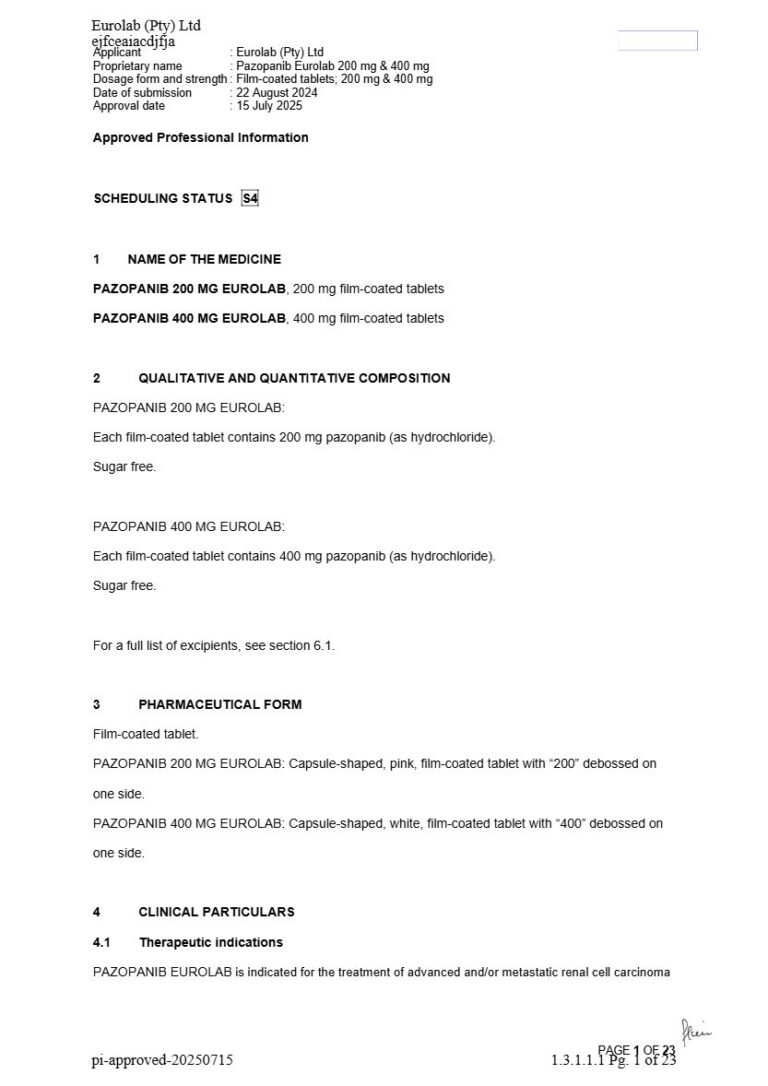
PDF Leaflet Revision Date: 15 July 2025
Clinical Summary
Quick overview from the medicine insert
Indication
Treatment of advanced and/or metastatic renal cell carcinoma.
Dosage (summary)
800 mg orally once daily; adjust in 200 mg increments based on tolerability.
Special Populations
- Elderly
- Renal impairment
- Hepatic impairment
Pregnancy & Breastfeeding
Not recommended during pregnancy; breastfeeding not established as safe.
Key Drug Interactions
- Strong CYP3A4 inhibitors
- Grapefruit juice
Contraindications
- Hypersensitivity to pazopanib
Common side effects
- Fatigue
- Hypertension
- Diarrhea
- Nausea
- Hypothyroidism
Counselling Points
- Take without food
- Monitor blood pressure
- Avoid pregnancy
- Report liver function changes
Serious warnings
- Hepatic failure
- Hypertension
- Cardiac dysfunction
- PRES/RPLS
- GI perforations
Important Disclaimer
The Pazopanib 200 Mg/400 mg Tablets professional information leaflet below is the property of Eurolab and is provided on Medinsert exactly as issued, with no.. alterations or editorial changes. We make every effort to keep content current by updating documents as soon as new versions become available. Medinsert serves as a trusted access point for healthcare professionals, but does not replace official sources or clinical judgement. For more details, please read our full disclaimer. read more>>
 Healthcare Professionals Only
This content is for registered healthcare professionals
Sign in or create a free account to read the full package insert.
Free for HPCSA-registered professionals. Powered by Medinsert.
Clinical Particulars
Section 4 of the official insert — extracted exactly as issued, no alterations
4.1 Therapeutic indications
PAZOPANIB EUROLAB is indicated for the treatment of advanced and/or metastatic renal cell carcinoma (RCC).
4.2 Posology and method of administration
Posology
The recommended dose of PAZOPANIB EUROLAB is 800 mg orally once daily.
Dose Modifications
Dose modification should be in 200 mg increments in a stepwise fashion based on individual tolerability in order to manage adverse reactions. The dose of PAZOPANIB EUROLAB should not exceed 800 mg.
CYP3A4 inhibitor
The concomitant use of strong CYP3A4 inhibitors may increase pazopanib concentrations and should be avoided (e.g., ketoconazole, itraconazole, clarithromycin, atazanavir, indinavir, nefazodone, nelfinavir, ritonavir, saquinavir, telithromycin, voriconazole). If co-administration of a strong CYP3A4 inhibitor is warranted, a dose reduction to 400 mg of PAZOPANIB EUROLAB is recommended based on pharmacokinetic studies. This dose is predicted to adjust the pazopanib AUC to the range observed without inhibitors (see section 4.5). However, there are no clinical data with this dose adjustment in patients receiving strong CYP3A4 inhibitors.
Special populations
Elderly
No alteration of dosage, dosing frequency or route of administration is required in patients over 65 years.
Renal Impairment
There is no experience of pazopanib in patients with severe renal impairment or in patients undergoing peritoneal dialysis or haemodialysis. Renal impairment is unlikely to have a clinically relevant effect on pazopanib pharmacokinetics given the low renal excretion of pazopanib and metabolites (see section 5.2).
Hepatic Impairment
The safety and pharmacokinetics of pazopanib in patients with hepatic impairment have not been fully established (see section 4.4).
Paediatric Population
The safety and efficacy of pazopanib in children have not been established.
Method of administration
For oral use. PAZOPANIB EUROLAB should be taken without food (at least one hour before or two hours after a meal) (see section 5.2).
4.3 Contraindications
Hypersensitivity to pazopanib and other ingredients listed in section 6.1.
4.4 Special warnings and precautions for use
Class effects of Tyrosine Kinase Inhibitors (TKIs) such as contained in PAZOPANIB EUROLAB: Although TKIs may have different kinase inhibition profiles and/or off target binding profiles, there is some evidence that the TKIs share to a variable degree, class related cerebrovascular adverse events (e.g., cerebrovascular accident, transient ischaemic attack, ischaemic stroke, and cerebral infarction). These cerebrovascular adverse events may occur in patients on treatment with TKIs with or without risk factors for these events and may occur at any time during treatment with TKIs. Patients on treatment with PAZOPANIB EUROLAB should be carefully monitored, and relevant risk factors managed to reduce the risk for these class related cerebrovascular adverse events. Treatment with PAZOPANIB EUROLAB should be discontinued, and alternative treatment options be considered in patients who developed these class related cerebrovascular adverse events.
Hepatic Effects
Cases of hepatic failure (including fatalities) have been documented with the use of pazopanib. Pazopanib has not been studied in patients with pre-existing hepatic impairment and therefore should be used with caution in these patients. In studies with pazopanib, increase in serum transaminases (ALT, AST) and bilirubin have been documented (see section 4.8). In the majority of the cases, isolated increases in ALT and AST have been reported, without concomitant elevations of alkaline phosphatase or bilirubin. Monitor serum liver tests before initiation of treatment with PAZOPANIB EUROLAB and at least once every 4 weeks for the first 4 months of treatment, and as clinically indicated. Periodic monitoring should then continue after this time period.
u2022 Patients with isolated transaminase elevations u2264 8 X ULN may continue on PAZOPANIB EUROLAB with weekly monitoring of liver function until transaminases return to Grade 1 or baseline.
u2022 Patients with transaminases of > 8 X ULN should have PAZOPANIB EUROLAB interrupted until they return to Grade 1 or baseline. If the potential benefit for re-initiating PAZOPANIB EUROLAB treatment is considered to outweigh the risk for hepatotoxicity, then re-introduce PAZOPANIB EUROLAB at a reduced dose and measure serum liver tests weekly for 8 weeks (see section 4.2). If transaminase elevations > 3 X ULN recur, then PAZOPANIB EUROLAB should be discontinued.
u2022 If transaminase elevations > 3 X ULN occur concurrently with bilirubin elevations > 2 X ULN, bilirubin fractionation should be performed. If direct (conjugated) bilirubin is > 35 % of total bilirubin, PAZOPANIB EUROLAB should be discontinued.
Hypertension
Events of hypertension including newly diagnosed symptomatic episodes of elevated blood pressure (hypertensive crisis) have been documented with the use of pazopanib. Blood pressure should be well controlled prior to initiating PAZOPANIB EUROLAB. Patients should be monitored for hypertension early after starting treatment (no longer than one week after starting pazopanib) and frequently thereafter to ensure blood pressure control. Elevated blood pressure levels (systolic blood pressure u2265 150 mm Hg or diastolic blood pressure u2265 100 mm Hg) have been documented early in the course of treatment (approximately 40 % of cases occurred by day 9 and approximately 90 % of cases occurred in the first 18 weeks). Blood pressure should be monitored and managed promptly using a combination of anti-hypertensive therapy and dose modification of PAZOPANIB EUROLAB (interruption and re-initiation at a reduced dose based on clinical judgement). PAZOPANIB EUROLAB should be discontinued if there is evidence of hypertensive crisis or if hypertension is severe and persists despite anti-hypertensive therapy and PAZOPANIB EUROLAB dose reduction (see sections 4.2 and 4.8).
Posterior reversible encephalopathy syndrome (PRES)/ Reversible posterior leukoencephalopathy syndrome (RPLS)
PRES/RPLS have been documented in association with pazopanib. PRES/RPLS can present with headache, hypertension, seizure, lethargy, confusion, blindness and other visual and neurological disturbances, and can be fatal. Permanently discontinue PAZOPANIB EUROLAB in patients developing PRES/RPLS.
Interstitial lung disease (ILD)/ Pneumonitis
ILD, which can be fatal, have been documented in association with pazopanib (see section 4.8). Monitor patients for pulmonary symptoms indicative of ILD/pneumonitis and discontinue pazopanib in patients developing ILD or pneumonitis.
Cardiac dysfunction/ Heart failure
The risks and benefits of PAZOPANIB EUROLAB should be considered before beginning therapy in patients who have pre-existing cardiac dysfunction. The safety and pharmacokinetics of pazopanib in patients with moderate to severe heart failure or those with a below normal left ventricular ejection fraction (LVEF) have not been studied. Events of cardiac dysfunction such as congestive heart failure and decreased LVEF have been documented in association with pazopanib (see section 4.8). Concurrent hypertension may have exacerbated cardiac dysfunction in patients at risk by increasing cardiac after-load. Prior anthracycline therapy may be a risk factor for cardiac dysfunction. Interruption of pazopanib and/ or dose reduction should be combined with treatment of hypertension (if present, refer to hypertension warning section above) in patients with significant reductions in LVEF, as clinically indicated. Patients should be carefully monitored for clinical signs or symptoms of congestive heart failure. Baseline and periodic evaluation of LVEF is recommended in patients at risk of cardiac dysfunction.
QT Prolongation and Torsade de Pointes
In studies with pazopanib, events of QT prolongation or Torsade de Pointes have been documented (see section 4.8). PAZOPANIB EUROLAB should be used with caution in patients with a history of QT interval prolongation, patients taking antiarrhythmics or other medications that may potentially prolong QT interval, or those with relevant pre-existing cardiac disease. When using PAZOPANIB EUROLAB, periodic monitoring of electrocardiograms and maintenance of electrolytes (calcium, magnesium, potassium) within normal range is recommended.
Arterial Thrombotic Events
In studies with pazopanib, myocardial infarctions, angina, ischemic stroke and transient ischemic attack have been documented (see section 4.8). PAZOPANIB EUROLAB should be used with caution in patients who are at increased risk for these events. A treatment decision should be made based upon the assessment of individual patientu2019s benefit/risk.
Venous thromboembolic events
In studies with pazopanib, venous thromboembolic events including venous thrombosis and fatal pulmonary embolus have been documented.
Thrombotic microangiopathy (TMA)
In studies with pazopanib, TMA events have been documented (see section 4.8). Patients developing TMA should permanently discontinue treatment with pazopanib. Reversal of effects of TMA has been observed after treatment was discontinued. Pazopanib is not indicated for use in combination with other medicines.
Haemorrhagic Events
In studies with pazopanib haemorrhagic events have been documented (see section 4.8). PAZOPANIB EUROLAB is not recommended in patients who had a history of haemoptysis, cerebral, or clinically significant gastrointestinal haemorrhage in the past 6 months. PAZOPANIB EUROLAB should be used with caution in patients with significant risk of haemorrhage.
Aneurysms and artery dissections
The use of Vascular Endothelial Growth Factor (VEGF) pathway inhibitors in patients with or without hypertension may promote the formation of aneurysm and/or artery dissections. Before initiating pazopanib, this risk should be carefully considered in patients with risk factors such as hypertension or history of aneurysm.
Gastrointestinal Perforations and Fistula
In studies with pazopanib, events of gastrointestinal (GI) perforation or fistula have been documented (see section 4.8). PAZOPANIB EUROLAB should be used with caution in patients at risk for GI perforation or fistula.
Wound Healing
No formal studies on the effect of pazopanib on wound healing have been conducted. Since VEGF inhibitors may impair wound healing, treatment with PAZOPANIB EUROLAB should be stopped at least 7 days prior to scheduled surgery. The decision to resume PAZOPANIB EUROLAB after surgery should be based on clinical judgement of adequate wound healing.
PAZOPANIB EUROLAB should be discontinued in patients with wound dehiscence.
Hypothyroidism
In studies with pazopanib, events of hypothyroidism have been documented (see section 4.8). Baseline laboratory measurement of thyroid function is recommended and patients with hypothyroidism should be treated as per standard medical practice prior to the start of PAZOPANIB EUROLAB treatment. All patients should be observed closely for signs and symptoms of thyroid dysfunction on pazopanib treatment. Laboratory monitoring of thyroid function should be performed periodically and managed as per standard medical practice.
Proteinuria
In studies with pazopanib, proteinuria has been documented. Baseline and periodic urine analysis during treatment is recommended and patients should be monitored for worsening proteinuria. PAZOPANIB EUROLAB should be discontinued if the patient develops nephrotic syndrome.
Tumour lysis syndrome (TLS)
The occurrence of TLS, including fatal TLS, has been associated with the use of pazopanib (see section 4.8). Patients at increased risk of TLS are those with rapidly growing tumours, a high tumour burden, renal dysfunction, or dehydration. Preventative measures, such as treatment of high uric acid levels and intravenous hydration, should be considered prior to initiation of PAZOPANIB EUROLAB. Patients at risk should be closely monitored and treated as clinically indicated.
Infections
Cases of serious infections (with or without neutropenia), in some cases with fatal outcome, have been documented.
4.6 Fertility, pregnancy and lactation
Women of childbearing potential / Contraception in males and females
Female patients and female sexual partners of male patients receiving PAZOPANIB EUROLAB should be advised to avoid becoming pregnant and to use highly effective contraception until the end of relevant systemic exposure to the genotoxic compound including potential genotoxic metabolites plus an additional 6 months after exposure (i.e. five half-lives after the last dose, plus 6 months which covers the growth and maturation phase of folliculogenesis).
Male patients treated with PAZOPANIB EUROLAB (including those who have had vasectomies) should be advised to use condoms, during sexual intercourse until the end of relevant systemic exposure to the genotoxic compound including potential genotoxic metabolites plus an additional 3 months after exposure (i.e. five half-lives after the last dose, plus 60 to 75 days for sperm production plus 10 to 14 days for the transport to the epididymis).
Pregnancy
PAZOPANIB EUROLAB should not be used during pregnancy. There are no adequate data from the use of PAZOPANIB EUROLAB in pregnant women. Studies in animals have shown reproductive toxicity. The potential risk for humans is unknown.
Breastfeeding
The safe use of PAZOPANIB EUROLAB during breastfeeding has not been established. It is not known whether PAZOPANIB EUROLAB or its metabolites are excreted in human milk. There are no animal data on the excretion of PAZOPANIB EUROLAB in animal milk. A risk to the breastfed child cannot be excluded. Breastfeeding should be discontinued during treatment with PAZOPANIB EUROLAB.
Fertility
Animal studies documented that male and female fertility may be affected by treatment with PAZOPANIB EUROLAB.
4.7 Effects on ability to drive and use machines
PAZOPANIB EUROLAB has no or negligible influence on the ability to drive and use machines. A detrimental effect on such activities cannot be predicted from the pharmacology of pazopanib. The clinical status of the patient and the adverse event profile of PAZOPANIB EUROLAB should be borne in mind when considering the patientu2019s ability to perform tasks that require judgement, motor or cognitive skills. Patients should avoid driving or using machines if they feel dizzy, tired or weak.
4.8 Undesirable effects
Tabulated summary of adverse reactions Adverse reactions are listed below by MedDRA body system organ class. The following convention has been utilised for the classification of frequency: Frequent, less frequent and frequency unknown
SOC category Frequency Side effect
Infections and Infestations Frequent Infections (with or without neutropenia) u2020 Less frequent Gingival infection, Infectious peritonitis
Neoplasms benign, malignant and unspecified (incl cysts and polyps) Less frequent Tumour pain
Blood and lymphatic system disorders Frequent Thrombocytopenia, Neutropenia, Leukopenia Less frequent Polycythaemia, Thrombotic microangiopathy (including thrombotic thrombocytopenic purpura and haemolytic uraemic syndrome) u2020 Endocrine disorders Frequent Hypothyroidism
Metabolism and nutrition disorders Frequent Decreased appetite e , Hypophosphataemia, Dehydration, Weight decreased, Anorexia Less frequent Hypomagnesaemia Frequency unknown Tumour lysis syndrome*
Psychiatric disorders Frequent Insomnia
Nervous system disorders Frequent Dysgeusia c , Headache, Dizziness, Lethargy, Paraesthesia, Peripheral sensory neuropathy Less frequent Hypoaesthesia, Transient ischaemic attack, Somnolence, Cerebrovascular accident, Ischaemic stroke, Posterior reversible encephalopathy/ reversible posterior leukoencephalopathy syndrome u2020 Eye disorders Frequent Vision blurred Less frequent Retinal detachment u2020 , Retinal tear u2020 , Eyelash discolouration
Cardiac disorders Frequent QT prolongation Less frequent Bradycardia, Myocardial infarction, Cardiac dysfunction f , Myocardial ischaemia,
Torsade de Pointes Vascular disorders Frequent Hypertension, Hot flush, Venous thromboembolic event g , Flushing Less frequent Hypertensive crisis, Haemorrhage, Cerebral haemorrhage Frequency unknown Aneurysms and artery dissections
Respiratory, thoracic, and mediastinal disorders Frequent Epistaxis, Dysphonia, Dyspnoea, Haemoptysis Less frequent Rhinorrhoea, Pulmonary haemorrhage, Pneumothorax, Interstitial lung disease/ pneumonitis u2020 Gastrointestinal disorders Frequent Diarrhoea, Nausea, Vomiting, Abdominal pain a , Stomatitis, Dyspepsia, Flatulence, Abdominal distention, Mouth ulceration, Dry mouth Less frequent Pancreatitis, Rectal haemorrhage, Haematochezia, Gastrointestinal haemorrhage, Melaena, Frequent bowel movements, Anal haemorrhage, Large intestine perforation, Mouth haemorrhage, Upper gastrointestinal haemorrhage, Enterocutaneous fistula, Haematemesis, Haemorrhoidal haemorrhage, Ileal perforation, Oesophageal haemorrhage, Retroperitoneal haemorrhage
Hepatobiliary disorders Frequent Hyperbilirubinaemia, Hepatic function abnormal, Hepatotoxicity Less frequent Jaundice, Drug induced liver injury, Hepatic failure
Skin and subcutaneous tissue disorders Frequent Hair colour change, Palmar-plantar erythrodysaesthesia syndrome, Alopecia , Rash, Skin hypopigmentation, Dry skin, Pruritus, Erythema, Skin depigmentation, Hyperhidrosis Less frequent Nail disorders, Skin exfoliation, Photosensitivity reaction, Rash erythematous, Skin disorder, Rash macular, Rash pruritic, Rash vesicular, Pruritus generalised, Rash generalised, Rash papular, Plantar erythema
Musculoskeletal and connective tissue disorders Frequent Arthralgia, Myalgia, Muscle spasms Less frequent Musculoskeletal pain
Renal and urinary disorders Frequent Proteinuria Less frequent Haemorrhage urinary tract
Reproductive system and breast disorders Less frequent Menorrhagia, Vaginal haemorrhage, Metrorrhagia
u2020 Spontaneous case reports documented from pazopanib use and adverse reactions documented from pazopanib studies.
The following terms have been combined: a Abdominal pain, abdominal pain upper and abdominal pain lower b Oedema, oedema peripheral, eye oedema, localised oedema and face oedema c Dysgeusia, ageusia and hypogeusia d White cell count decreased, neutrophil count decreased and leukocyte count decreased e Decreased appetite and anorexia f Cardiac dysfunction, left ventricular dysfunction, cardiac failure and restrictive cardiomyopathy g Venous thromboembolic event, deep vein thrombosis, pulmonary embolism and thrombosis
4.9 Overdose
Overdosage
Pazopanib doses up to 2 000 mg have been evaluated in studies without dose limiting toxicity.
Symptoms and Signs
There is currently limited experience with overdosage in pazopanib.
Treatment
Further management should be as clinically indicated or as recommended by the national poisons centre, where available. Haemodialysis is not expected to enhance the elimination of pazopanib because pazopanib is not significantly renally excreted and is highly bound to plasma proteins.
