
Pazopanib 200 Cipla 200 mg Tablet
PDF Leaflet Revision Date: 29 August 2023
Clinical Summary
Quick overview from the medicine insert
Indication
Treatment of advanced and/or metastatic renal cell carcinoma.
Dosage (summary)
800 mg orally once daily; modify in 200 mg increments based on tolerability.
Special Populations
- Renal impairment
- Hepatic impairment
- Elderly population
Pregnancy & Breastfeeding
Not recommended during pregnancy; potential reproductive toxicity. Breastfeeding not established.
Key Drug Interactions
- Strong CYP3A4 inhibitors
- Simvastatin
- Grapefruit juice
Contraindications
- Hypersensitivity to pazopanib or excipients
Common side effects
- Diarrhoea
- Hypertension
- Nausea
- Fatigue
- Elevated liver enzymes
Counselling Points
- Take on an empty stomach.
- Monitor liver function regularly.
- Use contraception during treatment.
- Report any signs of bleeding or severe hypertension.
Serious warnings
- Cerebrovascular adverse events
- Hepatic failure
- Hypertension
- QT prolongation
- Cardiac dysfunction
Important Disclaimer
The Pazopanib 200 Cipla 200 mg Tablet professional information leaflet below is the property of Cipla Medpro and is provided on Medinsert exactly as issued, with no.. alterations or editorial changes. We make every effort to keep content current by updating documents as soon as new versions become available. Medinsert serves as a trusted access point for healthcare professionals, but does not replace official sources or clinical judgement. For more details, please read our full disclaimer. read more>>
 Healthcare Professionals Only
This content is for registered healthcare professionals
Sign in or create a free account to read the full package insert.
Free for HPCSA-registered professionals. Powered by Medinsert.
Clinical Particulars
Section 4 of the official insert — extracted exactly as issued, no alterations
4.1 Therapeutic Indications
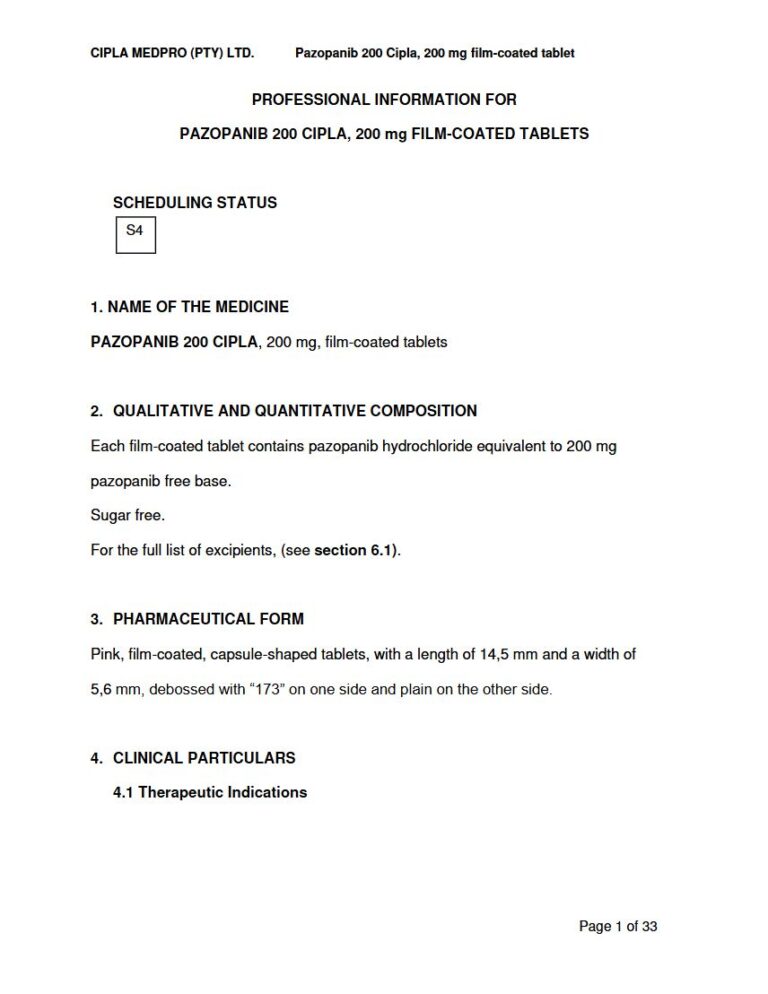
PAZOPANIB 200 CIPLA is indicated for the treatment of advanced and/or metastatic renal cell carcinoma (RCC).
4.2. Posology and method of administration
Posology
The recommended dose of PAZOPANIB 200 CIPLA is 800 mg orally once daily.
Dose modification
Dose modification should be in 200 mg increments in a stepwise fashion based on individual tolerability in order to manage adverse reactions. The dose of PAZOPANIB 200 CIPLA should not exceed 800 mg.
CYP3A4 inhibitor
The concomitant use of strong CYP3A4 inhibitors may increase PAZOPANIB 200 CIPLA concentrations and should be avoided (e.g., ketoconazole, itraconazole, clarithromycin, atazanavir, indinavir, nefazodone, nelfinavir, ritonavir, saquinavir, telithromycin, voriconazole). If co-administration of a strong CYP3A4 inhibitor is warranted, a dose reduction to 400 mg of PAZOPANIB 200 CIPLA is recommended based on pharmacokinetic studies. This dose is predicted to adjust the pazopanib AUC to the range observed without inhibitors (see section 4.5). However, there is no clinical data with this dose adjustment in patients receiving strong CYP3A4 inhibitors.
Special Populations
Renal Impairment
There is no experience of PAZOPANIB 200 CIPLA in patients with severe renal impairment or in patients undergoing peritoneal dialysis or haemodialysis. Renal impairment is unlikely to have a clinically relevant effect on pazopanib pharmacokinetics given the low renal excretion of pazopanib and metabolites (see section 5.2).
Hepatic Impairment
The safety and pharmacokinetics of PAZOPANIB 200 CIPLA in patients with hepatic impairment have not been fully established.
Elderly population
No alteration of dosing, dosage frequency, or route of administration is required in patients over 65 years, but greater sensitivity of some elderly patients cannot be ruled out.
Paediatric Population
The safety and efficacy of PAZOPANIB 200 CIPLA in children have not yet been established.
Method of administration
PAZOPANIB 200 CIPLA should be taken orally without food (at least one hour before or two hours after a meal). (See section 4.5 and 5.2)
4.3. Contraindications
Hypersensitivity to pazopanib or to any of the excipients (see section 6.1).
4.4. Special warnings and precautions for use
Class effects of Tyrosine Kinase Inhibitors (TKIs)
Although TKIs may have different kinase inhibition profiles and/or off target binding profiles, there is some evidence that the TKIs share to a variable degree, class related cerebrovascular adverse events (e.g., cerebrovascular accident, transient ischaemic attack, ischaemic stroke, and cerebral infarction). These cerebrovascular adverse events may occur in patients on treatment with TKIs with or without risk factors for these events and may occur at any time during treatment with TKIs. Patients on treatment with PAZOPANIB 200 CIPLA should be carefully monitored, and relevant risk factors managed to reduce the risk for these class related cerebrovascular adverse events. Treatment with PAZOPANIB 200 CIPLA should be discontinued, and alternative treatment options be considered in patients who developed these class related cerebrovascular adverse events.
Hepatic effects
Cases of hepatic failure (including fatalities) have been reported during the use of pazopanib. Pazopanib has not been studied in patients with pre-existing hepatic impairment (mild or moderate hepatic impairment) and so should be used with caution and close monitoring. PAZOPANIB 200 CIPLA is not recommended in patients with severe hepatic impairment (total bilirubin > 3 x ULN regardless of the ALT value) (see sections 4.2 and 5.2). Exposure at a 200 mg dose is markedly reduced, though highly variable, in these patients, with values considered insufficient to obtain a clinically relevant effect. In clinical studies with pazopanib, increase in serum transaminases (ALT, aspartate aminotransferase [AST]) and bilirubin were observed (see section 4.8). In the majority of the cases, isolated increases in ALT and AST have been reported, without concomitant elevations of alkaline phosphatase or bilirubin. Patients over 60 years of age may be at greater risk for mild (> 3 x ULN) to severe (> 8 x ULN) elevation of ALT. Patients who carry the HLA-B*57:01 allele have an increased risk of pazopanib-associated ALT elevations. Liver function should be monitored in all subjects receiving pazopanib, regardless of genotype or age (see section 4.4 and 4.8). Monitor serum liver tests before initiation of treatment with PAZOPANIB 200 CIPLA at least once every 4 weeks for the first 4 months of treatment, and as clinically indicated. Periodic monitoring should then continue after this time period.
See Table 1 for dose modification guidance for patients with baseline values of total bilirubin u2264 1, 5 x ULN and AST and ALT u2264 2 x ULN.
4.5. Interactions with other medicines
Concomitant treatment with strong inhibitors of CYP3A4, P-glycoprotein (P-gp) or breast cancer resistance protein (BCRP) should be avoided due to risk of increased exposure to pazopanib (see section 4.5). Selection of alternative concomitant medicines with no or minimal potential to inhibit CYP3A4, P-gp or BCRP should be considered. Concomitant treatment with inducers of CYP3A4 should be avoided due to risk of decreased exposure to pazopanib (see section 4.5). Cases of hyperglycaemia have been observed during concomitant treatment with ketoconazole.
4.6. Fertility, pregnancy and lactation
Women of child bearing potential/Contraception in males and females
Women of childbearing potential should be advised to use adequate contraception during treatment and for at least 2 weeks after the last dose of PAZOPANIB 200 CIPLA and to avoid becoming pregnant while receiving treatment with PAZOPANIB 200 CIPLA. Male patients (including those who have had vasectomies) should use condoms during sexual intercourse while taking pazopanib and for at least 2 weeks after the last dose of pazopanib to avoid potential exposure to the medicine for pregnant partners and female partners of reproductive potential.
Pregnancy
PAZOPANIB 200 CIPLA should not be used during pregnancy. There are no adequate data from the use of pazopanib in pregnant women. Studies in animal have shown reproductive toxicity. The potential risk for humans is unknown.
Breastfeeding
The safe use of PAZOPANIB 200 CIPLA during breastfeeding has not been established. It is not known whether pazopanib or its metabolites are excreted in human milk. There are no animal data on the excretion of pazopanib in animal milk. A risk to the breast-fed child cannot be excluded. Breastfeeding should be discontinued during treatment with PAZOPANIB 200 CIPLA.
Fertility
PAZOPANIB 200 CIPLA may impair fertility in human males and females. In female reproductive toxicity studies in rats, reduced female fertility has been observed.
4.7. Effects on ability to drive and use machines
There have been no studies to investigate the effect of pazopanib on driving performance or the ability to operate machinery. A detrimental effect on such activities cannot be anticipated from the pharmacology of pazopanib. The clinical status of the patient and the adverse event profile of pazopanib should be borne in mind when considering the patientu2019s ability to perform tasks that require judgement, motor or cognitive skills. Patients should avoid driving or using machines if they feel dizzy, tired or weak.
4.8. Undesirable effects
a) Summary of the safety profile
The most important serious (including fatal) adverse reactions identified were transient ischaemic attack, ischaemic stroke, myocardial ischaemia, myocardial and cerebral infarction, cardiac dysfunction, gastrointestinal perforation and fistula, QT prolongation, Torsade de Pointes and pulmonary, gastrointestinal and cerebral haemorrhage. The most common adverse reactions included: diarrhoea, hair colour change, skin hypopigmentation, exfoliative rash, hypertension, nausea, headache, fatigue, anorexia, vomiting, dysgeusia, stomatitis, weight decreased, pain, elevated alanine aminotransferase and elevated aspartate aminotransferase.
b) Tabulated list of adverse reactions
The following undesirable effects are reported corresponding to: Frequent, Less Frequent and Frequency Unknown.
4.9. Overdose
Pazopanib doses up to 2000 mg have been evaluated in clinical studies without dose-limiting toxicity. There is currently limited experience with overdosage in pazopanib. Further management should be as clinically indicated or as recommended by the national poisons centre, where applicable. Haemodialysis is not expected to enhance the elimination of PAZOPANIB 200 CIPLA because PAZOPANIB 200 CIPLA is not significantly renally excreted and is highly bound to plasma proteins.
