
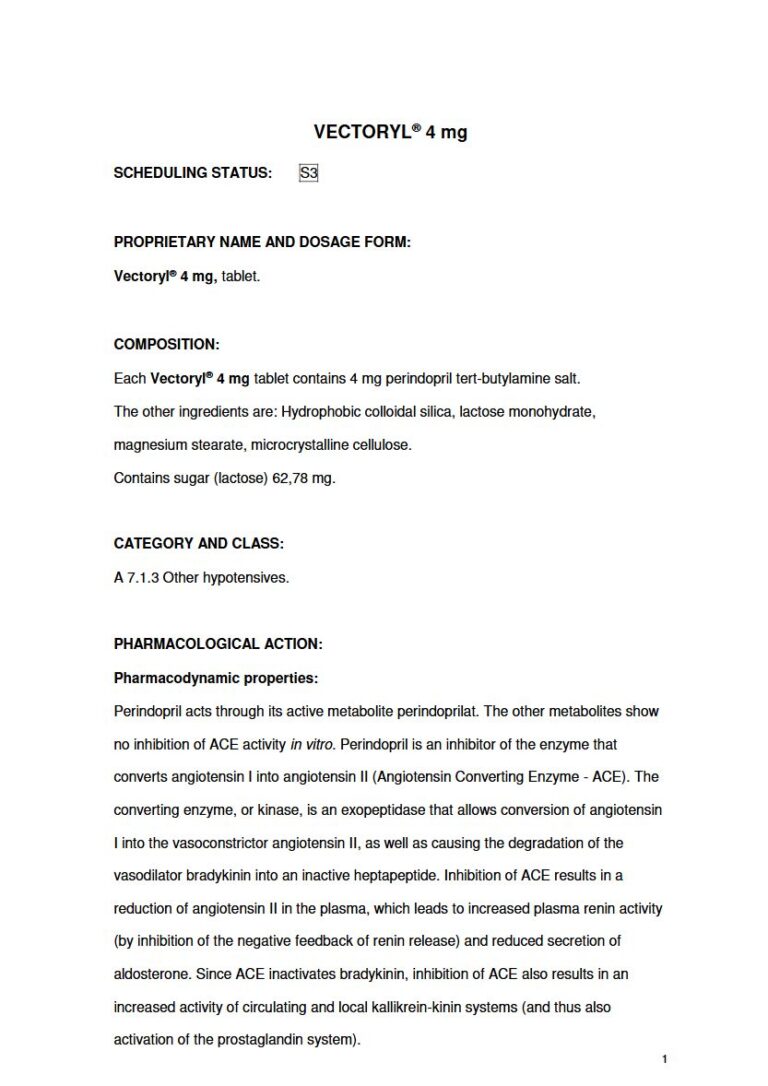
Vectoryl 4mg Tablet
PDF Leaflet Revision Date: 14 January 2019
Clinical Summary
Quick overview from the medicine insert
Indication
Mild to moderate hypertension, congestive heart failure, cardiovascular risk reduction.
Dosage (summary)
4 mg once daily, may increase to 8 mg after one month; 2 mg for elderly or heart failure.
Onset of Action / Duration
Onset: 30 mins, Duration: 24 hours
Special Populations
- Elderly
- Renal impairment
- Hepatic impairment
Pregnancy & Breastfeeding
Contraindicated in pregnancy and lactation; may harm fetus.
Key Drug Interactions
- Potassium-sparing diuretics
- Lithium
- Aliskiren
- Fluoroquinolones
Contraindications
- Hypersensitivity
- History of angioedema
- Severe renal impairment
- Bilateral renal artery stenosis
Common side effects
- Dizziness
- Hypotension
- Cough
- Abdominal pain
- Hyperkalaemia
Counselling Points
- Take before breakfast
- Monitor blood pressure
- Report signs of angioedema
Serious warnings
- Risk of hypotension
- Angioedema
- Dual blockade of RAAS contraindicated
Important Disclaimer
The Vectoryl 4mg Tablet professional information leaflet below is the property of Biogaran South Africa and is provided on Medinsert exactly as issued, with no.. alterations or editorial changes. We make every effort to keep content current by updating documents as soon as new versions become available. Medinsert serves as a trusted access point for healthcare professionals, but does not replace official sources or clinical judgement. For more details, please read our full disclaimer. read more>>
 Healthcare Professionals Only
This content is for registered healthcare professionals
Sign in or create a free account to read the full package insert.
Free for HPCSA-registered professionals. Powered by Medinsert.
Clinical Particulars
Section 4 of the official insert — extracted exactly as issued, no alterations
4.1 INDICATIONS
Vectoryl u00ae 4 mg is indicated in:
- Mild to moderate hypertension.
- Congestive heart failure not adequately controlled by conventional therapy with diuretics and digitalis in whom vasodilatation is indicated.
- Reduction of risk of cardiovascular events in patients with stable coronary artery disease and without heart failure.
4.2 CONTRAINDICATIONS
- Hypersensitivity to any of the ingredients of Vectoryl u00ae.
- A history of angioedema associated with previous ACE-inhibitor therapy or angiotensin receptor blockers (ARBs). These patients must never again be given these medicines. (see WARNINGS AND SPECIAL PRECAUTIONS).
- Hereditary or idiopathic angioedema.
- Hypertrophic obstructive cardiomyopathy (HOCM) (see WARNINGS AND SPECIAL PRECAUTIONS).
- Severe renal function impairment (creatinine clearance below 30 ml/min).
- Bilateral renal artery stenosis.
- Significant renal artery stenosis or stenosis of the artery to a single functioning kidney.
- Aortic stenosis (see WARNINGS AND SPECIAL PRECAUTIONS).
- Concomitant therapy with potassium sparing diuretics such as spironolactone, triamterene, amiloride (see INTERACTIONS).
- Porphyria.
- Lithium therapy: Concomitant use with Vectoryl u00ae may lead to toxic blood concentration of lithium (see INTERACTIONS).
- Pregnancy and lactation (see WARNINGS AND SPECIAL PRECAUTIONS and HUMAN REPRODUCTION).
- Concomitant use of Vectoryl u00ae with aliskiren-containing products in patients with diabetes mellitus or renal impairment (GFR < 60 ml/min/1,73 mu00b2) (see INTERACTIONS).
- Concomitant use with sacubitril/valsartan (see WARNINGS AND SPECIAL PRECAUTIONS and INTERACTIONS).
- Extracorporeal treatments leading to contact of blood with negatively charged surfaces (see INTERACTIONS).
- Concomitant use with fluoroquinolones in patients with moderate to severe renal failure, such as elderly patients.
4.4 WARNINGS AND SPECIAL PRECAUTIONS
Should a woman become pregnant while receiving Vectoryl u00ae, the treatment must be stopped promptly and switched to a different medicine (see CONTRAINDICATIONS and HUMAN REPRODUCTION). Should a woman contemplate pregnancy, the doctor should consider alternative medication.
Dual blockade of the renin-angiotensin-aldosterone system (RAAS): There is evidence that the concomitant use of ACE-inhibitors, angiotensin II receptor blockers (ARBs) or aliskiren may increase the risk of hypotension, hyperkalaemia and decreases renal function (including acute renal failure). Dual blockade of RAAS through the combined use of Vectoryl u00ae and aliskiren is therefore contraindicated (see CONTRAINDICATIONS). Vectoryl u00ae should not be used concomitantly with aliskiren. (see CONTRAINDICATIONS).
Stable coronary artery disease: If an episode of unstable angina pectoris (major or not) occurs during the first month of perindopril treatment, a careful appraisal of the benefit/risk should be performed before treatment continuation.
Hypotension: ACE-inhibitors may cause a fall in blood pressure. Symptomatic hypotension is rarely seen in uncomplicated hypertensive patients and is more likely to occur in patients who have been volume-depleted e.g. by diuretic therapy, dietary salt restriction, dialysis, diarrhoea or vomiting, or who have severe renin-dependent hypertension (see INTERACTIONS and SIDE EFFECTS).
In patients with symptomatic heart failure, with or without associated renal insufficiency, symptomatic hypotension has been observed. This is most likely to occur in those patients with more severe degrees of heart failure, as reflected by the use of high doses of loop diuretics, hyponatraemia or functional renal impairment.
In patients with an increased risk of symptomatic hypotension, initiation of therapy and dose adjustment should be closely monitored (see SIDE EFFECTS). Similar considerations apply to patients with ischaemic heart or cerebrovascular disease in whom an excessive fall in blood pressure could result in a myocardial infarction or cerebrovascular accident.
If hypotension occurs, the patient should be placed in the supine position and, if necessary, should receive an intravenous infusion of normal saline. A transient hypotensive response is not a contra-indication to further doses, which can be given usually without difficulty, once the blood pressure has increased after volume expansion.
In some patients with congestive heart failure, who have normal or low blood pressure, additional lowering of systemic blood pressure may occur with Vectoryl u00ae. If hypotension becomes symptomatic, a reduction of the dose or discontinuation of perindopril may be necessary.
Aortic and mitral valve stenosis/hypertrophic cardiomyopathy: Vectoryl u00ae should be given with caution to patients with mitral valve stenosis and obstruction in the outflow of the left ventricle, such as aortic stenosis or hypertrophic cardiomyopathy.
Impaired renal function: In cases of renal impairment (creatinine clearance < 60 ml/min) the initial Vectoryl u00ae dosage should be adjusted according to the patientu2019s creatinine clearance (see DOSAGE AND DIRECTIONS FOR USE) and then as a function of the patientu2019s response to treatment (see Renal Insufficiency). Routine monitoring of potassium and creatinine are part of normal medical practice for these patients (see SIDE EFFECTS).
In patients with symptomatic heart failure, hypotension following the initiation of therapy with ACE-inhibitors may lead to some further impairment in renal function. Acute renal failure has been reported in this situation.
In patients with bilateral renal artery stenosis, or stenosis of the artery to a solitary kidney, and who have been treated with ACE-inhibitors, increases in blood urea and serum creatinine may occur. This is usually reversible upon discontinuation of therapy. It is especially likely in patients with renal insufficiency. If renovascular hypertension is also present, there is an increased risk of severe hypotension and renal insufficiency. In these patients, treatment should be started under close medical supervision with low doses and careful dose titration.
Some hypertensive patients with no apparent pre-existing renal vascular disease have developed increases in blood urea and serum creatinine, especially when Vectoryl u00ae was given concomitantly with a diuretic. This is more likely to occur in patients with pre-existing renal impairment. Dosage reduction and/or discontinuation of the diuretic and/or Vectoryl u00ae may be required.
Haemodialysis patients: Anaphylactic reactions have been reported in patients dialysed with high flux membranes, and treated concomitantly with an ACE-inhibitor. In these patients consideration should be given to using a different type of dialysis membrane or different class of antihypertensive agent.
Kidney transplantation: There is no experience regarding the administration of Vectoryl u00ae in patients with a recent kidney transplant.
Renovascular hypertension: There is an increased risk of hypotension and renal insufficiency when patients with renovascular hypertension and pre-existing bilateral renal artery stenosis or stenosis of the artery to a single functioning kidney are treated with ACE-inhibitors (see CONTRAINDICATIONS). Treatment with diuretics may be a contributory factor. Loss of renal function may occur with only minor changes in serum creatinine even in patients with unilateral renal artery stenosis.
Hypersensitivity/Angioedema: Angioedema of the face, lips, mucous membranes, tongue, glottis and/or larynx, and extremities has been reported, in patients treated with ACE-inhibitors. This may occur at any time during therapy. In such cases, Vectoryl u00ae should immediately be discontinued and appropriate monitoring should be initiated and continued until the symptoms have disappeared completely. In those instances where swelling was confined to the face and lips, the condition generally resolved without treatment, although antihistamines have been useful in relieving symptoms. Angioedema associated with laryngeal oedema may be fatal. Where there is involvement of the tongue, glottis or larynx, and is likely to cause airway obstruction, emergency therapy should immediately be administered. This may include the administration of epinephrine (adrenaline) and/or the maintenance of the patientu2019s airway. The patient should be under close medical supervision until the symptoms have disappeared.
ACE-inhibitors cause a higher rate of angioedema in black patients than in other ethnic groups. Patients with a history of angioedema unrelated to ACE-inhibitor therapy may be at increased risk of angioedema while receiving an ACE-inhibitor (see CONTRAINDICATIONS).
Intestinal angioedema has been reported in patients treated with ACE-inhibitors. These patients presented with abdominal pain (with or without nausea or vomiting); in some cases there was no prior facial angioedema and C-1 esterase levels were normal. The angioedema was diagnosed by procedures including abdominal CT scan, or ultrasound or at surgery and symptoms resolved after stopping the ACE-inhibitor. Intestinal angioedema should be included in the differential diagnosis of patients on ACE-inhibitors presenting with abdominal pain.
The combination of perindopril with sacubitril/valsartan is contraindicated due to the increased risk of angioedema (see CONTRAINDICATIONS). Sacubitril/valsartan must not be initiated until 36 hours after taking the last dose of perindopril therapy. If treatment with sacubitril/valsartan is stopped, perindopril therapy must not be initiated until 36 hours after the last dose of sacubitril/valsartan (see CONTRAINDICATIONS and INTERACTIONS).
Concomitant use of other NEP inhibitors (e.g. racecadotril) and ACE-inhibitors may also increase the risk of angioedema (see INTERACTIONS). Hence, a careful benefit-risk assessment is needed before initiating treatment with NEP inhibitors (e.g. racecadotril) in patients on perindopril.
Concomitant use of mTOR inhibitors (e.g. sirolimus, everolimus, temsirolimus): Patients taking concomitant mTOR inhibitors (e.g. sirolimus, everolimus, temsirolimus) therapy may be at increased risk for angioedema (see WARNINGS AND SPECIAL PRECAUTIONS).
4.6 FERTILITY, PREGNANCY AND LACTATION
The use of Vectoryl u00ae is contraindicated during pregnancy. Pregnant women should be informed of the potential hazards to the foetus and must not take Vectoryl u00ae during pregnancy (see CONTRAINDICATIONS). Patients planning pregnancy should be changed to alternative anti-hypertensive treatments which have an established safety profile for use in pregnancy. When pregnancy is diagnosed, treatment with Vectoryl u00ae should be stopped immediately and if appropriate, alternative therapy should be started. Foetal exposure to ACE-inhibitors during the first trimester of pregnancy has been reported to be associated with an increased risk of malformations of the cardiovascular (atrial and/or ventricular septal defect, pulmonic stenosis, patent ductus arteriosus) and central nervous system (microcephaly spins bifida) and of kidney malformations. Vectoryl u00ae passes through the placenta and can be presumed to cause disturbance in foetal blood pressure regulatory mechanisms.
Oligohydramnios as well as hypotension, oliguria and anuria in newborns have been reported after administration of ACE-inhibitors in the second and third trimester. Cases of defective skull ossification have been observed. Prematurity and low birth mass can occur (see CONTRAINDICATIONS). It is not known whether perindopril is excreted into human breast milk. Therefore, the use of Vectoryl u00ae is contraindicated during pregnancy and lactation.
4.8 UNDESIRABLE EFFECTS
Summary of safety profile: The safety profile of perindopril is consistent with the safety profile of ACE-inhibitors: The most frequent adverse events reported in clinical trials and observed with perindopril are: dizziness, headache, paraesthesia, vertigo, visual disturbances, tinnitus, hypotension, cough, dyspnoea, abdominal pain, constipation, diarrhoea, dysgeusia, dyspepsia, nausea, vomiting, pruritis, rash, muscle cramps, and asthenia.
Tabulated list of adverse reactions: The following undesirable effects have been observed during clinical trials and/or post-marketing use with perindopril and ranked under the following frequency: Very common (u2265 1/10); common (u2265 1/100, < 1/10); uncommon (u2265 1/1 000, < 1/100); rare (u2265 1/10 000, < 1/1 000); very rare (< 1/10 000); not known (cannot be estimated from the available data).
4.9 OVERDOSE
Symptoms associated with overdose of ACE-inhibitors may include hypotension, circulatory shock, electrolyte disturbances, renal failure, hyperventilation, tachycardia, palpitations, bradycardia, dizziness, anxiety and cough. The recommended treatment of an overdose is an intravenous infusion of normal saline solution. If hypotension occurs, the patient should be placed in the shock position. If available, treatment with angiotensin II infusion and/or intravenous catecholamines may also be considered. Vectoryl u00ae may be removed from the general circulation by haemodialysis. Pacemaker therapy is indicated for therapy-resistant bradycardia. Vital signs, serum electrolytes and creatinine concentrations should be monitored continuously. Expected symptoms and signs would be linked to hypotension. Further treatment is symptomatic and supportive.
