
Phenylephrine Hydrochloride 10 mg Solution
PDF Leaflet Revision Date: 05 October 2022
Clinical Summary
Quick overview from the medicine insert
Indication
For increasing blood pressure in adults with hypotension from vasodilation.
Dosage (summary)
Dilute before administration; 50-250 mcg IV bolus or 0.5-6 mcg/kg/min continuous infusion.
Onset of Action / Duration
Onset: minutes, Duration: short-lived
Special Populations
- Elderly
- Renal impairment
Pregnancy & Breastfeeding
Not recommended in pregnancy; small amounts excreted in breast milk.
Key Drug Interactions
- Non-selective MAO inhibitors
- Dopaminergic agents
- Tricyclic antidepressants
Contraindications
- Hypersensitivity
- Uncontrolled hypertension
- Severe cardiac failure
Common side effects
- Bradycardia
- Hypertension
- Nausea
- Vomiting
Counselling Points
- Monitor for side effects
- Avoid extravasation
- Gradually reduce dosage when discontinuing
Serious warnings
- Risk of ischemic gangrene
- Monitor blood pressure
- Caution in patients with coronary artery disease
Important Disclaimer
The Phenylephrine Hydrochloride 10 mg Solution professional information leaflet below is the property of Abbott Laboratories Sa and is provided on Medinsert exactly as issued, with no.. alterations or editorial changes. We make every effort to keep content current by updating documents as soon as new versions become available. Medinsert serves as a trusted access point for healthcare professionals, but does not replace official sources or clinical judgement. For more details, please read our full disclaimer. read more>>
 Healthcare Professionals Only
This content is for registered healthcare professionals
Sign in or create a free account to read the full package insert.
Free for HPCSA-registered professionals. Powered by Medinsert.
Clinical Particulars
Section 4 of the official insert — extracted exactly as issued, no alterations
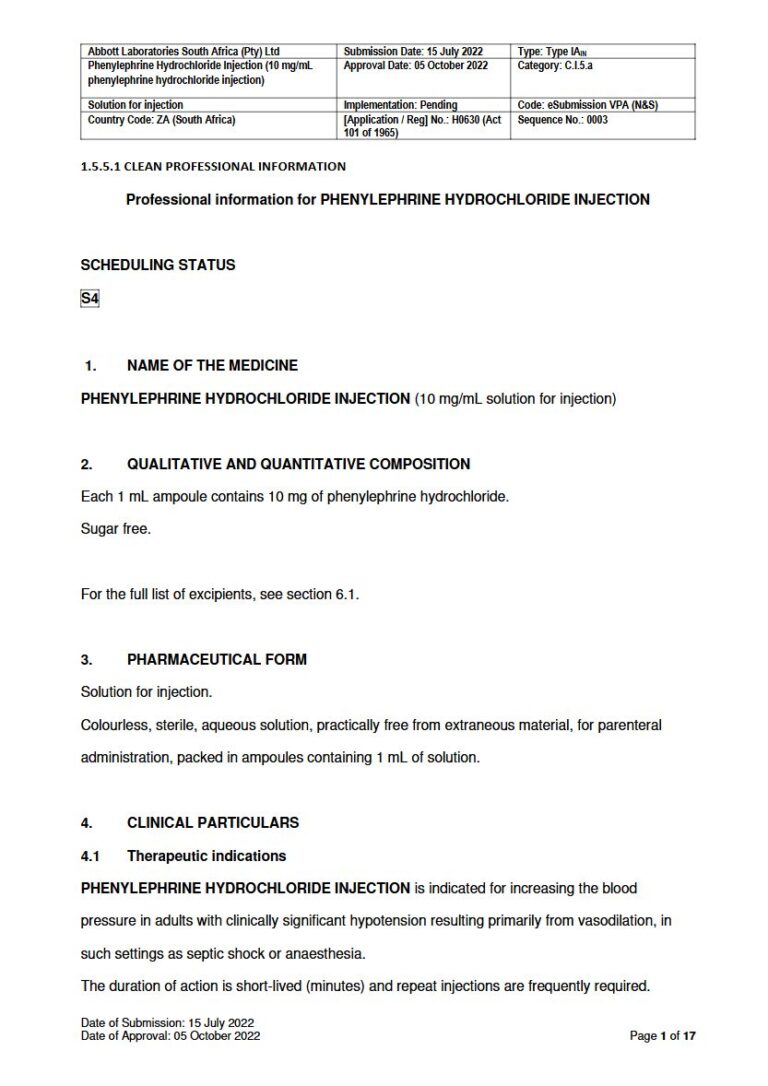
4.1 Therapeutic indications
PHENYLEPHRINE HYDROCHLORIDE INJECTION is indicated for increasing the blood pressure in adults with clinically significant hypotension resulting primarily from vasodilation, in such settings as septic shock or anaesthesia. The duration of action is short-lived (minutes) and repeat injections are frequently required.
4.2 Posology and method of administration
General dosing information Patients receiving PHENYLEPHRINE HYDROCHLORIDE INJECTION should be closely monitored. Treatment with PHENYLEPHRINE HYDROCHLORIDE INJECTION is not a substitute for replacement of blood, plasma, fluids and/or electrolytes. Prior to administration of therapy, hypovolaemia should be corrected. Acidosis may reduce the effectiveness of phenylephrine hydrochloride. An infusion pump or other suitable metering device should be used to control the rate of infusion in order to avoid unintended administration of a bolus dose. Infusions of PHENYLEPHRINE HYDROCHLORIDE INJECTION should be given into a large vein, or preferably, directly into the central venous line. Inspect the solution for particulate matter and discolouration prior to administration. The diluted solution should not be kept for more than 4 hours at room temperature or for more than 24 hours under refrigerated conditions. Discard any unused portion. PHENYLEPHRINE HYDROCHLORIDE INJECTION is not for intramuscular or subcutaneous use. Caution is recommended to avoid extravasation, which may cause tissue necrosis and sloughing of surrounding tissues (see section 4.4). When discontinuing therapy, the dosage should be reduced gradually, since sudden cessation of therapy may result in severe hypotension. Intravascular fluid should be replaced if necessary to avoid hypotension.
Posology PHENYLEPHRINE HYDROCHLORIDE INJECTION must be diluted before administration as bolus intravenous infusion or continuous intravenous infusion. Dosage must be adjusted to meet the individual requirements of each patient, on the basis of clinical response. Some patients may need higher than usual recommended doses for a time.
Preparing a 50 mcg/mL Solution of Bolus Intravenous Administration For bolus intravenous administration, add 10 mg (1 mL of a 10 mg/mL concentration) of PHENYLEPHRINE HYDROCHLORIDE INJECTION to 200 mL of 5 % dextrose injection or 0,9 % sodium chloride injection. This will yield a final concentration of 50 mcg/mL. Withdraw an appropriate dose from the 50 mcg/mL solution prior to bolus intravenous administration of the diluted solution.
Preparing a Solution for Continuous Intravenous Infusion For continuous intravenous infusion, withdraw 10 mg (1 mL of 10 mg/mL concentration) of PHENYLEPHRINE HYDROCHLORIDE INJECTION and add to 500 mL of 5 % dextrose injection or 0,9 % sodium chloride injection (providing a final concentration of 20 mcg/mL).
Dosing for Perioperative Setting In adult patients undergoing surgical procedures with either neuraxial anaesthesia or general anaesthesia: u2022 50 mcg to 250 mcg by intravenous bolus administration. The most frequently reported initial bolus dose is 50 mcg or 100 mcg. u2022 0,5 mcg/kg/min to 1,4 mcg/kg/min by intravenous continuous infusion, titrated to blood pressure goal.
Dosing for Septic or Other Vasodilatory Shock In adult patients with septic or other vasodilatory shock: u2022 0,5 mcg/kg/min to 6 mcg/kg/min by intravenous continuous infusion, titrated to blood pressure goal. Doses above 6 mcg/kg/min do not show significant incremental increase in blood pressure.
4.3 Contraindications
Hypersensitivity to phenylephrine hydrochloride or any of the excipients of PHENYLEPHRINE HYDROCHLORIDE INJECTION (see section 6.1). Paediatric use. PHENYLEPHRINE HYDROCHLORIDE INJECTION is contraindicated in the presence of severe: u2022 Uncontrolled hypertension or peripheral vascular disease due to the risk of ischemic gangrene or vascular thrombosis. u2022 Hyperthyroidism. u2022 Heart-block with or without bradycardia. u2022 Uncontrolled cardiac failure. u2022 Bradycardia (less than 50 bpm). u2022 Seriously impaired coronary circulation. PHENYLEPHRINE HYDROCHLORIDE INJECTION should not be used in combination with non-selective monoamine oxidase inhibitors (MAOs) (or within two weeks of their withdrawal) due to the risk of paroxysmal hypertension and possibly fatal hyperthermia (see section 4.5).
4.4 Special warnings and precautions for use
Sustained IV infusion may result in diminished efficacy. The arterial blood pressure should be monitored during treatment. PHENYLEPHRINE HYDROCHLORIDE INJECTION should be administered with care to patients with: u2022 diabetes mellitus; u2022 tachycardia; u2022 dysrhythmias; u2022 angina pectoris (PHENYLEPHRINE HYDROCHLORIDE INJECTION can precipitate or exacerbate angina in patients with coronary artery disease and history of angina); u2022 aneurysma; u2022 closed angle glaucoma. Concurrent use of a halogenated volatile anaesthetic (e.g. desflurane, enflurane, halothane, isoflurane, methoxyflurane, sevoflurane) with PHENYLEPHRINE HYDROCHLORIDE INJECTION may increase the risk of perioperative hypertensive crisis and dysrhythmia (see section 4.5). Cardiovascular effects: Severe bradycardia and decreased cardiac output may occur. Excessive peripheral and visceral vasoconstriction with ischaemia to vital organs may occur, especially in patients with extensive peripheral vascular disease e.g. Raynaudu2019s phenomenon. Increased blood pressure may occur and precipitate underlying heart failure, angina in patients with severe arteriosclerosis or past history of angina, and increase pulmonary arterial pressure. In patients with serious heart failure or cardiogenic shock, PHENYLEPHRINE HYDROCHLORIDE INJECTION may cause deterioration in the heart failure as a consequence of the induced vasoconstriction (increase in afterload) (see section 4.3). Therefore, care should be exercised in administering PHENYLEPHRINE HYDROCHLORIDE INJECTION to patients with arteriosclerosis, the elderly and to patients with impaired cerebral circulation. In patients with reduced cardiac output or coronary vascular disease, vital organ functions should be closely monitored and dose reduction should be considered when systemic blood pressure is near the lower end of the target range. Dermatologic effects: Avoid extravasation as this can cause necrosis or sloughing of tissue. Endocrine and metabolic effects: Use extreme caution in patients with hyperthyroidism. Monoamine oxidase (MAO) inhibitors: Concurrent use may prolong and intensify cardiac stimulation and vasopressor effects because of the release of catecholamines which accumulate in intraneuronal storage sites during MAO inhibitor therapy; this may result in headache, cardiac dysrhythmias, vomiting or sudden and severe hypertensive or hyper-pyretic crises. For patients who have been receiving MAO inhibitors 2 to 3 weeks prior to administration of sympathomimetic medicines, the initial dosage should be reduced to be no more than one-tenth of the usual dose (see section 4.3). Immunologic effects: Allergic reactions, including anaphylactic symptoms, may occur in patients with sulfite-sensitivity. Neurologic effects: Blood pressure response to PHENYLEPHRINE HYDROCHLORIDE INJECTION may be increased in patients with autonomic dysfunction. Renal Toxicity: PHENYLEPHRINE HYDROCHLORIDE INJECTION can increase the need for renal replacement therapy in patients with septic shock. Monitor renal function.
4.5 Interaction with other medicines and other forms of interaction
Contraindicated combinations u2022 Non-selective monoamine oxidase inhibitors (MAOIs) (e.g. iproniazid, nialamide, linezolid, phenelzine) u2013 concurrent use with PHENYLEPHRINE HYDROCHLORIDE INJECTION may cause paroxysmal hypertension and possibly fatal hyperthermia. Due to the long duration of action of MOAIs, this interaction is still possible 15 days after discontinuation of the MOAI.
Inadvisable combinations u2022 Dopaminergic and vasoconstrictor ergot alkaloids such as bromocriptine, lisuride, cabergoline, pergolide dihydroergotamine, ergotamine, methylergometrine, methylsergide u2013 concurrent use with PHENYLEPHRINE HYDROCHLORIDE INJECTION increases the risk of vasoconstriction and/or hypertensive crisis. u2022 Tricyclic antidepressants (e.g. imipramine) and noradrenergic-serotoninergic antidepressants (minalcipram, venlafaxine) u2013 concomitant use with PHENYLEPHRINE HYDROCHLORIDE INJECTION causes paroxysmal hypertension with possibility of dysrhythmias due to the inhibition of epinephrine (adrenaline) or norepinephrine (noradrenaline) entry in sympathetic fibers. u2022 Selective type A monoamine oxidase inhibitors (e.g. moclobemide, toloxatone) u2013 concurrent use with PHENYLEPHRINE HYDROCHLORIDE INJECTION may lead to a risk of vasoconstriction and/or hypertensive crisis. This interaction is still possible 15 days after discontinuation of monoamine oxidase inhibitors.
u2022 Selective type B monoamine oxidase inhibitors (e.g. selegiline, pargyline) u2013 concurrent use with PHENYLEPHRINE HYDROCHLORIDE INJECTION may prolong and intensify cardiac stimulation and vasopressor effects (see section 4.4). This interaction is still possible 15 days after discontinuation of monoamine oxidase inhibitors. u2022 Linezolid u2013 concurrent use with PHENYLEPHRINE HYDROCHLORIDE INJECTION may lead to a risk of vasoconstriction and/or hypertensive crisis. u2022 Guanethidine and related products u2013 concurrent use with PHENYLEPHRINE HYDROCHLORIDE INJECTION may cause a substantial increase in blood pressure (hyper reactivity linked to the reduction in sympathetic tone and/or to the inhibition of adrenaline or noradrenaline entry in sympathetic fibers). If the combination cannot be avoided, use with caution lower doses of sympathomimetic medicines due to the increase in cardiovascular effects and the potential for side effects. u2022 Reserpine and other sympatholytic medicines u2013 concomitant use with PHENYLEPHRINE HYDROCHLORIDE INJECTION causes a substantial increase in blood pressure (hyperreactivity linked to the reduction in sympathetic tone and/or to the inhibition of adrenaline or noradrenaline entry in sympathetic fibers). If the combination cannot be avoided, use with caution. u2022 Cardiac glycosides, quinidine u2013 concurrent use with PHENYLEPHRINE HYDROCHLORIDE INJECTION may increase the risk of cardiac dysrhythmias. u2022 Halogenated volatile anaesthetics (desflurane, enflurane, halothane, isoflurane, methoxyflurane, sevoflurane) u2013 concurrent use with PHENYLEPHRINE HYDROCHLORIDE INJECTION may lead to a risk of perioperative hypertensive crisis and dysrhythmia. u2022 Alpha-adrenergic blocking medicines (e.g. doxazosin, labetalol, prazosin, haloperidol, phenothiazines) u2013 concurrent use may antagonise the peripheral vasoconstriction effect of PHENYLEPHRINE HYDROCHLORIDE INJECTION.
The effect of antihypertensive and diuretic medicines used as antihypertensives may be reduced when used concurrently with PHENYLEPHRINE HYDROCHLORIDE INJECTION; the patient should be carefully monitored to confirm the desired effect is obtained. u2022 Beta-adrenergic blocking medicines, systemic or ophthalmic u2013 concurrent use of PHENYLEPHRINE HYDROCHLORIDE INJECTION in the presence of beta-adrenergic medicines (systemic or ophthalmic) may result in an exaggeration of the vasoconstriction effects and profound bradycardia. u2022 The pressor effect of PHENYLEPHRINE HYDROCHLORIDE INJECTION is increased in patients receiving atropine sulfate.
Combinations requiring precautions for use u2022 Oxytocic medicines u2013 concomitant use with PHENYLEPHRINE HYDROCHLORIDE INJECTION potentiates the vasopressor-active effects of sympathomimetic amines. Thus, some oxytocic medicines may cause severe persistent hypertension and strokes can occur during post-partum period. u2022 Digoxin u2013 PHENYLEPHRINE HYDROCHLORIDE INJECTION may be used with digoxin for therapeutic advantage; caution and close electrocardiographic monitoring are recommended during concurrent use.
4.6 Fertility, pregnancy and lactation
Pregnancy Administration of PHENYLEPHRINE HYDROCHLORIDE INJECTION in late pregnancy or labour may potentially cause fetal hypoxia and bradycardia. PHENYLEPHRINE HYDROCHLORIDE INJECTION is not recommended during pregnancy. The combination with some oxytocic medicines can cause severe hypertension (see section 4.5).
Breastfeeding Small quantities of PHENYLEPHRINE HYDROCHLORIDE INJECTION are excreted into human breast milk and oral bioavailability may be low. Administering vasoconstrictors to the mother exposes the infant to a theoretical risk of cardiovascular and neurological effects. However, in the event of a single bolus administration during childbirth, breastfeeding is possible.
Fertility There is no available data concerning fertility after exposure to PHENYLEPHRINE HYDROCHLORIDE INJECTION.
4.7 Effects on ability to drive and use machines
PHENYLEPHRINE HYDROCHLORIDE INJECTION has no or negligible influence on the mental and/or physical abilities to perform or execute tasks or activities requiring mental alertness, judgment and/or sound coordination and vision.
4.8 Undesirable effects
PHENYLEPHRINE HYDROCHLORIDE INJECTION can cause side effects. PHENYLEPHRINE HYDROCHLORIDE INJECTION may cause a transient tingling and coolness of the skin and a temporary sensation of fullness in the head. Extravasation of the injection may cause local necrosis (see section 4.4). Peripheral vasoconstriction, possibly leading to necrosis or gangrene, may occur with prolonged use of PHENYLEPHRINE HYDROCHLORIDE INJECTION in high doses or low doses in the presence of peripheral vascular disease.
Summary of the safety profile The most frequent adverse events of PHENYLEPHRINE HYDROCHLORIDE INJECTION reported in literature are bradycardia, hypertensive episodes, nausea and vomiting. Most undesired effects of PHENYLEPHRINE HYDROCHLORIDE INJECTION are dose dependent.
Structured listing of adverse reactions Immune system disorders: Less frequent: hypersensitivity Psychiatric disorders: Less frequent: anxiety, excitability, agitation, psychotic states, confusion Nervous system disorders: Frequent: headache Less frequent: nervousness or restlessness, insomnia, paresthaesia, tremor Eye disorders: Less frequent: mydriasis, aggravation of pre-existing angle-closure glaucoma Cardiac disorders: Less frequent: angina, bradycardia, hypertension, hypotension, tachycardia, and ventricular dysrhythmias Frequency unknown: reflex bradycardia, palpitations, dysrhythmia, myocardial ischemia Vascular disorders: Less frequent: cerebral haemorrhage, hypertensive crisis Respiratory, thoracic and mediastinal disorders: Less frequent: dyspnoea, pulmonary oedema Gastrointestinal disorders: Less frequent: nausea, vomiting Skin and subcutaneous tissue disorders: Less frequent: sweating, pallor or skin blanching, piloerection, skin necrosis with extravasation Musculoskeletal and connective tissue disorders: Less frequent: muscular weakness Renal and urinary disorders: Less frequent: difficulty in micturition and urinary retention
Description of selected adverse reactions As PHENYLEPHRINE HYDROCHLORIDE INJECTION has been frequently used in the critical care setting in patients with hypotension and shock, some of the reported serious adverse events and deaths are probably related to the underlying disease and not related to the use of PHENYLEPHRINE HYDROCHLORIDE INJECTION.
Other special population Elderly: risk for phenylephrine toxicity is increased in elderly patients (see section 4.4).
Reporting of suspected adverse reactions Reporting suspected adverse reactions after authorisation of PHENYLEPHRINE HYDROCHLORIDE INJECTION is important. It allows continued monitoring of the benefit/risk balance of PHENYLEPHRINE HYDROCHLORIDE INJECTION. Health care providers are asked to report any suspected adverse reactions to SAHPRA via the u201c6.04 Adverse Drug Reactions Reporting Formu201d, found online under SAHPRAu2019s publications: https://www.sahpra.org.za/Publications/Index/8.
4.9 Overdose
Symptoms Symptoms of overdose include headache, nausea, vomiting, paranoid psychosis, hallucinations, hypertension (which may be severe), palpitations and reflex bradycardia. Cardiac dysrhythmia such as ventricular extra-systoles and short paroxysmal episodes of ventricular tachycardia may occur.
Treatment Treatment should consist of symptomatic and supportive measures. For excessive hypertensive effects, the administration should be reduced, or the medication temporarily discontinued until blood pressure is decreased. If these measures fail to lower the blood pressure, a short acting alpha-adrenergic blocking medicine, such as phentolamine, may be administered.
