
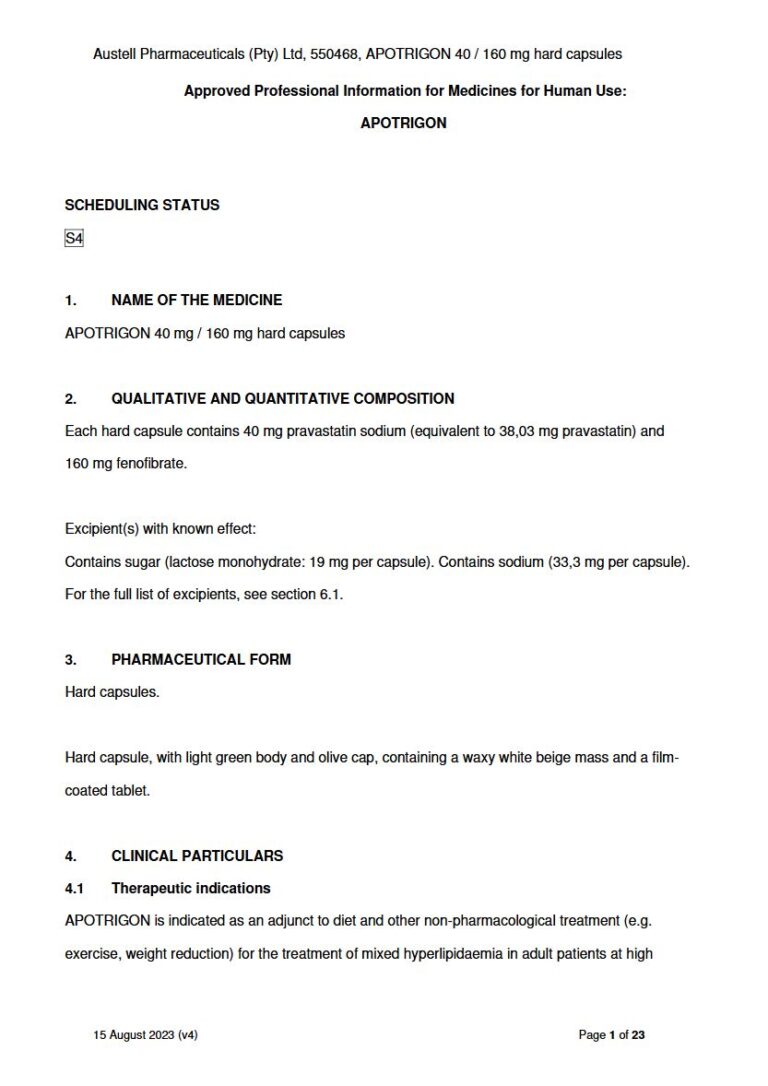
Apotrigon 40 mg or 160 mg Capsules
Clinical Summary
Quick overview from the medicine insert
Indication
Used for the treatment of dyslipidemia, including hypercholesterolemia and hypertriglyceridemia.
Dosage (summary)
The usual recommended dose is one capsule (40 mg Fenofibrate and 160 mg Pravastatin) taken orally once daily.
Onset of Action / Duration
Effects on lipid levels may be observed within 2 to 4 weeks of initiation.
Special Populations
- Patients with renal impairment
- Elderly patients
- Patients with liver impairment
Pregnancy & Breastfeeding
Use is not recommended during pregnancy and lactation due to potential risks to the fetus and infant.
Key Drug Interactions
- Increased risk of myopathy and rhabdomyolysis with concomitant use of other statins or fibrates.
- Caution with anticoagulants, as Pravastatin may enhance their effects.
- Potential interaction with cyclosporine, leading to increased Pravastatin levels.
Contraindications
- Active liver disease or unexplained persistent elevations of hepatic transaminases.
- Severe renal impairment.
- Hypersensitivity to any component of the formulation.
Common side effects
- Muscle pain or weakness.
- Gastrointestinal disturbances (nausea, diarrhea, abdominal pain).
- Elevated liver enzymes.
- Rash or pruritus.
Counselling Points
- Advise patients to report any unexplained muscle pain, tenderness, or weakness.
- Instruct patients to maintain a healthy diet and lifestyle to enhance treatment efficacy.
- Inform patients about the importance of regular follow-up and lipid level monitoring.
Serious warnings
- Monitor liver function tests before and during treatment.
- Use caution in patients with a history of muscle disorders.
- Discontinue use if muscle symptoms occur, especially if accompanied by fever or malaise.
Important Disclaimer
The Apotrigon 40 mg or 160 mg Capsules professional information leaflet below is the property of Austell Laboratories and is provided on Medinsert exactly as issued, with no.. alterations or editorial changes. We make every effort to keep content current by updating documents as soon as new versions become available. Medinsert serves as a trusted access point for healthcare professionals, but does not replace official sources or clinical judgement. For more details, please read our full disclaimer. read more>>
 Healthcare Professionals Only
This content is for registered healthcare professionals
Sign in or create a free account to read the full package insert.
Free for HPCSA-registered professionals. Powered by Medinsert.
Clinical Particulars
Section 4 of the official insert — extracted exactly as issued, no alterations
4.1 Therapeutic indications
APOTRIGON is indicated as an adjunct to diet and other non-pharmacological treatment (e.g. exercise, weight reduction) for the treatment of mixed hyperlipidaemia in adult patients at high cardiovascular risk to reduce triglycerides and increase HDL-C when LDL-C levels are adequately controlled while on a treatment with pravastatin 40 mg monotherapy.
4.2 Posology and method of administration
Prior to initiating APOTRIGON, secondary causes of combined dyslipidaemia should be excluded and patients should be placed on a standard cholesterol and triglycerides-lowering diet which should be continued during treatment.
Posology
The recommended dose is one capsule per day. Dietary restrictions instituted before therapy should be continued. Response to therapy should be monitored by determination of serum lipid values. Rapid reduction of serum lipid levels usually follows APOTRIGON treatment, but treatment should be discontinued if an adequate response has not been achieved within three months.
Special populations
Elderly patients (u2265 65 years old)
Treatment initiation with APOTRIGON should be decided after renal function has been evaluated (see section 4.4 Renal and urinary disorders). Limited safety data on APOTRIGON is available in patients > 75 years of age and care should be exercised.
Renal impairment
APOTRIGON is contraindicated in patients with moderate to severe renal impairment (defined as a creatinine clearance < 60 mL/min) (see section 4.3.) No modification of posology should be necessary in patients with mild renal impairment.
Hepatic impairment
APOTRIGON is not recommended in patients with moderate hepatic impairment and is contraindicated in patients with severe hepatic impairment (see section 4.3). No posology adjustment is required in patients with mild hepatic impairment.
Paediatric population (< 18 years old)
There is no relevant data on the use of APOTRIGON in the paediatric population (< 18 years old) for the indication of mixed dyslipidaemia. Hence APOTRIGON cannot be recommended for this group (see section 4.3).
Method of administration
Oral use. The recommended dose is one capsule taken daily during the evening meal. Since it is less well absorbed from an empty stomach, APOTRIGON should always be taken with food (see sections 4.5 and 5.2).
4.3 Contraindications
- Hypersensitivity to fenofibrate or pravastatin, or to any of the excipients listed in section 6.1.
- Severe hepatic impairment including biliary cirrhosis or active liver disease including unexplained persistent elevations in liver function tests (including serum transaminase elevation) exceeding 3 fold the upper limit of normal (ULN) (see section 4.4).
- Children and adolescents (age below 18 years).
- Moderate to severe renal impairment (defined as an estimated creatinine clearance < 60 mL/min).
- Known photo allergy or photo toxic reaction during treatment with fibrates or ketoprofen.
- Gallbladder disease (see section 4.4).
- Chronic or acute pancreatitis with the exception of acute pancreatitis due to severe hypertriglyceridaemia (see section 4.4).
- Pregnancy and breastfeeding (see section 4.6).
- Personal history of myopathy and/or rhabdomyolysis with statins and/or fibrates or confirmed creatine phosphokinase (CK) elevation above 5 times the ULN under previous statin treatment (see section 4.4).
- APOTRIGON should not be administered with fusidic acid (see section 4.4)
4.4 Special warnings and precautions for use
The pharmacokinetic properties of APOTRIGON are not identical to the co-administration of the existing monotherapies when taken with fat-meal or in fasting state.
Musculoskeletal and connective tissue disorders
Pravastatin and fenofibrate have been associated with the onset of myalgia, myopathy and rhabdomyolysis with or without secondary renal insufficiency. Rhabdomyolysis is an acute potentially fatal condition of skeletal muscle, which may develop at any time during treatment and is characterised by massive muscle destruction associated with major increase in CK (usually > 30 or 40 times the ULN) leading to myoglobinuria. The risk of muscle toxicity is increased when a fibrate and a 3-hydroxy-3-methyl-glutaryl-Coenzyme A (HMG-CoA) reductase inhibitor, such as pravastatin, are administered together. Myopathy must be considered in any patient presenting with unexplained muscle symptoms such as pain or tenderness, muscle weakness, or muscle cramps. In such cases CK levels should be measured (see below).
Consequently, patients should be monitored for any signs of muscle toxicity. Certain predisposing factors such as age > 70, renal impairment, hepatic impairment, hypothyroidism, personal history of muscular toxicity with a statin or fibrate, personal or familial history of hereditary muscular disorders or alcohol abuse may increase the risk of muscular toxicity and therefore CK measurement is indicated before starting the combination therapy in these patients (see below).
Pravastatin, as in APOTRIGON, must not be co-administered with fusidic acid (see section 4.3). There have been reports of rhabdomyolysis (including fatalities) in patients receiving this combination (see section 4.5). In patients where the use of fusidic acid is considered essential, APOTRIGON should be discontinued throughout the duration of fusidic acid treatment. The patient should be advised to seek medical advice immediately if they experience any symptoms of muscle weakness, pain or tenderness.
APOTRIGON may be re-introduced seven days after the last dose of fusidic acid.
Before treatment initiation
CK levels should be measured prior to initiation of therapy. The baseline CK levels may also be useful as a reference in the event of a later increase during the combination therapy. When measured, CK levels should be interpreted in the context of other potential factors that can cause transient muscle damage, such as strenuous exercise or muscle trauma and repeated if necessary.
If CK levels are significantly elevated > 5 times the ULN at baseline, the test should be repeated after 5 u2013 7 days. If confirmed, the treatment should definitively not be initiated (see section 4.3).
During treatment
Routine monitoring of CK is recommended every 3 months during the first 12 months of treatment with APOTRIGON and then at time intervals as determined by the treating medical practitioner but not less than annually. Patients should be advised to promptly report unexplained muscle pain, tenderness, weakness or cramps. In these cases, CK levels should be measured. If a markedly elevated (> 5 times the ULN) CK level is detected and confirmed, APOTRIGON therapy must be discontinued. Treatment discontinuation should also be considered if the muscular symptoms are severe and cause daily discomfort (whatever CK levels). If a hereditary muscular disease is suspected in such patients, restarting APOTRIGON therapy is not recommended.
There have been reports of an immune-mediated necrotising myopathy (IMNM) during or after treatment with some statins such as pravastatin. IMNM is clinically characterised by persistent proximal muscle weakness and elevated serum creatine kinase, which persist despite discontinuation of statin treatment.
Hepatobiliary disorders
Increases in transaminase levels have been reported in patients treated with APOTRIGON. In the majority of cases, liver transaminase levels have returned to their baseline value without the need for treatment discontinuation. It is recommended that transaminase levels be monitored every 3 months during the first 12 months of treatment and then at time intervals as determined by the treating medical practitioner beyond this period. Special attention should be paid to patients who develop an increase in transaminase levels and APOTRIGON should be discontinued if increases in aspartate aminotransferase (AST) and alanine aminotransferase (ALT) exceed 3 times the ULN and persist for longer than 30 days. Caution should be exercised when APOTRIGON is administered to patients with a history of liver disease or heavy alcohol ingestion.
Renal and urinary disorders
APOTRIGON is contraindicated in moderate to severe renal impairment (section 4.3). It is recommended to assess the estimated creatinine clearance at the initiation of the treatment and every 3 months during the first 12 months of the combination therapy and then at time intervals as determined by the treating medical practitioner but not less than annually. Treatment should be discontinued in case of an estimated creatinine clearance < 60 mL/min.
Interstitial lung disease
Cases of interstitial lung disease have been reported with pravastatin as in APOTRIGON, especially with long term therapy (see section 4.8). Presenting features can include dyspnoea, non-productive cough and deterioration in general health (fatigue, weight loss and fever). If it is suspected a patient has developed interstitial lung disease, APOTRIGON therapy should be discontinued.
Cholelithiasis
Fenofibrate may increase cholesterol excretion into the bile, potentially leading to cholelithiasis. If cholelithiasis is suspected, gallbladder studies are indicated. APOTRIGON should be discontinued if gallstones are found.
Pancreatitis
Pancreatitis has been reported in patients taking fenofibrate or pravastatin as in APOTRIGON (see section 4.3). In the FIELD study (fenofibrate study), a randomised placebo-controlled trial performed in 9 795 patients with type 2 diabetes mellitus, a statistically significant increase in pancreatitis cases was observed in patients receiving fenofibrate versus patients receiving placebo (0,8 % versus 0,5 %; p = 0,031). This occurrence may represent a failure of efficacy in patients with severe hypertriglyceridaemia, a direct effect of the medicine, or a secondary phenomenon mediated through biliary tract stone or sludge formation, resulting in the obstruction of the common bile duct.
Venothromboembolic events
In the FIELD study (fenofibrate study), a statistically significant increase was reported in the incidence of pulmonary embolism (0,7 % in the placebo group versus 1,1 % in the fenofibrate group; p = 0,022) and a statistically non-significant increase in deep vein thromboses (placebo: 1,0 % [48/4 900 patients] versus fenofibrate 1,4 % [67/4 895 patients]; p = 0,074). Caution should be exercised in patients with history of pulmonary embolism.
Diabetes Mellitus
Statins such as pravastatin contained in APOTRIGON may raise blood glucose and in some patients, at high risk of future diabetes, may produce a level of hyperglycaemia where formal diabetes care is appropriate. Patients at risk (fasting glucose 5,6 to 6,9 mmol/L, BMI > 30 kg/m2, raised triglycerides, hypertension) should be monitored both clinically and biochemically according to national guidelines.
Risk of myasthenia gravis and ocular myasthenia
Excipient: Lactose
This medicine contains lactose. Patients with rare hereditary problems of galactose intolerance, the total lactase deficiency or glucose-galactose malabsorption should not take APOTRIGON.
Excipient: Sodium
APOTRIGON contains 33,3 mg sodium per capsule (excipients and active substance), equivalent to 1,7 % of the WHO recommended maximum daily intake of 2 g sodium for an adult.
4.5 Interaction with other medicines and other forms of interaction
The following statements reflect the information available on the individual active substances (fenofibrate and pravastatin).
Interactions relevant to pravastatin
Cholestyramine/Colestipol
Concomitant administration resulted in approximately 40 to 50 % decrease in the bioavailability of pravastatin. There was no clinically significant decrease in bioavailability or therapeutic effect when pravastatin was administered one hour before or four hours after cholestyramine or one hour before colestipol.
Ciclosporin
Concomitant administration of pravastatin and ciclosporin leads to an approximately 4 fold increase in pravastatin systemic exposure. In some patients, however, the increase in pravastatin exposure may be larger. Clinical and biochemical monitoring of patients receiving this combination is recommended.
Medicines metabolised by cytochrome P450
Pravastatin is not metabolised to a clinically significant extent by the cytochrome P450 system. The absence of a significant pharmacokinetic interaction with pravastatin has been specifically demonstrated for several medicines e.g. diltiazem, verapamil, itraconazole, ketoconazole, protease inhibitors, grapefruit juice and CYP2C9 inhibitors (e.g. fluconazole).
In a study with pravastatin and erythromycin, a statistically significant increase in the area under the curve (AUC) (70 %) and C max (121 %) of pravastatin was observed. In a similar study with clarithromycin, a statistically significant increase in AUC (110 %) and C max (127 %) was observed. Caution should be exercised when co-administering pravastatin with erythromycin or clarithromycin or other macrolide antibiotics.
Fusidic acid
Interaction between pravastatin and fusidic acid can lead to an increased risk of rhabdomyolysis. The risk of myopathy including rhabdomyolysis is increased by the concomitant administration of systemic fusidic acid with statins, such as pravastatin. Co-administration of this combination may cause increased plasma concentrations of both medicines. The mechanism of this interaction (whether it is pharmacodynamic or pharmacokinetic, or both) is yet unknown. There have been reports of rhabdomyolysis (including some fatalities) in patients receiving this combination. If treatment with fusidic acid is necessary, pravastatin treatment should be discontinued throughout the duration of the fusidic acid treatment. Also see section 4.3 and 4.4.
Other medicines
In interaction studies, no statistically significant differences in bioavailability were observed when pravastatin was administered with aspirin, antacids (when given one hour prior to pravastatin), nicotinic acid or probucol.
Interactions relevant to fenofibrate
Bile acid resin
Cholestyramine or colestipol reduce the absorption of medicines and when cholestyramine or colestipol are being co-administered, fenofibrate should be taken 1 hour before, or 4 to 6 hours after the resin, so as not to impede the absorption of fenofibrate.
Oral anticoagulants
Fenofibrate enhances oral anticoagulant effect and may increase risk of bleeding. It is recommended that the dose of anticoagulants is reduced by about one third at the start of treatment and then gradually adjusted if necessary according to INR (International Normalised Ratio) monitoring. This combination is, therefore, not recommended.
Ciclosporin
Severe but reversible renal function impairment has been reported during concomitant administration of fenofibrate and ciclosporin. The renal function of these patients must therefore be closely monitored and the treatment with fenofibrate stopped in the case of severe alteration of laboratory parameters.
Glitazones
Some cases of reversible paradoxical reduction of HDL-cholesterol have been reported during concomitant administration of fenofibrate and glitazones. Therefore, it is recommended to monitor HDL-cholesterol if APOTRIGON is co-administered with a glitazone and to stop one of the two treatments if HDL-cholesterol is too low.
Food interaction
APOTRIGON must be taken with food, as food enhances the bioavailability of fenofibrate (see sections 4.2 and 5.2). In all clinical trials, patients were instructed to take APOTRIGON daily during the evening meal and dietary restrictions instituted before therapy should be continued. Since current safety and efficacy data are based upon administration with food and with dietary restrictions, it is recommended that APOTRIGON is administered with food. (see sections 4.2 and 5.2).
4.6 Fertility, pregnancy and lactation
Pregnancy
APOTRIGON is contraindicated during pregnancy (see section 4.3). Women of child-bearing potential must use highly effective contraception while taking APOTRIGON. Special caution is recommended in women of childbearing potential to ensure proper understanding of the potential risk associated with pravastatin therapy during pregnancy. If a patient plans to become pregnant or becomes pregnant, the medical practitioner has to be informed immediately and APOTRIGON (pravastatin) should be discontinued because of the potential risk to the foetus (see section 4.3).
Breastfeeding
APOTRIGON is contraindicated during breastfeeding (see section 4.3). Mothers on APOTRIGON should not breastfeed their infants. Pravastatin sodium is excreted in human breast milk; therefore pravastatin is contraindicated for use in mothers who are breastfeeding their infants (see section 4.3). Fenofibrate is excreted in milk and therefore, fenofibrate is contraindicated for use in mothers who are breastfeeding their infants (see section 4.3). There are no data on the excretion of fenofibrate and/or its metabolites into human breast milk.
4.7 Effects on ability to drive and use machines
Dizziness and visual disturbances may occur during treatment which may impair the patientu2019s ability to drive and operate machinery. Patients should be advised not to drive or operate machinery until they are aware of how APOTRIGON affects them.
4.8 Undesirable effects
Summary of the safety profile
The most commonly reported adverse drug reactions (ADRs) during APOTRIGON therapy are increased transaminases and gastrointestinal disorders.
Tabulated list of adverse reactions
In clinical trials, over 1 566 patients received APOTRIGON. The frequencies of adverse reactions are ranked according to the following: Very common (u2265 1/10), Common (u2265 1/100 to < 1/10), Uncommon (u2265 1/ 1 000 to < 1/100), Rare (u2265 1/10 000 to < 1/1 000), Very rare (< 1/ 10 000).
System organ class Adverse reaction Frequency
- Immune system disorders: Hypersensitivity reactions - Uncommon
- Metabolism and nutrition disorders: Aggravated diabetes mellitus, obesity - Uncommon
- Psychiatric disorders: Sleep disturbance including insomnia and nightmares - Uncommon
- Nervous system disorders: Dizziness, headache, paraesthesia - Uncommon
- Cardiac disorders: Palpitations - Uncommon
- Gastrointestinal disorders: Abdominal distension, abdominal pain, upper abdominal pain, constipation, diarrhoea, dry mouth, dyspepsia, eructation, flatulence, nausea, abdominal discomfort, vomiting - Common
- Hepato-biliary disorders: Increased transaminases - Common
- Hepatic pain, increased gammaglutamyl transferase - Uncommon
- Skin and subcutaneous tissue disorders: Pruritus, urticaria - Uncommon
- Musculoskeletal, connective tissue and bone disorders: Arthralgia, back pain, increased blood creatine phosphokinase, muscle spasms, musculoskeletal pain, myalgia, pain in extremity - Uncommon
- Renal and urinary disorders: Increased blood creatinine, decreased creatinine renal clearance, increased creatinine renal clearance, renal failure - Uncommon
- General disorders and administration site conditions: Asthenia, fatigue, influenza like illness - Uncommon
- Investigations: Increased blood cholesterol, increased blood triglycerides, increased low-density lipoprotein, increased weight - Uncommon
Description of selected adverse reactions
Skeletal muscle: Marked and persistent increases of creatine phosphokinase (CK) have been reported. In clinical studies, the incidence of important elevations in creatine phosphokinase (CK u2265 3 times the ULN, u2264 5 times the ULN) was 1,92 % for patients treated with APOTRIGON. Clinically important elevations in creatine phosphokinase (CK u2265 5 times the ULN, u2264 10 times the ULN without muscular symptoms) were seen in 0,38 % of the patients treated with APOTRIGON. Clinically important elevation (CK u2265 10 times the ULN without muscular symptoms) was seen in 0,06 % of the patients treated with APOTRIGON (see section 4.4).
Liver reactions: Marked and persistent increases of serum transaminases have been reported. In clinical studies, the incidence of important elevations in serum transaminases (ALT and/or AST u2265 3 times the ULN, < 5 times the ULN) was 0,83 % for patients treated with APOTRIGON. Clinically important elevations in serum transaminases (ALT and/or AST u2265 5 times the ULN) were seen in 0,38 % of the patients treated with APOTRIGON (see section 4.4).
Additional information on the individual active substances of the fixed dose combination
Additional adverse reactions associated with the use of medicines containing pravastatin or fenofibrate are listed below.
System Organ Class Adverse reaction (Fenofibrate) Adverse reaction (Pravastatin) Frequency
- Blood and lymphatic system disorders: Decreased haemoglobin, decreased white blood cell count - Less frequent
- Nervous system disorders: Fatigue and vertigo - Less frequent
- Peripheral polyneuropathy - Less frequent
- Myasthenia gravis - Frequency unknown
- Eye disorders: Vision disturbance (including blurred vision and diplopia) - Less frequent
- Ocular myasthenia - Frequency unknown
- Vascular disorders: Thromboembolism (pulmonary embolism, deep vein thrombosis) - Less frequent
- Respiratory, thoracic and mediastinal disorders: Interstitial pneumopathies - Not known
- Hepatobiliary disorders: Cholelithiasis - Less frequent
- Jaundice, fulminant hepatic necrosis - Less frequent
- Jaundice, complications of cholelithiasis (e.g. cholecystitis, cholangitis, biliary colic, etc). - Not known
- Skin and subcutaneous tissue disorders: Skin rash, scalp/hair abnormality (including alopecia) - Less frequent
- Alopecia, photosensitivity reactions - Less frequent
- Musculoskeletal, connective tissue and bone disorders: Muscle disorder (e.g. myositis, muscular weakness) - Less frequent
- Rhabdomyolysis, which can be associated with acute renal failure secondary to myoglobinuria, myopathy (see section 4.4); myositis, polymyositis. Isolated cases of tendon disorders, sometimes complicated by rupture - Less frequent
- Rhabdomyolysis - Immune-mediated necrotising myopathy (see section 4.4) - Not known
- Renal and urinary disorders: Abnormal urination (including dysuria, frequency, nocturia) - Less frequent
- Reproductive system and breast disorders: Sexual dysfunction - Sexual dysfunction - Less frequent
- General disorders: Fatigue - Less frequent
- Investigations: Increased blood urea - Less frequent
The following adverse events have been reported with some statins:
- Nightmares
- Memory loss
- Depression
- Cases of interstitial lung disease, especially with long term therapy (see section 4.4).
- Diabetes Mellitus: Frequency will depend on the presence or absence of risk factors (fasting blood glucose u2265 5,6 mmol/L, BMI > 30 kg/m2, raised triglycerides, history of hypertension).
4.9 Overdose
In the event of an overdose, symptomatic and supportive measures should be employed.
