
Mypreto 200 mg Tablets
PDF Leaflet Revision Date: 30 May 2023
Clinical Summary
Quick overview from the medicine insert
Indication
Treatment of pulmonary XDR or treatment-intolerant MDR tuberculosis.
Dosage (summary)
200 mg once daily for 26 weeks, in combination with bedaquiline and linezolid.
Special Populations
- Elderly
- Hepatic impairment
- Renal impairment
Pregnancy & Breastfeeding
Contraindicated in pregnancy and lactation; potential reproductive toxicities.
Key Drug Interactions
- CYP3A4 inducers (e.g., rifampicin, efavirenz)
Contraindications
- Hypersensitivity to pretomanid
- Use with contraindicated medications
Common side effects
- Anaemia
- Peripheral neuropathy
- Visual impairment
- Nausea
- Fatigue
Counselling Points
- Take with food.
- Adhere to the full course of therapy.
- Report any vision changes immediately.
- Avoid alcohol and hepatotoxic medications.
Serious warnings
- Hepatotoxicity
- Myelosuppression
- QT prolongation
- Lactic acidosis
Important Disclaimer
The Mypreto 200 mg Tablets professional information leaflet below is the property of Mylan and is provided on Medinsert exactly as issued, with no.. alterations or editorial changes. We make every effort to keep content current by updating documents as soon as new versions become available. Medinsert serves as a trusted access point for healthcare professionals, but does not replace official sources or clinical judgement. For more details, please read our full disclaimer. read more>>
 Healthcare Professionals Only
This content is for registered healthcare professionals
Sign in or create a free account to read the full package insert.
Free for HPCSA-registered professionals. Powered by Medinsert.
Clinical Particulars
Section 4 of the official insert — extracted exactly as issued, no alterations
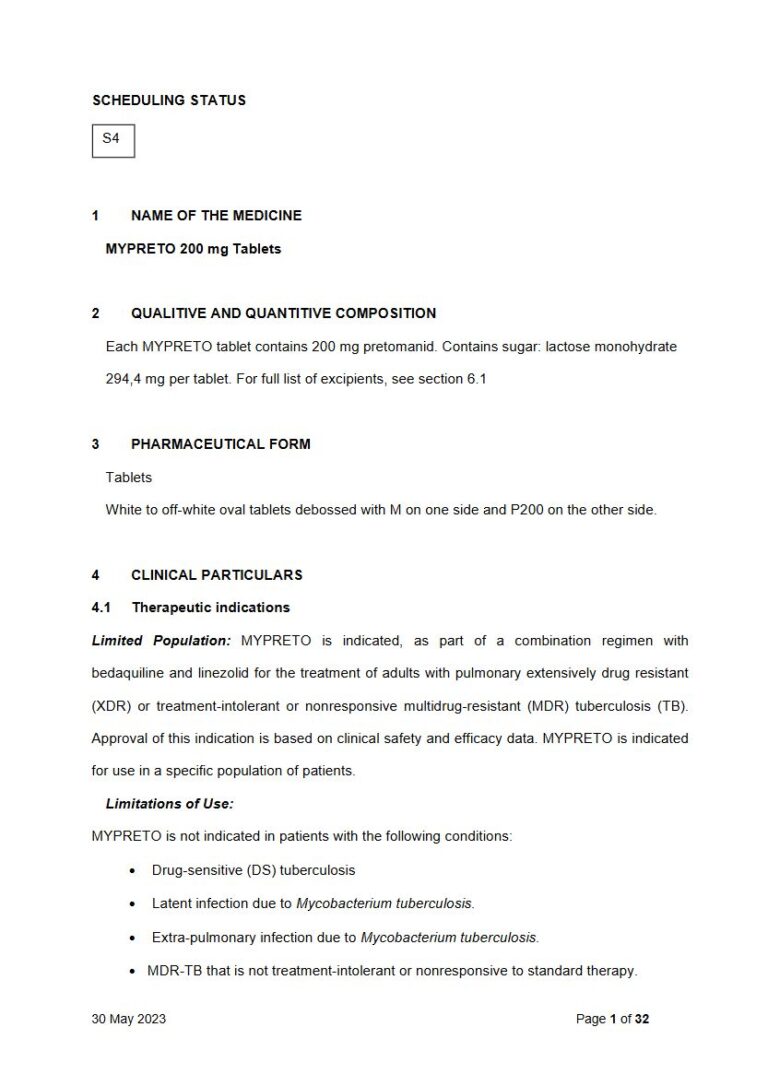
4.1 Therapeutic indications
Limited Population: MYPRETO is indicated, as part of a combination regimen with bedaquiline and linezolid for the treatment of adults with pulmonary extensively drug resistant (XDR) or treatment-intolerant or nonresponsive multidrug-resistant (MDR) tuberculosis (TB). Approval of this indication is based on clinical safety and efficacy data. MYPRETO is indicated for use in a specific population of patients. Limitations of Use: MYPRETO is not indicated in patients with the following conditions:
- Drug-sensitive (DS) tuberculosis
- Latent infection due to Mycobacterium tuberculosis.
- Extra-pulmonary infection due to Mycobacterium tuberculosis.
- MDR-TB that is not treatment-intolerant or nonresponsive to standard therapy.
Safety and effectiveness of MYPRETO have not been established for its use in combination with medicines other than bedaquiline and linezolid as part of the recommended dosing regimen (see section 4.2).
4.2 Posology and method of administration
Posology: Important Administration Instructions MYPRETO must be used only in combination with bedaquiline and linezolid as part of the recommended dosing regimen. Emphasize the need for compliance with the full course of therapy to patients. Administer the combination regimen of MYPRETO, bedaquiline, and linezolid by directly observed therapy (DOT).
Recommended Dosage MYPRETO must be administered in combination with bedaquiline and linezolid. The recommended dosage and duration for bedaquiline and linezolid when used in the combination regimen with MYPRETO are as follows:
- MYPRETO 200 mg orally (1 tablet of 200 mg), once daily, for 26 weeks. Swallow MYPRETO whole with water.
- Bedaquiline 400 mg orally once daily for 2 weeks followed by 200 mg 3 times per week, with at least 48 hours between doses, for 24 weeks for a total of 26 weeks.
- Linezolid starting at 1,200 mg orally per day for 26 weeks, with dose adjustments to 600 mg daily and further reduction to 300 mg daily or interruption of dosing as necessary for known linezolid adverse reactions of myelosuppression, peripheral neuropathy, and reversible optic neuropathy (see section 4.4).
- Take the combination regimen of MYPRETO, bedaquiline, and linezolid with food (see section 5.1).
- If the combination regimen of MYPRETO, bedaquiline, and linezolid is interrupted by a healthcare provider for safety reasons, missed doses can be made up at the end of the treatment; doses of linezolid alone missed due to linezolid adverse reactions should not be made up.
- Dosing of the combination regimen of MYPRETO, bedaquiline, and linezolid can be extended beyond 26 weeks, if necessary (see 5.3 CLINICAL STUDIES).
Assessments Prior to Initiating the Combination Regimen of MYPRETO, Bedaquiline, and Linezolid Assess for symptoms and signs of liver disease (such as fatigue, anorexia, nausea, jaundice, dark urine, liver tenderness, and hepatomegaly). Obtain laboratory tests (alanine aminotransferase [ALT], aspartate aminotransferase [AST], alkaline phosphatase, and bilirubin). See section 4.4. Obtain complete blood count (see section 4.4). Obtain serum potassium, calcium, and magnesium and correct if abnormal (see section 4.4). Obtain an ECG before initiation of treatment (see section 4.4).
Discontinuation of Dosing If either bedaquiline or MYPRETO are discontinued, the entire combination regimen should also be discontinued. If linezolid is permanently discontinued during the initial four consecutive weeks of treatment, bedaquiline and MYPRETO should also be discontinued. If linezolid is discontinued after the initial four weeks of consecutive treatment, continue administering bedaquiline and MYPRETO.
Method of administration For oral use.
4.3 Contraindications
- MYPRETO is contraindicated in patients with known hypersensitivity to pretomanid or any of the excipients (see section 6.1).
- MYPRETO used in the combination regimen with bedaquiline and linezolid are contraindicated in patients for whom bedaquiline and/or linezolid are contraindicated. Refer to the bedaquiline and linezolid professional information.
- MYPRETO is contraindicated in patients using strong or moderate CYP3A4 inducers, such as rifampicin or efavirenz (see section 4.4, 4.5 and 5.3).
- Pregnancy and lactation (see section 4.6).
4.4 Special warnings and precautions for use
Risks Associated with the Combination Treatment Regimen MYPRETO is indicated for use as part of a regimen in combination with bedaquiline and linezolid. Refer to the professional information for bedaquiline and linezolid for additional risk information. Warnings and Precautions related to bedaquiline and linezolid also apply to their use in the combination regimen with MYPRETO.
Hepatotoxicity Hepatic adverse reactions were reported with the combination regimen of MYPRETO, bedaquiline, and linezolid (see section 4.8). Avoid alcohol and hepatotoxic medicines, including herbal supplements and medicines other than bedaquiline and linezolid (see section 4.1) while on MYPRETO, especially in patients with impaired hepatic function. Monitor symptoms and signs (such as fatigue, anorexia, nausea, jaundice, dark urine, liver tenderness, and hepatomegaly) and laboratory tests (ALT, AST, alkaline phosphatase, and bilirubin) at a minimum at baseline, at two weeks, and then monthly while on treatment and as needed. If evidence of new or worsening liver dysfunction occurs, test for viral hepatitides and discontinue other hepatotoxic medications. Interrupt treatment with the entire regimen if:
- Aminotransferase elevations are accompanied by total bilirubin elevation greater than 2 times the upper limit of normal.
- Aminotransferase elevations are greater than 8 times the upper limit of normal.
- Aminotransferase elevations are greater than 5 times the upper limit of normal and persist beyond 2 weeks.
Myelosuppression Myelosuppression (including anaemia, leukopenia, thrombocytopenia, and pancytopenia) was reported with the combination regimen of MYPRETO, bedaquiline, and linezolid. Myelosuppression is a known adverse reaction of linezolid. Anaemia can be life threatening (see section 4.8). When linezolid dosing, as part of the combination regimen of MYPRETO, bedaquiline, and linezolid, was reduced, interrupted, or discontinued, the observed hematologic abnormalities were reversible. Complete blood counts should be monitored at a minimum at baseline, at two weeks, and then monthly in patients receiving linezolid as part of the combination regimen of MYPRETO, bedaquiline, and linezolid, and decreasing or interrupting linezolid dosing should be considered in patients who develop or have worsening myelosuppression (see section 4.2).
Peripheral and Optic Neuropathy Peripheral neuropathy and reversible optic neuropathy were reported with the combination regimen of MYPRETO, bedaquiline, and linezolid (see section 4.8). Neuropathy is a known adverse reaction of long-term linezolid use. Neuropathy associated with linezolid is generally reversible or improved with appropriate monitoring and interruption, dose reduction, or discontinuation of linezolid dosing. Monitor visual function in all patients receiving the combination regimen of MYPRETO, bedaquiline, and linezolid; if a patient experiences symptoms of visual impairment, interrupt linezolid dosing and obtain prompt ophthalmologic evaluation.
QT Prolongation QT prolongation was reported with the combination regimen of MYPRETO, bedaquiline, and linezolid (see sections 4.8 and 5.1). QT prolongation is a known adverse reaction of bedaquiline. Obtain an ECG before initiation of treatment, and at least 2, 12, and 24 weeks after starting treatment with the combination regimen of MYPRETO, bedaquiline, and linezolid. Obtain serum potassium, calcium, and magnesium at baseline and correct if abnormal. Monitor these electrolytes if QT prolongation is detected (see section 4.8). The following may increase the risk for QT prolongation when patients are receiving bedaquiline as part of the combination regimen of MYPRETO, bedaquiline, and linezolid: a history of Torsade de Pointes, congenital long QT syndrome, ongoing hypothyroidism, ongoing bradydysrhythmia, uncompensated heart failure, or serum calcium, magnesium, or potassium levels below the lower limits of normal. If necessary, bedaquiline treatment initiation could be considered in these patients after a favourable benefit-risk assessment and with frequent ECG monitoring. Discontinue the combination regimen of MYPRETO, bedaquiline, and linezolid if the patient develops clinically significant ventricular bradydysrhythmia or a QTcF interval of greater than 500 ms (confirmed by repeat ECG). If syncope occurs, obtain an ECG to detect QT prolongation.
Interactions CYP3A4 Inducers Pretomanid may be in part metabolised by CYP3A4 (see section 4.5 and 5.3). Avoid co-administration of strong or moderate CYP3A4 inducers, such as rifampicin or efavirenz, during treatment with MYPRETO.
Reproductive Effects Pretomanid caused testicular atrophy and impaired fertility in male rats. Advise patients of reproductive toxicities seen in animal studies and that the potential effects on human male fertility have not been adequately evaluated (see Special Populations below and section 5.3).
Lactic Acidosis Lactic acidosis was reported with the combination regimen of MYPRETO, bedaquiline, and linezolid (see section 4.8). Lactic acidosis is a known adverse reaction of linezolid. Patients who develop recurrent nausea or vomiting should receive immediate medical evaluation, including evaluation of bicarbonate and lactic acid levels, and interruption of linezolid or the entire combination regimen of MYPRETO, bedaquiline, and linezolid should be considered.
Special Populations Paediatric Use Safety and effectiveness of MYPRETO in paediatric patients have not been established. Use in elderly Clinical studies of the combination regimen of MYPRETO, bedaquiline, and linezolid did not include sufficient numbers of subjects aged 65 and over to determine whether they respond differently from younger subjects. Hepatic Impairment The effect of hepatic impairment on the safety, effectiveness, and pharmacokinetics of pretomanid is not known. Renal Impairment The effect of renal impairment on the safety, effectiveness, and pharmacokinetics of pretomanid is not known. Lactose: Patients with the rare hereditary problems of galactose intolerance, total lactase deficiency or glucose-galactose malabsorption should not take MYPRETO.
4.5 Interaction with other medicines and other forms of interaction
Effect of Other Medicines on Pretomanid CYP3A4 Inducers Co-administration of pretomanid with rifampicin and efavirenz resulted in a decrease in pretomanid plasma concentrations (see section 5.1). Avoid co-administration of the combination regimen of MYPRETO, bedaquiline, and linezolid with rifampicin, efavirenz, or other strong or moderate CYP3A4 inducers. Refer to the prescribing information for bedaquiline for additional information about drug interactions with CYP3A4.
Lopinavir/ritonavir Co-administration of pretomanid with lopinavir/ritonavir did not affect the plasma concentrations of pretomanid (see section 5.1). Lopinavir/ritonavir can be co-administered with the combination regimen of MYPRETO, bedaquiline, and linezolid.
Effect of Pretomanid on Other Medicines Midazolam Co-administration of pretomanid with the CYP3A4 substrate, midazolam, resulted in no clinically significant effect on the pharmacokinetics of midazolam or its major metabolite, 1-hydroxy-midazolam (see section 5.1). The combination regimen of MYPRETO, bedaquiline, and linezolid can be administered with CYP3A4 substrate medicines.
Organic Anion Transporter - 3 (OAT3) Substrates The effect of co-administration of pretomanid on the pharmacokinetics of OAT3 substrates in humans is unknown. However, in vitro studies indicate that pretomanid significantly inhibits the OAT3 medicine transporter (see section 5.1), which could result in increased concentrations of OAT3 substrate medicines clinically and may increase the risk of adverse reactions with these medicines. If pretomanid is co-administered with OAT3 substrate medicines (e.g., methotrexate), monitor for OAT3 substrate medicine-related adverse reactions and consider dosage reduction for OAT3 substrate medicines, if needed. Refer to the professional information of the co-administered medicine for dosage reduction information.
4.6 Fertility, pregnancy and lactation
Pregnancy Risk Summary MYPRETO should not be used during pregnancy and lactation (see section 4.3). There are risks associated with active tuberculosis during pregnancy (see Clinical Considerations below). When MYPRETO are administered in combination with bedaquiline and linezolid, the pregnancy information for bedaquiline and linezolid also applies to this combination regimen. Refer to the bedaquiline and linezolid professional information for more information on bedaquiline and linezolid associated risks of use during pregnancy. In animal reproduction studies, there was increased post-implantation loss in the presence of maternal toxicity (reduced bodyweight and feed consumption) with oral administration of pretomanid during organogenesis in rats at doses about 4 times the exposure at the recommended dose in humans. There were no adverse embryo fetal effects in rats or rabbits dosed with oral pretomanid during organogenesis at doses up to approximately 2 times the exposure in humans. The estimated background risk of major birth defects and miscarriage for the indicated population is unknown.
Clinical Considerations Disease-Associated Maternal and/or Embryo/Foetal Risk Active tuberculosis in pregnancy is associated with adverse maternal and neonatal outcomes including maternal anaemia, caesarean delivery, preterm birth, low birth weight, birth asphyxia, and perinatal infant death.
Animal Data In animal reproduction studies, pregnant rats were dosed orally with pretomanid at 10, 30, and 100 mg/kg/day during organogenesis (gestational Days 7 through 17). Rats showed increased post-implantation loss in the presence of maternal toxicity (including reduced body weight and feed consumption) at 100 mg/kg/day, approximately 4 times the exposure in humans for a 200 mg dose on an AUC basis. There were no adverse embryo-foetal effects in rats dosed with oral pretomanid during organogenesis at doses up to approximately 2 times the exposure in humans. Pregnant rabbits were dosed orally with pretomanid during organogenesis (gestational Days 7 through 19) at 10, 30, and 60 mg/kg/day. No evidence of adverse developmental outcomes was observed when oral doses of pretomanid were administered to dams during organogenesis (gestational Days 7 to 19) at doses up to 60 mg/kg/day (approximately 2 times the exposure in humans for a 200 mg dose on an AUC basis). In a pre- and postnatal development study, there were no adverse developmental effects in pups of pregnant rats orally dosed with up to 20 mg/kg/day from gestational Day 6 through lactation Day 20. Pups of pregnant females dosed at 60 mg/kg/day (about 2 times the exposure for the 200 mg dose) had lower body weights and a slight delay in the age at which the air-drop righting reflex developed. These effects occurred at a maternally toxic dose (based on maternal weight loss and reduced food consumption).
Lactation Risk Summary Women taking MYPRETO should not breastfeed their babies (see section 4.3). There is no information regarding the presence of pretomanid in human milk, or its effects on milk production or the breastfed infant. Pretomanid was detected in rat milk (see Data). When a medicine is present in animal milk, it is likely that the medicine will be present in human milk. When MYPRETO are administered in combination with bedaquiline and linezolid, information on lactation for bedaquiline and linezolid also applies to this combination regimen. Refer to the bedaquiline and linezolid prescribing information for more information on their use during lactation.
Data Animal Data In a pre- and postnatal development study in rats treated with pretomanid at doses 0.5 and 2 times the human exposure for a 200 mg dose (AUC) from gestational day 7 through lactation day 20, concentrations in milk on lactation day 14 were 1.4 and 1.6 times higher than the maximum concentration observed in maternal plasma, respectively. The concentration of pretomanid in rat milk does not necessarily predict the concentration of pretomanid in human milk.
Females and Males of Reproductive Potential Infertility Males Reduced fertility and/or testicular toxicity were observed in male rats and mice treated with oral pretomanid. These effects were associated with hormonal changes including decreased serum inhibin B and increased serum follicle stimulating hormone and luteinizing hormone in rodents (see section 5.3). Reduced fertility and testicular toxicity cannot be definitively ruled out in male human subjects. Male patients should consider sperm conservation before starting treatment with MYPRETO.
4.7 Effects on ability to drive and use machines
MYPRETO may cause dizziness and visual impairment. Patients should be cautioned about operating hazardous machinery, including motor vehicles until they are reasonably certain that MYPRETO does not adversely affect them.
4.8 Undesirable effects
a. Summary of the safety profile The following serious adverse reactions are discussed in section 4.4 Special warnings and precautions for use:
- Hepatotoxicity
- Myelosuppression
- Peripheral and Optic Neuropathy
- QT Prolongation
- Reproductive Effects
- Lactic Acidosis
Clinical Trials Experience Because clinical studies are conducted under widely varying conditions, adverse reaction rates observed in the clinical studies of a medicine cannot be directly compared to the rates in the clinical studies of another medicine and may not reflect the rates observed in clinical practice. When MYPRETO is administered in combination with bedaquiline and linezolid, refer to the professional information for the respective medicines for a description of the adverse reactions associated with their use. A total of 1168 subjects, 879 patients with tuberculosis and 289 healthy volunteers, have been exposed to pretomanid, either alone or as part of a combination therapy in 19 trials. Study 1 (NCT02333799) was a single-arm, open-label study conducted in three sites in South Africa in which patients with XDR, treatment-intolerant MDR, or non-responsive MDR pulmonary TB received the combination regimen of pretomanid, bedaquiline, and linezolid for 6 months (extendable to 9 months) with 24 months of follow-up. One hundred and nine subjects were treated; 76 % were black, and 23 % were of mixed race. Their ages ranged from 17 years to 60 years (mean 36 years), and all patients were from South Africa. Fifty-six (51 %) patients were HIV-positive. There were 8 deaths. Six patients died while receiving treatment; all surviving patients, excluding one patient who withdrew consent, completed treatment. Two patients died during follow-up at Day 369 and Day 486, respectively.
b. Tabulated summary of adverse reactions Adverse drug reactions (ADRs) reported from the uncontrolled phase 3 trial in 109 patients treated with pretomanid in combination with bedaquiline and linezolid are summarized in the table below by system organ class and frequency. ADRs considered attributed to linezolid are marked with u0394.
System organ class Frequency Adverse reactions Infections and infestations Less frequent Fungal infection, oral candidiasis, oral fungal infection Blood and lymphatic system disorders Frequent Anaemia u0394, Leukopenia u0394, neutropenia u0394, thrombocytopenia u0394 Less frequent Lymphopenia u0394, pancytopenia u0394 Metabolism and nutrition disorders Frequent Decreased appetite, hypoglycaemia, lactic acidosis u0394 Less frequent Acidosis u0394, dehydration, hypocalcaemia, hypovolaemia, hypomagnesaemia Psychiatric disorders Frequent Insomnia Less frequent Anxiety, depression Nervous system disorders Frequent Peripheral neuropathy* u0394, headache, dysgeusia, dizziness Eye disorders Frequent Visual impairment*, eye irritation, eye pain, optic neuropathy*u0394 Less frequent Lens disorder, dry eye, eye pruritis, eye swelling, papilloedema, presbyopia Ear and labyrinth disorders Less frequent Deafness Cardiac disorders Less frequent Palpitations, sinus tachycardia Vascular disorders Less frequent Hypotension Respiratory, thoracic and mediastinal disorders Less frequent Cough, epistaxis Gastrointestinal disorders Frequent Nausea, vomiting, dyspepsia, abdominal pain*, gastritis*, diarrhoea, constipation, gastrooesophageal reflux disease, pancreatitis* Less frequent Abdominal distension, glossodynia, haematemesis Hepato-biliary disorders Frequent Transaminase increased*, hyperbilirubinaemia Less frequent Hepatomegaly, jaundice Skin and subcutaneous tissue disorders Frequent Acne*, pruritus*, rash*, dry skin, alopecia Less frequent Dermatitis allergic, skin hyperpigmentation Musculoskeletal and connective tissue disorders Frequent Musculoskeletal pain*, muscle spasms Less frequent Musculoskeletal stiffness Reproductive system and breast disorders Less frequent Erectile dysfunction, metrorrhagia General disorders and administration site conditions Frequent Fatigue, asthenia Less frequent Malaise Investigations Frequent Gamma-glutamyltransferase increased; amylase increased*, electrocardiogram QT prolonged, blood alkaline phosphatase increased, blood creatine phosphokinase increased, blood urea increased, lipase increased* Less frequent Albumin urine present, blood creatinine increased, blood creatine phosphokinase MB increased, blood uric acid increased, creatinine renal clearance decreased
*Selected terms are collapsed as follows: peripheral neuropathy (burning sensation, hypoesthesia, hyporeflexia, neuropathy peripheral, paraesthesia, peripheral motor neuropathy, peripheral sensorimotor neuropathy, peripheral sensory neuropathy); gastritis (gastritis, chronic gastritis); acne (acne, dermatitis acneiform); musculoskeletal pain (arthralgia, back pain, costochondritis, myalgia, pain in extremity); transaminases increased (alanine aminotransferase (ALT) increased, aspartate aminotransferase (AST) increased, drug-induced liver injury, hepatic enzyme increased, hepatic function abnormal, liver function test increased, transaminases increased); rash (rash, rash erythematous, rash maculo-papular, rash papular, rash vesicular); pruritus (pruritus, pruritus generalized, rash pruritic); abdominal pain (abdominal pain, abdominal pain lower, abdominal pain upper, abdominal tenderness); visual impairment (vision blurred, visual acuity reduced, visual impairment); amylase increased (amylase increased, hyperamylasaemia); lipase increased (hyperlipasaemia, lipase increased); optic neuropathy (optic neuropathy, optic neuritis); pancreatitis (pancreatitis, haemorrhagic pancreatitis).
c. Description of selected adverse reactions In Study 1, 28 % of patients experienced increased transaminases. Except for one patient who died due to pneumonia and sepsis, all patients who experienced increased transaminases were able to continue therapy and complete the full course of treatment. Myelosuppression is a known adverse reaction of linezolid. The most common haematopoietic cytopenia was anaemia (37 %). The majority of cytopenias began after 2 weeks of treatment. Three patients experienced cytopenias that were considered serious: neutropenia in 1 patient and anaemia in 2 patients. All 3 serious adverse reactions resulted in interruption of linezolid or all components of the combination regimen of pretomanid, bedaquiline, and linezolid, and all resolved. Peripheral and reversible Optic Neuropathy Peripheral neuropathy is a known adverse reaction of linezolid. In Study 1, peripheral neuropathy was reported in 81 % of patients. Most of these adverse reactions (64 %) occurred after 8 weeks of treatment and resulted in dosing interruption, dose reduction, or discontinuation of linezolid. Severe, moderate, and mild peripheral neuropathy occurred in 22 %, 32 %, and 26 % of patients, respectively. No adverse reaction related to peripheral neuropathy led to a discontinuation of the entire study regimen. Optic neuropathy is a known adverse reaction of linezolid. Two patients (2 %) in Study 1 developed optic neuropathy after 16 weeks of treatment. Both were serious, confirmed on retinal examination as optic neuropathy/neuritis, and resulted in discontinuation of linezolid; both adverse reactions resolved. Overall, patients administered a linezolid dose of 600 mg twice daily had a similar safety profile to those administered a dose of 1,200 mg once daily.
Reporting of suspected adverse reactions Reporting suspected adverse reactions after authorisation of the medicine is important. It allows continued monitoring of the benefit/risk balance of the medicine. Health care providers are asked to report any suspected adverse reactions to SAHPRA via the u201c6.04 Adverse Drug Reactions & Quality Problem Reporting Formu201d, found online under SAHPRAu2019s publications: https://sahpra.org.za/wp-content/uploads/2020/01/6.04_ARF1_v5.1_27Jan2020.pdf
4.9 Overdose
There is no experience with the treatment of acute overdose with pretomanid. Take general measures to support basic vital functions including monitoring of vital signs and ECG (QT interval) in case of deliberate or accidental overdose.
